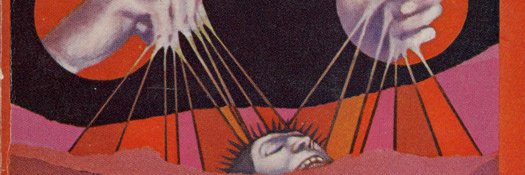
Myths are not merely things that were made in times past: myths are among the things that maintain the present in being. I wish most strongly that the present should be maintained: I often live in it.
"Boomer Flats" (1971)
For five thousand dollars I can give you gift of second sight. Just put your head into this helmet, bite down on the bullet of your selection, and remember that pain has no memory.
"The Funny Face Murders" (1980)
Previously unpublished R A Lafferty story, scholarly articles, Lafferty inspired artwork, and much more. Still available online at Amazon ($15): https://t.co/8scWbJBYdx
"We are sold and we are ransomed, we are lost and we are found. We are dead and we are re-surrected, which is to say 'surged up again.'"
-- The Epistle of Judy Thatcher to the Church of Omaha in Dispersal (from R. A. Lafferty's "And Walk Now Gently Through the Fire"). 3/3
"Whooo! What was that stroke like invisible lightning coming right through the walls?" Art Slick asked. "That was one eerie jolt."
"It was just a time-inversion shock wave," the genial Greek said.
"Rainy Day in Halicarnassus" (1979)
Not one Earth child in a hundred could build a planet and have it a going concern within a week. Not one in a thousand would be able to comprehend pentacosmic logic.
"The Primary Education of the Camiroi" (1966)
"A book here tells how to make friends, but I can't do it that way. I'll make one my own way."
So Albert set out to make a friend.
He made Poor Charles, a machine as stupid and awkward and inept as himself.
"Eurema's Dam" (1972)
“The contingence of the intransigence is the most mystifying aspect,” said Arpad Arkabaranan.
“Yes,” said Willy McGilly. “Who would have thought that you could do it with a beer can & two pieces of cardboard? When I was a boy I used an oatmeal box & red crayola.”
Seven-Day Terror
That, I suppose, is what made her so lumpy everywhere. She was entirely compounded of love & concern & laughter, & much of it bulged out from her narrow form. Her ugliness was one of the unusual things & I believe that she enjoyed giving it to the worlds.
"Ride a Tin Can" (1970)
"Help, help! Shriek!"
"It's always nice to be married to a wife who doesn't understand you," Homer said. He enfolded her affectionately, bore her down, trod on her with large friendly hooves, and began (as it seemed) to devour her.
"The Hole on the Corner" (1967)
He bound on the elbow and knee and toe and heel daggers, needle-pointed, double-bladed, curiously curved. He bound on the crotch and throat armour. He slipped the casing fangs over his own dog teeth. He bound on the cap with the skull saber.
"Frog on the Mountain" (1970)
Got things to say about Lafferty’s (and science fiction’s, etc) attitudes toward race and culture but SF novels about migrants and natives banding together to overthrow an entrenched white overclass were not all that common even in the late 60s
"Why won't I be able to see it?" Baxter asked.
"You won't have anything left to see it with. We'll have your eyes in the eye jug, and you won't be in your skull anymore."
"Oh, I forgot." Baxter seemed a little bewildered.
The Reefs of Earth (1968)
You cannot give, you cannot take, you cannot love, you think there is something else, you think there is a sky-bridge you may loiter on without crashing down. I am bristled-bear earth, there is no other.
"Continued On Next Rock" (1970)