An RNN view of Transformers?
Softmax Attention: An infinite hierarchy of increasingly large recurrent states. Linear Attention: The first-order component.
What's in between? Polynomial Attention.
We had fun exploring the Taylor-expanded space b/w Linear & Softmax Attention.
It begins!
Here we're seeing the first real world (not tech demo) use case where a world model runs circles around engines.
There will be continual leapfrogging as world models leverage engines for training, and engines leverage world models for scene understanding.
In case anyone is curious:
We’ve had a ~pixel-perfect world model since last year, which is critical for synthetic data generation.
The (much) smaller version of that in the car is a conditional mean-flow model, based on the recent sequence of Tesla Universal Vision Encoder features, which are the same ones that are plugged into the 3B encoder model that produces the driving actions.
We fork off from these UVE features, then run a separate ~1B diffusion model. This takes in the previous reality-view generation with added noise and then denoises it to the current visualization.
It then produces a small video chunk (8 images at 36 fps, at the resolution of the UI screen). This work is done by 1/2 of a TRIP engine every UVE frame at 18 hz and is spread over 4 cycles.
Currently, the latency is a bit high due to compute constraints, but we have ways to interleave newer UVE features along the diffusion transformer layers to cut roughly 35% of the latency.
New BlaGPT best: 3.1153 val loss, with Latent Lattice.
One small recurrent latent (width 256) runs across layers 2-7. At each layer it steers q/k/v and the MLP through FiLM.
Paper: https://t.co/vGq2AU0hUX
Code + results: https://t.co/iQ6ibPy8X8
FSD v15 now starting to roll out – upgrading every part of the end-to-end driving network
Safety
25x better handling of safety critical cases
Tesla Reality View
Adds a live visualization of the drive that lets you see & control what FSD is planning to do
Navigation for start & end of the trip now learns end-to-end from fleet route preferences. Later v15 releases will expand this to the entire route.
You also should notice better detection of signs, animals, debris, potholes and standing water, plus more natural speed handling in school zones and inclement weather.
Lastly, FSD can now slow for speed cameras & Bike Rack Mode lets you enable FSD w/ bike racks or similar hitch accessories
Language models process each token through a single residual stream (blue arrows): reading / writing memory and applying MLPs at each layer, and finally decoding the next token.
Can we scale up this single stream computation?
Introducing Latent Lattice Language Models (LLLMs): augmenting this vertical stream with a horizontal axis of computation—the Lattice of Latents (orange arrows).
RNN 🤝 Transformers 🧵
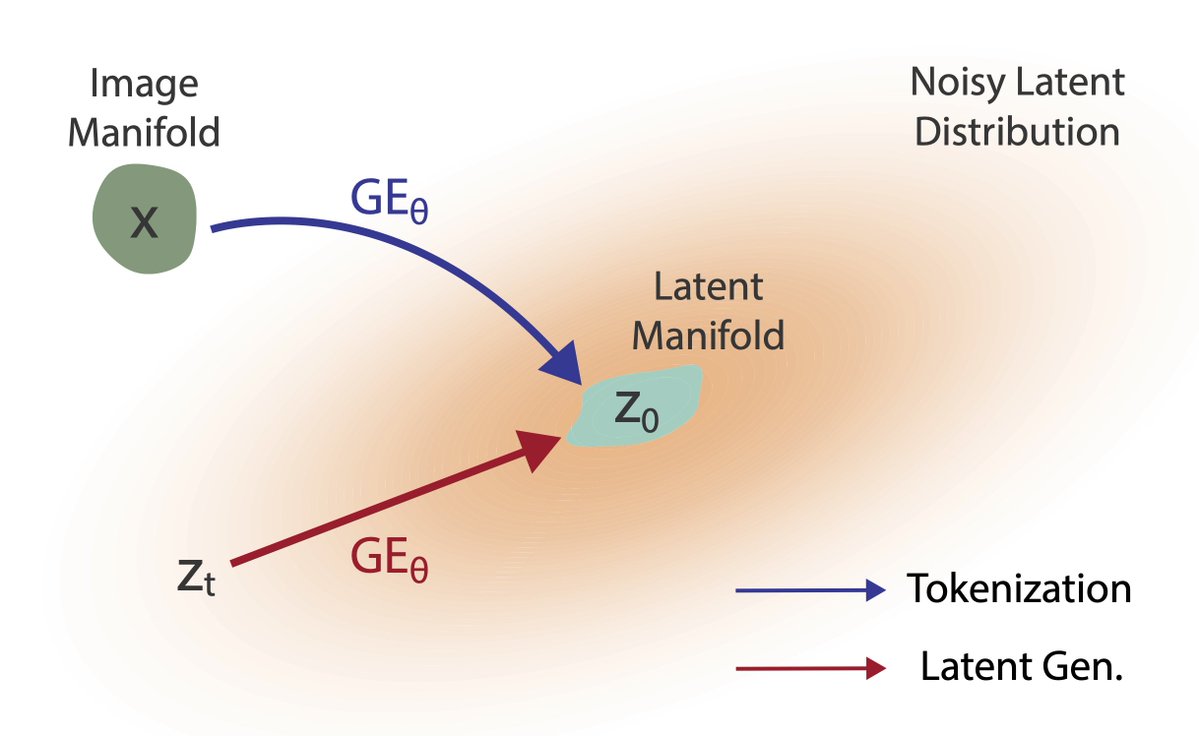
Tokenization & Generation power Large Models. But are they really separate?
Tokenization=Generation under strong observability
UNITE: An end-to-end training framework where one shared Generative Encoder (GE) performs both token. & latent denoising
Paper: https://t.co/8idMdy123h
Similar thought.
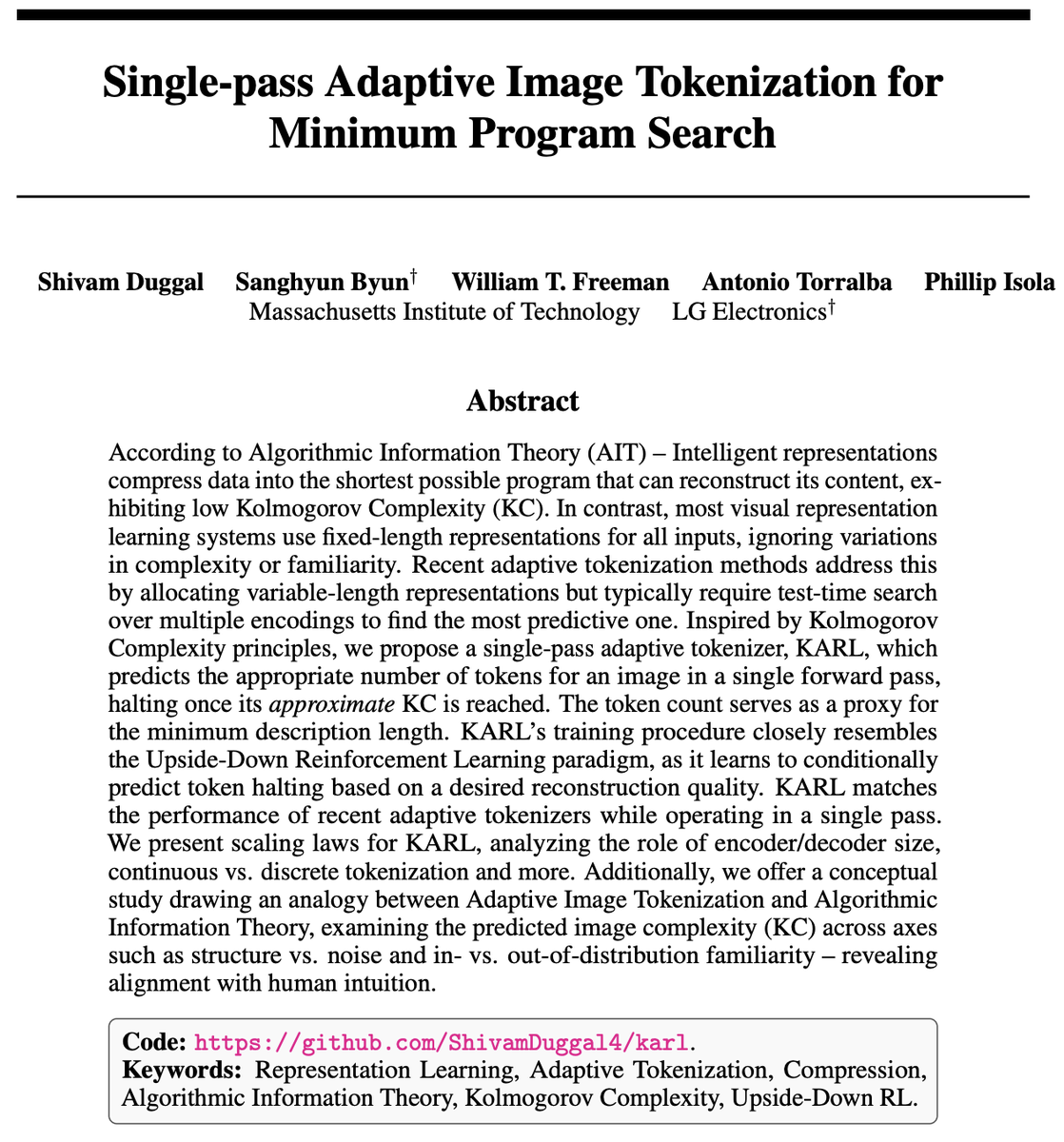
Next-token prediction feels statistical: perplexity / shannon-entropy minimization. But creativity / science may require: finding compact generative structures, then exploring in that space. Closer to algorithmic complexity? More Kolmogorov than Shannon.
Compression is the heart of intelligence
From Occam to Kolmogorov—shorter programs=smarter representations
Meet KARL: Kolmogorov-Approximating Representation Learning.
Given an image, token budget T & target quality 𝜖 —KARL finds the smallest t≤T to reconstruct it within 𝜖🧵
Current vision systems use fixed-length representations for all images. In contrast, human intelligence or LLMs (eg: OpenAI o1) adjust compute budgets based on the input. Since different images demand diff. processing & memory, how can we enable vision systems to be adaptive ? 🧵
@Aleen@fetchpackage It is literally the worst service I've ever used. No customer support. Have a package that was delivered 3 days back and @fetchpackage hasn't logged it in and no response from customer support team.
Check out this #CVPR21 paper from our lab, addressing the voxel resolution issues from our previous unsupervised 3D feature learning approaches. Now we have continuous (subvoxel) features, which outperform voxel-contrastive and point-contrastive learning!
Tie in ODI finals
Aus vs WI MCG 1984 - B & H World Series Cup
Eng vs Aus Lord's 2005 - NatWest Series
Eng vs NZ Lord's 2019 - World Cup
#ENGvNZ#CWC19Final