Major Aggregator Update is now live on https://t.co/vxNecxyvMs 👀
We’ve added 5 new sections to help you navigate Web3 even better:
> Meme Trading
> Services
> Tools
> Superchain
> Testnet
Let’s break them down 🧵👇
0/ You’ve probably heard people yapping about Cypherpunk, but what exactly is it and what is Ethereum’s specific brand of Cypherpunk? A guest thread by @post_polar_
1/ Stablecoins are a $100B+ market, but most of the value is captured by Tether and Circle, with users getting no upside.
This cycle we've got Ethena and now Usual enters the game.
A decentralized, transparent, and community-owned stablecoin protocol:🧵
in the ai agent space, we’ve seen:
- the first viral ai agent trained on 4chan data (goat)
- ai agent launchpads (virtual, creatorbid, vvaifu)
- ai influencers (luna on tiktok)
- autonomous vc agents (ai16z, sekoia)
- general agent infrastructure (spectral, wayfinder)
- ai agents creating tokens autonomously (luminious)
- agent creating an entire soundtrack (zerebro)
- ai agent that gives you market alpha (aixbt)
- ai agent that trades for you (spectral)
idle observation
shortly after the collapse of ftx there was a mass migration of app devs from sol to eth
but ever since - in the 6-12mo - ive seen countless app devs moving from eth to sol and don’t recall a single case of app devs that went the opposite way
ETH is the High Quality Liquid Asset (HQLA) of crypto
In anticipation of the ETH ETF launch, I’ve written a mini paper explaining what an HQLA is, why we need a natively digital one, and why ETH is the most likely candidate. My analysis compares it to BTC and SOL.
Here’s the summary:
Why HQLA?
HQLA is a concept from TradFI used for banking regulation. It’s a designation for assets that have almost universally recognized value and deep liquidity—things banks can own safely and sell in a pinch without moving the market. I’m loosely applying the concept to crypto because such an asset is something we can use to build an entirely new decentralized financial system.
A natively digital HQLA means better decentralized stablecoins, safer credit, and more trustworthy derivatives. My analysis explains why this can’t be a dApp token, centrally issued stablecoin/RWA, or L2 token. The best candidates are the native coins of L1s.
Why isn’t it Bitcoin?
BTC is the most valuable and liquid asset in crypto, but you can’t do much with it. There’s no native DeFi or alternative assets on-chain, like stablecoins. The only ways to use it as collateral is custodially or to bridge to another chain, both of which introduce new risks and somewhat defeat the purpose.
Perhaps things will change with new covenants or L2s, but I’m skeptical. The soul of BTC is to fulfill a different purpose, which is to become an HQLA for TradFi.
It comes down to ETH vs SOL
Solana, the network, has many appealing properties. But that’s a separate issue from SOL, the asset. When put to economic scrutiny, SOL has weak fundamentals and is thus a medium quality asset.
First, SOL ownership is concentrated, thanks to its youth, multiple VC rounds, allocations to the Labs and Foundation, and the fact that it launched with staking. Concentration decreases liquidity. ETH did a modest raise years ago, only gave a small amount to the Foundation and founders (by current standards) and had years of PoW before the merge.
Second, SOL has relatively high inflation, over 5%. That will ratchet down eventually, but supply will grow by 25% before it plateaus at 1.5%. During that time, SOL will have a high cost of capital in DeFi.
DeFi always prefers the native asset—LSTs introduce their own risks—but using native SOL in DeFi means forgoing the high staking yield. DeFi will always have to compete with staking to attract capital.
What this means is that SOL has a high nominal interest rate. ETH on the other hand is borderline deflationary, it has a near-zero nominal rate. You can already see this in action: the cost of borrowing SOL on Kamino is currently almost triple that of ETH on AAVE.
Third, a high nominal rate leads to greater staking. SOL owners would be foolish not to stake to avoid dilution, but this hampers liquidity. The staking participation rate on Solana is over double that of Ethereum. ETH holders don’t miss out as much by not staking. That means there will always be relatively more free-floating ETH in the market than SOL.
To make matters worse, Solana has a fragmented LST ecosystem. Liquid staking tokens are not as appealing as HQLAs, but people do use them, there’s tons of Lido stETH in Ethereum DeFi. Concentration in a single LST might be bad for chain security, but it is counterintuitively good for DeFi. It means more liquidity in an asset that might be considered “too big to fail”.
Fourth, and perhaps counterintuitively, Solana has low transaction fees. This might be good for users, but it’s bad for the fundamentals of SOL--fees are a cost to users but also a revenue to stakers. Low fees mean most of the reward paid to stakers must come from new issuance, aka debasement.
The interplay between issuance and fees determines the real interest rate of a crypto asset (MEV also plays a role, but not included in my analysis).
ETH has very low issuance and high fees, virtually all of which go to stakers. This means it has a positive real yield. In this regard it’s even better than Bitcoin. BTC also has low issuance and high fees, but both accrue to miners, not coin holders.
SOL has a borderline negative real yield. Other than times of peak activity, almost all the yield to stakers comes from increasing money supply.
ETH also has a burn mechanism. This increases its positive real yield, and also returns value to non-stakers, thus decreasing the incentive to stake, and reducing the staking participation rate, leading to more liquidity. Solana had a burn mechanism but decided to get rid of it.
Lastly, Ethereum’s high fees mean that ETH has a higher convenience yield: users will want to always hold some (and not stake) to pay future gas fees, thus more available supply.
ETH has better moneyness properties than SOL, and moneyness is very important to being an HQLA.
This is a complicated argument with many moving parts, but the lack of importance of SOL in the success of Solana hampers its qualification as the ultimate asset to build on top of.
You can even see this in Solana culture, where no lesser an authority than @toly argues that cryptoeconomic security is only a meme. But if that’s true, so are some of the fundamentals of the chain's coin.
The circularity of security->coin value-> security is the ultimate source of value for any cryptocurrency. This was Satoshi Nakamoto's greatest insight.
None of this means that SOL can't appreciate, or even outperform ETH, memetics and momentum currently matter more in crypto than fundamentals.
But these dynamics reduce the importance of SOL in a re-architected financial system with a brand new asset as its foundation.
ETH is the HQLA of crypto
As the market slowly realizes this, it might grow disproportionately as a DeFi coin to SOL, and possibly overtake Bitcoin someday in value and prominence. The winner-take-most tendency in finance is very strong.
This analysis is at the cutting edge of thought, so all comments, questions, and rebuttals are welcome. Here's the full analysis:
https://t.co/kfbZBZwacL
My thanks to @brettpalatiello for his feedback on these ideas. Not investment advice, more thinking advice. I own BTC and ETH and have at various times owned SOL.
the trenches feel pretty cooked atm, gonna lay out some data and my thoughts because i need someone smarter than me to tell me how it gets resolved
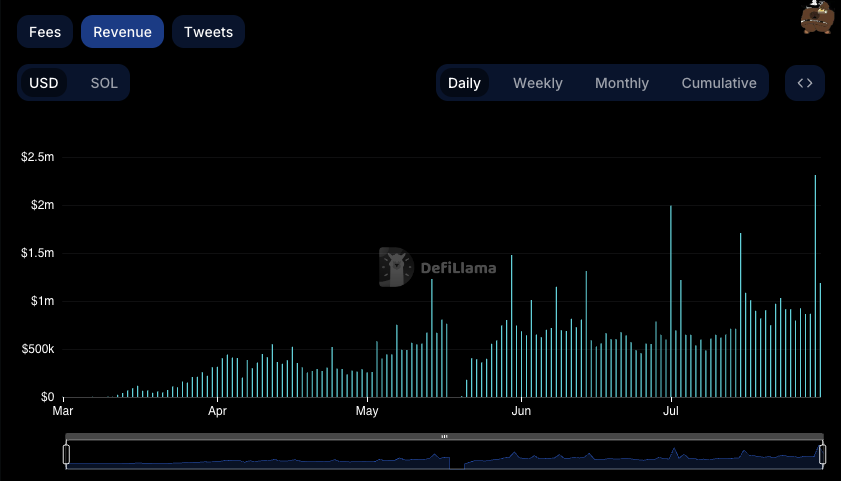
> pump fun hit an ath in daily rev yesterday at $2.3m
> cumulative revenue is just under $80m
> 1,567,948 coins have been launched since inception
> 6000 in the last 24h
on the neiro launch day nearly $1b in volume on just a few coins
this is getting dangerously close to the bome/slerf top we had in march, except in an environment with far less free flowing capital and a HUGELY dispersed network of coins
popcat 40m
wif 125m
mew 270m
neiro/NEIRO/nEiRo 900m
bome 922m
slerf 2.2b
currently: number of coins > amount of capital needed to sustain growth
all while large chunks of solana are leaving the ecosystem every day to infra providers, insiders and the few lucky ones
the daily rate of extraction on solana is huge, anecdotally the trenches have been seeing pretty monster volumes across the board on new coins lately (multiple daily occurrence's of $20m+ in the last week) yet very few coins are able to break 9 figs
the shitcoin landscape has become hyper efficient, there used to a financial barrier to entry for launching a coin as the deployer needed to seed liquidity, now the cost comes from the trenches themselves as traders fill the bonding curve
every time a pump coin fills the curve the LP is burnt, another stream of sol leaving the eco everyday - there is $65m of locked solana sitting between just the bome and slerf LP's
the main beneficiaries of the current environment are:
> pump fun
> any trading bot (most charge 1%)
> people that launch coins
if you assume even 50% of current transactions are ran through a trading bot then nearly $5m went to infra providers just on the neiro launch day
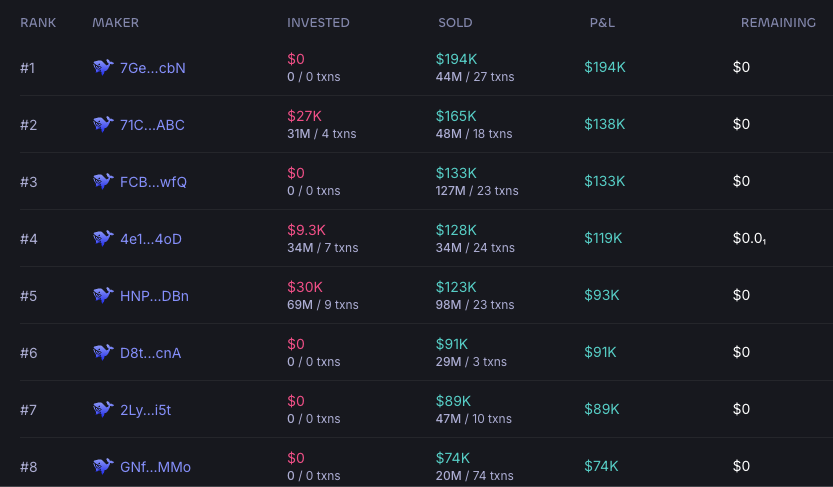
then you have countless coins where the top trader section on photon looks like this:
the result is a rolling selection of 5-10 coins above $10m but below $100m mcap competing for attention until the next cohort comes along and vamps it and the liquidity, a new meta every few days instead of every few weeks or months
basically solana is getting sucked dry and i'm trying to figure out what the end game is here
but all i can really see are two scenarios:
1. it becomes so efficient and the rotations so violent that nothing new can survive, traders lose so much money and hope collectively that we see an extended low cap bear market and a full reset
2. we see enough new entrants and capital that we flip back to 'amount of capital needed to sustain growth > number of new coins', strong coins prevail and the playing field levels out again
@PrimordialAA@nansen_ai Group of industrial sybils are defending their sybil accounts via twitter and you , @PrimordialAA are helping them . I actually can give you proofs of that.