🚨 DOUBLE ANNOUNCEMENT! 🚨
The wait is over – we can finally reveal the locations for our next two MC events! 🎉
The lucky people who joined us in Liverpool already got a sneak peek, but now it’s time to share the news with everyone!
🔥 MC42
📍 Trinity Academy, Barnsley (S70 6FP)
📅 14th November 2026
🔥 MC43
📍 Penrice Academy, St Austell (PL25 3NR)
📅 20th March 2027
We’re incredibly excited to be heading to two fantastic venues and can’t wait to welcome you all! 🙌
Make sure these dates are in your diary, start planning your trips, and get ready for two amazing events! 🔥
🎟️ Tickets for Barnsley are available now, with MC43 tickets coming soon. https://t.co/FbhlsVrN5g
#MC42 #MC43
🧠 Unlock Deeper Understanding with Variation Theory! with @MrMattock
How can we help pupils recognise mathematical structure, make meaningful connections and avoid over- or under-generalising?
Variation Theory offers a powerful approach to teaching mathematics by carefully considering what changes and what stays the same. In this practical session, we’ll explore how thoughtful choices in examples can help pupils notice important relationships and develop a deeper understanding of mathematical concepts.
🎯 What will you explore?
✅ Procedural variation: Discover how changing the steps or features of a task can develop fluency and highlight mathematical patterns.
✅ Conceptual variation: Explore how contrasting examples can help pupils recognise the essential features of a concept.
✅ Variation in practice: Examine classroom examples and consider how variation can make mathematical structure more visible.
✅ Planning for impact: Learn how to design sequences of examples that guide pupils towards deeper understanding.
You’ll have the opportunity to explore when and how to use different types of variation and plan ways to incorporate them into your own teaching.
Leave with practical ideas to help pupils spot connections, develop their reasoning and build a more secure understanding of mathematics.
🎟️ Book your place: https://t.co/c5KGsF2jpf
#MathsConf42
💙➗ Great maths teaching doesn’t happen in isolation. It grows when we share, question and learn together.
What makes MathsConf42 worth attending? It’s the chance to step away from the everyday demands of the classroom and spend time focusing on what matters most: teaching and learning mathematics.
✨ Discover something new – Explore ideas that challenge your thinking and inspire fresh approaches to familiar topics.
🧠 See maths differently – Take away new perspectives on how pupils learn, where misconceptions arise and how we can help them move forward.
💬 Be part of the conversation – Meet teachers who understand the challenges, share your experiences and learn from the ideas of others.
🔎 Make time to reflect – Revisit your own practice, ask new questions and discover opportunities to develop your teaching.
🌱 Invest in your professional growth – Leave with fresh thinking, renewed enthusiasm and ideas to explore long after the conference ends.
Because sometimes, the most valuable thing you can do for your pupils is invest in yourself as a teacher.
💙 Join the maths teaching community at MathsConf42.
🎟️ Find out more and get your ticket: https://t.co/c5KGsF1LzH
#MathsConf42
📐 Simultaneous Equations: Take Your Teaching Deeper! with @mathsjem
Ready to explore simultaneous equations beyond the usual methods and procedures? Join this brand-new workshop from the Topics in Depth series for a closer look at one of the key topics in secondary mathematics.
This session will unpack simultaneous equations from multiple perspectives, helping you strengthen your subject knowledge, anticipate pupil difficulties and reflect on how best to teach the topic.
🎯 What will we explore?
✅ Curriculum: Where simultaneous equations fit into the wider maths curriculum.
✅ Misconceptions: Common stumbling blocks and why pupils find them challenging.
✅ Explanations: How to communicate the underlying mathematics clearly and effectively.
✅ Subject knowledge: Deepen your understanding of the topic and its connections.
✅ History: Explore the development of simultaneous equations and the ideas behind them.
✅ Resources: Discover materials and approaches to support effective classroom teaching.
Whether you’re looking to refresh your knowledge, refine your explanations or find new ways to approach familiar content, this workshop offers an opportunity to examine simultaneous equations in depth.
Come ready to question, reflect and develop your teaching with this new addition to the Topics in Depth series!
🎟️ Book your place: https://t.co/c5KGsF1LzH
#MathsConf42
📊 Could We Help More Students Achieve a Grade 4 in GCSE Maths? with @gareth_shadick
Around 30% of Year 11 students in England do not achieve at least a Grade 4 in GCSE Maths. That’s more than 200,000 young people each year — and missing this important benchmark can close doors to future opportunities in education and employment.
But what can we do to change that?
Rather than asking who is to blame, this workshop challenges us to ask a more important question: Could the number of students not achieving Grade 4 be lower in our schools — and what could we do differently to make that happen?
🎯 What will the session explore?
✅ What students needed to know and be able to do to achieve a Grade 4 last summer.
✅ The factors that may prevent students from reaching this key benchmark.
✅ How we can rethink our approaches to improve outcomes for more learners.
✅ Practical ways to reduce the proportion of students who leave school without a Grade 4 in Maths.
This is an opportunity to reflect honestly on our practice, challenge our assumptions and consider how we can make a meaningful difference to students’ futures.
🚨 Spoiler alert: This isn’t a workshop about last-minute catch-up in Year 11. It’s about thinking differently and exploring what we can do earlier to help more students succeed.
🎟️ Book your place: https://t.co/c5KGsF1LzH
#MathsConf42
🔢 Unlock the Power of the Rekenrek!
Looking for a simple yet powerful way to develop children’s number sense? Discover how the rekenrek can transform early maths learning!
Join this engaging, hands-on workshop to explore how this versatile, mess-free manipulative helps children build, practise and truly understand numbers. From developing number relationships to encouraging deeper mathematical thinking, the rekenrek offers exciting opportunities to make learning meaningful and engaging.
🎯 What will you discover?
✅ How to use the rekenrek to strengthen early number sense.
✅ Practical ways to help children develop a deeper understanding of numbers.
✅ How this simple tool can spark rich mathematical discussions.
✅ Ideas to take straight back to your classroom and put into practice.
Teachers are consistently impressed by the rekenrek’s simplicity and versatility. Come and experience how this accessible resource can support children in moving beyond counting towards a stronger understanding of number.
Whether you’re new to the rekenrek or looking to make better use of it, this session will leave you inspired with practical ideas to support mathematical understanding.
🎟️ Book your place: https://t.co/c5KGsF2jpf
#MathsConf42
☑️ Structure Seeking: A Tickbox for Mathematical Success!
How can we help pupils make better decisions, recognise patterns and uncover mathematical structure?
This workshop explores how explicitly prioritising decision making and structure seeking in teaching can support learning and improve outcomes across a wide range of abilities.
Discover how a simple, structured approach can help pupils make sense of mathematical problems, identify connections and develop greater confidence in their thinking.
🎯 What will you explore?
✅ How to make decision making an explicit part of your teaching.
✅ Ways to help pupils recognise and use mathematical structure.
✅ How a simple tickbox approach can scaffold learning across different ability ranges.
✅ Practical applications across topics from fractions to algebra.
✅ Strategies you can take straight back to your classroom.
Whether you’re teaching foundational concepts or tackling more complex algebra, discover how structure seeking can give pupils a clearer route into mathematical thinking.
Come along for a practical session full of ideas to try — it really will be a tickbox exercise!
🎟️ Book your place: https://t.co/c5KGsF1LzH
#MathsConf42
@MrSmithMathsA14
🧠 Unlock the Power of Goal-Free Problems in Your Maths Classroom!
Looking for new ways to develop pupils’ mathematical thinking and enrich classroom learning? Discover the potential of Goal-Free Problems in this interactive, hands-on workshop!
Goal-Free Problems offer an alternative approach to mathematical problem-solving, encouraging pupils to explore information, make connections and think mathematically without being restricted by a single specified goal.
🎯 What will you explore?
✅ Understand what Goal-Free Problems are and how they work.
✅ Explore why they can be beneficial for learning in the maths classroom.
✅ Experience a range of Goal-Free Problems for yourself.
✅ Develop your understanding of how to implement them effectively.
✅ Design your own tasks to use with your pupils.
This session is all about getting involved, experimenting with ideas and discovering practical approaches you can take straight back to your classroom.
Whether you’re new to Goal-Free Problems or looking to expand your teaching toolkit, come ready to explore, create and rethink how pupils engage with mathematical problems!
🎟️ Book your place: https://t.co/c5KGsF2jpf
#MathsConf42
Imagine spending a whole day with people who love maths as much as you do. 💙➕
What if you could leave with fresh ideas, renewed enthusiasm and the feeling that you’re part of something bigger?
✨ Discover practical ideas you can take straight back to your classroom.
💬 Share experiences and learn from teachers who understand your challenges.
🤝 Make new connections and friendships with people who share your passion.
🚀 Find fresh inspiration to challenge your thinking and bring maths to life.
That’s what MathsConf is all about.
It’s more than a conference. It’s a chance to step away from the day-to-day, invest in yourself and your teaching, and spend time with a community that truly gets it.
Whether you're a classroom teacher, maths lead or trainee teacher, you’ll find inspiration, support and ideas worth taking home.
And the best bit? You’ll have a brilliant day along the way! 🎉
Your next great idea could start at MathsConf42.
🎟️ Don’t just hear about it. Be part of it! Get your ticket and join the community: https://t.co/c5KGsF2jpf
#MathsConf42
🍕 Fractions: Understanding the Shifting Whole!
Why do pupils find fractions so challenging? The difficulty isn’t always the arithmetic — it’s understanding what the fraction represents. After all, a half is not always the same amount; it depends entirely on what it is a half of!
This session explores how we can strengthen pupils’ relational understanding of fractions by making the whole explicit. Through precise mathematical language, physical representations and carefully chosen tasks, we’ll investigate how the idea of a “shifting whole” influences understanding across Key Stages 2, 3 and 4.
🎯 What will you explore?
✅ Why the changing whole can create confusion and common misconceptions.
✅ How precise mathematical language can help pupils explain what fractions represent.
✅ How physical representations can make abstract ideas more accessible.
✅ How to analyse tasks where the whole changes midway through.
✅ A suite of reusable classroom representations to support deeper understanding.
Whether you teach primary or secondary maths, this session will offer fresh ways to help pupils move beyond procedures and develop a more connected understanding of fractions.
Let’s make the whole visible, tackle misconceptions and help pupils understand what fractions really mean!
🎟️ Book your place: https://t.co/c5KGsF2jpf
#MathsConf42
📊 Discover the Reality of Proportionality!
Fractions, ratio, percentages, best buys, scale drawings, exchange rates and more — what connects these seemingly different GCSE Maths topics?
The answer is proportionality! Yet, when topics are taught in separate units, students can struggle to recognise the connections and see how familiar mathematical ideas apply to something new.
This interactive workshop explores how we can make those connections clear, helping students recognise the underlying mathematics and approach unfamiliar problems with greater confidence.
🎯 What will you explore?
✅ How proportionality connects topics across the GCSE Maths curriculum.
✅ Ways to make the links between familiar and new concepts more explicit.
✅ How to help students recognise the mathematics behind different problem types.
✅ Strategies to build confidence and help students access a greater proportion of the curriculum.
When students see the connections, a new topic can feel less daunting and more achievable. Come and explore how making the Reality of Proportionality visible can transform the way students approach maths!
🎟️ Book your place: https://t.co/c5KGsF1LzH
#MathsConf42
🧩 What if fluency practice could develop automatic recall and problem-solving at the same time?
In this hands-on workshop, you'll explore Area Mazes—engaging puzzles where students use familiar multiplication and division facts while developing geometric reasoning, decision-making and mathematical thinking.
During the session, you'll:
✅ Solve Area Mazes collaboratively
✅ Explore how fluency and problem-solving can work together
✅ Develop students' reasoning without increasing arithmetic demand
✅ Investigate geometric relationships, proportionality and structure
✅ Take away classroom-ready puzzles and activities
Leave with practical resources and a fresh approach to raising challenge while strengthening the fluency skills students already possess.
🎟️ https://t.co/c5KGsF2jpf
#MathsConf41
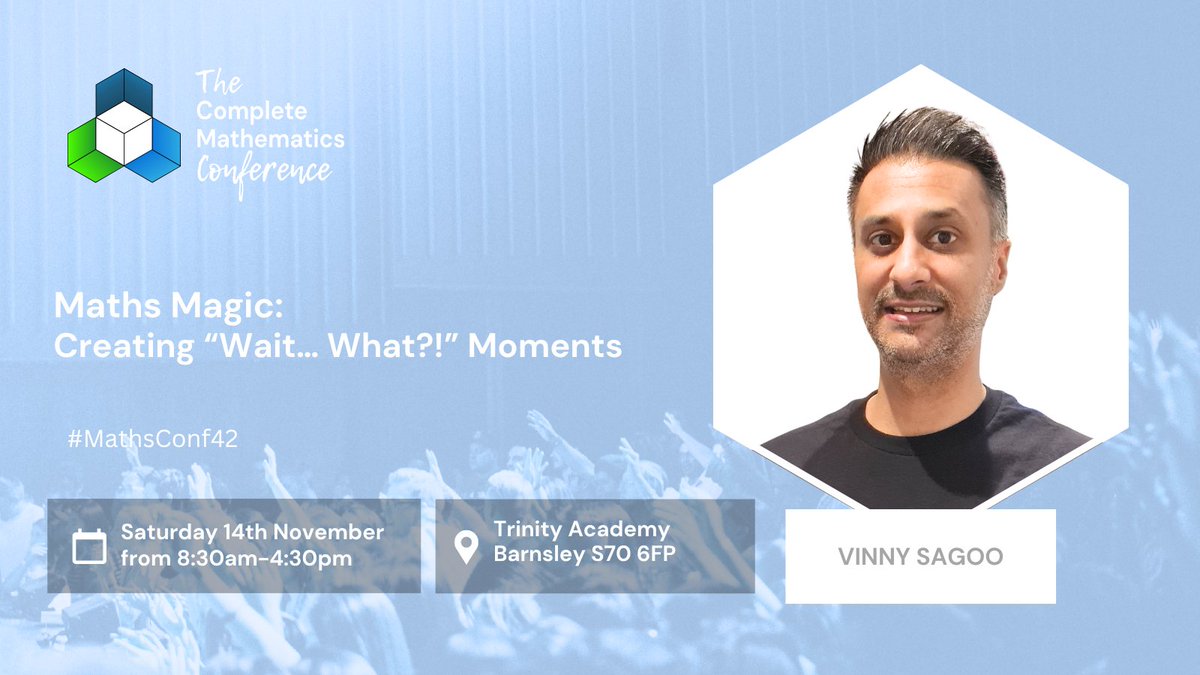
✨ Discover the magic hidden inside mathematics! 🎩
Can maths create moments that feel like real magic?
Join Vinny Sagoo for a fun, interactive workshop where mathematical ideas become surprising, engaging, and unforgettable.
Through a collection of practical mathematical magic effects, you’ll explore how number patterns, logic, prediction, and problem-solving can be used to create those brilliant classroom moments that make students stop and think:
🤯 “Wait… what?!”
During the session, you’ll:
🔢 Experience a range of mathematical magic effects
🧠 Uncover the mathematics and reasoning behind the tricks
🎯 Explore how prediction and logic can develop mathematical thinking
💡 Discover ways to use mathematical magic to spark curiosity and discussion
🙌 Take part in plenty of hands-on activities
But this isn’t just about performing tricks.
It’s about using the surprise and wonder of mathematics to help learners become curious, confident, and willing to explore mathematical ideas.
Whether you’re looking for a memorable lesson starter, an engaging classroom activity, or simply want to experience the joy of mathematical discovery yourself, this workshop will give you plenty to take away.
🎩 Expect hands-on participation, unexpected results, and more than a few moments of mathematical magic!
🎟️ https://t.co/c5KGsF2jpf
#MathsConf42
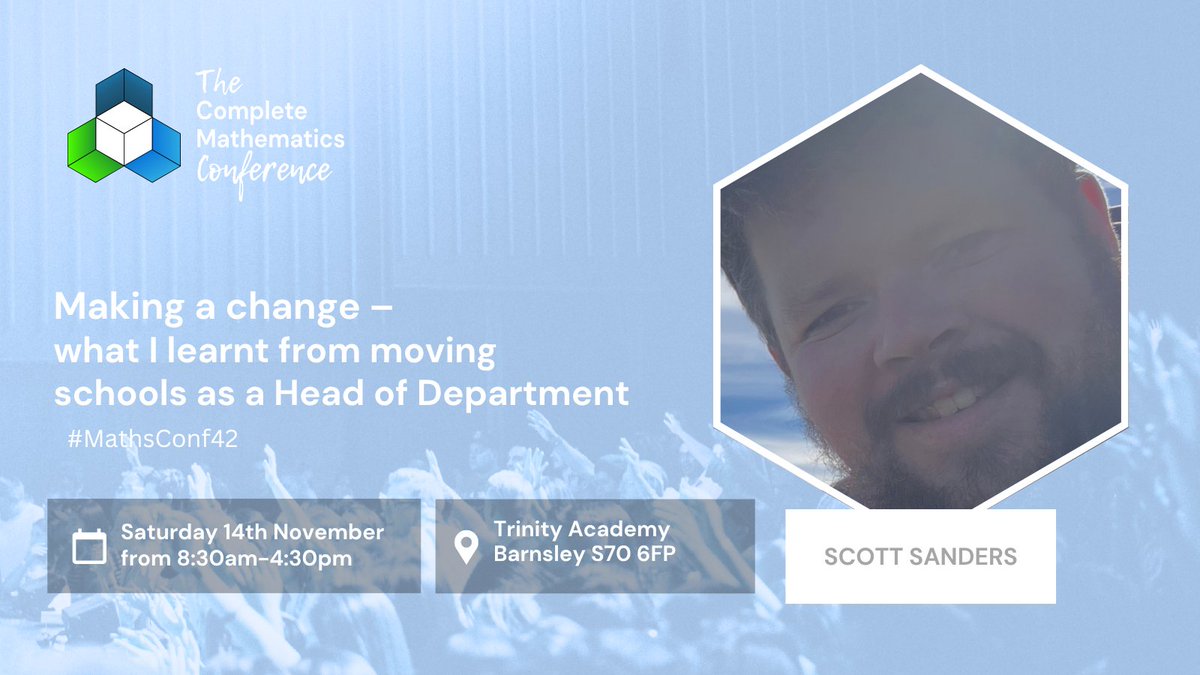
📚 What happens when you start again?
After five years in mathematics department leadership, including two and a half years as Head of Department, moving to a new school created an unexpected opportunity: to reflect on what I thought I knew about departmental leadership and discover which lessons really transferred to a new context.
This workshop will share stories, successes, mistakes, and lessons learnt from leading mathematics in two different schools.
Together, we’ll explore:
✅ Building trust and relationships
✅ Understanding a new school’s context
✅ Deciding what to change — and what not to
✅ Adapting leadership approaches to a new environment
✅ Finding your feet when you have to start again
Whether you’re an experienced maths leader, new to departmental leadership, or considering your next step, this session offers an honest opportunity to reflect on the realities of leading mathematics in different contexts.
🎟️ https://t.co/c5KGsF2jpf
#MathsConf42
🧩 How can we make problem-solving an integral part of everyday maths lessons?
Problem-solving is an essential part of mathematics, but embedding it consistently into classroom practice can be difficult.
Teachers often face practical challenges: finding appropriate tasks, deciding what prior knowledge students need, and making meaningful connections between problems and existing schemes of work.
This workshop focuses on practical approaches that can make problem-solving easier to embed across the curriculum.
During the session, we’ll explore two approaches:
✅ Curriculum-mapped questions — connecting problem-solving directly to the mathematical content students are learning
✅ Longer investigations — giving students opportunities to explore, reason, make connections, and develop their problem-solving skills over time
But this won’t be a presentation where you simply sit and listen.
📚 You’ll be part of the workshop.
Using resources provided during the session, you’ll engage with a range of problem-solving tasks, consider the mathematical thinking they develop, and explore how they could work within your own curriculum.
You’ll leave with practical ideas, useful resources, and approaches that can help make problem-solving a more natural and regular part of your maths teaching.
🎟️ https://t.co/c5KGsF1LzH
#MathsConf42
💡 Ever had a lightbulb moment in your maths classroom?
That little change that got students talking?
That activity that made a tricky concept click?
That resource you wish you’d discovered years ago? 👀
Someone else could benefit from it — and #MathsConf42 is the perfect place to share it! 🎤
We’re inviting maths educators to step forward and host a workshop. It doesn’t have to be groundbreaking or complicated. Sometimes, the simplest ideas spark the biggest conversations. 🙌
✨ Share a success.
✨ Explore a challenge.
✨ Swap ideas with fellow educators.
✨ Help someone see maths teaching differently.
You bring the idea. We’ll bring the community!
🔥 MathsConf42
📍 Trinity Academy, Barnsley (S70 6FP)
📅 14th November 2026
📧 Send your workshop proposal to [email protected]
🌐 Or submit it here: https://t.co/FbhlsVskUO
Your next big idea might be the one that inspires someone else. What are you waiting for? 🚀
Ready for inspiration, ideas and a whole lot of maths? 👀
🎟️ Grab your tickets now https://t.co/c5KGsF2jpf
#MathsConf42
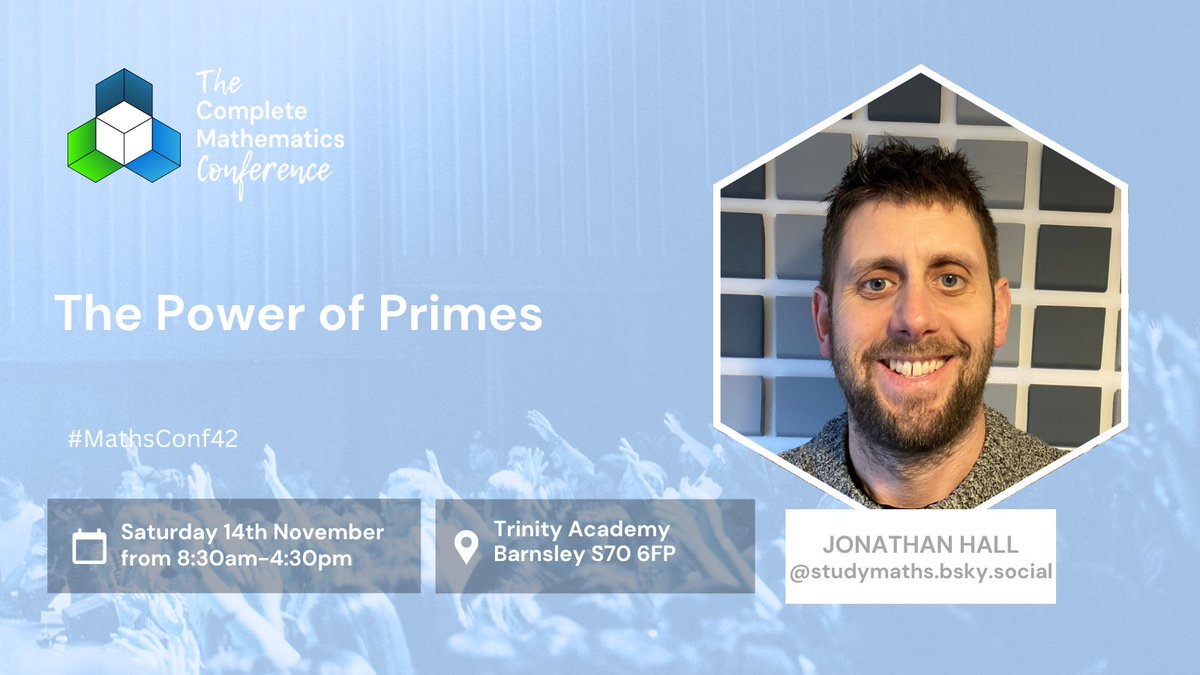
🧩 Discover the power of Prime Factor Tiles!
Looking for a cheap, versatile, and practical mathematical manipulative? Prime Factor Tiles can be made with just a few sheets of colour-printed paper and a guillotine — enough to use throughout the whole term!
In this engaging workshop, discover how these simple tiles can support teaching a wide range of topics, including:
✅ Commutativity of multiplication
✅ Simplifying ratios and fractions
✅ Highest common factors and lowest common multiples
✅ Factorising expressions
✅ Manipulating surds
Underpinning all of these ideas is the Fundamental Theorem of Arithmetic, providing a powerful connection between seemingly different areas of mathematics.
Come along to explore how one simple resource can help make mathematical structures visible, tangible, and easier to understand — with plenty of ideas to take straight back to your classroom.
🎟️ https://t.co/c5KGsF2jpf
#MathsConf42
🤖 How does A-Level Mathematics provide the foundations for Artificial Intelligence and Machine Learning?
Artificial Intelligence can sometimes feel like a world away from the mathematics classroom. But many of the mathematical ideas behind today’s AI technologies are rooted in concepts students encounter throughout their A-Level Mathematics journey.
This engaging session will explore the connections between familiar A-Level topics and the mathematics that underpins AI algorithms and machine learning.
During the session, you’ll:
✅ Explore the mathematical foundations behind AI and machine learning
✅ Make connections between familiar A-Level Maths topics and real-world AI
✅ Discover how mathematical concepts are used to develop and understand AI algorithms
✅ See how the mathematics students learn today can be applied to emerging technologies
✅ Consider ways to bring these connections to life for students
From the mathematics classroom to the rapidly developing world of artificial intelligence, this session will demonstrate how powerful and relevant mathematical thinking can be.
Whether you’re looking to inspire A-Level students, deepen your own understanding, or explore new ways to connect mathematics with the world beyond school, this session will offer plenty to think about.
🧠 Come and discover the mathematics behind the machines — and show students where their A-Level Maths can take them.
🎟️ https://t.co/c5KGsF1LzH
🧊 How much mathematics can you uncover from a simple cube?
Join us for a hands-on and engaging workshop exploring the many mathematical opportunities offered by this familiar 3D shape.
Together, we’ll participate in a range of activities that can be taken straight back to the classroom, using the cube as a starting point for exploring mathematics at a variety of levels.
🔷 Explore combinatorics through counting, arranging, and investigating possibilities
🔷 Discover geometry through the properties and relationships within a cube
🔷 Investigate probability through engaging problems and challenges
🔷 Take your thinking into 4D for those ready for a more adventurous mathematical journey!
The beauty of these activities is that they require no more than GCSE-level mathematical skills, while offering plenty of opportunities for deeper thinking, discussion, problem-solving, and mathematical curiosity.
Whether you’re looking for new classroom activities, richer mathematical investigations, or simply enjoy exploring interesting problems, this workshop will give you plenty to take away and try.
Come ready to get involved, think creatively, and see just how much mathematics is hiding inside a cube! 🧊📐
🎟️ https://t.co/c5KGsF2jpf
#MathsConf42
📚 Something strange happens to our brightest Year 7 mathematicians — and it’s not what you’d expect.
Pupils in England perform strongly in maths at primary school, but by Year 9, progress stalls. Most strikingly, many disadvantaged pupils who were top attainers at primary school do not go on to achieve a grade 7 or higher at GCSE.
So, what changes?
A survey of 2,000 pupils and parents across Years 6–9 reveals a surprising shift. High-attaining pupils become significantly more negative about maths when they start Year 7 — they are twice as likely to describe maths as boring, less likely to say it’s fun, and considerably more stressed.
Meanwhile, the opposite happens for lower-attaining pupils.
In this session, we’ll explore the data, debate the possible reasons behind this paradox, and test our theories against what pupils and parents actually told us.
🔎 You’ll leave with:
✅ A clearer understanding of what changes for high-attaining mathematicians
✅ Insights from pupils and parents
✅ Evidence-based ideas for supporting our brightest mathematicians
✅ Practical approaches to protecting confidence, enjoyment, and progress through the transition to secondary school
Join us to explore what happens to our most promising mathematicians — and what we can do about it.
🎟️ https://t.co/c5KGsF1LzH
#MathsConf42
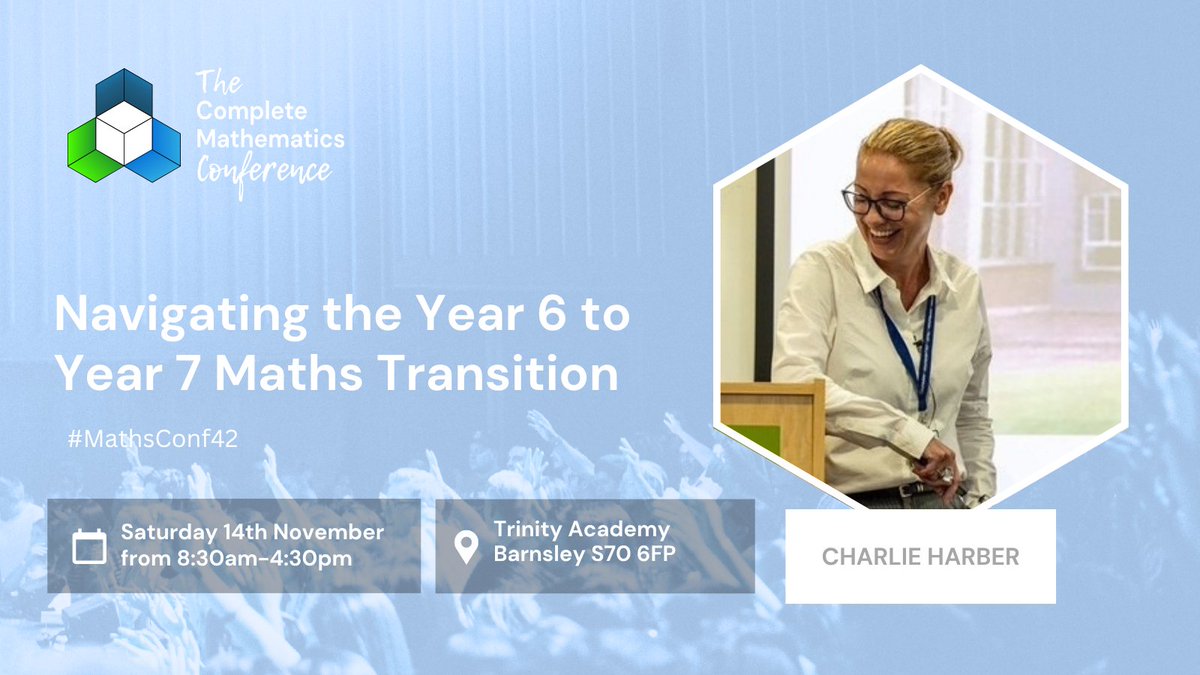
📚 Navigating the Year 6 to Year 7 Maths Transition
How can we ensure the move from KS2 to KS3 feels like a natural continuation of pupils’ mathematical learning rather than a sudden change?
This engaging session explores the transition from Year 6 to Year 7, looking closely at what pupils experience at KS2 — the concrete resources they use, the mathematical language they hear, and the conceptual foundations they develop.
During the session, we’ll:
✅ Explore the pitch and expectations of the KS2 curriculum and SATs
✅ Unpack the pedagogy and approaches pupils are familiar with
✅ Consider the role of concrete resources and mathematical language
✅ Reflect on the experiences pupils bring with them into Year 7
✅ Discuss how KS3 teachers can build on prior learning rather than starting again
✅ Explore ways to make maths feel familiar, accessible, and inspiring
By developing a greater awareness of pupils’ prior experiences, we can help sustain their confidence, strengthen mathematical understanding, and create a smoother trajectory as they move into secondary mathematics.
Join us for a thoughtful discussion about how we can make the Year 6 to Year 7 transition a positive step forward in every pupil’s mathematical journey.
🎟️ https://t.co/c5KGsF1LzH
#MathsConf42