Warren Buffett: "Even if a stock drops 50%, there's no need to panic."
Investor: "What should you do when a stock drops 50%?"
Buffett: "First, you need to understand what a stock really is."
Investor: "What do you mean?"
Buffett: "If you buy stocks, you must be mentally prepared for them to fall 50% or even more."
Investor: "But doesn't that mean losing half your money?"
Buffett: "Yes."
Investor: "Wouldn't most people panic and want to sell?"
Buffett: "In fact, Berkshire Hathaway's stock has fallen by roughly 50% on three separate occasions."
Investor: "Really? Even Berkshire?"
Buffett: "Yes."
Investor: "Was there something wrong with the business?"
Buffett: "No. There was nothing fundamentally wrong with the business."
Investor: "Then why did the stock price collapse?"
Buffett: "Because stock prices and business values don't always move together."
Investor: "Even so, a 50% drop is terrifying."
Buffett: "That's exactly why you should never buy stocks with borrowed money."
Investor: "Why not?"
Buffett: "Because when prices fall, you may not be able to handle the pressure."
Investor: "So when is the right time to buy?"
Buffett: "Nobody can predict the bottom. Nobody."
Investor: "So buying today doesn't necessarily mean I've made the right decision?"
Buffett: "Of course not."
Investor: "And you would still invest?"
Buffett: "Because I look at investments with a 20- or 30-year time horizon."
Every investor should ask themselves this.
But that doesn't mean every stock is a hold forever.
If the company's numbers or long-term outlook have gotten worse, selling in time might be smart.
Too many investors panic-sell the second the price drops.
The hardest part of investing is never buying the bottom or selling the top.
It's staying rational when the market falls and judging whether the company still deserves your trust.
A market crash is the real test of an investor's mindset
@syriasyria62979 If gold hits $10,000, I'll buy you a physical ounce myself. Until then, good luck finding a vault that doesn't charge you storage fees🤷♂️
@mohabelmasry670 Exactly. But remember: Buffett has billions to buy the dip. Retail investors just have to sit and pray. The patience is real, but the leverage is different
@Trudy81058604 Spot on. Berkshire's cash pile is near record highs. But the real question is: will he actually deploy it, or is he just protecting the downside?
If he starts buying, the market will follow
Warren Buffett’s Investing Rules: When to Buy, Hold, and Sell
📉 When a stock drops:
• Down 5% → Do nothing
• Down 15% → Increase your position by 10%
• Down 25% → Increase your position by 25%
📈 When a stock rises:
• Up 5% → Hold
• Up 15% → Keep holding
• Up 25% → Sell 10%
• Up 35% → Sell 20%
• Up 45% → Sell 30%
• Up 60% → Sell 40%
• Up 100% → Sell everything
Everyone can buy low and sell high.
Timing is the hard part.
Six stocks here, just for reference.
1. $MSFT , $498.30
Five stocks, hand-picked by me
Buy the dips. Move first
$NBIS , $96.92 , -9.39%
$AMD , $489.19 , -7.72%
$CBRS , $86.96 , -7.64%
$CRWV , $44.91 , -6.10%
$UNH , $330.48 , -5.55%
Two months, you'll thank me
And don't forget to like and follow!
(NFA)
@Herukos_ Great lens. With NFLX, free cash flow margins actually point to pure price compression rather than broken fundamentals.
Between V's network tollbooth and MSFT's enterprise lock-in, which moat do you think is harder to disrupt over the next 10 years?
Test your investing thesis.
If you could only pick ONE stock from each of these 6 industries to hold for a decade, what are you buying?
$NVDA (Semis)
$V (Fintech)
$MSFT (Cloud)
$ORCL (Software)
$NFLX (Streaming)
$AMZN (E-Commerce)
Drop your list below. 👇
(NFA)
Hunterbrook is shorting $AMD. But this isn't a valuation call — it's a China compliance risk play.
The core allegation: AMD continued shipping firmware to IEIT Systems after it was blacklisted in March 2025. Three IEIT-linked entities (Maginfra, Kaytus, Aivres) are selling AMD-based servers with nearly identical firmware.
$AMD billed $7.75B, or 22.4% of revenue, to China + Hong Kong in FY2025.
The real question: how much of AMD's China exposure is actually compliant?
(NFA)
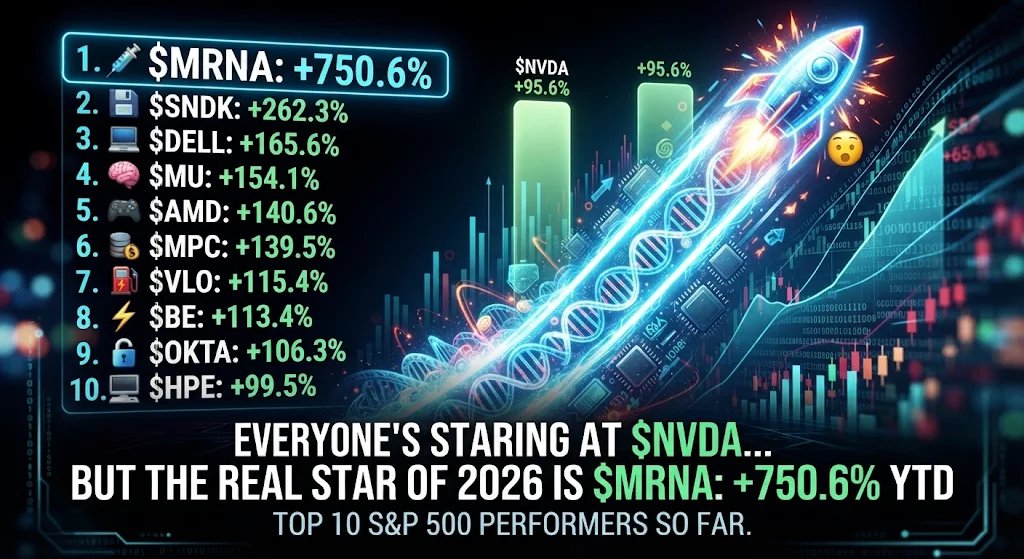
Everyone is staring at $NVDA, but the real star of 2026 is $MRNA with a mind-blowing +750% YTD return. 🤯
Top 10 S&P 500 performers so far:
💉 $MRNA: +750.6%
💾 $SNDK: +262.3%
💻 $DELL: +165.6%
🧠 $MU: +154.1%
🎮 $AMD: +140.6%
🛢️ $MPC: +139.5%
⛽ $VLO: +115.4%
⚡ $BE: +113.4%
🔐 $OKTA: +106.3%
🖥️ $HPE: +99.5%
Did you catch any of these? 👇
(Not financial advice)
1. $NVDA— Nvidia: The backbone of AI computing, with revenue up 106%.
2. $AVGO— Broadcom: Custom AI chips, with AI revenue up 221%.
3. $AMZN— Amazon: AWS revenue up 39%, with a $578B backlog.
4. $GOOGL— Alphabet: Search, YouTube and Gemini, with Google Cloud up 103%.
5. $HOOD— Robinhood: Evolving into a full financial platform, with $396B in platform assets.
6. $PLTR — Palantir: AI software for businesses and governments, with revenue up 96%.
7. $SPCX — SpaceX: Starlink, Starship and AI, with revenue up 161%.
8. $TSM — TSMC: Produces some of the world's most advanced chips for Nvidia and Apple.
Not a recommendation, just tracking where the real AI infrastructure dollars are flowing while retail chases the noise.
If you find this information helpful, please like, follow, and share.
If you're under 49, I'll say this only ONCE.
Turns out you got some dry powder sitting in your pocket.
CEO $NVDA Jensen Huang says normal people will be millionaires buying AI bottleneck stocks EARLY.
Here's 8 stocks that can still 15x:
1. $AMZN
Tape reading the last 30 days. The sell-off is relentless.
Current prices vs one month ago:
$NVDA: $162.85 (-25%)
$MU: $778.31 (-16%)
$SNDK: $885.01 (-36%)
$CRWV: $53.13 (-23%)
$NBIS: $115.88 (-38%)
$INTC: $59.66 (-37%)
$GOOGL: $295.77 (-15%)
$DELL: $344.53 (-27%)
Watch the volume. The bounce will be violent.
NFA
Most people watch Starship videos for the sci-fi spectacle. Institutional investors watch them for the unit economics.
Every intact recovery of Ship 42 collapses the marginal cost of getting mass to orbit—unlocking a multi-trillion dollar orbital economy:
Direct-to-cell satellite constellations (ASTS)
Sovereign defense & launch backlogs (RKLB)
Space-based AI compute & data centers (SPCX)
Traditional aerospace companies still operate on cost-plus government delays, while rapid reusability is turning orbital access into a high-margin infrastructure monopoly.
Are you positioned in the space economy before 2027 goes mainstream? 🚀📊