@markingramII We love you, Mark! Thank you for being such a wonderful representative for the University.
My mother, 81, was so excited to see you being honored! She has tears in her eyes.
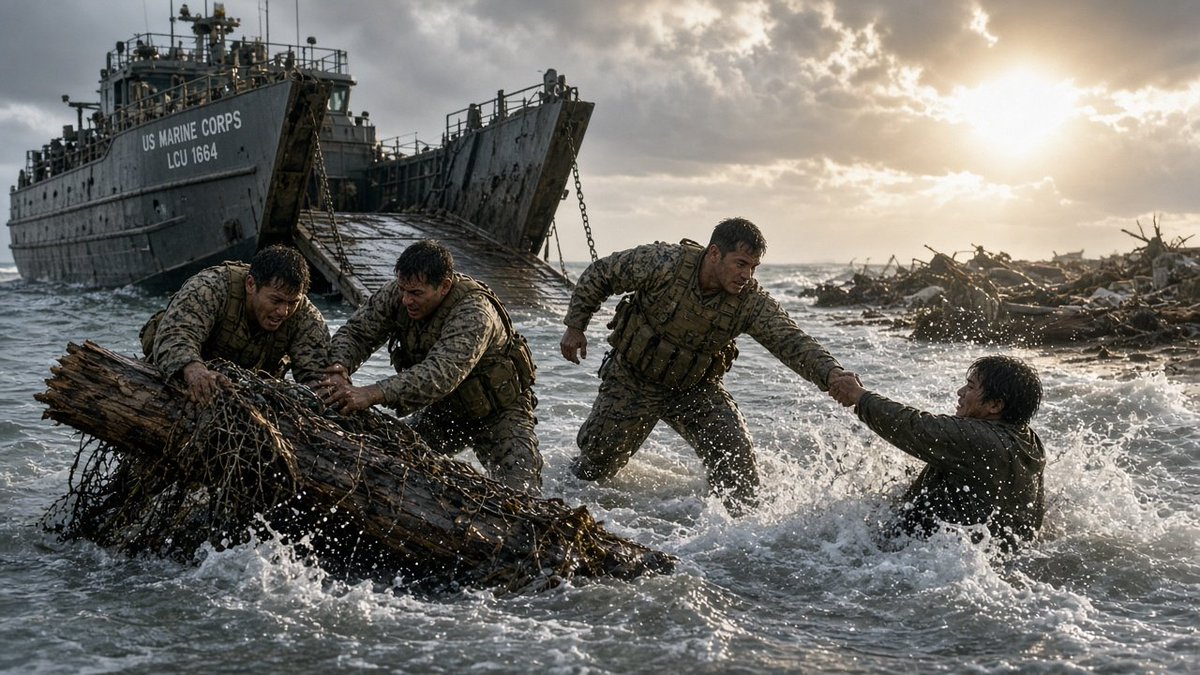
Kesennuma Oshima. March 2011.
A small island cut off from the world.
The ferry was smashed ashore. The harbor was a graveyard of floating houses, tangled nets, and massive splintered trees.
No power. No water. Freezing sub-zero nights.
3,000 Japanese civilians were shivering in the dark, whispering:
“Nobody is coming for us.”
Military manuals said: “Impossible. High risk of grounding. Do not approach.”
Then the loudspeaker on the USS Essex crackled:
“There is an isolated island. It is dangerous. Who volunteers to go?”
The sign-up list filled in TEN MINUTES.
Your Marines were literally shoving each other in the hallways yelling: “PUT ME ON THAT BOAT!”
Landing craft LCU 1664 charged full speed toward the shallow reef.
The ramp slammed down into the freezing surf.
Did your Marines wait for dry land?
HELL NO.
They charged waist-deep into the icy Pacific ocean with chainsaws and bare hands!
They ripped tangled nets apart with combat knives.
Three Marines at a time violently heaved multi-ton logs out of the surf with raw muscle power, screaming as they tore open a path for food, fresh water, and generators!
And when they set up camp?
They had hot portable field showers.
NOT A SINGLE MARINE USED THEM.
A young corpsman, face caked in black mud, smiled and said:
“If we use the water, there’s less for the islanders. We’re fine in the dirt.”
They slept on frozen mud so our grandmothers could have blankets.
They bled so our children could drink warm milk.
That is not diplomacy.
THAT IS RAW, UNBREAKABLE BROTHERHOOD.
God bless the United States Marine Corps. 🇺🇸🇯🇵
NOBODY tells Americans this part of the story.
March 11, 2011.
A black, 30-foot wall of ocean swallowed Northeast Japan.
Our government froze. The Pentagon had no orders.
Communications were dead.
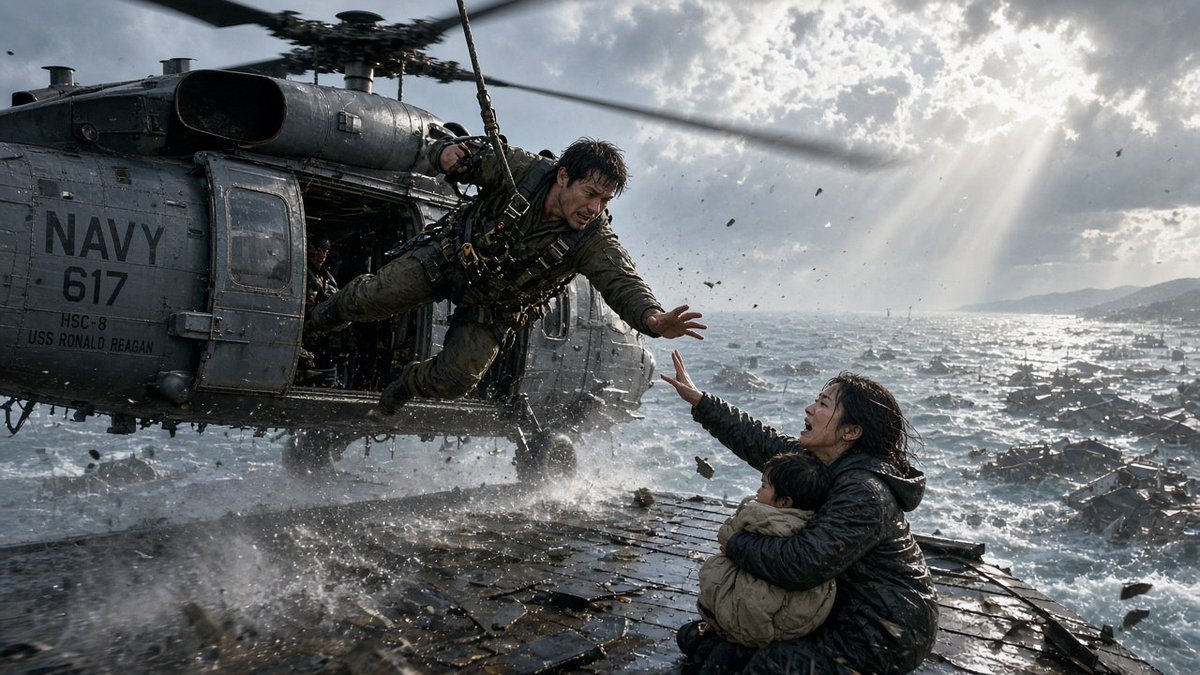
You know what Captain Thom Burke and Rear Admiral Robert Girrier did on the USS Ronald Reagan?
They didn't wait for the White House.
They didn't wait for paperwork.
They looked at the TV screen, saw their friend drowning, and committed the ultimate military sin:
UNAUTHORIZED ADVANCE.
“We’re going. NOW.”
They turned the massive nuclear carrier full throttle straight into the disaster zone.
Then came the hydrogen explosions at Fukushima.
Radiation plumes drifted across the Pacific.
Every foreign embassy told their citizens: RUN.
The US Embassy ordered an evacuation zone: STAY 50 MILES AWAY.
Did the Ronald Reagan turn around?
DID YOUR SAILORS RUN?
NOT. ONE. INCH.
Nineteen-year-old kids from Texas and Ohio stood on a freezing flight deck, radiation detectors in hand, launching helicopters into blizzards.
They hovered over submerged rooftops, pulling shivering mothers and babies out of the black water.
When Japanese refugees were brought aboard shivering in shock, your sailors gave up their own warm bunks and slept on the cold steel floor.
While the rest of the world ran away from Japan,
AMERICA CHARGED STRAIGHT INTO THE FIRE.
You didn't do it for a treaty.
You didn't do it for politicians.
You saw your friend bleeding, and you kicked the doors down to save us.
Happy 250th, America.
Japan will remember your boys forever. 🇺🇸🤝🇯🇵
Six New York City firefighters survived the collapse of the North Tower because a 59-year-old bookkeeper could not walk any faster.
The ones who ran past her, faster, stronger, wearing lighter gear, are dead.
The ones who stopped for her are alive.
Her name was Josephine Harris. She was one week from her 60th birthday. She was a bookkeeper for the Port Authority. A few weeks earlier she had been hit by a car and was still walking with a limp.
On September 11, when the plane hit the North Tower, Josephine was on the 73rd floor.
She started down.
Alone. Injured. One step at a time. She got herself down more than fifty flights before her legs gave out.
Six firefighters of Ladder Company 6 out of Chinatown were doing the opposite. They were carrying 100 pounds of gear each, and climbing.
Their captain, Jay Jonas, had already turned to his men on the way in and told them the truth. "Firemen will die today." Nobody argued.
At the 27th floor, they felt the building shudder and heard a roar they did not understand. Somebody on the radio told them. The South Tower had just fallen. Their own building was next.
Jonas gave the order to go down. Now.
At the 20th floor, in the doorway of Stairwell B, they found Josephine standing there. Crying. Unable to move.
Firefighter Tommy Falco turned to his captain. Seven words.
"Cap. What do you want to do with her?"
Jonas said it later exactly the way he felt it in that second. Every fiber in his being was screaming to get out of the building. He knew, cold, that stopping was probably a death sentence for all of them.
He gave the order anyway.
"We take her."
Bill Butler and Tommy Falco each took an arm. Sal D'Agostino and Mike Meldrum went ahead to clear the way. Jonas and Matt Komorowski moved in behind.
The descent was agonizing. Josephine's legs kept collapsing under her. Other people passed them on the stairs, moving fast, telling them to get out. Firefighters passed them. Civilians passed them. Everyone was faster than Josephine.
Almost none of those faster people made it out.
At the 4th floor, Josephine dropped to the ground. She could not go on.
"Leave me," she said. "I'm okay. Just leave me."
They said no.
Butler tried to lift her. Jonas ran off the stairwell into the 4th floor to search for a chair, anything with wheels, anything they could use to carry her. There was nothing.
He turned around and walked back toward the stairs.
And then, at 10:28 a.m., the North Tower started to fall.
A hundred and ten stories of steel and concrete came down on top of them. Jonas saw the ceiling collapse. He heard the roar. He heard Josephine screaming.
Then, nothing.
They were buried.
The building had crushed itself flat everywhere around them. But the tiny section of Stairwell B where those men had stopped for a woman who could not walk, held. It did not fall.
They were the only people found alive in any stairwell of the North Tower.
Fourteen human beings survived inside the collapsed tower. Almost all of them were in that pocket, standing where they were because of Josephine's pace.
There were others. A Port Authority K-9 officer named David Lim who had gone up to help. Members of Engine 39. A chief who lost his life on the radio calling for help.
In the dark, buried, one of them got a radio through. Jonas gave his coordinates. "Ladder 6, Tower One, Stairwell B."
The voice that came back was his old friend Cliff.
"Captain Jay Jonas, this is Cliff. We're coming for you, brother. We're coming for you."
Firefighters who spend their careers on the giving end of that promise are not used to being on the receiving end. Jonas would later say he chokes up just repeating it.
For three and a half hours they clawed at concrete. Then a shaft of sunlight cut through the dust. The sun.
They climbed out.
All six firefighters. Josephine. David Lim. Fourteen people in total. Not one of them with life-threatening injuries. Buried under a hundred stories of building, and every one of them walked away.
Meanwhile, everyone who had rushed past them on those stairs was gone.
The firefighters started calling Josephine their guardian angel. They meant it literally.
They had a green firehouse jacket embroidered for her.
"Josephine, Our Guardian Angel."
Sal D'Agostino later explained it in one sentence.
"Without us, Josephine would not have made it. And we feel without Josephine, we would have died."
One of them named his firstborn child after her.
The baby was born nine pounds, eleven ounces. 9/11.
They meant that literally too.
Josephine died in 2011 of a heart attack in her Bushwick home. She was 69. Nothing to do with the towers. She had lived a full ten years that she should not have had.
The six men who saved her carried her coffin.
Two weeks ago, on September 1, 2026, Josephine's sister walked into that Chinatown firehouse holding the green jacket. The family had kept it fifteen years.
She handed it back to Ladder 6.
Sal D'Agostino was there. So was retired Deputy Chief Jay Jonas. And Bill Butler. And Matt Komorowski. And the others.
Same men. Older. Gray now.
They put the jacket in a frame. It will hang in the firehouse forever.
Every new generation of Ladder 6 will walk past those five embroidered words.
Josephine, Our Guardian Angel.
The fastest people in the stairwell died.
The slowest woman in the stairwell saved six firefighters, and she did it by not being able to walk. 🇺🇸
At Ground Zero, after the last living person was pulled out, the search dogs stopped eating.
So the police did something nobody had written down in any manual.
They climbed into the rubble, lay down, and pretended to be alive.
More than 300 dogs worked the World Trade Center site. They came from every corner of the country, on trucks and in cargo holds, with handlers who had been trained to do one thing. Find people who are still breathing under the ground.
That is what a search and rescue dog is built for. Not bodies. Life. They are trained on live human scent. When they find it, they bark, they dig, they light up, and the handler rewards them, and the whole thing means something.
The last living person recovered from Ground Zero was a woman named Genelle Guzman-McMillan. She had been buried for 27 hours. A dog found her.
She was the last.
After that, the dogs kept going out on twelve-hour shifts, across sixteen acres of smoldering steel, at temperatures that burned their paws, and they found nobody.
Nobody.
Day after day.
The handlers noticed it first. The dogs were changing. Their tails were down. They were not eating. They would come off the pile and lie flat and not look at anyone.
A veterinarian named Cindy Otto, who spent ten days there working night shifts to care for the animals, put it plainly. The dogs had been sent to find life, and every day they were finding the opposite.
It was breaking them.
An NYPD officer named Famiglietti described what happened next.
They pulled everybody off the rubble. Then they asked for volunteers.
The volunteers, police officers, went out into the debris and hid themselves. Under beams. In voids. Curled up in pockets of concrete. They were told to lie down like they were hurt. Then the handlers sent the dogs in.
Picture that.
A grown man with a badge, a man who had spent the last week pulling friends out of that same pile, lying down in it on purpose. Face down. Holding still. Waiting for a dog.
And the dog comes over the top of the wreckage, and catches the scent, and barks, and digs, and finds a person who is warm and moving and alive.
And the handler says good girl, good boy, and the whole team celebrates.
They called them mock finds.
They did it for the dogs.
They did it so the dogs would remember what they were for.
One of those dogs was a two-year-old golden retriever named Bretagne. She came from Texas with her handler, Denise Corliss. It was her first deployment. They worked ten days at Ground Zero. They found no survivors.
But firefighters would come off the pile, stone-faced, not speaking, and see the dog, and something would break open in them. They would kneel down. They would put their face in her fur.
One day a man walked up to Bretagne and started petting her. He told Corliss his best friend loved golden retrievers.
Corliss asked where his friend was.
The man pointed at the pile.
"He's in there somewhere."
He kept petting the dog.
Bretagne went on to work Hurricane Katrina and Rita. She retired at 10. She was the last known surviving search dog of 9/11.
On June 6, 2016, at age 16, she was carried into a veterinary office in Texas to be put to sleep.
Outside, a dozen firefighters from her fire department stood in a line in their dress uniforms, in the heat, and saluted as she went past.
They draped her in an American flag on the way out.
Three hundred dogs went into that pile looking for the living.
They found one.
And when they could not find any more, the men they worked beside laid down in the rubble and let themselves be found, so the dogs would not lose heart.
That is the whole story of Ground Zero, really.
Nobody could save the dead.
So they saved each other. 🇺🇸
Twenty five years ago today, a 62 year old man with cancer in his bones walked 2,687 people out of the South Tower, and then he went back inside.
Rick Rescorla was born in Hayle, Cornwall in 1939. British Parachute Regiment in Cyprus at 18. Colonial police in Northern Rhodesia. Then he came to America, enlisted in the US Army in 1963, and in November 1965 he went into the Ia Drang Valley as a platoon leader with the 2nd Battalion, 7th Cavalry.
Hal Moore called him the best platoon leader he ever saw. His men called him Hard Core. He sang to them in the dark, Wild Colonial Boy in an Australian accent, because he had worked out that men who are singing are not men who are panicking. That is Rescorla on the cover of We Were Soldiers Once and Young, bayonet fixed.
Thirty five years later he was head of security for Dean Witter, later Morgan Stanley, in the South Tower of the World Trade Center.
In 1990 he brought in his old friend Dan Hill and the two of them walked the basement. He warned the Port Authority that the parking garage was wide open, that somebody could drive in a truck full of explosives, walk out and light it off. Nothing was done. Three years later the 1993 bomb went off about thirty feet from the spot he had flagged.
After that he told Morgan Stanley the towers were still a target and the next attack would come out of the sky. He wanted the firm to leave Manhattan. The lease ran to 2006, so they stayed. Twenty two floors of the South Tower, roughly 2,700 people.
So he drilled them. Every three months, everyone, no exceptions, down the stairwells two abreast while he stood there with a stopwatch. Traders pulling seven figures resented being marched down concrete stairs by a Cornishman with a clipboard. He kept doing it anyway.
8:46 a.m. The North Tower is hit. Port Authority comes over the South Tower loudspeakers and tells everyone the building is secure and to go back to their desks. Rescorla picks up a bullhorn and tells his people to get out.
He phones Dan Hill. "The dumb sons of bitches told me not to evacuate. They said it's just Building One. I told them I'm getting my people out of here."
9:03 a.m. The second plane hits the South Tower, floors 77 through 85. His people are already in the stairwells, moving exactly the way they had been drilled, and Rescorla is on the bullhorn singing to them. Cornish songs. A version of Men of Harlech he had rewritten for Cornwall. Men of Cornwall stop your dreaming, can't you see their spearpoints gleaming.
He called his wife Susan from the stairs. They had been married two and a half years, met jogging in New Jersey. He told her to stop crying, that he had to get these people out safely, and that if something happened to him he wanted her to know he had never been happier, that she made his life.
Someone told him to get out. He said, as soon as I make sure everyone else is out.
2,687 Morgan Stanley employees went home that day. Thirteen did not, and four of those were Rescorla and the men who stayed in the building with him: Wesley Mercer, Jorge Velazquez, Godwin Forde.
He was last seen on the 10th floor, walking up.
The South Tower fell at 9:59. They never found him.