We did actually. Kabalega used guerilla warfare against the British for years, and annihilated most of their units and their Sudanese Mercenaries. Until Semei Kakungulu and his group joined the British. And like the saying goes; a house divided can't stand! Later, Kabaka Mwanga, together with Kabalega used it,too.
The Great MUHUMUZA used it against the British in the hills of Kigezi and northern Rwanda-FOR 20 years! The British couldn't capture her. Until again, INTERNAL BETRAYAL....
Later, in 1912, the Acholi people used it to fight the British forces in GURUGURU HILLS- in today's AMURU District. The British couldn't defeat them and had to resort to use of CHEMICAL WEAPONS: they used POISONOUS GAS against our people by flooding those hills and caves with the POIDONOUS GAS!
Same old CRIMINAL METHODS of extermination! And Africans used it elsewhere. Problem wasn't methods of resistance, it was INTERNAL DISUNITY among us. Because we basically fought ourselves basically....as the British just watched.....
Anyone who has studied how contracting 4 public infrastructure projects in Uganda works, knows that, where a contractor delivers poor-quality work, they likely paid many bribes along the way & were left with money that can only deliver poor-quality results. Check the money trail.
Never seen a manager like David Moyes. You only get the best out of him if you place him in poverty and adversity. Give him money to spend to improve the team and it’s downhill from there
PLU, shall actively promote the Kiswahili language all over Uganda. So that we will realise Mzee's dream of a national language. If you cannot speak the local dialect, speak Kiswahili. English should be the last resort.
The guess I can make with some confidence is that, if whites hadn't come, Kabalega Chwa would have merged all the kingdoms of Uganda into one. Perhaps he would have also added Rwanda and Karagwe into his empire. He was only 22 or thereabouts when he reclaimed Tooro, and he wasn't going to stop there. Within the next two decades, his Abarusula were probably going to extend the boundaries of Bunyoro to the boundaries of the defunct Chwezi empire. So there would have been only one ruling clan in Uganda and parts of Tanzania, Rwanda and DRC: the Babito.
My darling Brother,let me use myself as an example. I am single, and one reason I take relationships seriously is because I have children. Their father is alive and responsible for them, and that responsibility does not disappear because I meet someone else.
But if a man chooses to build a life with me, he is also choosing a woman who is a mother. I wouldn’t expect him to replace their father, but I would expect him to love, care and contribute when needed. We cannot build one household and say, “Those are your children, call their father.”
The same applies to me: if I choose a man with children, I must understand that his children are part of the life I am choosing.
Love comes with responsibility. You cannot truly embrace the parent while rejecting the children. ❤️
Imagine coming from the very interiors of Teso North. Imagine studying hard all your life. Becoming the best student in all the schools you attended despite coming of the very definition of humble background.
Your hardwork finally pays off, your MP notices you and sponsors you to become the First Male Pilot from the Iteso Community. You finish Flying School with flying colours. You do very well that your school employs you to become an instructor immediately. Your humble parents come to your graduation ceremony, you fly them over the Kenyan capital. You finally achieved what you alway wanted in life. It's now time to lift your parents from the lows of life.
Then 27 days after your graduation, you crash while training another student, and your story ends there.
What is life. Why was he working so hard to only gain nothing. WHAT IS LIFE SURELY?
"A minister who appoints himself the inspector of everything is not strengthening government. He is advertising its institutional collapse."
We shall be there
AFRICAN STRUCTURAL DEPENDENCY which translates into GEO-STRATEGIC SUBSERVIENCE:
Just to give you one example; FOREIGN OIL COMPANIES in Uganda's Oil Sector. I know, some political economists will argue how this is FDI which empowers us,etc, and is not RESOURCE EXTRACTION as of old, something I don't agree with. But that is an argument for another time.
For now, just the figures of the Equity share in Uganda's Petroleum Sector:
Both TotalEnergies(France) and CNOOC(China) control 85% of all upstream productions & 70% of cross-border Pipeline. Leaving UNOC(Uganda)with just 15% equity stake.
Just imagine what this asymmetric equity means in REAL POWER DYNAMICS! Ultimately, you will lose control of your state policy, etc.
Now, this could have been avoided through JOINT REGIONAL INTERGRATED APPROACH. By, eg, the whole enterprise becoming an EAST AFRICAN PROJECT. So that the 8 EAC States PULL RESOURCES and finance the entire project so as to minimise the foreign equity. But alas!
Instead, what we have is each individual Country pursuing it's own MICRO KA-THING...with Kenya now bringing in Dangote to compete with AECOP....instead of being part of it.
AFRICAN DISUNITY, as usual, like it led to our COLONIZATION, is perpetuating our ECONOMIC ENSLAVEMENT, which necessarily results into GEOSTRATEGIC SUBSERVIENCE.
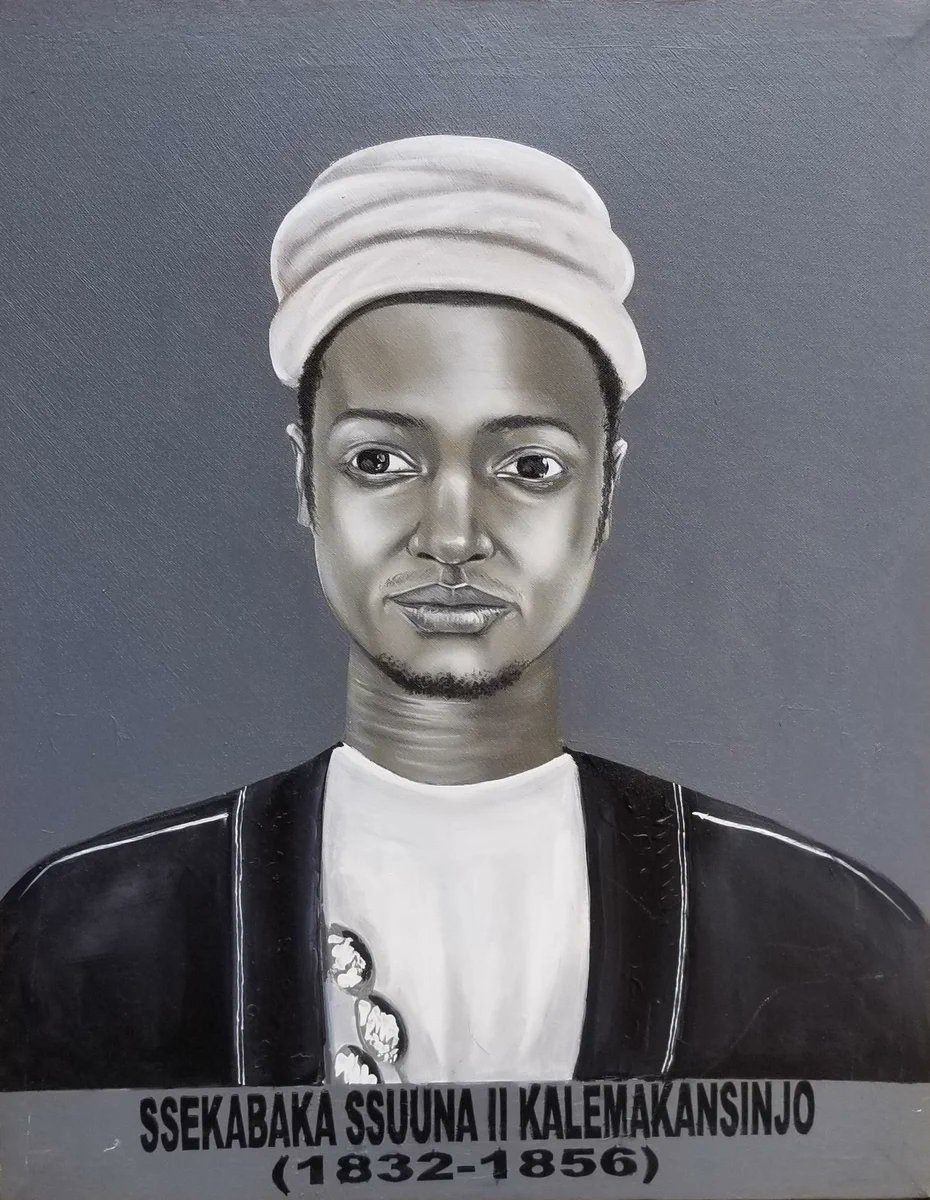
You think modern leadership is cold? You haven't read about Kabaka Ssuuna II of Buganda! 😳👑
This man didn't take chances with power at all. The moment he took the throne around 1832 at 12 years, he literally ordered the execution of ALL his brothers just to make sure no one would ever challenge his crown. 58 were executed and only 2 managed to escape.
And it didn't end there... Ssuuna was so feared that even looking at his mother the wrong way could get a chief executed (Just imagine).
He went on to marry over 148 wives, sired 200+ kids, and ruled with an absolute iron fist until smallpox took him down in 1856.
No modern political drama can top ancient East African royal history, wallahi! 😂
Which historical African ruler do you think was the more ruthless than Kabaka Ssuuna?
Nick, you know that long before colonialism arrived carrying fake inacurate maps, dual legal systems, Hebrew history(Bibles) and an extraordinary confidence in rearranging other people’s societies, political authority often grew from protection
A physically and intellectually formidable man could fight off enemies, protect his village and organise other men who trusted his strength. Soon, neighbouring communities wanted his protection. With enough followers, cattle, victories and strategic marriages, yesterday’s village strongman could become tomorrow’s chief, and eventually somebody’s king. Once he married and produced children, those children became “royals”, not because heaven had issued them certificates of blue blood, but because Daddy had been unusually successful at beating enemies and organising society.
There you can see an elementary form of the social contract developing. The protected surrendered some freedom, labour, produce or taxes in exchange for continuing protection and order. The king acquired authority, but that authority carried obligations. A king who could neither protect nor organise his people eventually had a legitimacy problem, however magnificent his leopard skin. Then republicanism and modern democracy arrived and either abolished these kingdoms or substantially weakened their political authority. Today, many kingdoms resemble canon law: politically diminished, sometimes practically irrelevant, but historically memorable and culturally persistent.
Their strongest contemporary justification, in my view, is cultural custodianship. Yet that also raises an uncomfortable question of whether they actually preserved the cultures they claim to embody.
Many have abandoned substantial parts of indigenous culture while retaining the throne. They carry colonial names, worship in religions introduced during colonialism, conduct ceremonies through imported forms and sometimes remember indigenous traditions mainly when somebody needs to wear barkcloth for photographs. We kept the crown but misplaced much of the civilisation that originally gave the crown meaning. We have even failed to develop the african jurisprudence and still look at our customary laws as repugnant, and common law precedent as progressive.
That is perhaps the contradiction worth discussing--a kingdom cannot indefinitely claim legitimacy as custodian of culture while becoming culturally estranged from the society whose traditions supposedly justify its existence.
The same problem possibly confronts education and religion. Any education that teaches people everything about somebody else’s civilisation while leaving them ignorant of their own produces educated strangers at home. Any religion that requires people to despise their ancestral culture before approaching God risks becoming cultural conquest wearing ecclesiastical robes.
Institutions must grow roots in the societies they claim to serve. Otherwise, Nick, we end up with the magnificent African absurdity of defending an indigenous throne in a colonial language, under a colonial name, while praying to the ancestors’ conqueror that God may preserve our culture. So, when are you free and we talk about our Batsyaba clan and how we can posture as resilient leaders of Mpororo? There is no weak Mutsyaba 🤣🤣 look at our patriarch Besigye, you, etc. We can invite rebel @hillarytaylorvi
By the time you turn 30 your friend group should include:
- a rich international friend with questionable business holdings
- a lawyer with questionable morals
- a finance bro with terrible morals
- an unemployed friend who always has money to drink
- a guy who always knows a guy