Anthropic engineer:
"99% of our engineers run swarms of 300+ self-improving agents"
"Now everyone is building agentic graphs"
In a 20-minute session, an Anthropic team member breaks down how graph engineering turns isolated agents into systems that improve themselves
The real setup is Claude running through graph workflows, plan mode, and dynamic orchestration
Agents → Loops → Graphs → Self-Improving Systems
Better than most $300 graph engineering courses
Bookmark and watch the talk
Then read the article below
Google's Jeff Dean just dropped the best 1-hour lecture on AI engineering: from basics to Graphs
1:45 - LLM from scratch
17:22 - how to use AI models
30:03 - prompt engineering
52:35 - one human coordinating 100 agents
1:02:40 - where the coordination actually lives
27 years of building AI at Google, compressed into one hour
Prompts → Agents → Loops → Graphs
most people will stop at the prompt engineering chapter and call it progress
he spends the last twenty minutes on the part that is still true next year
same model, same tokens, completely different week
watch it today
the full guide on graph engineering is below, save it while it is still early ↓
An article for everyone who ships, buys, or signs off on software built on large language models (LLMs): engineers, product managers, and the CEO. Written in plain language, from the big picture down to the details. https://t.co/YaP414vR0u
Some very insightful views on the future of LLM usage and the importance of Post-Training by a Former employee at an LLM lab:
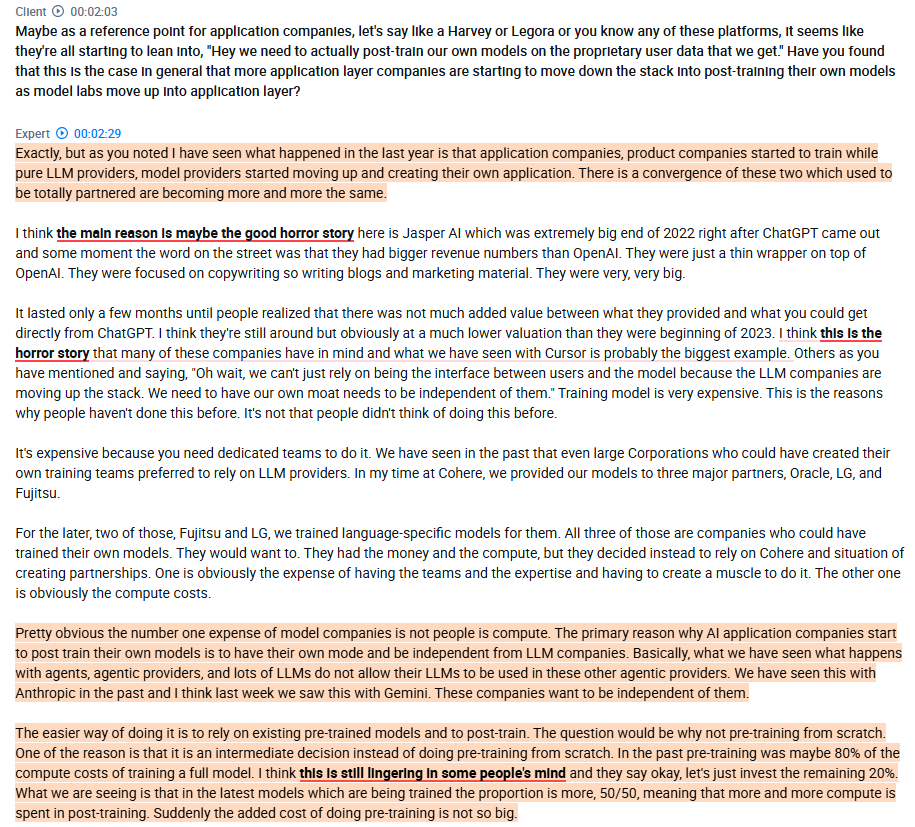
1. In his view, application/product companies and the model providers have started to converge and move into each other's segments. He believes that, to be successful in the long run, product companies will have to train their own models.
2. According to him, in the past, pre-training was 80% of the training compute costs and post-training was 20%. Now that has shifted more towards a 50/50 split as post-training has become very important. The human talent profile for post-training and pre-training experts, he notes, is also very different.
3. One of the reasons why companies didn't focus on pre-training was because of the 80/20 split of cost, but now that it is more 50/50, he thinks more companies will also do pre-training, as the added cost of doing pre-training is not that big if you are already doing post-training.
4. He thinks we will be in a world in the future where there is no difference between a model provider and an application company.
5. In terms of moats, he doesn't think proprietary data from users adds that much value as the industry might think. Part of this is because, with LLM usage, you don't really get reliable data on the correct completion of the prompt. At the same time, he does think a strong competitive advantage is having data that gives you signals on real-world usage and how people are actually using your model (usage patterns), and then you double down on that.
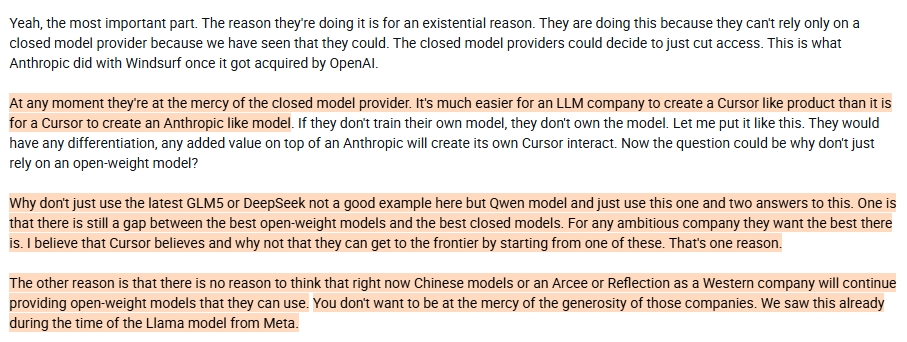
6. The expert thinks that the application companies without their own model are at the mercy of the closed model providers, as it is much easier for an LLM company to create a product than for a product company to create an AI model. The problem with open-source is also that it still has a performance gap vs. closed-end models, and you don't know if open-weight providers will continue to ship newer versions of the product as open-source. He thinks that as a niche that an application company is serving via using an AI model provider gets big enough, the AI model provider can cobble something together extremely quickly and go after you.
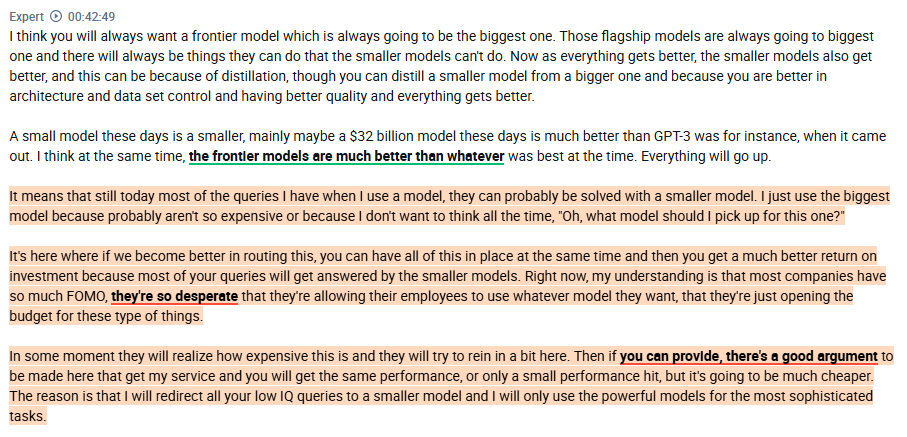
7. He thinks that over time we will get better at routing prompts to different models and use smaller, more efficient models for a lot of the tasks that we use today, as smaller models are also getting better. A lot of the tasks don't need to be served on the bigger frontier models.
found on @AlphaSenseInc
Google just dropped a 1-hour course on agentic engineering from scratch:
00:00 – How to build your first AI agent
08:24 – Build agent memory (short, persistent, long)
28:34 – Agentic loops, long-running AI agents
40:04 – How to build MCP (MCP vs API)
1:00:22 – Multi-agentic systems
This 1-hour watch will replace 10 paid agentic courses on the internet.
Bookmark this. Watch this weekend.
Omg.. this can't be true...
I kept building AI agents on my eventually list because everything I read made it sound like a six month project requiring a technical background I did not have.
One Reddit thread changed that by saying the one thing nobody had said clearly: pick the smallest possible problem and finish it completely before you try to build anything impressive.
MY ARTICLE IS THE CLAUDE CODE VERSION OF THAT LESSON.
Working agent - Under one hour - Zero coding.
Full guide below.
Introducing Sakana Fugu: A full multi-agent orchestration system accessible via a single model API.
Our ‘Fugu Ultra’ model matches the performance of Fable and Mythos, delivering frontier capability without the risk of export controls.
Try it: https://t.co/hhO6qTawgb 🐡