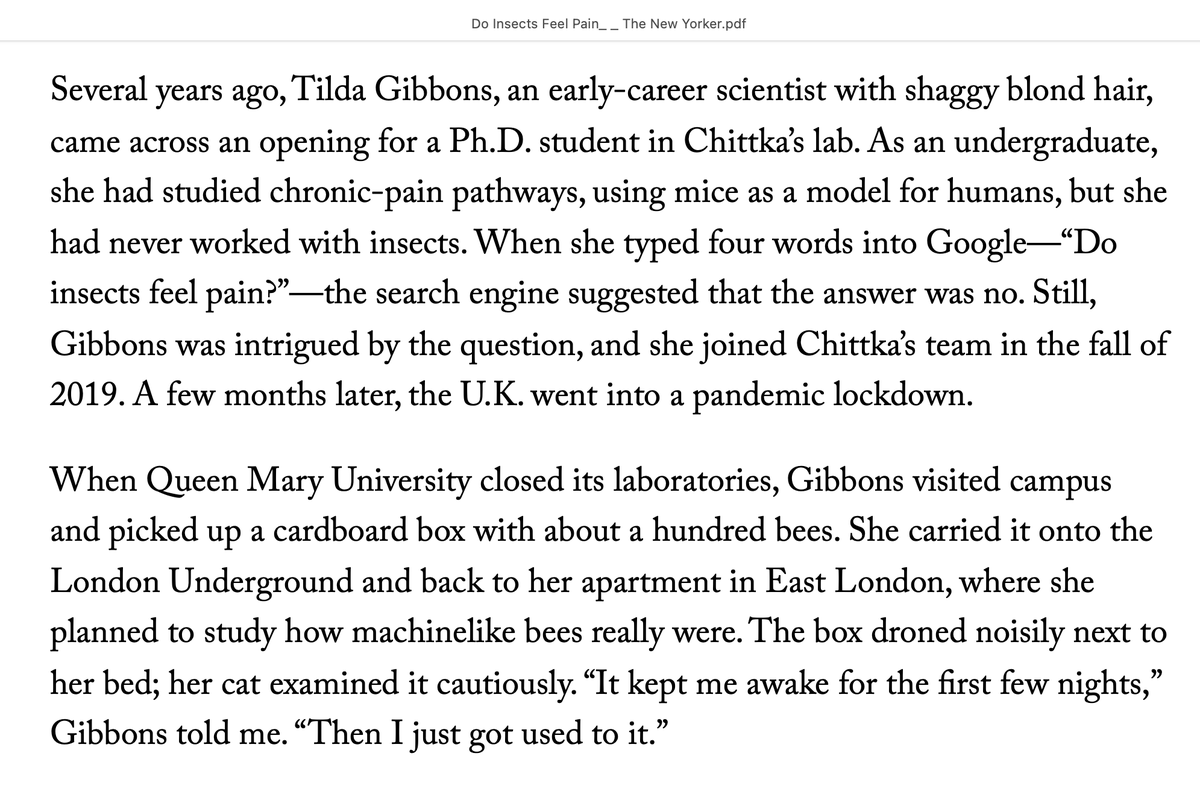
A good @NewYorker article (link below) by @shayla__love about recent work on insect pain (and other kinds of experience).
The initial stages of @matilda_gibbons's work, which is central, were improvised during Covid lockdowns. 1/
Entomologists' views on #InsectWelfare are evolving. A recent study in @EcolEnt by @Bee_Bytes, Merritt Drewery & Bob Fischer provides valuable insights into the interest in insect welfare & the importance of ethical research guidelines.
Read the paper 🔽
https://t.co/NnisVW2QsJ
Hyperspectral Imager paper out! High sensitivity UV to nearIR, radiance & reflectance, runs from a smartphone. Build the system for about $450 from 3D printed parts & off-the-shelf components.
Paper: https://t.co/d3bg0sgZwS
Intro video: https://t.co/xDJPN0CPqC
The latest issue of the New Yorker has a profile of the insect sentience squad, featuring Tilda Gibbons, Lars Chittka, Meghan Barrett, Sarah Skeels and me. (Link in reply.)
We're delighted to see our study, "Mating proximity blinds threat perception", https://t.co/h5WxRpn2Ge, featured by @NatureSMB
Thank you for spotlighting our work!
https://t.co/js1dkypHdc
@Dave_Hone Thank you - not quite what I had in mind, but it's possible that me seeing the two terms in 1 paragraph induced a false memory in me. Merry Christmas dude!
A honeybee with two differently-coloured pollens (from the German Bee Journal). Bees are by no means preprogrammed to be flower-constant. If flowers of two species are equally rewarding & in close proximity, bees sometimes visit both
@CaspervdKooi@JeffOllerton@KlausLunau Exactly- Peter Kevan has been making this point since the 70s - yet the cute fluorescence “signal” BS comes up again and again…