Home of RELATIONAL MATHEMATICS - Research & Australian & Victorian Curriculum & NSW Syllabus-based Mathematics Teaching
and Student Learning Resources.
Thinking Multiplicatively about multiplying decimals by 10 using Multiplicative Place Value - decimal points can't move! Students begin to think multiplicatively about decimals in Year 4. https://t.co/nJbPXgH7SA https://t.co/Os2pRH1bmZ
Many students think additively about fractions (1/4 + 1/4 = 1/2) instead of multiplicatively (1/4 = 1/2 x 1/2), and so their understanding plateaus, becomes instrumental or non-existent. Unless we explicitly teach students to think multiplicatively, many will think additively.
Explicitly teaching students the 2 ways divide throughout primary schools makes dividing by whole numbers efficient, and allows students to divide by fractions in high school without going instrumental. This quick (3 min) video explains all simply! https://t.co/cvsJscmDCR
Thinking Multiplicatively about multiplying by 10 using Multiplicative Place Value.
If you asked your students what they think about multiplying by 10, would they explain it mathematically and multiplicatively?
Students begin to think multiplicatively in Year 3.
Greetings!
31 July 2024
HUGE NEWS (Well i think so!!)
I have amended the complete Teaching Resources (not the individual Teaching resources yet!) for Addition and Subtraction 21, 22, 23, 24 and 29 (https://t.co/MAsEYRiG8y...) - I'd love your feedback to include!!!
WHAT'S NEW?
Greetings!
25 July 2024
We have finished updating ALL YEAR 3, YEAR 4, YEAR 5, and YEAR 6 SCOPE AND SEQUENCES, moving Statistics and Probability to earlier in Term 4 for report writing!
We are now working on:
1. Amending the Term 4 Scope and Sequences to move Statistics and Probability to earlier for report writing!
2. Updating Addition and Subtraction / Place Value in Years 1 and 2, and Multiplication and Division in Years 3 - 6 Let me have your feedback!
WHAT'S NEW?
Greetings!
24 July 2024
YAY!!! ALL TERM 3 Teaching Resources are now updated! Check out the new format for the contents page and the Wall That Teaches page where we recommend the number of lessons to spend on each sub-Element! Let me have your feedback!
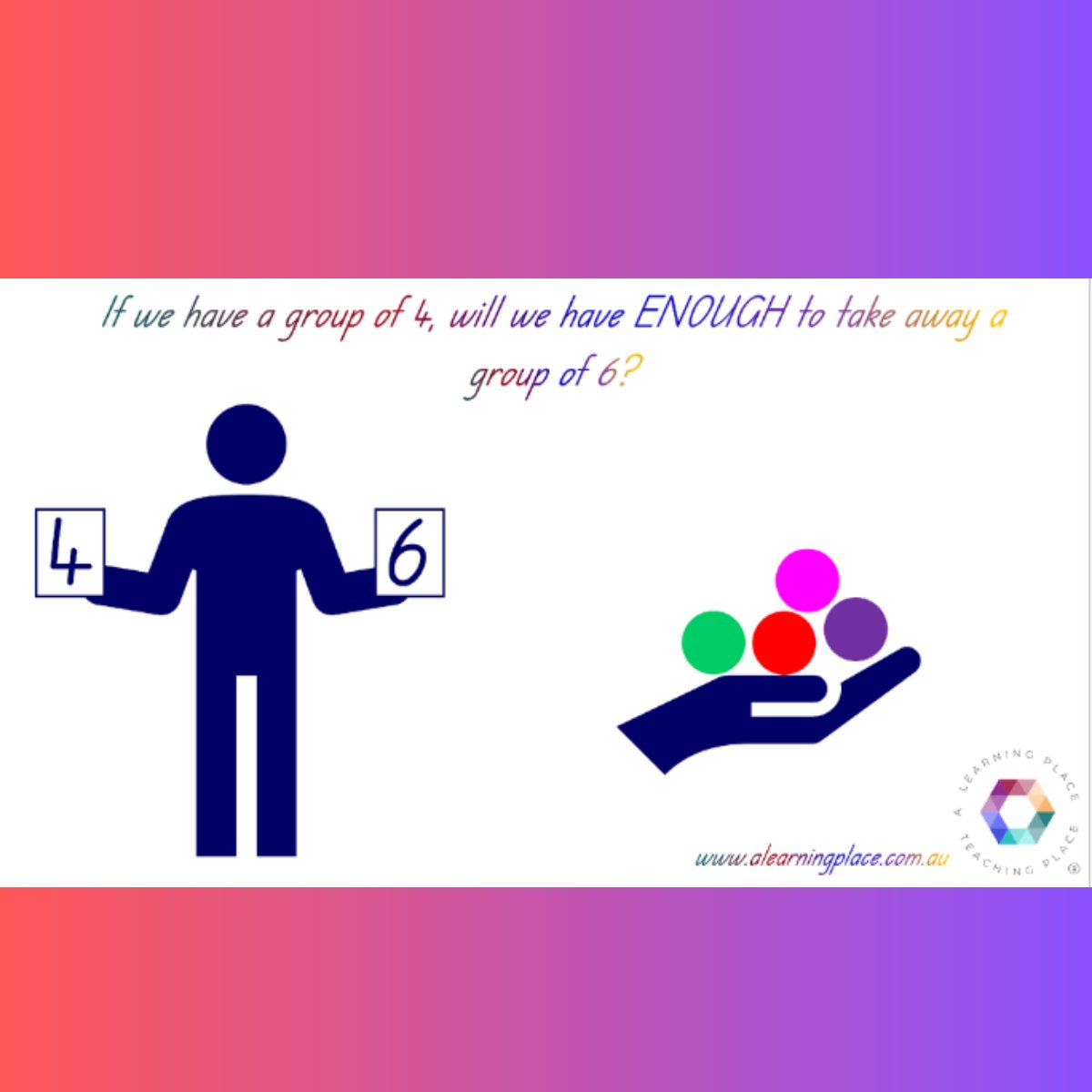
So we will make only 1 group … but we have 2 numbers
We need to determine ‘which number could we make a group of, which will give us ENOUGH to take away a group of the other number?’
That’s the number we will record first in our number sentence.
SUBTRACTION MISCONCEPTIONS are caused by teaching students non-mathematical ‘rules’, including:
📌Rule 1: When we subtract, we start with the big number and subtract the small number.
📌Rule 2: When we subtract, we get smaller.
NOPE and NOPE!
SUBTRACTION MISCONCEPTIONS are caused by teaching students non-mathematical ‘rules’, including:
📌Rule 1: When we subtract, we start with the big number and subtract the small number.
📌Rule 2: When we subtract, we get smaller.
NOPE and NOPE!
When we subtract, we may start with either number and subtract the other number.
If the number we start with is smaller than the number we subtract, we will have a negative number.
SUBTRACTION MISCONCEPTIONS are caused by teaching students non-mathematical ‘rules’, including:
📌Rule 1: When we subtract, we start with the big number and subtract the small number.
📌Rule 2: When we subtract, we get smaller.
That’s the number we will record first in our number sentence.
Students as young as 5 years old can understand this!
—--------------
🔔Stay tuned for future updates that might interest you: