Institutions used to ask if stablecoins were safe. But now, that conversation has moved on.
Now, the focus is on whether your compliance framework can pass a counterparty review, if you have AML reporting, and if your regulators know you before any issues arise.
At Ledig, this thinking shaped our approach. Last year we worked with Nigeria's SEC through ARIP, registered with the NFIU, aligned with NITDA, and became an MSB in the US. We did this not because we had to, but because our clients expect it.
#stablecoins #compliance #usdt #usdc #fintech #payments
You approve a $10,000 international transfer. The fee seems fine, so you move on.
The rate changes before the transfer finishes. An intermediary takes a cut, then another does too. The recipient also pays a withdrawal fee just to access the money.
They received $9,400, maybe less. No one told you or asked.
The fee you saw at the start was never the real cost. It just quietly vanished into a chain you never agreed to.
This is how most cross-border business payments work today.
Stablecoin infrastructure locks the conversion rate, shows you the fee upfront, and ensures what you send is what arrives. Companies like Ledig offer this for businesses across Africa and other emerging markets.
Ask your recipient how much they actually received on your last transfer. The answer will tell you everything.
#stablecoins #crossborderremittance #payments #fintech #finance #crypto
Expanding into a new market should not require a six-month entity registration process just to open a bank account.
Ledig's Virtual Named Accounts lets foreign businesses entering Nigeria, Kenya, Ghana, or other supported markets receive local currency payments straight into an account in their own business name. There is no need to set up a local company or use a third-party account that complicates reconciliation and raises questions for your partners.
It works the other way too. An African business with international operations can hold USD, GBP, EUR and other supported currencies in accounts in their company name and pay suppliers, contractors, and partners in those currencies directly. No more payouts arriving under a provider's name. No more explaining to a London supplier why the payment came from a fintech they have never heard of.
The account is real. The rails are local. The name on the account is yours.
If your business moves money across borders and you are tired of using accounts that do not reflect your company, contact the Ledig team at https://t.co/CZqFv2FDff.
#stablecoins #virtualaccounts #payouts #fintech #payments #bankaccounts #crossborderremittance
CFOs and treasury teams who move money across borders, especially in African and Asian markets, are increasingly asking important questions. Are stablecoins truly safe? What backs this token? Who checks the reserves? What happens when it’s time to redeem?
We explain how reserve-backed stablecoins work, what the GENIUS Act and MiCA mean for institutions, and why the main risk is not the stablecoin itself but the infrastructure provider behind it.
Worth a read if you're managing cross-border payments, supplier settlements, or treasury operations in emerging markets.
Read the full article here: https://t.co/FndgEjBdkV
#Stablecoins #CrossBorderPayments #TreasuryManagement #Fintech #EmergingMarkets #Web3
The US just issued an executive order directing federal financial regulators to review and update rules that create barriers for fintech firms working with traditional financial institutions.
The most important part for stablecoin infrastructure is that the Federal Reserve will look at whether non-bank fintech companies, including digital asset providers, can get direct access to Federal Reserve payment accounts. The report is due in 120 days.
If this access is granted, the settlement process for stablecoin providers could change a lot. There would be fewer middlemen, faster clearing, and a more direct way into the US payment system.
The review itself is not the final decision, but it means the question is now officially being considered.
Full order: https://t.co/zQaHdKjWQW
#stablecoins #federalreserve #US #regulation
A merchant in Lagos prices their goods in dollars, not by choice, but because the naira is too unstable to protect their margins. Customers are forced to pay in naira at whatever the day's rate is, so the merchant spends more time managing currency risk than running the business.
This isn’t a niche problem. It happens every day across emerging markets, in retail, services, and small businesses that don’t have treasury teams or FX desks. They’re left with a pricing problem and tools that weren’t made for them.
Stablecoins change things. They’re not just for big institutions moving millions, but also for merchants who want a checkout that accepts USDT/USDC directly so prices stay the same on both sides. NGOs can accept global donations without incurring FX conversion losses before the funds reach their cause. Service businesses can send a payment link and receive payment in USDT or USDC instantly, with no bank delays or currency conversions.
The use case for stablecoins in payments is bigger than most people realize. Cross-border infrastructure is just one side. The other is giving stable, accessible payment tools to businesses that have never had reliable options.
That’s the part I think deserves more attention as our industry evolves.
-David Osawaru
Product Manager, Ledig.
#stablecoins #crypto #Africa #emergingmarkets #fiat
This generation of builders will shape the global economy. @LEDiG_Tech is revolutionizing cross-border finance by providing stablecoin liquidity across Africa and beyond.
Base is the home for builders.
Most treasury teams and PSPs focus on rates, fees, and settlement time when choosing a Stablecoin provider. These are important, but in large-scale B2B payments, there is an even more important question that often gets overlooked.
Thin liquidity in emerging market corridors can quietly cost businesses thousands in slippage per transaction, often without anyone realizing it is the reason.
To learn more about how this affects your business, read the full article at: https://t.co/iIwoK5LNz8
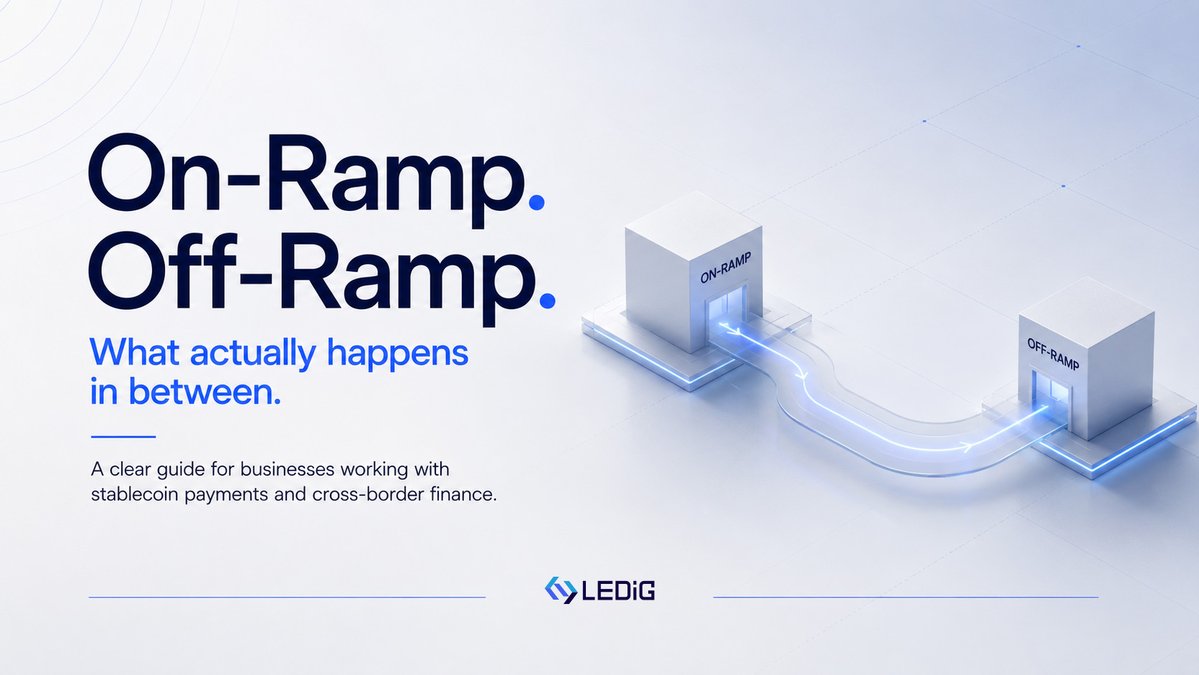
If you work with stablecoin payments or cross-border finance, you often hear the terms on-ramping and off-ramping. Most people have a general sense of what they mean, but here’s a clear explanation.
On-ramping means converting fiat into a stablecoin. For example, a business that accepts dollars, pounds, or euros converts those currencies into USDT or USDC. This lets them move value quickly using stablecoins instead of waiting for traditional banks. The process goes through a licensed provider or OTC desk, the rate is set in advance, and the stablecoin arrives in the business’s wallet, ready to use. This is how you get started.
Off-ramping is the exit. For example, a supplier in Lagos might receive payment in USDT but need Naira to pay employees and keep the business running. The stablecoin is converted to Naira and sent directly to their bank account via local banking systems. To do this well, the provider must have real banking partners and sufficient local-currency liquidity in that market, not just offer it as an option on their website.
Which brings up what most people get wrong. Off-ramping is not universally harder than on-ramping. The corridor decides. A market with deep liquidity, solid banking infrastructure, and clear regulation processes both smoothly. A market with dollar shortages, limited banking access, or complex compliance requirements needs more expertise and stronger local connections to get the same transaction across the line.
So, instead of asking a provider how many markets they cover, ask which ones they truly support and how they do it.
Ledig provides on and off-ramp infrastructure across African and emerging market corridors, in markets where the banking relationships and liquidity are already in place.
Visit https://t.co/CZqFv2FDff to find out more
#Stablecoins #CrossBorderPayments #OnRamp #OffRamp #Fintech #EmergingMarkets #Ledig #Treasury #Africa #USDT #USDC #cNGN
@yosephayele@lavavc_ Businesses in emerging markets need effective tools to hedge FX risk, and onchain derivatives tailored to local market conditions help provide this solution. We’re glad to have you on this journey with us.
7/ FX hedging is designed to solve this problem. It lets businesses lock in a local currency rate against the US dollar for a set period. Companies like Ledig help businesses manage this risk directly, so the rate you plan for is the rate you get, no matter what happens in the parallel market before settlement.
If your business works in emerging markets and you’re not sure how changes between the official and parallel rates affect your margins, it’s a good idea to talk with your treasury team this week.
1/ In most African markets, there are two exchange rates, but most businesses only plan for one. Let’s look at what the other rate is, why it exists, and why it can surprise you.
6/ The real risk is that the gap between rates can change quickly. A business that set its prices on Monday might see its profit margins change by Thursday if the spread shifts and there’s no protection in place.
Last year, businesses in Sub-Saharan Africa moved $200 billion on-chain, and 43% of that was in stablecoins.
Not every business made the switch for the same reason.
What motivated your business to make the change?