@NGSentinel01@TrueGritNG That's the same evolution the west and Europeans went through beyond they became the civilised societies we adore now.
We need to understand that every evolution isn't peace or comes with handshakes
@TrueGritNG there's a strong argument that African societies would also have evolved their own institutions, civilizations, and systems rooted in their histories rather than inheriting structures that often reflected colonial priorities more than African realities.
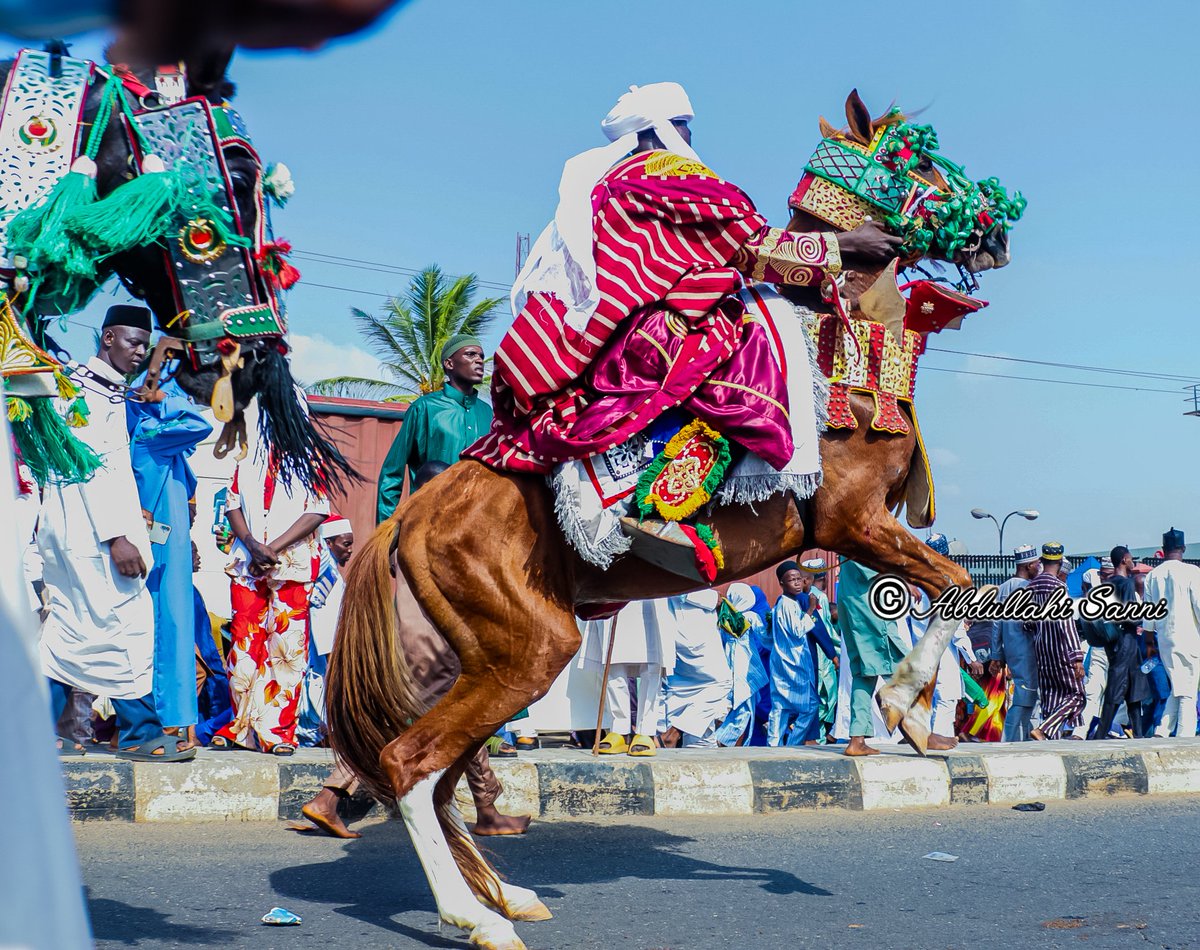
The Emir of Ilorin, Alh. Dr. Ibrahim Sulu-Gambari (CFR), led a majestic procession from the palace to the Baseball Stadium, Adeta, amid cheers from residents and indigenes.
📍 Ilorin Emirate Durbar ‘26
📅 May 28, 2026
📸 Abdullahi Sanni
#IlorinDurbar2026#IlorinEmirate
I know a Captain currently in the North-East. Every Sunday at 12:00 PM, he walks to the one spot in the camp where the signal is strong enough for a quick video call to his wife in Lagos.
He doesn't talk about the heat or the danger. He talks about his daughter’s grades and the Sunday meal he’s missing. He hides the fear so she can feel the strength. To all the families waiting for a Sunday call: you are the silent heroes of this war. We see your sacrifice.
DEFENCE MINISTER WARNS TERRORISTS AND THIER SYMPATHIZERS NATIONWIDE
“Now, our new strategy: A friend of a thief is a thief. Anybody who is doing any trading or providing any support to them, we will find you together and we will deal with you like bandits, like terrorists.”
@DejiAdesogan It’s painful that the games played by politicians are paid for with the lives of ordinary Nigerians,our soldiers, and loved ones. It’s hard to ignore the role of government complicity in why insurgency and banditry persist. But the hard truth is the government lacks the will.
When a reporter asked President Trump why he declared “Glory be to God” while American forces bombed Iran with impunity, he replied without hesitation:
“God supports the United States. God is good.”
When Iranian forces launched missiles and drones toward Qatar, they invoked the name of God and even inscribed Quranic verses on the missiles.
Qatar, in its official statement after successfully intercepting most the missiles, thanked God for His mercy in protecting civilians and sparing the country from greater harm.
Israeli pilots, before climbing into their fighter jets to strike Iranian political and military leaders killing thousands, paused to pray to God and read their Torahs.
American fighter pilots also pray, before carrying out the mission that resulted in the deaths of more than 160 primary-school children in Iranian city of Minab.
Oh wow. God! God is good, all the time.
MUST READ: Why Many Arab Rulers Want the US to Defeat Iran
In 1979, Ayatollah Ruhollah Khomeini led the Islamic Revolution that removed Mohammad Reza Pahlavi from power. Pahlavi was the Shah of Iran at the time, a title that literally means KING in Persian, the language spoken in Iran.
His dethroning ended centuries of monarchy in the country. Monarchy, the system of hereditary rule by a king and his family, had defined Iran’s governance for generations.
As the first Supreme Leader of the newly established Islamic Republic, Khomeini’s ambitions went far beyond Iran’s borders.
Deeply convinced that this hereditary system violated core Islamic principles, he sought to uproot monarchy across the entire Muslim world.
Almost immediately after the revolution succeeded, he denounced the rulers of Saudi Arabia, Jordan, Bahrain, Oman, Kuwait, Qatar, and the UAE as illegitimate tyrants, criticizing them both for maintaining hereditary rule and for aligning themselves with Western powers.
He openly called on ordinary citizens across the region to rise up and overthrow these regimes, which he termed oppressive and corrupt.
Khomeini’s dream was to create a political-Islam, a society where every aspect of life and government is based on divine Sharia law and Islamic jurisprudence.
He formulated a new system of government around Shia ideology, in which a theological scholar would rule the country as Supreme Leader with ultimate and final say over all matters.
He argued that Islam offers principles sufficient to govern all aspects of life and society, including all the issues facing the entire world at large.
He rejected democracy, secularism, and liberal values as incompatible with true Islam. Many Shia clerics at the time believed Khomeini had gone too far with this expansive political theory.
His aim was to abolish Western social, cultural, military, and financial influence not only in Iran but across the entire Muslim world, replacing it with Islamic principles.
According to this system, obeying the Supreme Leader is required at all times as a religious duty, and disobedience is seen as a sin.
This ambitious vision quickly extended beyond Iran’s borders, creating serious problems for the region as Khomeini began actively promoting the export of the Islamic Revolution.
This development posed a particular challenge to the Saudi royal family, which positions itself and is widely accepted as the leader of the Muslim world due to its custodianship of Islam’s two holiest sites in Mecca and Medina.
Iran’s Shia-centric revolutionary ideology differed fundamentally from the Sunni monarchies of Saudi Arabia and the other Gulf countries, creating an ideological clash.
Sunni-Arab countries, which prized stability and their long-standing alliances with the West, now saw Iran collectively as an existential threat to their way of life.
What truly broke the camel’s back was the shocking siege of the Grand Mosque in Mecca on November 20, 1979 the same year as the Iranian Revolution.
Hundreds of conservative Wahhabi militants, led by Juhayman al-Otaybi, disguised themselves as pilgrims, hid assault rifles, machine guns, and grenades under their clothes, then suddenly stormed the Kaaba and its surroundings.
They seized control of Islam’s holiest site, took thousands of worshippers hostage, and denounced the Saudi royal family as corrupt tyrants who had betrayed true Islam.
What truly deepened the division between Saudi Arabia and Iran was what followed the siege.
In the tense atmosphere created by the Grand Mosque takeover, Shia communities in the Eastern Province of Saudi Arabia launched large-scale protests.
These demonstrations were inspired by the Iranian Revolution and received open rhetorical support from Ayatollah Ruhollah Khomeini.
The protesters directly challenged the Saudi monarchy and called for an end to what they saw as oppressive rule by the House of Saud.
1/2
It’s hard to believe in God when you’re a Palestinian. For 78 years, these people have endured relentless oppression, constant bombardment, forced displacement, and the daily erasure of their humanity.
They’re starved, shot at, and buried under rubble while the world watches and does nothing. It’s as though God has abandoned them to their fate, ignoring all their prayers. Yet, despite all this unimaginable suffering, their faith remains unparalleled. They still pray. They still draw strength from God amid the hardships. Their resilience defies all logic.
While they endure so much pain, their oppressors continue living large building world-class economy, technology, and advanced infrastructure and forming alliances with consequential nations. Look at Israel, you will barely know it’s a country at war.
Iranian leaders are about to make another mistake if they believe President Trump’s statement to delay strikes on Iran’s critical power infrastructure for 5 days so as to negotiate.
Last year during negotiations, Iran was attacked. This year, in the middle of negotiations, the US came with war. This talk of 5 days delay to give room for negotiations is a ruse, and should be taken with a pinch of salt. It’s Trump's way of buying time.
Trump is positioning for a surprise attack again. He gave the Iranians a 5-day ultimatum, meanwhile US financial market is closing on Friday, just enough time for the market to react positively and ease oil price.
And on the day the ultimatum expires, the warship carrying thousands of US Marines is expected to arrive in the region for operations he earlier said will forcefully reopen the Strait of Hormuz.
Trump is not negotiating. He's buying time. I hope the Iranian leadership act accordingly.
@the_Lawrenz AI won’t take your job. Someone using AI better will. The new labour market will reward those who deliver quality faster. Efficiency and skill with AI will define who stays ahead.
@AkinOges@DefenseNigeria While we commend progress, the political will to end insurgency and invest heavily in security still isn’t enough. Nigeria is a key player in Africa, and that role can’t be effective without strong technology and a well-equipped military.