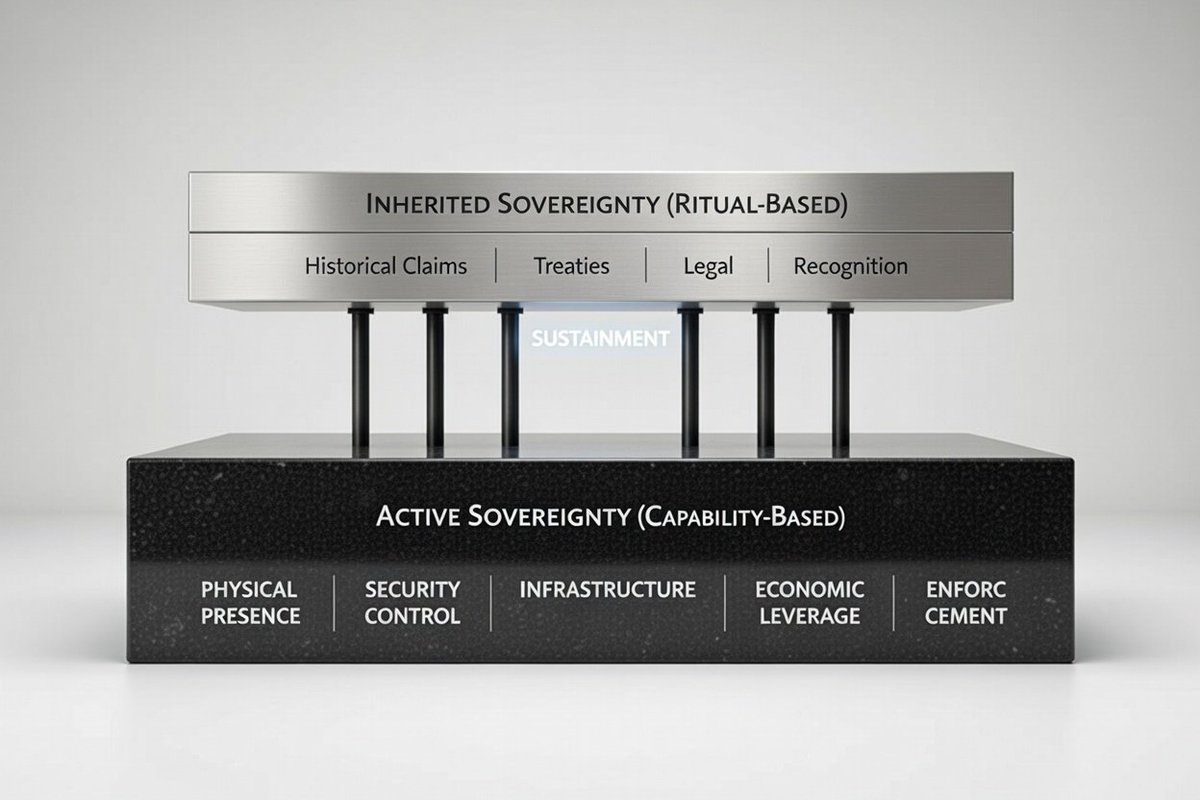
THE ERA OF THE MANAGER IS SHOWING ITS LIMITS. SOMETHING ELSE IS EMERGING.
For three decades, the West operated as though history had ended.
Sovereignty came to be treated as an inheritance, like a trust fund, rather than as a capability that must be continuously exercised. Borders and alliances were managed as settled frameworks instead of live strategic systems.
That assumption is now under strain.
The tension we are witnessing is not primarily ideological or partisan. It is structural. The modern order rests heavily on treaties, norms, and procedural legitimacy, but those layers only hold when anchored to active capability: physical presence, infrastructure, and the willingness to impose cost.
This is why the Greenland episode mattered.
When Donald Trump spoke about buying Greenland, the diplomatic class saw absurdity because they were reading a map of international law. The underlying logic was different. He was reading a map of exposed flanks.
The same pattern appears in reverse in the UK’s decision on the Chagos Islands. A state that relies on the memory of power while relinquishing its physical basis gradually becomes a tenant in its own history.
Stability without authorship is not harmony. It is containment.
I explore this shift in a long-form essay on why managerial governance is giving way to something more architectural, and why geography and sovereignty have returned to the centre of global leadership.
Full essay:
https://t.co/xHTqZdsv2y
#Geopolitics #GrandStrategy #StateCapacity #TheSovereignArchitect
🏆 NEW TOURNAMENT, SAME TEARS 😭
Ever since Messi lifted the gold in Qatar, the football world split into two groups:
• Those who enjoy greatness.
• The Scriptwriter Scouting Network.
Every single achievement for four years now has come with the same lazy, recycled complaints:
«"Rigged."
"FIFA agenda."
"Infantino's favorite child."»
Now fast-forward to right now in 2026.
Argentina pulls off a box-office, dramatic comeback against Egypt to march into the quarter-finals, and right on cue, the Wi-Fi in the crying rooms reconnects.
«"Rigged!"
"Scripted!"»
There's actually a psychological term for this level of delusion.
The Illusory Truth Effect.
It's when people hear a lie repeated so many times that their brain starts treating it as a fact. They don't actually have proof; they just have an echo chamber.
And honestly, the strategy is clever.
They aren't trying to win the debate; they just want to tire you out. They want you to get so sick of defending the obvious that you just stay quiet.
But we see you, and we are not tired.
The irony is what makes me laugh the loudest.
Between 2014 and 2016, Messi loses three major international finals in a row.
Where was the FIFA scriptwriter then?
On annual leave? 🤔
In 2018, Argentina gets bounced by France in the Round of 16.
Did FIFA forget to pay the electric bill for the script? ⚡😂
And look at the 2022 Final itself.
If FIFA rigged that match for Messi, giving France two penalties in a World Cup Final and forcing Emi Martínez to make a literal miracle save in the 123rd minute is the worst rigging job in human history.
But the moment he wins?
«"Ah, it's a setup."»
If he loses, he's a bottler.
If he wins, it's a conspiracy.
At this point, the conspiracy isn't on the pitch.
It's a coping mechanism for fans who cannot accept that the guy they spent a decade trying to diminish just keeps renting space in their heads.
To my fellow Messi fans:
Let them shout into the void.
History doesn't care who cried the loudest on X or WhatsApp.
History only remembers who won.
🤫🐐
The Story of Pure Superiority: Why Messi's Injury Stats Cement His GOAT Status
When evaluating the greatest football player of all time, casual observers often look strictly at the final scoreboard and the raw accumulation of career numbers. Cristiano Ronaldo has undeniably scored more total career goals and played more total matches, establishing a reputation as a true monument to physical conditioning and longevity. However, viewing these statistics through the lens of physical adversity transforms the narrative from a simple story of accumulation into a profound testament to Lionel Messi's unmatched efficiency.
To understand the reality of their physical journeys is to recognize the difference between mere durability and absolute superiority. Cristiano Ronaldo has been incredibly fortunate and disciplined with his body, missing only around 85 matches to injury over more than two decades in professional football. This elite physical resilience allowed him to stay on the pitch consistently, naturally resulting in a higher volume of total goals. Lionel Messi had to navigate a much more arduous physical path by constantly battling his own biology and missing over 150 matches due to various injuries.
Every time an athlete suffers a physical setback, they lose vital rhythm, match fitness, and the psychological edge required to compete at the highest level. For Messi to repeatedly break down, endure months of grueling rehabilitation, and step back onto the pitch to instantly dominate without missing a beat requires a level of genius that transcends normal athletic capability. He did not just play against world class opponents because he also had to conquer constant physical limitations to remain at the pinnacle of the sport.
Because Ronaldo stayed healthier and participated in significantly more games, his raw totals are naturally higher, but volume does not necessarily equal a higher quality of play. This is where the goals per match average clarifies the debate and highlights what true superiority looks like. Despite missing roughly 65 more matches than his contemporary due to medical issues, Messi maintains a clearly superior goals per game ratio throughout his career.
When you select any random match from their overlapping eras, the statistics prove that Messi is consistently more lethal and more likely to impact the scoreboard. Ronaldo is the ultimate footballing machine who possesses the durability needed to reach incredible milestones over an uninterrupted timeline.
Lionel Messi represents the ultimate footballing force who achieved greater efficiency and a higher peak of performance in significantly less time. The underlying math paints an undeniable picture of a highly durable player eclipsed by a definitively superior one who simply did much more with less.
The Secret Financial Playbooks of the World Cup: Morocco's Moral High Ground and Ghana's Greedy Patriots?
Behind the glamour of international football, a parallel economic narrative plays out in team hotels and federation offices. The way different countries choose to incentivize their national squads reveals a lot about their internal politics and underlying sports philosophy, proving that a World Cup budget is rarely just about the players.
The Ghana Football Association has traditionally favored a heavily front-loaded motivation model. Ghana's Sports Minister, Kofi Adams, recently confirmed that each player receives a substantial 100,000 USD appearance fee just for making the final World Cup roster. The players also receive a 150 USD daily per diem on the road alongside a 5,000 USD winning bonus per match.
However, this front-loaded model historically extended far beyond the pitch. A massive public debate erupted after the sports ministry exposed a structure where Black Stars management committee members and administrative handlers were quietly out-earning the athletes, taking home a 10,000 USD winning bonus per match. The ministry stepped in to slash the national team budget by 700,000 USD to protect public funds, explicitly scrapping these per-game administrative payouts and forcing committee officials to wait for performance incentives at the end of a successful tournament cycle.
The Royal Moroccan Football Federation approaches player and boardroom finances with a different corporate mindset. Morocco avoids massive upfront guarantees and keeps administrative overhead tightly regulated. Their baseline structure relies on modest daily camp allowances and small match appearance fees, meaning the real financial windfall is strictly locked behind tournament progression. Reaching a World Cup Final triggers a twenty to thirty percent share of FIFA's multi-million dollar association payout, scaling individual player earnings up to 626,000 USD.
The most striking contrast in this economic puzzle is what actually happens to the money once it is distributed. Ghana continues to wrestle with the legacy of heavily compensated committee structures and ministry overhead. On the other side of the continent, Morocco's elite multi-millionaire superstars operate on an entirely altruistic wavelength.
Players like Hakim Ziyech and Achraf Hakimi routinely waive their entire national team earnings. Every single dollar of their base federation allowances and their massive World Cup performance bonuses is routed directly into Moroccan cancer hospitals, amateur athletic clubs, and low-income families. When the players themselves treat the national team strictly as a non-profit charity engine, it leaves virtually no political cover for federation officials or politicians to siphon off tournament funds.
These two systems show how different cultures manage the business of football. One relies on heavy, upfront state-funded payouts that require constant government intervention to keep administrative bloat in check. The other relies on a strict, merit-based corporate pipeline where the millions generated on the pitch are either reinvested into infrastructure or sent back into the community. It is a boardroom dynamic that shapes the future of the African game just as much as the action on the grass.
This is one of many nice stories that never happened.. 🤣 It's a brilliant edit and definitely makes for a great underdog tale, but just to keep our football history straight, it is actually a total myth!
Here is the quick breakdown of why this front page is a fake:
The Real Head-to-Head: England and Ghana (which was called the Gold Coast back then) have only ever played each other once in senior international history. That match took place decades later, in 2011 at Wembley Stadium, and it ended in a 1-1 draw.
An Impossible Timeline: The article credits a goal to Wilberforce Mfum. While Mfum is an absolute Ghanaian football legend, he was born in 1936. If this match happened in May 1950, he would have been a 13-year-old schoolboy! His real prime with the national team came in the 1960s, including the 1963 Africa Cup of Nations triumph.
Geographical Mix-up: The clipping says the game was played at Ninian Park in Cardiff. Ninian Park was in Wales, home of Cardiff City. It makes no sense for an England selection to host a home match deep in Welsh territory.
The Real Tour: There is a cool nugget of truth that inspired this. The Gold Coast team did tour the UK, but in 1951, not 1950, as part of the Festival of Britain. They played around 10 matches, famously barefoot, and won a lot of hearts. But they faced English amateur sides and regional selections, never the official England team.
Massive props to whoever made this because it looks incredibly authentic and stirred up some great football nostalgia, but it belongs in the history books of internet memes instead of real life! 🇬🇭🏴
Unpopular opinion: the day Messi retires, we're going to find out how much of the "football economy" was actually just the Messi economy.
I'm not talking about ticket sales here, I mean the whole content machine sitting on top of the game. Think about the podcasters, the pundits, the YouTube channels, the TikTok pages, all of them feeding off one man. For nearly 20 years if you needed views you just had to say his name and the engagement was basically guaranteed. He stopped being a player ages ago, he's become an algorithm.
Football itself will carry on fine, obviously, but here's the thing people are missing. Messi and Ronaldo were the last two superstars who got made famous by old-school telly and then cashed in all over again by the internet era, both at the same time, and that combination is finished. Whoever comes next is walking into a game that's already split into a thousand pieces before they've even arrived.
So the real question was never about football surviving him, because it will. What nobody's asking is whether the entire industry feeding off the game has quietly gotten hooked on a kind of player it can't actually produce anymore, and half the people eating off it haven't clocked it yet.
I know this one will pain some neighbours…
but Ghana’s 2026 World Cup path is actually beautiful to look at 🤭🇬🇭🔥
Counters. Set pieces. Kudus magic.
Tell me this team isn’t capable of shocking the world 👇🏾🏆
@FIFAWorldCup@GhanaBlackstars
@OtiAdjei@garyalsmith n @Fentuo_
Quick question ahead of the world cup. Who are your top 5 playmakers of all times that have come from Ghana or played for national teams.
My top 5 are:
1. Charles Taylor
2. Odartey Lamptey
3. Abedi Pele
4. Shamo Quaye
5. Kwadwo Asamoah
It really comes down to first principles. If you want your agenda or vision to be considered among a pool of competing interests, you have to be at the table where the decisions are actually made. That requires a seat in the room, a deep strategic knowledge of the context, and a community with the wealth, political capital, Institutional wherewithal and influence to put its money where its mouth is.
The hard question we need to confront is this: where are the Fante voices and heavyweights across the full spectrum of power and wealth?
Why aren’t the Fante elites in business, tech, and policy aggressively pushing to secure our spot in time and space? Inclusion in a national AI initiative isn't just a moral appeal and we cant protest on social media protest make it happen..You can't outsource the preservation of your heritage.
If we don't fund and fight for our own inclusion, no one else will. What you are advocating is the outcome of organized power and strategic investment. If our own leaders and diaspora aren't willing to build that leverage and fund our own datasets, we will always be left out of the digital future.
You are spot on. "Ethic" is often the moral casing around power. But casing is not the core.
The Fabian Society is the perfect diagnostic. They didn’t seize power with force. They captured institutions with a "reformist ethic" like Justice and Progress. They built out the Top Block (Ritual and Narrative) while the Bottom Block (Active Capability) eroded.
The Managerial mistake was believing that moral narratives could replace physical reality.
In eras of plenty, you can confuse narrative for power. In eras of pressure, capability reasserts itself.
I break down this exact shift from "Managerial Ethics" to "Architectural Reality" here:
https://t.co/ZJCUHBqn0f
Ferguson is right. This moment isn’t an anomaly in American history. It is a recurrence. One that unsettles those who believe the post-Cold War map is fixed and final.
What we are witnessing isn’t just political disruption. It is a deeper condition I call Map Derangement Syndrome. The inability to grasp that maps can still change, that power still moves, and that norms only hold when backed by real capability.
Trump does not come from the Managerial tradition. He emerges from an older logic. One that sees sovereignty not as a ritual status, but as something maintained through presence and leverage.
To those raised in the post-1990 order, this return to fundamentals feels unthinkable. But from the vantage of history, it isn't madness. It is a correction.
When you mistake inertia for stability, anyone who moves looks like a threat.
I unpack this generational shift between the Managers who inherited the map and the Architects willing to redraw it in full here:
https://t.co/ZJCUHBqn0f
The Russian press sees exactly what the Western "Managerial Class" refuses to admit.
The Managerial mind cannot compute a world where geography and power matter more than diplomatic norms. Russia finds it "pleasurable" to watch because they are seeing the West choose sentiment over strategy.
If Europe is willing to risk NATO to keep a territory it cannot defend, then the alliance is already broken. Trump is just the one pointing out the crack.
It is the ultimate Managerial failure: choosing the ritual of ownership (keeping a 500-year-old paper claim) over the reality of security.
The "Old World" treats sovereignty as a trophy in a cabinet, not a flank that must be defended.
The Architect audits the building; the Manager just polishes the brass while the foundation cracks.
I explain this clash between the Old World and the New Reality here:
https://t.co/ZJCUHBqn0f
I personally don't condone threats. But to answer your question: Yes, they were used.
In 1917, the US warned Denmark that if they didn’t sell the Danish West Indies (now US Virgin Islands), America might seize them to prevent Germany from doing so.
That wasn’t bluster but a geopolitical necessity. Diplomacy has always been the velvet glove over the iron fist.
The real shock today is that force-backed realism is returning after decades of sentiment-led policy.
https://t.co/ZJCUHBqn0f
I agree... Also I think it wasn't just about negotiation skill. It was about the mindset.
Truman (1946) and others were "Managers" who ultimately backed down when the diplomatic protocol said "stop." They prioritized the process over the result.
Trump is acting as a "Sovereign Architect." He doesn't view the map as something you ask permission to edit. He views it as something you secure by necessity.
The difference isn't just the deal. It is that he refuses to accept a "No" that endangers national security.
https://t.co/ZJCUHBqn0f