Did 5 years residency and still dont understand MRI physics. Old enough to have bought aol and yahoo stocks via dial up internet on their opening days.
Depends
There are 2-3 big blockers (persistent agents can't work without ingesting/monitoring ur data (ZDR fundamentally can't exist in this scenario), and it will be super expensive (favorable for incumbent cybersec companies)
Always-on defence agents are certainly coming
Cybersecurity will finally move from continuous monitoring to continuous action (without a human in the loop)
We will see Hugging Face-style attacks in the future where a swarm of agents/AI (100s of thousands or maybe millions) are continuously attacking ur infra and also get smarter with each failed attempt. Current cybersecurity systems can't defend against it. U need a swarm of defence agents (favorable for model labs)
I still don't understand/fathom how AI models that can learn continually will exist in an enterprise setting. The customers will be literally paying model labs to teach their AI models everything about their business.
SILC is the only pure play hardware pics and shovels for cybersecurity with $FTNT $NTSK $AVGO $CSCO $DELL etc, etc, as customers
With a edge ai CustomNIC biz deals w/ hyperscalers just starting to grow
Very uniquely positioned and favorable evaluation building upon multiple Qs of growth
I have seen a clear trend emerge from this year's FMS and Hot Chips conference
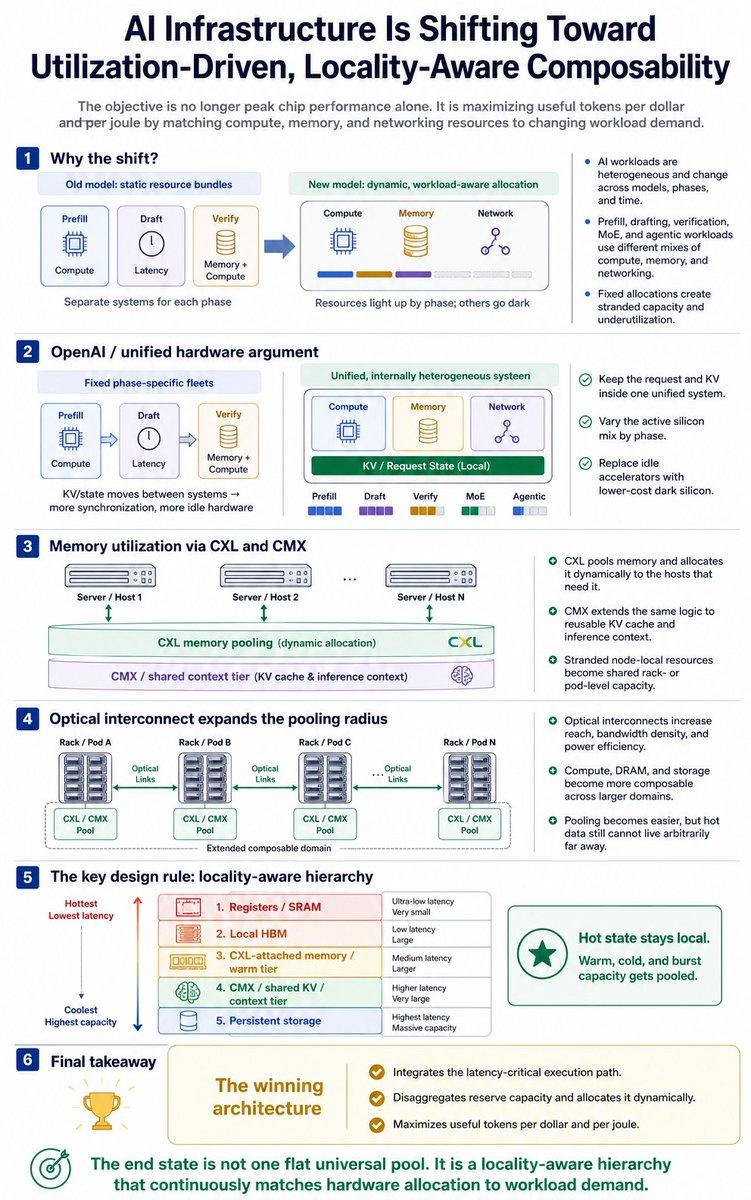
Due to CAPEX per GW going up (especially due to memory), CSPs/XPU designers are focusing on improving the utilization of their compute stack by any means possible.
CXL adoption will increase significantly from late 2027/28 (so that memory can be pooled together and dynamically allocated to improve utilization). Nvidia has now introduced scale-in (although u need optical interconnects to make full use of it)
Lots of money to be made
"straight to A16, TSMC's upgraded version of its 2nm process, and will also raise the share of SoIC 3D stacking, with custom HBM and CPO expected to be combined on top of that."
cHBM & CPO 👀👀👀
$LITE Monster print.
> $1.01B rev, +24.5% QoQ / +109% YoY
> Q1 guide of $1.225B-$1.275B
> $1.25B midpoint = another ~24% QoQ growth
> Operating margins: 32.2% → 36.6% → ~40% guide
> EPS: $3.23 → $4.20 Q1 guide midpoint
> OCS + 1.6T are only beginning to layer in
> CPO laser demand increasing
> First ELS module order
> Broad NPO engagements
ELS has now moved from an opportunity to an actual order.
And NPO gives them a path to start monetizing optical scale-up before full scale-up CPO really ramps.
They are already guiding to a $5B annualized revenue run rate and 40% operating margins while that opportunity is still early.
At the Q1 midpoint, they are already at 62.5% of the $2B quarterly revenue target.
The stock is barely reacting so far.
My guess is the massive run into earnings is a big part of that. Q4 revenue itself was also around the top of guide rather than a huge beat, and the market probably wants Hurlston to explain what is driving that monster $1.25B next-quarter guide.
The giant GAAP loss headline may also create some confusion, but that was driven by the one-time non-cash convertible debt accounting charge.
The call is going to be important.
But fundamentally, this was extremely strong.
We are still very early stages. 2027 is going to be wild.
I think the market ultimately has no choice but to go sell memory, long optical in the "short term." Actually, some hedge funds already seem to have this position on.
There are three main reasons.
1. With Korean leveraged ETFs effectively dead, LPs are in a redemption rush, which could bring out additional sell on flow.
2. Nvidia is nerfing Rubin Ultra's HBM and responding with optics, tying multiple racks together, so that even if Rubin Ultra's per rack performance is not superior to Rubin, at the cluster level optics let the Rubin Ultra cluster hold an edge over the Rubin cluster. This holds even if Rubin Ultra's HBM nerf is a supply problem rather than a demand problem.
3. Consensus is forming that memory prices will peak within the next two quarters.
Medium to long term I am still a memory bull, but short term I am somewhat bearish on memory. I currently have no memory position.
They don't have enough inference capacity to fulfil demand, so they are trying to raise prices and destroy demand
One of the reasons why I'm not worried about closed-source lab revenue is that they or their investors (hyperscalers like Google, Amazon, Microsoft) control the majority of global inference capacity
DeepSeek, Kimi, Zhipu (have less than 400MW of combined compute capacity) can't challenge Ant/OAI (have over 6GW of compute)
The real threat for Ant/OAI is a company like Meta/xAI (have 3-4 GW of compute) starting a price war in the near term
The long-term threat is on-prem adoption of open models with enterprises setting up mini clusters (Jensen wants this to happen as it reduces customer concentration risk)
Indium Phosphide (InP) LASERs are suddenly catching everyone's interest since it suddenly became one of the more strategic components in computing. As optical connectivity moves ever closer to the package, every optical engine and laser source inevitably runs on InP LASERs. But supply isn't keeping up with demand, particularly for Continuous Wave (CW) Distributed Feedback (DFB) LASERs which enable near-package optical connectivity. (1/2)🧵
I know the bears don't want to hear this. But Warsh is giving you a "Goldilock" setup here:
1) Framing higher yields is a function of resilient economy, not structural issues.
2) Market has already done the job that he was going to do with higher yields.
Also, this 4:1 exchange ratio is only for training (FLOPS)
On a memory bandwidth basis, this falls to 2:1 (8TB/s vs 4 TB/s)
But since the scale-up world size is so big for Huawei, u can have some crazy sharding strategies
I suspect that the decode throughput per GPU difference between Ascend SuperPOD and GB300 will be in the 1.3x-1.7x range
$GOOGL upgrade 2026 capex guidance to $195B-$205B.
Up from previous estimate of $180B-$190B.
"We expect our capex to increase significantly in 2027"
$300B capex in 2027...?
$sive $sivef The CEO purchased shares again on the open market yesterday (7/21). And it’s almost 3X as much as he did on the open market two weeks prior. What’s the old adage again? Insiders sell for multiple reasons. And insiders buy for one reason.