Pleased to share our new review on translational readthrough to restore tumor suppressor activity. We cover key studies and where the field stands today. Check it out here!
https://t.co/UZIDdVW76K
@Caroliten2@biobizkaia
How much biology can we recover from single-cell latent representations? 🧬
Latent spaces have become the backbone of modern single-cell analysis. They power atlas integration, foundation models, and increasingly perturbation prediction and Virtual Cell approaches.
Yet there is a surprisingly basic question that has received little attention:
👉 How well can we reconstruct gene expression from these latent representations?
In our new work, we introduce ReconEval, a benchmark for gene expression reconstruction across more than 100 million cells. We systematically evaluate three settings:
🔹 End-to-end reconstruction (PCA, autoencoders, VAEs)
🔹 Foundation model reconstruction (a new benchmark task for single-cell foundation models, asking how much gene-level information can be recovered from pretrained embeddings)
🔹 Latent shift reconstruction (evaluating reconstruction after perturbation prediction models operate in latent space)
A few takeaways:
📊 Autoencoders (not VAEs) achieve the strongest stand-alone reconstruction performance. This is perhaps not surprising, as reconstruction is exactly their training objective.
🧠 Foundation model embeddings retain substantial recoverable gene-level information, although performance depends strongly on the decoder and pretraining strategy.
🔬 The optimal latent representation depends on the downstream task. What works best for reconstruction is not necessarily what works best after perturbation prediction.
As the field moves toward increasingly sophisticated Virtual Cell models, reconstruction deserves more attention as an evaluation axis ie another task to evaluate. Ultimately, biological interpretation happens in gene expression space, not in latent coordinates.
Congratulations to Xiaotong Fu for driving this project and to all collaborators involved in making this benchmark possible. 👏
📄 Preprint: https://t.co/cVZtV2pVZ3
💻 Code: https://t.co/HfauGyHDIF
#SingleCell #ComputationalBiology #VirtualCell
Finally out in @Cellcellpress!
Proteins with long intrinsically disordered regions (IDRs) are prone to misfolding during protein synthesis.
This is prevented by mRNA 3′UTRs that act as mRNA-based IDR chaperones.
https://t.co/Pa4bWYhOMe
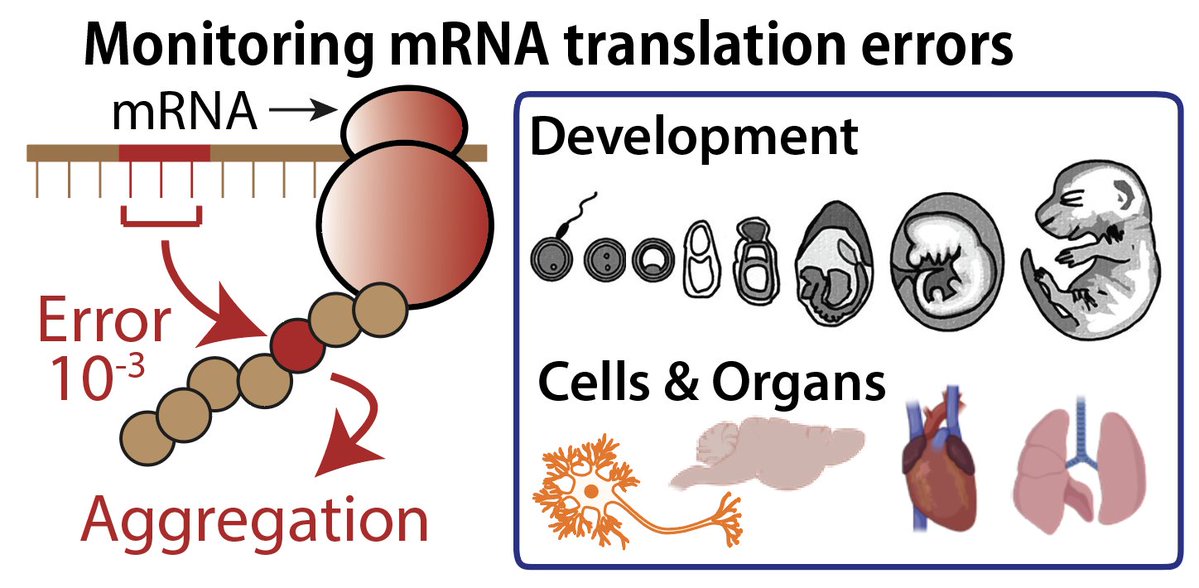
Protein synthesis is not equally accurate across organs.
Excited to share our new preprint:
https://t.co/SKoTVsPspZ
We developed a new mouse model to quantitatively monitor translation errors and uncovered the spatiotemporal dynamics of the “quality” of protein synthesis.
🔴@Gob_eus e @IBMResearch inauguran en Donostia el primer IBM Quantum System Two de Europa💻El Centro de Computación Cuántica IBM-Euskadi ofrece ya a sus miembros acceso a uno de los ordenadores cuánticos más potentes del mundo. El ordenador se ubicará en el edificio @Ikerbasque
our latest work shows sucrase (and not isomaltase) drives genetic risk of #carbohydrate maldigestion. is sugar a culprit causing bowel symptoms?
potential to design personalised carb-focused diets for #IBS prevention and treatment
https://t.co/kblUf4Hwoc
Happy to share our latest work in @AGA_Gastro
We link sucrase domain genetic variation with GI symptom burden, IBS and dislike for sucrose-rich foods, which points to the digestion of sucrose, and not other carbs digested by this and other enzymes, as the causative agent 🧬
🔥3yr #postdoc position available in my lab for a computational biologist to lead research in #genetics, #genomics and #metagenomics of gastrointestinal diseases🔥
want to know more?
https://t.co/2emUlPHbmq
https://t.co/vU5psFAcSz
https://t.co/w58eaJVe9Z
nice piece about work in @elcorreo_com
gracias por destacar nuestra investigación!
El deseo irrefrenable por lo dulce también es innato y se hereda
https://t.co/fps7WyBkDu
our latest work is out, with a twist:
sucrase-isomaltase gene not only relevant to #IBS risk but also to dietary intake and preference of sucrose-rich foods
potential for personalising prevention and treatment of metabolic and digestive diseases
https://t.co/dOHiMHFsVX
our latest work is out, with a twist:
sucrase-isomaltase gene not only relevant to #IBS risk but also to dietary intake and preference of sucrose-rich foods
potential for personalising prevention and treatment of metabolic and digestive diseases
https://t.co/dOHiMHFsVX
🎯🔬It is my immense pleasure to share that we have published this collaborative work on the impact on B7-H3 immune checkpoint protein in metastatic renal cancer 🔬🎯
Full article: https://t.co/YFeXpuVBPQ
🔬✨ En la charla sobre HIGH-PERFORMANCE BIOINFORMATICS EN SCAYLE! 🚀💻 @CrisEstebanB ha contado cómo se puede aprovechar la aceleración #GPU para un análisis genómico avanzado. 🧬🔍 ¡Únete a nosotros y descubre el futuro de la #bioinformática! 🌟 #Genómica#congresosebibc2024
Our latest work is out @AGA_CGH
Functional variation in human CAZyme genes in relation to the efficacy of a carbohydrate-restricted diet in #IBS patients
Potential for personalising dietary approaches based on hCAZyme genotype
https://t.co/Db70woeADO