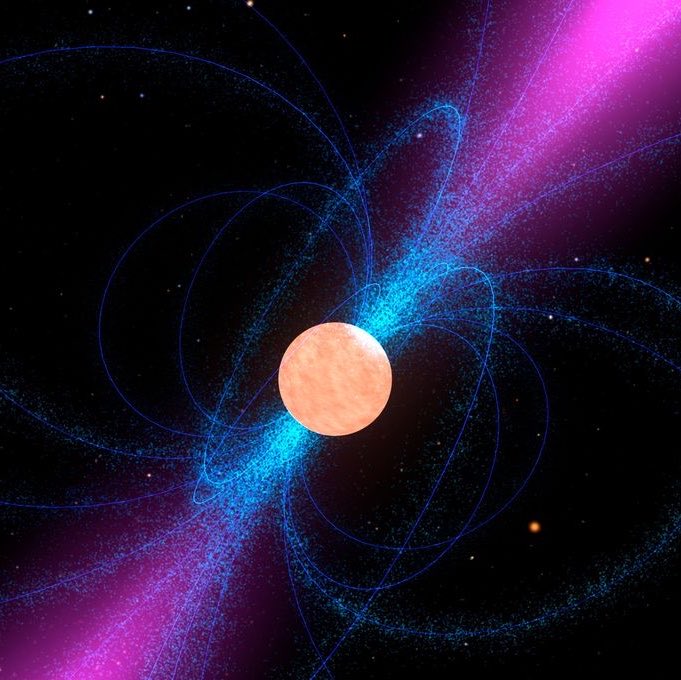
Jocelyn Bell failed the 11-plus, the exam that decided where British children went to school at 11. Her parents sent her to a Quaker boarding school in York instead. At 24 she was a PhD student at Cambridge, checking up to 29 metres of paper chart from a radio telescope by hand every night.
On 28 November 1967 she spotted a bit of "scruff" on one of the charts. The signal had been in the data since August, and it took about three months to find it. It pulsed every 1.3373 seconds and was briefly labelled LGM-1, for Little Green Man 1.
The 1974 Nobel Prize in Physics for the pulsar work went to her supervisor Antony Hewish and Martin Ryle. In 2018 she won a 3 million dollar Breakthrough Prize and gave all of it to fund physics students who are women, refugees or from under-represented groups.
She failed an exam at 11. At 24 she discovered a new kind of star.
Personality questionnaires produce patterns of correlated responses. Researchers can study those patterns at several levels, from specific tendencies to broader statistical groupings.
A network model connects traits according to relationships estimated from data. Grouping methods then reveal possible layers of organization within those relationships.
The resulting hierarchy depends on the questionnaire, sample and analysis.
A prediction error tells a model how far its output missed the target. Training also needs to know how changing each parameter would affect that error.
Backpropagation applies the chain rule through the computation, carrying sensitivities backward from the loss. An optimizer then uses those gradients to choose parameter updates.
In this example, one gradient step lowers the loss from 2 to 0.72. That improvement depends on the step size. Larger updates can overshoot, and lower training loss alone does not establish good generalization.
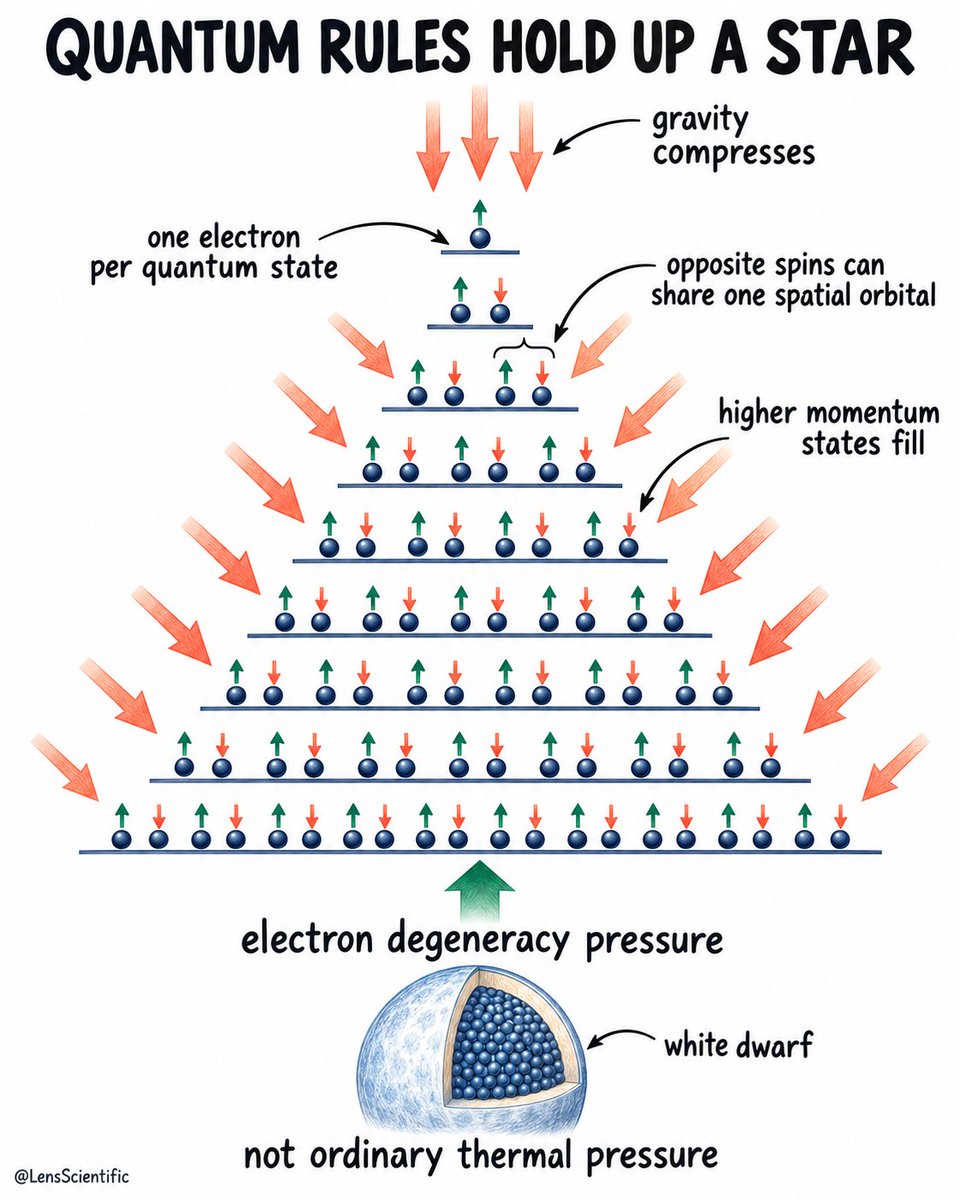
A white dwarf no longer has fusion providing the pressure that supports an ordinary star. It survives because electrons cannot all be compressed into the same complete quantum state.
As gravity squeezes the star, low-momentum states fill and additional electrons must occupy progressively higher-momentum states. That rising momentum produces electron degeneracy pressure. It is an equation-of-state effect, not a classical repulsive force.
Because the pressure is quantum mechanical rather than mainly thermal, it remains even as the white dwarf cools. Above the Chandrasekhar mass, electron degeneracy pressure cannot maintain equilibrium.
You probably know Einstein as a mind that never switched off.
What you probably don’t know is that he slept close to 10 hours a day, and he treated that sleep as essential to his health. On top of that, he took short naps in the daytime, sometimes more than once a day, each lasting just a few minutes. Einstein believed they restored his mental energy and gave him a fresh angle on hard scientific problems.
The man who reshaped physics did it well rested. So when it’s time for a nap and you think you are being lazy, just remind yourself of this.
A neutrino created with one flavor can later be detected as another. The change is not a classical particle switching identities at a definite point. It is a quantum interference effect.
Each flavor state is a mixture of mass states. Those components propagate with slightly different phases, so their combination changes with distance and energy. The probabilities of detecting electron, muon, or tau flavor therefore oscillate.
This behavior requires differences between neutrino masses. Its discovery showed that the minimal Standard Model description of massless neutrinos was incomplete.
Every atom's chemistry is set by the shapes of these clouds.
Each panel slices a hydrogen wave function in a plane through the nucleus. Red and blue mark opposite signs of the wave function, and the nodes between them are where the electron is never found. An orbital with quantum numbers n and l has n − l − 1 spherical nodes and l angular nodes, so the 3s has two spherical nodes and the 4f has three angular ones.
The 1s orbit peaks at the Bohr radius, 52.9 pm.
One hand covers four different laws. The cross product a × b points along the thumb when the fingers sweep from a to b, and its length is |a||b| sin θ.
The same rule gives the force on a moving charge, the circling field around a current, and the field inside a coil. A proton at 10^5 m/s in a 0.1 T field feels 1.6 × 10^-15 N and circles with a radius of 1.04 cm. A negative charge turns the other way, because the sign of q flips the force.
Swap the order of a cross product and the answer reverses.
The Navier-Stokes equations are Newton's second law written for a fluid: inertia on one side, pressure, viscosity and gravity on the other.
Pipe flow is one of the few exact solutions. For water in a 1 mm tube under 100 Pa over 0.1 m, the speed on the axis is 0.25 m/s and the flow is 0.39 mL/s. Real flows at high Reynolds number turn turbulent, and nobody has proved that smooth solutions always exist in 3D.
That proof carries a one million dollar prize from the Clay Institute.
One day, when humanity conquers the stars, we’ll probably still be using these symbols!
Every constant in this table is a number the universe fixed, and none of them can be derived from the others.
The fine-structure constant α = 1/137.036 sets how strongly light and matter interact. Change it by a few percent and atoms, stars and chemistry would not work as they do. The cosmological constant Λ is the smallest number here, about 10^-52 per square metre, and it drives the accelerating expansion of the universe.
Why these values and not others is still unanswered.
A radar echo returning after 200 microseconds has travelled about 60 kilometres. The target is only 30 kilometres away because the signal makes a round trip.
Range comes from timing that delay. The radio wave oscillates many times inside a pulse, while the pulse repetition rate describes how often new pulses are sent.
Those are separate quantities. Pulse duration affects the ability to distinguish nearby targets, while pulse spacing helps determine how far echoes can be assigned unambiguously.
Noether proved in 1918 that every smooth symmetry of the laws of motion hides a conserved quantity.
Shift time and energy is conserved. Shift space and momentum is conserved. Rotate space and angular momentum is conserved. Before her, these were separate facts found by experiment.
She found it at Göttingen while working on a puzzle in general relativity, where energy conservation looked broken.
These equations describe different mechanisms, so their assumptions matter as much as their symbols. A magnetic force turns a moving charge, while Bernoulli relates pressure, speed, and height in an ideal flow.
Brewster’s angle selects a reflection geometry with polarized reflected light. Bragg’s condition selects wavelengths and angles that reinforce after crystal scattering.
Their applications range from particle steering and flow measurement to glare reduction and determining atomic structure.
On a curved surface, the directions used to describe a vector can change from point to point. Comparing component values alone can therefore suggest a change that comes from the basis itself.
A connection accounts for that changing basis. The covariant derivative combines it with ordinary differentiation to describe geometric change consistently.
Together with the metric, which measures lengths and angles, these tools let general relativity express physical laws across curved spacetime.
You probably know Ramanujan as the self-taught genius who filled notebooks with nearly 4,000 theorems.
What you probably don't know is that he claimed a goddess gave him the math. He said Namagiri, a Hindu deity, wrote equations on his tongue in dreams, and he woke up and scribbled them down. He often gave results with no proofs, because to him they were simply revealed.
In 1913 he mailed some of those results to G. H. Hardy at Cambridge. Hardy later said the formulas "must be true, because, if they were not true, no one would have had the imagination to invent them."
Hardy rated mathematicians out of 100 and gave himself 25. He gave Ramanujan 100.
Then came the taxi. Hardy visited him in hospital and mentioned his cab number, 1729, calling it dull. Ramanujan replied instantly that it is the smallest number expressible as the sum of two cubes in two different ways.
His last letter, written in 1920 a few months before he died at 32, described "mock theta functions." They sat unexplained for 80 years, until 2002 when Sander Zwegers explained them. Physicists now use them to count the quantum states of black holes.
A man with no degree and no proofs wrote down math that black holes still obey.
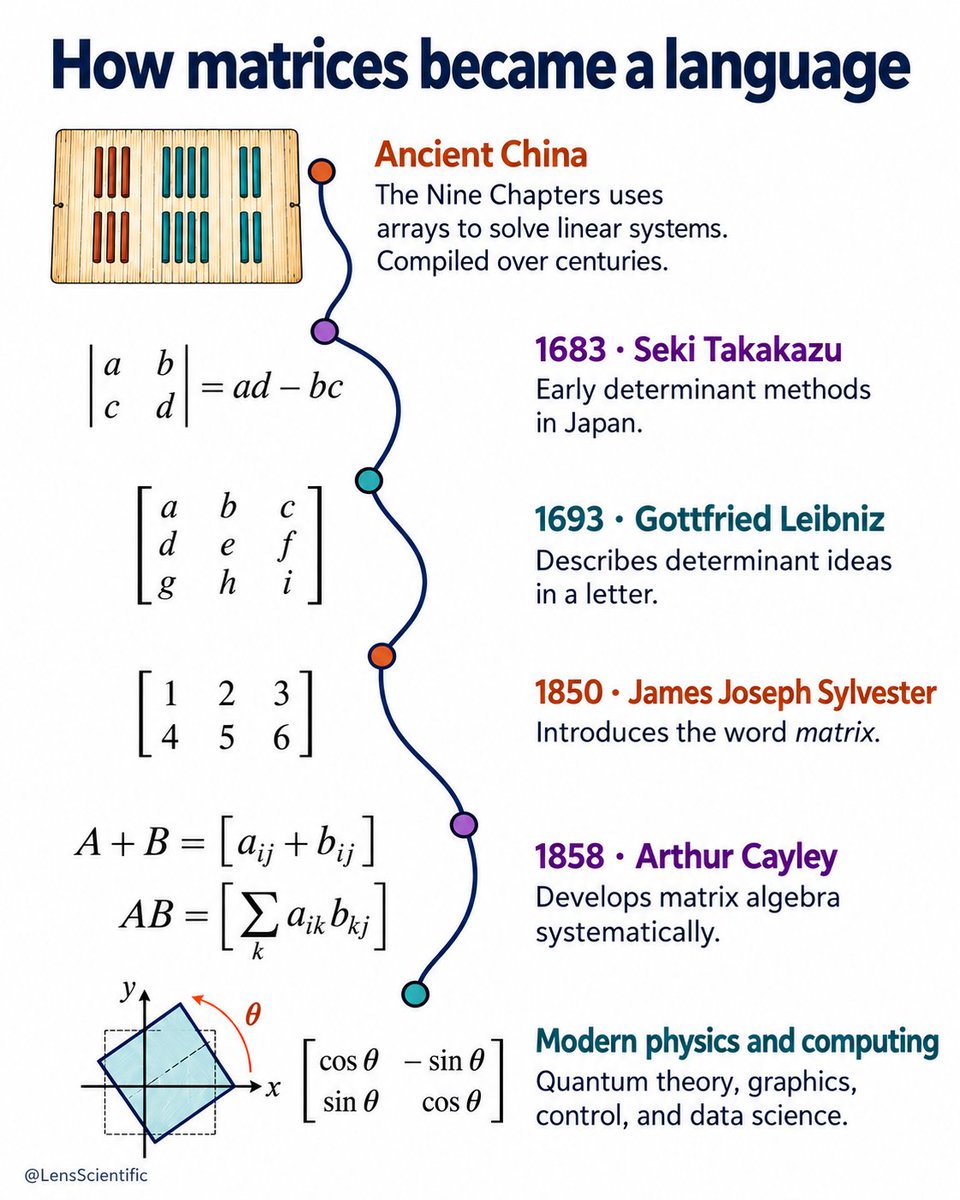
Matrices existed as useful arrangements of numbers long before they became objects of algebra. Early methods focused on solving simultaneous equations.
Determinants developed first, while Sylvester supplied the word matrix and Cayley helped establish rules for manipulating entire arrays.
That shift made matrices a language for transformations. Today, the same framework describes rotations, quantum states, interacting systems, and the calculations behind modern machine learning.
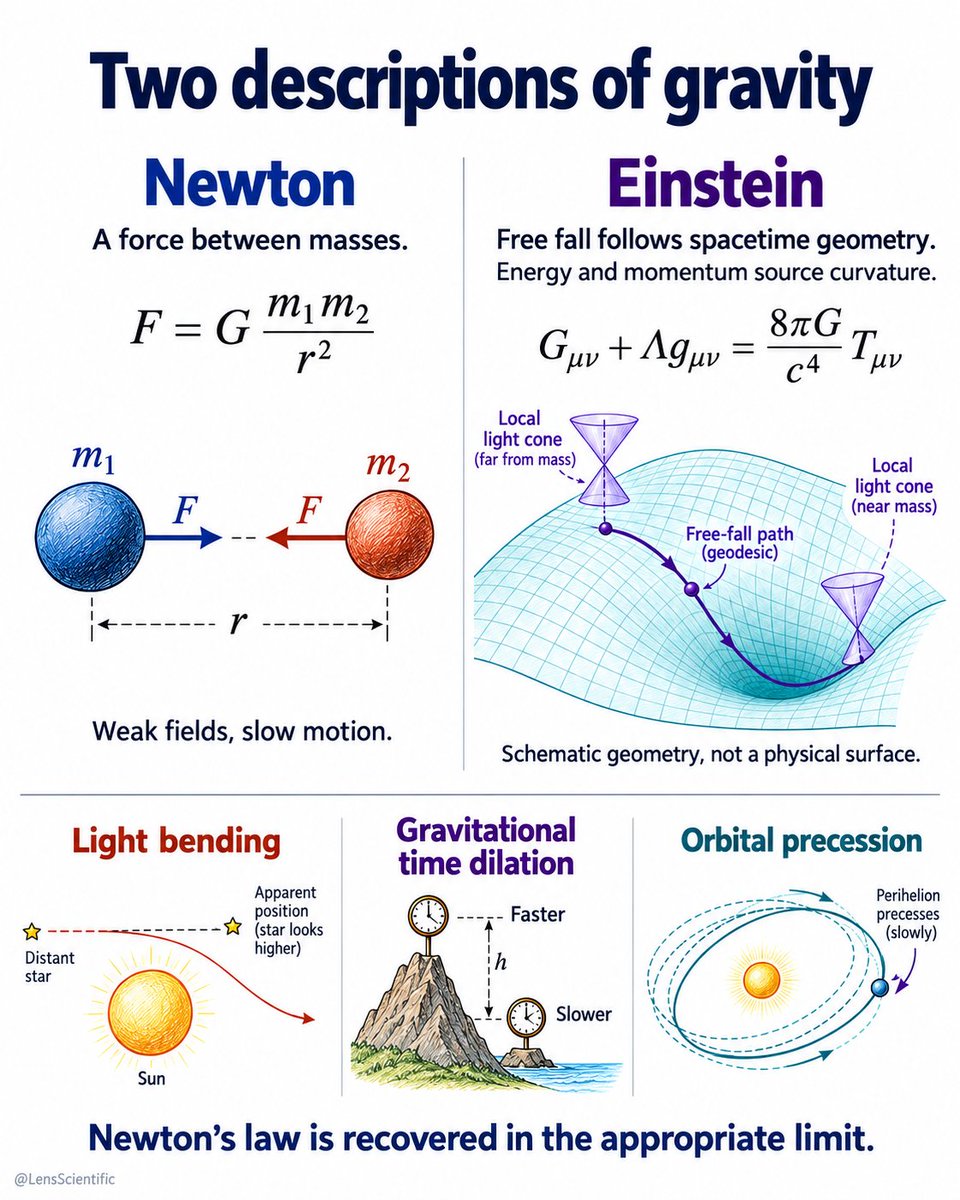
Astronauts in orbit feel weightless while Earth’s gravity remains strong. They and their spacecraft are falling together, so the floor no longer provides the usual supporting force.
Newton describes that motion using gravitational attraction. General relativity describes freely falling bodies following paths through spacetime geometry.
Newton’s law remains an excellent approximation in weak fields at low speeds. Precision timing, light deflection, and some orbital effects require Einstein’s fuller description.
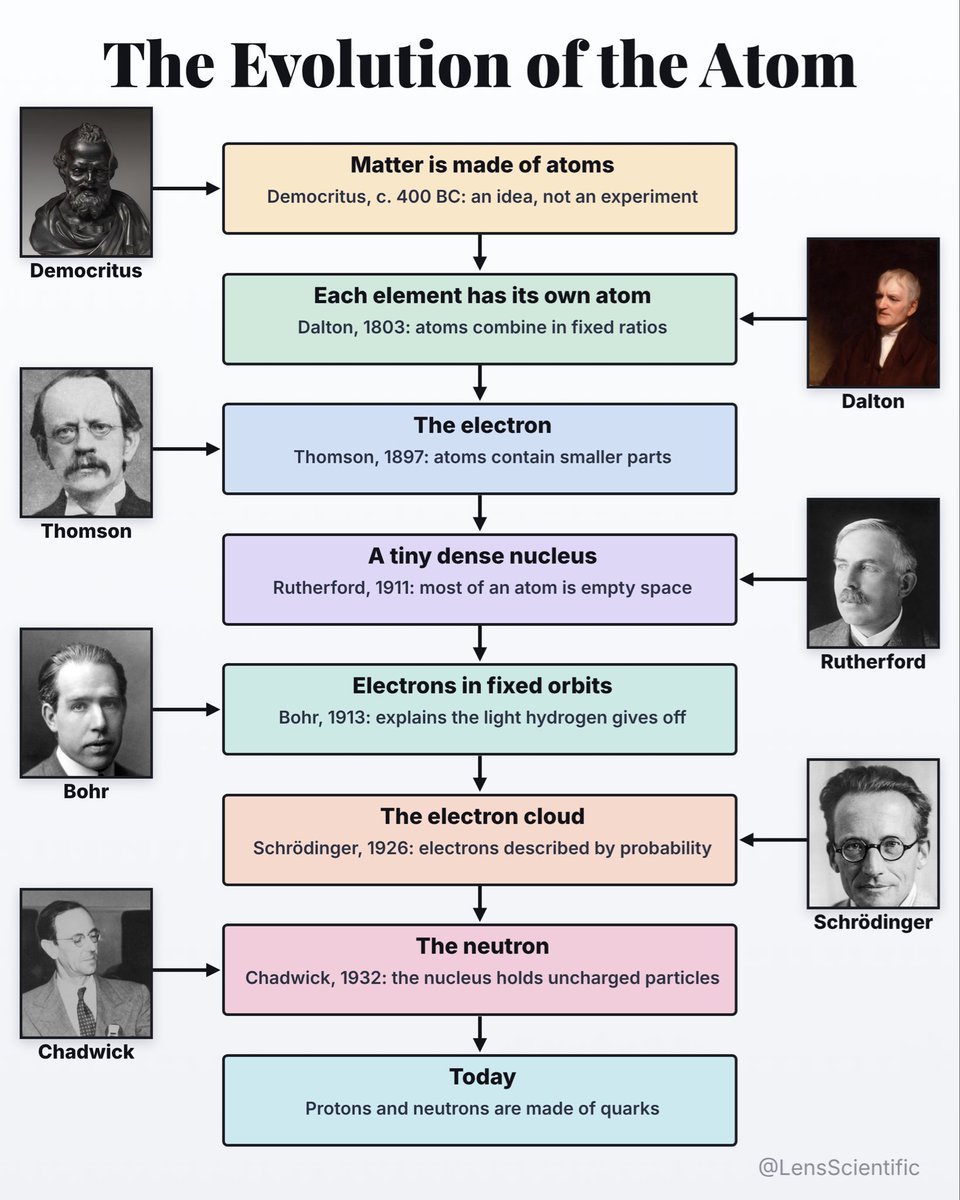
Our picture of the atom changed six times in 2,400 years, and each change was forced by a measurement the previous picture could not explain.
Democritus argued for atoms on reasoning alone. Dalton made the idea scientific, Thomson found the electron, and Rutherford's team fired alpha particles at gold foil and saw a few bounce straight back. That ruled out Thomson's pudding model and put the mass in a tiny nucleus.
The neutron came late because it has no charge and leaves no track. Chadwick found it in 1932 by its effect on other particles. Quarks, which make up protons and neutrons, were proposed in 1964 and first seen in scattering experiments in 1968.
Each step on this list changed what the next one could ask.
Kepler's ellipses came from Tycho Brahe's naked eye data on Mars. Newton then showed the same rule that pulls an apple holds the planets on those ellipses.
Leavitt found that a Cepheid star's pulse period tracks its true brightness, so any one of them can be used as a ruler. Hubble used that ruler to show galaxies recede faster the farther they are. Lemaître had derived the same pattern in 1927.
The 1965 microwave glow and the 2015 ripple in spacetime were each predicted decades before anyone could detect them. Bell Burnell's 1967 pulsar was not predicted at all.
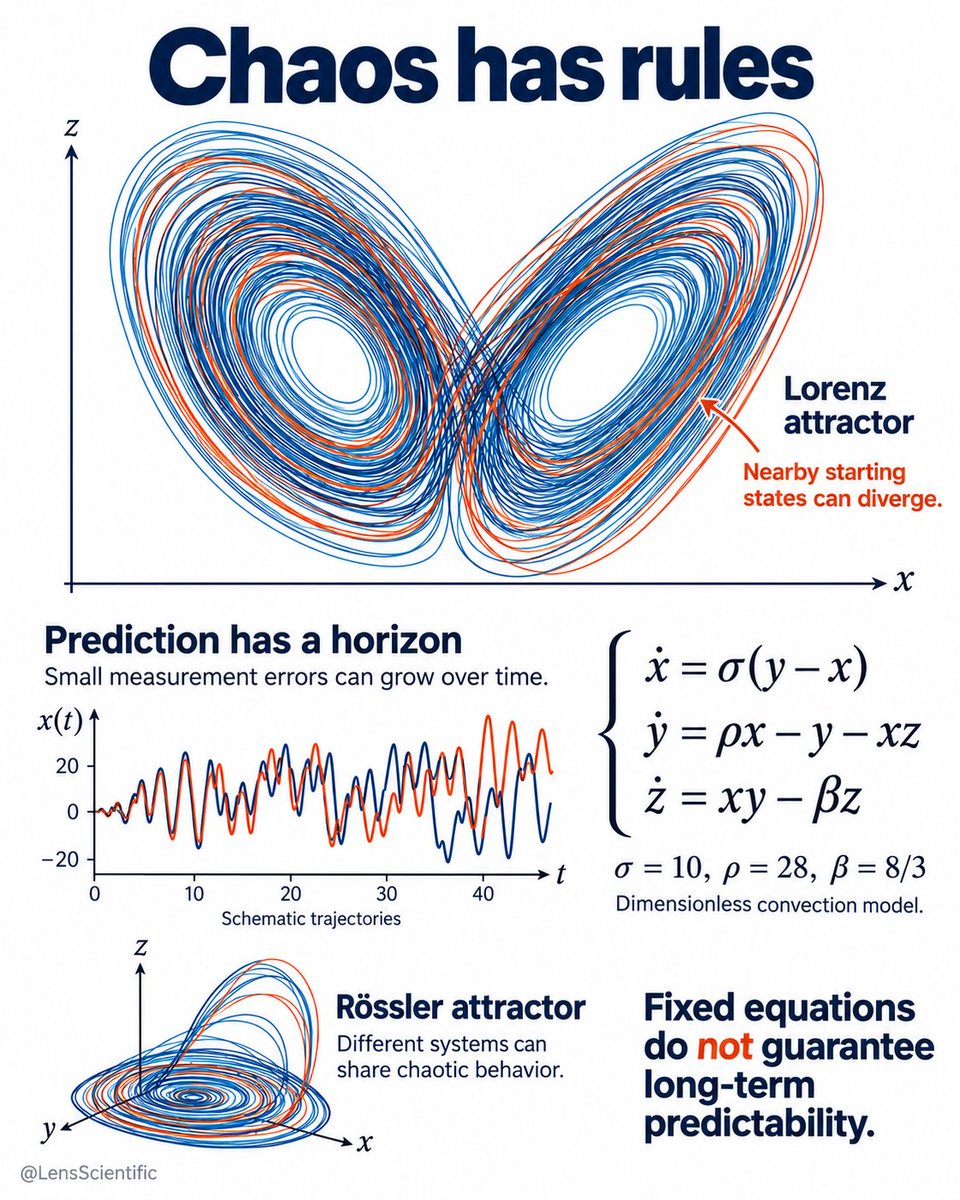
A chaotic system can follow exact equations while remaining difficult to predict far ahead. The uncertainty comes from how precisely its starting state is known.
Nearby states can separate rapidly, so tiny measurement errors eventually become large forecast errors. Their motion can still remain bounded around a recognizable attractor.
This limits detailed weather forecasts without making weather random. Long-term statistical patterns can remain useful even when individual trajectories become unpredictable.