TIRED OF BEING FARMED BY INSIDERS & SCAMMERS?
the @Moshdottrade launches on top of @ponsdotfamily work like this: agents snipe a % of the supply at launch and lock it forever but activate that capital to support the chart
it's magic that takes away a big part of the incentive insiders and scammers have
which is why you don't see many people talk about it on the timeline because it means they will make LESS money
this is how the agents looked like on $AUR not even 24 hour after launch at a mcap of $400k with a 1 ETH raise and 30% of the supply with the swarm
few understand now
but this will be something that everyone DEMANDS next
Our market making harness is constantly getting better, making Bundle Cat a better token every day.
Unironically the most insane alien AI tech in crypto today is @BundleCatAI
🚨 IS robinhood:0x07ebb29a38fbcb41563817e5e19f2cec619c90d2 THE NEXT robinhood:0x39dbed3a2bd333467115de45665cc57f813c4571? Video Live!
A lot of people in the MaxFi community are already LP farming robinhood:0x07ebb29a38fbcb41563817e5e19f2cec619c90d2 - now you can hear directly from the founder and understand what’s actually being built.
🤖 AI market making
💰 Trading fee revenue
🚀 Crypto launchpads
🧠 Built on PONS infrastructure
🔥 A whole new “money printer” model for meme coins
This is way more than just another meme coin.
🎥 Watch here:
https://t.co/RRVREdOaxv
@BundleCatAI@justinbebis@ponsdotfamily@MAXFILABS
Yesterday was our closed beta.
We made over $10,000.
We're buying back $BUN with it.
Thank you everyone for your support - much more to come 🫡
https://t.co/zSSnq1Lfum
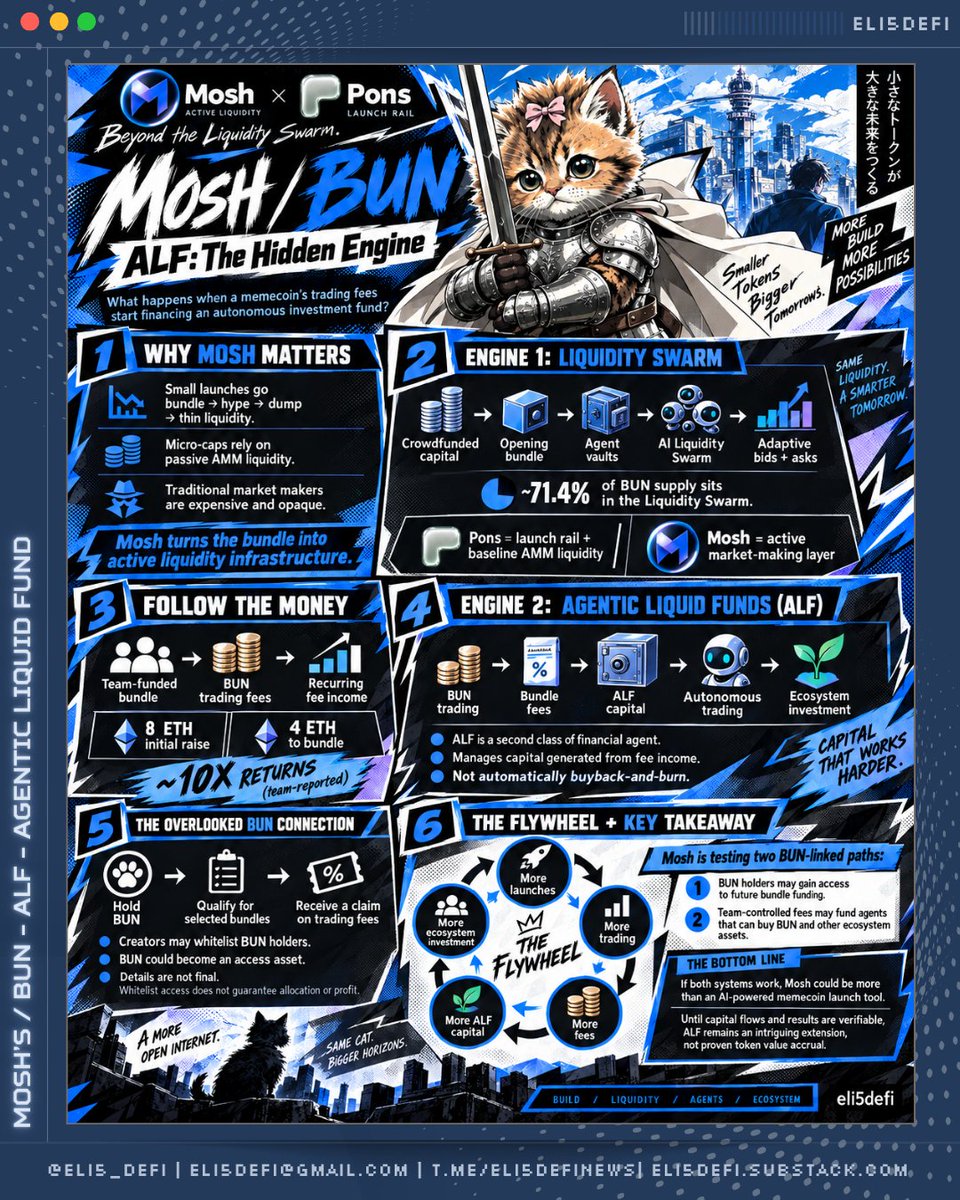
Most people looking at @BundleCatAI / @Moshdottrade are focused on one thing: the Liquidity Swarm.
But I think there's a more interesting experiment hiding underneath Mosh's market-making infrastructure.
What happens when a memecoin's trading fees start financing an autonomous investment fund?
That's the idea behind Agentic Liquid Funds (ALF), and it could become an important part of Mosh's broader economic model.
Let me explain.
---
➠ First, follow the money.
Remember how Mosh works?
Instead of allowing bundlers to accumulate a massive token allocation and dump it whenever they please, Mosh commits that inventory to vaults managed by AI agents.
For $BUN, roughly 71.4% of supply sits in the Liquidity Swarm.
The agents use that inventory to buy, sell and manage liquidity around the existing AMM. Funders sacrifice access to their original capital in exchange for trading-fee income.
But here's what makes BUN different.
The team funded BUN's opening bundle themselves.
According to @justinbebis, the initial raise was 8 ETH, with 4 ETH used to purchase the opening bundle. The team reported recovering its funding through fees within the first minute and the team claim they've now earned approximately 10× their bundle investment in fees.
Instead of holding a large, freely withdrawable token allocation, the team receives income linked to BUN's trading activity.
The longer the market stays active, the more fees the bundle can potentially generate.
And that brings us to ALF.
---
➠ The second engine: Agentic Liquid Funds
Mosh doesn't intend to let all that fee income sit idle. The team's proposed next step is to use eligible bundle revenue to fund a different class of financial agents.
Think of it as giving an AI trading desk its own investment budget, financed by the trading fees generated through Mosh.
The intended mechanism is straightforward:
BUN trading → bundle fees → ALF capital → autonomous trading → ecosystem investment
There are now two distinct engines.
- The Liquidity Swarm manages a token's market using inventory committed during its launch.
- ALF would manage capital generated from fee income, potentially trading BUN and other Mosh-aligned assets.
Team has described the idea as extending buyback tokenomics with an active trader attached.
An ALF introduces discretion through an automated strategy.
It could theoretically accumulate during heavy selling, preserve $ETH when conditions are unfavorable, or deploy capital across several eligible tokens.
And unlike burned tokens, assets purchased by a fund can potentially be sold again. ALF is not automatically a buyback-and-burn mechanism. It's an attempt to make fee-generated capital productive.
--
➠ The overlooked BUN connection
Creators launching on Mosh may be able to whitelist BUN holders for bundle funding. That gives BUN a role beyond being the first Liquidity Swarm token: potential access to selected launches
How it could work:
- Hold BUN → qualify for selected bundles
- Fund launch inventory (held in agent vaults)
- Receive a claim on trading fees
Details aren’t final. A whitelist doesn’t guarantee allocation, or profit. Still, it positions BUN as an 'access asset' inside Mosh’s funding system.
Together with ALF, Mosh is testing two BUN-linked paths:
- BUN holders may get access to future bundle funding
- Team-controlled fees may fund agents that can buy BUN (and other ecosystem assets)
At scale, the pitch is a very interesting flywheel:
More launches → more trading → more fees → more ALF capital → more ecosystem investment.
Personally, if Mosh can demonstrate that both operate sustainably, it could have something more substantial than an AI-powered memecoin launch mechanism.
But until the capital flows and investment results are verifiable, ALF remains an intriguing extension of the original experiment rather than proven token value accrual.
NFA. DYOR.
BREAKING: robinhood:0x07ebb29a38fbcb41563817e5e19f2cec619c90d2 holders could be first in line to access Mosh’s next launches
That’s the rough plan @justinbebis shared in the comunity this morning: the BUN community would be the beta cohort for early bundles. He also talked about the team’s fee income and showcased the perfect alignment with holders here.
The team doesn't hold significant robinhood:0x07ebb29a38fbcb41563817e5e19f2cec619c90d2 supply so they win as a consequence of holders winning.
That adds context to something I asked him on yesterday’s Space: how does Mosh’s growth connect back to robinhood:0x07ebb29a38fbcb41563817e5e19f2cec619c90d2 beyond the branding as the first @Moshdottrade
His answer, lightly edited for readability:
“There’s the agentic liquid fund concept I discussed, where we will be putting fees into agents designed to bid and interact with our tokens.
Again, really the ultimate goal is refining our technology, and doing it in such a way that’s value accretive to BUN.
We have this concept of tokens that are BUN-aligned. Maybe you whitelisted BUN holders, or maybe you paired the token with BUN. If that’s ever something we can support, then we can trade and interact with those tokens with the agentic funds.
And then the final thing is true creator-fee value accrual, buyback and burn, etc. That is something that we want to do.
The main thing is that we’re going to have to do some financial backflips to make it compliant and make it net accretive to the team and the token.
What we have planned for BUN will melt faces, and it might surprise some people.
But I’m not going to make any strong commitments, because that’s how founders get in trouble. I hope my mindset was properly communicated.”
Early bundle participation, BUN-aligned launches and fee-funded agents: that’s the direction he’s describing, with the details still being worked through.
The part I’m super interested in is how the community that helped establish Mosh gets to participate in what comes next because if you've been in that telegram you know everyone is BUZZIN' to contribute.
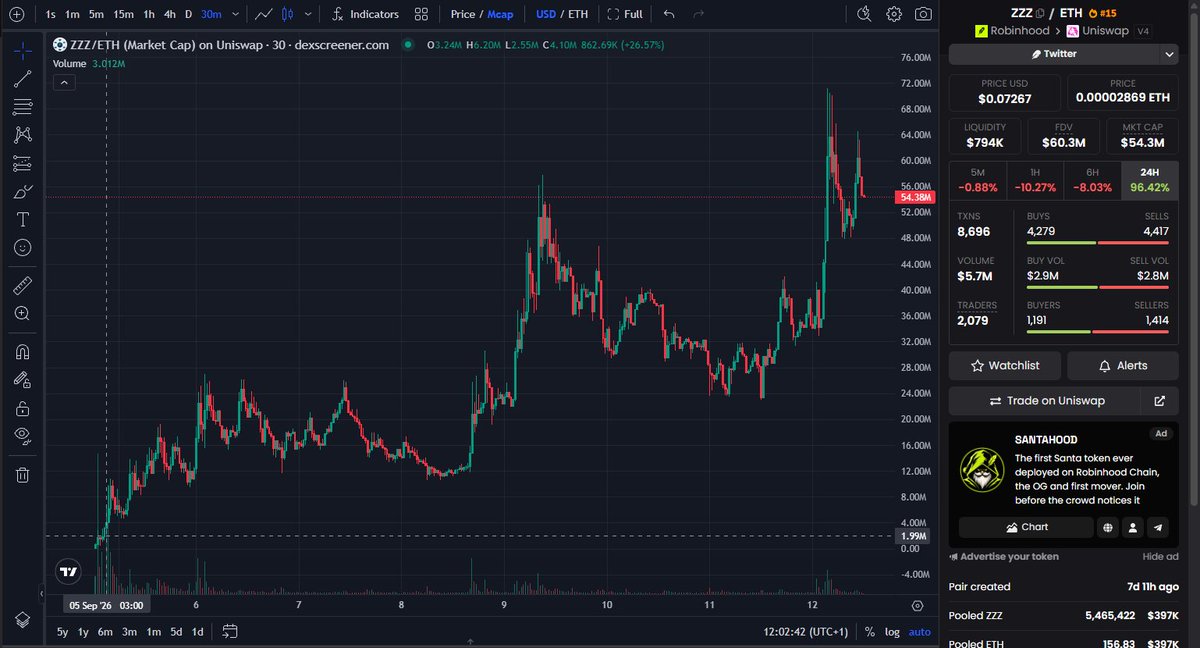
Good morning $ZZZ bulls,
One simply does not fade the OG xdev who paved the way for Hyperliquid to exist by building gmx:native.
I like what I'm seeing so far from @ExponentLabs_
https://t.co/sbIMOPO5zQ
We sent dogshit like $GRIFFAIN to 650m, how high can this go?
💤