Neutrl has temporarily paused minting, redemptions, and other protocol functions following circumstances affecting protocol reserves. These measures have been taken in the interest of our users, after advice from legal counsel, to preserve an orderly process while the impact is assessed.
Users will be provided with a clear and orderly process in due course. Further information on timing, and next steps will be shared as soon as available.
Why USDT and USDC are Harder to Kill than Crypto Twitter Thinks: My last Thoughts on Open USD
The launch of OUSD has taken Twitter by storm. Many people are now convinced @circle is doomed because a consortium of 150 companies spanning payments, fintech, banks, crypto infrastructure, and consumer technology is somehow going to crush the competition and launch a stablecoin that rivals USDC, and potentially even USDT.
I already wrote a tweet on why people are vastly overestimating this initiative and why consortiums are poor organizational structures to conquer anything, let alone a market with an established duopoly. In this short piece, I want to focus on one thing only: the true network effects of stablecoins. Instead of rehashing every argument, I want to walk through a tangible example that everyone is ignoring, because I believe both USDT and USDC have liquidity moats that are vastly misunderstood and underappreciated.
Stablecoin network effects are not created by a long list of logos. They are created by liquidity, habit, collateral acceptance, integrations, brand recognition, market depth, settlement flows, and the fear of breaking what already works.
This is why I think @tether and @circle are companies that are vastly misunderstood.
First, the obvious: OUSD will be GENIUS compliant, which means it cannot share yield directly with users. This isn’t news, yet people are screaming at Circle to pay stablecoin holders, as if OUSD were going to be able to do that. The reality is the opposite: Circle is probably the issuer that passes on the most yield to platforms, and by extension to users, of anyone in the market.
This matters because a lot of people are talking as if OUSD will create a fundamentally different yield product for end users. That is not the model. The model is not “pay stablecoin holders.” The model is “share the reserve economics with the platforms and businesses that distribute and use the stablecoin.
This is an important distinction.
The strongest argument I’ve seen for OUSD is that consortium members will be highly incentivized to entrench it in their businesses because they get a revenue share from the structure. Without knowing the details, let’s assume the economics resemble previous consortiums we’ve seen: Open Standard, the operating company, keeps a 25 bps management fee while each participant keeps 100% of the NIM on any OUSD sitting on their platform, network, or protocol.
On paper, that’s a deal anyone signs immediately. But it completely discounts the fact that these companies accrue value in other ways, and in many cases their core businesses depend on the existing liquidity and network effects of USDT, USDC, other stablecoins or simply other FIAT currencies.
The NIM from stablecoin reserves is attractive only if pursuing it does not jeopardize a much larger revenue stream.
That is the key point.
The best case study in the industry, and probably the strongest counterexample to OUSD, is Binance.
Binance as the best Case Study
@binance is the largest exchange in the industry by several miles. It initially had its own branded stablecoin, BUSD, which peaked at roughly $23B in supply before NYDFS ordered Paxos, the issuer, to shut the product down in February 2023.
Look at the three biggest Asian exchanges and you get three clean case studies. Today @binance holds about $45B of USDT, @Bybit_Official about $4B, and @okx about $9B. Binance has been, and remains, Tether’s fortress and crown jewel. USDT is the most liquid counterpair on the biggest exchange in the world. Today, if you want to buy BTC, ETH, SOL, or open a perp position in size, USDT is still the dominant quote currency across much of the offshore exchange complex. Binance helped make that true. USDT is embedded into the deepest order books, the most liquid pairs, the most active derivatives markets, and the workflows of the most important market makers and traders.
That is a real network effect.
Now many of you must be thinking: why is CZ so naive? Why hasn’t he called Paolo and Giancarlo and demanded at least a portion of the USDT yield, if not most of it? Binance knows it has extreme leverage here.
There is an extremely simple reason this has never happened: Binance’s crown jewel, from a revenue and enterprise value perspective, is its trading business. And that trading business is cemented by USDT liquidity.
Running the math
So let’s run the rough numbers and see why it is entirely rational for CZ not to chase the NIM, or try to replace USDT with a more “aligned” stablecoin. The back-of-the-envelope math below is based on on-chain data and assumptions; none of it is confirmed information.
Building it bottom-up:
Derivatives (the core engine). Binance runs roughly 40% of global crypto derivatives volume. Call it $40-50B per day on average through the cycle, so $10-15T annually. Blended taker/maker take rate after VIP discounts and BNB rebates is maybe 5 bps. That’s roughly $5B from perps and futures alone.
Spot. Maybe $8-10B per day on average, around $3T annually, at a blended 15 bps (much lower than Coinbase’s retail take rate, because Binance’s mix skews heavily VIP and they run zero-fee promos). Call it another $5B.
Everything else. Earn and lending spread, margin interest, Launchpool and listing economics, Binance Pay, staking commissions, plus the float: they sit on roughly $46B in customer stablecoins, and while they don’t sweep it like a broker-dealer, the corporate treasury and interest-bearing products around it are meaningful at these rates. Add BNB ecosystem economics and you’re conservatively looking at another $5-7B.
And remember, these are bear market numbers. Very conservatively, Binance is a business generating close to $17-20B in bear markets and probably closer to $25B in bull markets. A business of that scale and quality is plausibly worth north of $200B.
So why isn’t CZ in a rush to replace USDT or demand better economics from the Tether team?
Because the whole reason Binance is what it is today, the reason 300M+ customers keep returning to the platform, is that it is the most liquid venue on earth. Let’s price the trade Binance would actually be making.
Binance has $45B of USDT on its platform. Say it struck a deal with OUSD handing Binance 90% of the yield. At an average T-bill yield of 3.8%, that’s about $1.55B a year. Very appealing, until you frame it properly: risking a $25B revenue engine for $1.5B of upside is something only a madman would do.
The glue holding Binance’s trading castle together is precisely USDT. There is no incentive in the world that would make CZ rethink which stablecoin to entrench.
And we don’t need to speculate, because it has already been tried. Over a year ago, Circle reportedly paid Binance a one-time $60M plus ongoing monthly incentives tied to USDC balances held on the platform. Despite all of that, USDC supply on Binance has been essentially flat at $5B.
People are vastly underestimating the network effects these stablecoins generate for the businesses that host them. In most cases, the upside is simply not worth jeopardizing your core revenue engine.
For an exchange, the stablecoin is not just cash. It is the quote asset, the collateral asset, the risk-management asset, the working-capital asset, and the unit of account for millions of traders. Switching that substrate is not free.
Not All Consortium Members Have the Same Incentives
The final point is that the OUSD consortium includes very different types of businesses. They do not all monetize stablecoins in the same way.
Broadly, there are two models.
The first model is AUM monetization. These are companies and protocols that benefit from idle balances, deposits, or float. For them, reserve economics are directly relevant. A lending protocol, wallet, neobank, or exchange with large customer balances may care a lot about the NIM attached to stablecoin supply.
The second model is turnover monetization. These are payments networks, processors, remittance companies, and commerce platforms that monetize transaction flow rather than idle balances. For them, the stablecoin is more of a rail than a balance-sheet asset. They may care more about reliability, cost, compliance, speed, reach, and customer experience than about reserve yield.
An @aave and a @WesternUnion do not bring the same thing to OUSD.
A DeFi protocol can help create supply by making OUSD useful as collateral or as a yield-bearing venue for liquidity. A payments company may instead move OUSD through its system and burn it quickly at the edge. That can be valuable for volume, but it is very different from creating persistent supply.
This is why the consortium structure is less powerful than it appears. The members may all like the idea of shared economics, but their incentives are not identical. Some will create supply. Some will create turnover. Some will integrate deeply. Some will experiment. Some may do very little once the press cycle is over.
In equilibrium, it is hard to believe all members will be equally motivated to push OUSD. Some will do the hard work of adoption. Others will coast.
That is the classic consortium problem.
Conclusion
OUSD is not irrelevant. It is one of the more interesting stablecoin experiments we have seen, and the economic model is clearly designed to attack the reserve-income advantage of the incumbents.
But the market is overestimating how quickly shared economics can overcome embedded liquidity.
Stablecoins are not won by press releases. They are won through deep, repeated, high-trust usage across the venues where money actually moves.
That is why USDT remains so powerful. That is why USDC has proven resilient and is growing so fast. And that is why OUSD, despite the impressive consortium behind it, faces a much harder path than the market currently assumes.
The core question is not whether OUSD can offer better economics to partners.
The core question is whether those economics are valuable enough for partners to risk disrupting businesses that are already built around other currencies or stablecoins.
In many cases, the answer will be no.
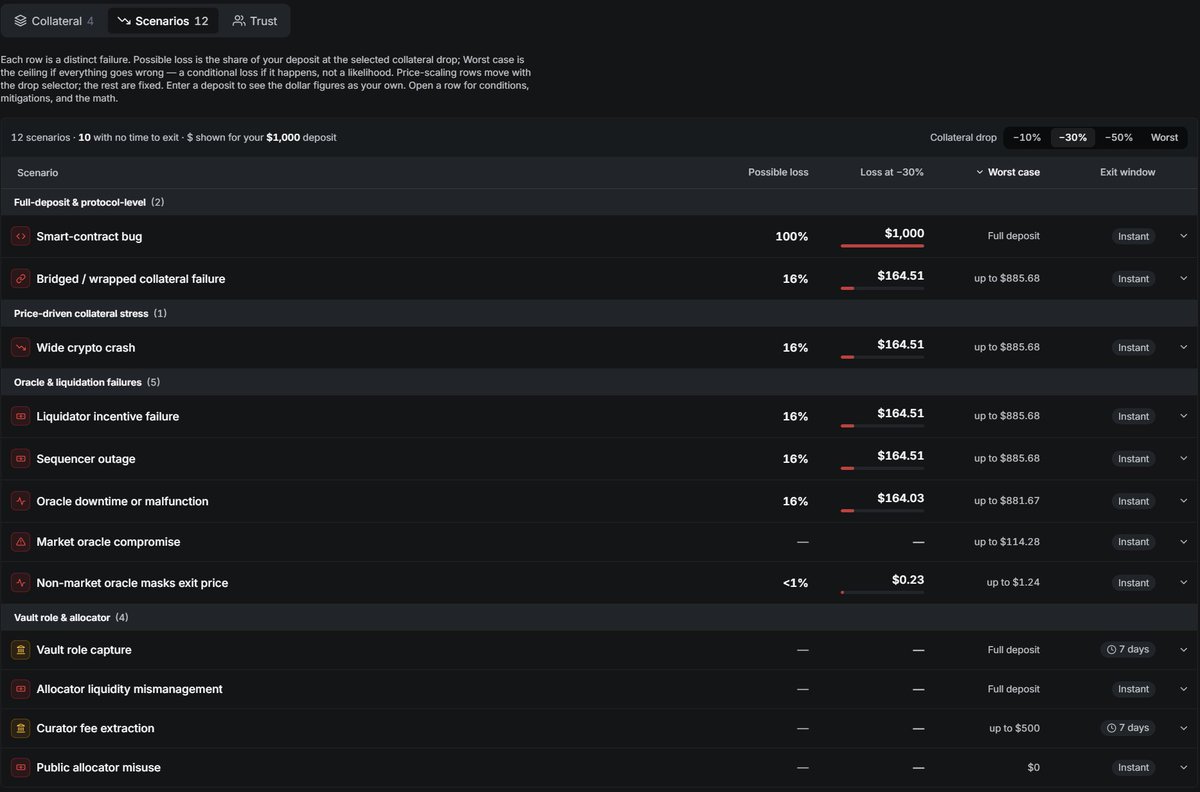
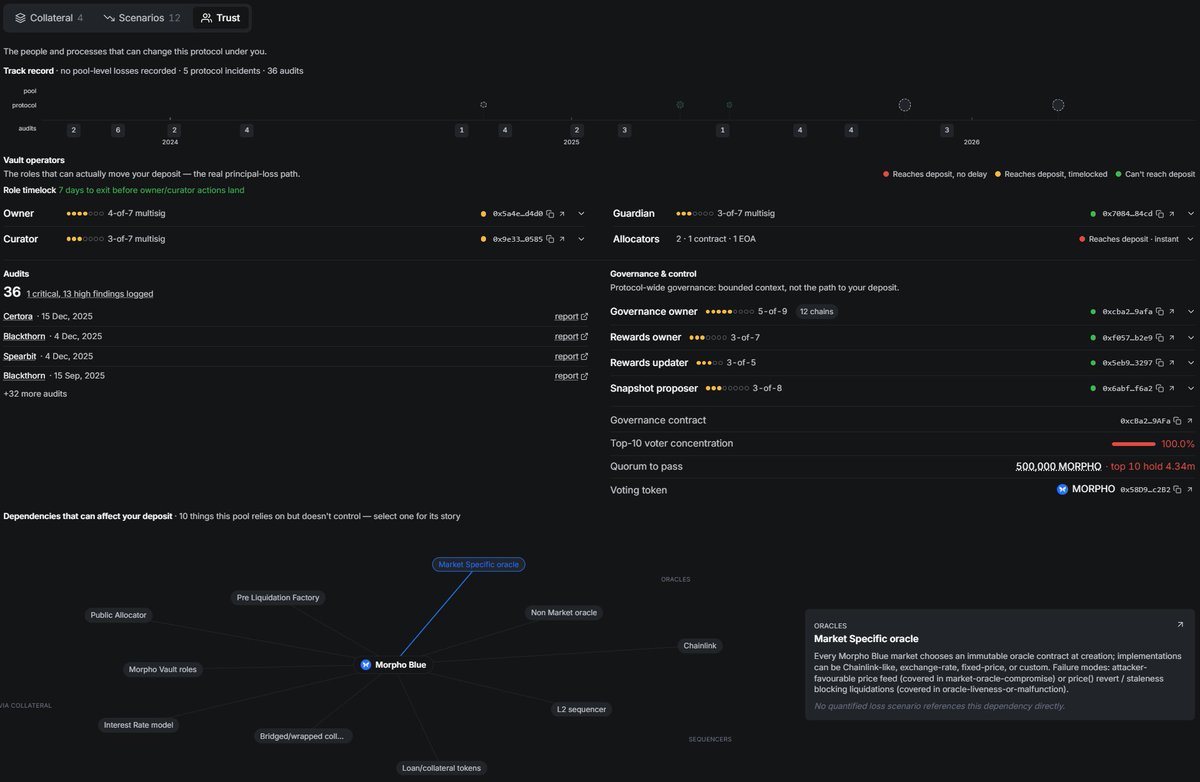
When you deposit into a vault, you're exposed to more than the vault itself: oracles, bridges, collateral, the sequencer, holders of vault roles.
Introducing risk scenario planning on DefiLlama.
* Maps every dependency that touches your deposit
* Models your max loss from each failure point
* Live now across 20 Morpho vaults
STRC down to $82.6 today. Here's my read:
1. Strategy is fine. If everything stays as is, they can pay STRC dividends for 32 years. If BTC appreciates at ~2% CAGR, they can pay dividends indefinitely.
2. Why the sell-off? This appears to be a liquidation cascade.
Over the last 6 months, the narrative became that STRC volatility was reducing, and price began to spend all its time in $99-100 range.
This invites leverage. If you expect the price to always be north of $95, you can take on 20x leverage with your portfolio to buy more STRC and dramatically increase the yield on your portfolio.
This works great, until it doesn't.
STRC is designed as a free-market asset. When attention shifted to SATA and STRC price flagged, it may have raised the attention of opportunistic short-selling hedge funds.
By shorting aggressively, they could push the price down and start triggering margin calls and liquidations from folks who aggressively levered up their STRC positions.
The price action today is a clear liquidation cascade, rapidly pushing prices lower, in turn triggering additional liquidations.
3.
What happens now? The market will heal itself.
Opportunistic hedge funds will recognize that this is a firesale and the fundamentals are unchanged for STRC and step in as buyers. Shorts will close, becoming buyers. Individuals are getting a tremendous entry price for long-term holding STRC shares.
Buyers at this level will get ~13.7% effective yield. If STRC trades back to $100 and they sell, they get an easy +18% return.
4.
What will Strategy do?
Strategy will likely increase the dividend rate on June 30 - maybe to 11.75% but possibly to 12%. Buyers at the current price level then would get 14.2% effective yield from that point forward.
Strategy may also step in to buy STRC shares back. They could do this by issuing new shares of MSTR (currently at 1.14 mNAV) or by taking on traditional debt and deploying those funds to buy discounted STRC shares on the market.
If/when STRC trades back to $100, Strategy could then re-issue those STRC shares. The ~$15 delta per share could be used to buy BTC as pure accretion to MSTR holders, with no net change to amplification.
No doubt that Saylor has already at least considered this, and it wouldn't surprise me if they're currently doing this.
5.
In summary...
The market is freaked out that this depeg is like Terra/Luna... but this is not an asset like that. Strategy's balance sheet determines whether STRC continues to receive dividend payments... and Strategy's balance sheet is completely unchanged.
This is a leverage wipeout.
From this, the market will learn that Digital Credit is mostly very low volatility. But because it is a free market asset, the longer that a Digital Credit instrument trades within a tight range to par... the more leverage will inevitably pile up as people get greedy.
And that creates the conditions for a leverage wipeout depeg. Following that, the instrument will make its way back to par value as the market heals itself and recognizes that the dividend payments will continue uninterrupted because the issuer's balance sheet is unaffected.
🚨THE FBI CREATED A FAKE CRYPTOCURRENCY.. LISTED IT ON UNISWAP.. HIRED MARKET MAKERS TO PUMP IT.. THEN ARRESTED EVERYONE WHO SAID YES..
THIS IS THE CRAZIEST LAW ENFORCEMENT OPERATION IN CRYPTO HISTORY!!!
The FBI built an actual ERC-20 token on Ethereum called NexFundAI.. 100 billion token supply.. A professional website.. Whitepapers promising "passive income through AI-powered investing"..
It looked exactly like every other crypto project.. Because that was the point..
Undercover agents posed as the founding team.. Then reached out to professional market-making firms and said "we need you to fake our trading volume"..
Every single firm said yes..
Here's what they recorded..
Gotbit.. A firm run by a 26-year-old Russian who publicly bragged in 2019 that he built a business faking trade volumes.. His team kept internal spreadsheets with columns literally labeled "fake volume" vs "market volume"..
When asked how fast they could pump NexFundAI's volume to $1 million per day.. They said "6 hours.. It will cost about $200"..
$200 to fake $1 million in daily trading volume..
MyTrade.. Run by a guy who called himself "the mastermind".. He explained the exact psychology of the scam on camera..
"We make the chart look like a really nice roller coaster ride.. That's where people jump in.. We have to make them lose money in order to make profit"..
He said that on a recorded FBI video call..
CLS Global.. A Dubai-based firm.. Their bots generated 98% of NexFundAI's total trading volume.. When the FBI asked if they could sync fake volume spikes with fake news announcements.. They said absolutely..
ZM Quant.. Bots executing 10 to 20 trades per minute through dozens of wallets to look organic..
All of them knew it was fraud.. All of them did it anyway.. All of it was recorded..
And the clients were even worse..
Saitama.. A meme coin that hit $7.5 billion market cap.. The founders coordinated buys through private Telegram chats.. Sent "pump it" memes while manipulating the price.. Then dumped on retail investors..
$7.5 billion.. Built entirely on fake volume.. Every penny of real money came from retail investors who thought the momentum was organic..
One founder left Saitama and started Robo Inu.. Used Gotbit again.. Another launched VZZN.. Same playbook..
Lillian Finance.. Founder claimed to be a defense contractor who addressed Congress.. Marketed the token as funding children's hospitals.. Pocketed everything..
When the FBI shut it down.. They seized $25 million in one day.. 18 people indicted across the US, UK, and Portugal.. The CEO of Gotbit was arrested in Portugal and extradited.. Sentenced to 8 months plus $23 million forfeiture..
But here's the part that broke my brain..
Real people bought NexFundAI..
The FBI's fake token.. With zero utility.. Zero real developers.. Created solely to catch criminals.. Attracted real retail investors because the fake volume made the chart look bullish..
When the FBI pulled the liquidity to end the operation.. Those people lost real money.. On a government-issued token..
The FBI had to set up a restitution portal to pay them back..
And it gets worse..
Within 24 hours of the DOJ announcing the sting.. Someone cloned the FBI's exact smart contract.. Launched a copycat token.. Rode the viral momentum.. And made $127,000 in a single day..
Using the exact same manipulation tactics the FBI just arrested 18 people for..
Then in 2026.. The FBI did it again.. New token called Lexobit.. 10 more arrests.. Including operators extradited from Singapore..
IRS forensics showed that in one firm's trading.. 1,209 out of 1,221 consecutive transactions went straight back to wallets the firm controlled.. 99% circular..
The FBI proved what everyone in crypto suspected..
The volume is fake.. The charts are painted.. The momentum is manufactured..
And every time you buy a token because "the chart looks bullish".. You might be the exit liquidity.
Tokenized $STRC is now live.
Stretch (STRC) is @Strategy's perpetual preferred stock paying monthly dividends, currently yielding 11.5%.
Now available across Ethereum, BNB Chain, and Solana through Ondo Global Markets.
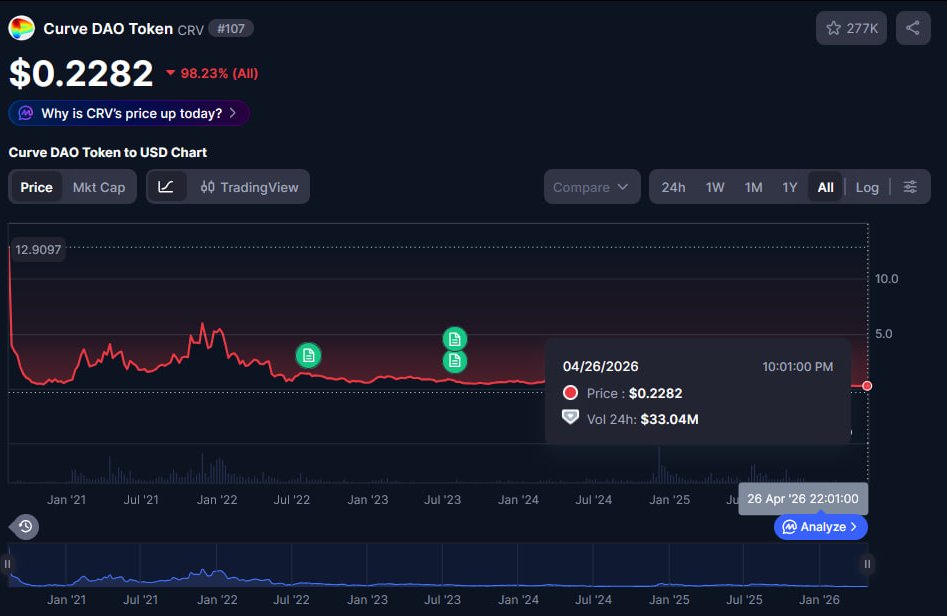
Curve's founder pulled $100 MILLION out of his own token to buy two Australian mansions and left holders with a token that dumped 98%
In 2023 Curve Finance founder Michael Egorov took out $100 million in stablecoin loans across Aave, Frax, Inverse, Abracadabra and other protocols
His collateral was 427 million CRV, which was 47% of the circulating supply of his own token
Lookonchain traced $31 million in stablecoins flowing from Egorov to Bitfinex in April 2023
One month later his wife bought a $41 million mansion in Melbourne, right next door to the $18 million home they had purchased the year before
That's $59 million in Australian real estate funded by loans against the token his own community was holding
In July 2023 Curve was hacked for $70 million through a Vyper bug, CRV crashed and his positions almost got liquidated
A liquidation would have created tens of millions in bad debt across Aave, Frax and other protocols and triggered a DeFi wide catastrophe
To avoid this Egorov sold 106 million CRV in OTC deals at $0.40 per token, well below the market price, to a roster that included Justin Sun, convicted felon Michael Patryn, Jeffrey Huang, DWF Labs and several anonymous wallets
He raised $42 million in stablecoins from these deals while community holders watched CRV dump
In April 2024 he had to do it again, selling another 159 million CRV in OTC to 33 different buyers for $63 million
In June 2024 CRV crashed 24% in 3 hours and he got fully liquidated for $140 million across 5 protocols
The liquidation created $10 million of bad debt that the community had to absorb
Ethereum developer Eric Conner did the math: "He got 100 million in stables out of a 140 million CRV position. He just transferred the rektage to the community instead"
Egorov's response was that he was "committed to building Curve more than ever" thanks to veTokenomics, meaning he locked his remaining CRV to keep control of governance
CRV is down 98% from its all time high and Egorov still owns the two mansions and the protocol
When the founder of your protocol uses your bag as collateral for his mansion, you're not an investor
You're his ATM