@angrygrrrl La gente no entiende que no se debe producir basura porque despues nadie se quiere hacer cargo de su manejo, que cuesta dinero no solo en personal, procesar la basura también tiene un costo, es un buen momento para preguntar quien debe asumirlo
OPINIÓN | "Vivo en un país profundamente racista, y también lo soy, por mucho que me duela, que pelee contra ello, que me rebele"
Por Cristina Fallarás
@patty_ma1 A mi en lo personal si me escandalizo que sacaran del certamen a las mujeres que siendo las “lideres” o veteranas se posicionaron en contra de la participación de hombres. Además cada vez más niños varones están siendo inscritos como niñas en los concursos infantiles
@lalunaenlibra Los estudios serios indican que los cerebros de los trans son diferentes a los de las mujeres y muy parecidos casi iguales a los de hombres
@Politica_Basica La ciudad esta llena de parques y espacios culturales literal debajo de los puentes con actividdes casi siempre gratuitas, hasta ya hay espacios para fumar mota, debe de haber otra explicación
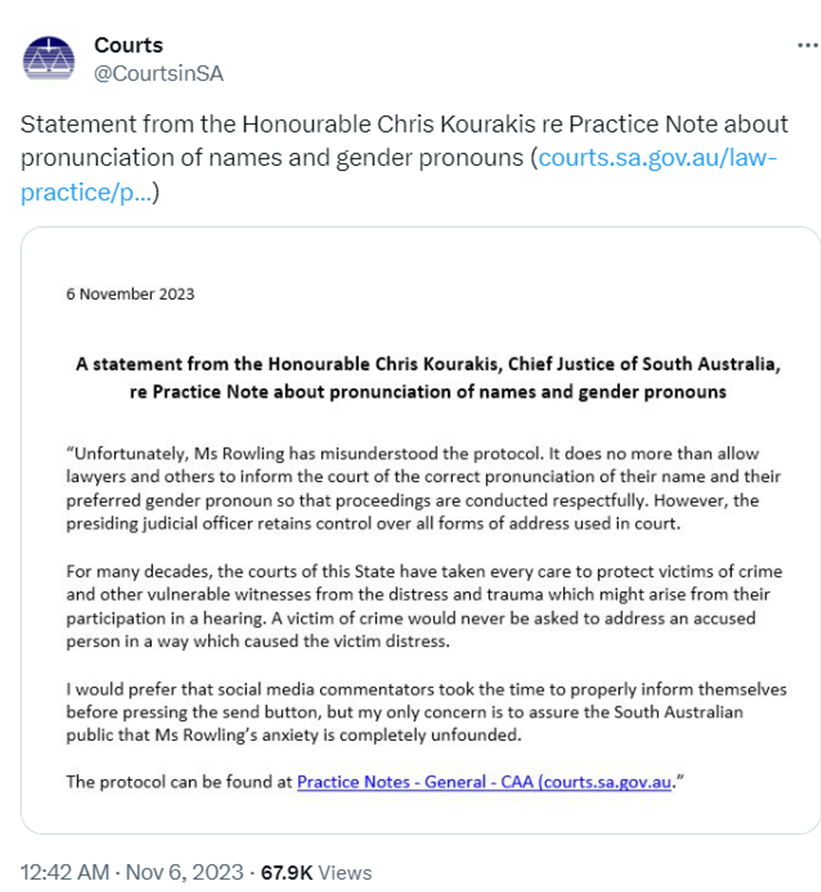
The Honourable Chris Kourakis has issued a statement referring to my 'anxiety' about the use of female pronouns for men standing trial for violence against women and rape. He states that 'a victim of crime would never be asked to address an accused person in a way which caused the victim distress.'
That assurance is welcome, although I note that he’s addressed the matter only after it was raised publicly. No such exemption is mentioned in the Practice Note, which takes the ideological position that the ‘use of preferred gender pronouns is a matter of respect’. The natural inference is that a woman would be considered guilty of disrespect if she, alone in the courtroom, described her male attacker as a man, while all court officials were addressing and describing him as a woman. This is not a hypothetical situation. The judge will be aware, if he's informed himself – as he implies I have not - that I've already cited an example where a 60-year-old woman was violently assaulted by a 26-year-old trans-identified male. She was chided by the judge for displaying 'bad grace' by not using her attacker's preferred pronouns.
The Practice Note does not acknowledge that in sexual and violent crimes committed by men against women, there is a clear clash of rights. The woman has a right - indeed, a legal duty - to speak truthfully about the male violence/sexual violence to which she was subjected. Meanwhile the Practice Note says that court officials should respectfully use female pronouns for the attacker if he says he identifies as a woman. The likely effect on a traumatised woman of hearing her attacker addressed and described as a female by the court is neither mentioned nor addressed in the Practice Note. Respect, it seems, goes only one way.
Millions of women are losing confidence in judicial systems that have adopted an ideological position with which they do not agree. In the very place where they go to seek justice, a woman may now be obliged to listen to court officials asserting they were raped or beaten by a fellow woman. Such women are not merely ‘anxious’, they are furious, about the apparent inability of certain men, judges or not, to understand how dystopian this situation seems to those of us who have suffered male sexual violence.