“Kanja and Amin are in office illegally,” Maraga says President Ruto bent the public officers’ retirement law during the appointment of Police IG and the DCI
Sixteen years ago, we the people of Kenya gave ourselves a new Constitution, not as a gift from the powerful, but a hard-fought assertion of our sovereign will.
On this Katiba Day, let us remember that a Constitution is only as strong as our willingness to defend it, obey it, and live by it, in government and in Opposition alike.
#HappyKatibaDay
The NRC contracted Earthcare Services Ltd to do an Environmental & Social Impact Assessment of the Proposed design & construction of social amenities in support of protection, restoration, rehabilitation and beautification works within the NRB
Project supervised by Ministry DOD!
Documents do not hold power on their own. People give them power.
The Constitution can sit on a shelf as a piece of paper, or it can live through the actions of people who demand accountability. It only breathes when we insist that those in power respect it.
Its loudest defenders are not always found in institutions. They are you and me, community organisers, local auditors, journalists, and everyday citizens who refuse to normalise small abuses of power.
Because accountability is not something we wait for. It is something we practise.
Ndo hii agenda ya Linda Mwananchi!
Kama mtoto anaelewa, nashangazwa na some tutam retards!!
“Development without dignity is decoration!”
#LindaMwananchi#RutoMustGo
When a local human rights group must write to The Hague to ask that Kenya be watched, that is not just advocacy. That is a confession of state failure. The very act of appealing to the ICC Prosecutor under Article 15 signals that our domestic institutions including police, prosecutors, courts, and oversight bodies are no longer trusted to prevent or punish political violence before it spirals.
This letter lands at a moment when organised goon squads are attacking civilians, journalists, and protesters with growing impunity, and when inflammatory rhetoric from political leaders is met with silence or selective enforcement. KNCHR has already condemned the escalating intolerance, violence, and use of criminal gangs to intimidate and disrupt rights. The @VOCALAfrica_ move to The Hague is the logical next step when national mechanisms appear unwilling or unable to act.
The request is not for intervention. It is for observation, preservation of evidence and early warning to those who might order, finance or protect violence. A Kenyan organisation is asking an international court to do what our own Constitution demands of our institutions, protect life, dignity, and democratic participation. That is the definition of a rule-of-law crisis.
We cannot normalise this. If the price of sovereignty is silence while citizens are attacked and institutions look away, then we have already lost. The state must either demonstrate it can uphold the law, or accept that the world will watch, record, and one day hold accountable those who failed.
PREPARE FOR COSTLY INTERNET:
The proposed Kenya Information and Communications (Amendment) Bill, 2025, sponsored by Aldai MP Marianne Kitany., has raised serious concerns about the future affordability and accessibility of internet services.
Among the proposals are:
1. Introduction of an internet metre number to facilitate billing subscribers based on consumption.
2. Moving away from unlimited internet packages towards consumption-based billing, similar to how electricity or water is billed.
3. Increased monitoring of internet usage by Internet Service Providers.
These proposals deserve serious public scrutiny because affordable internet is no longer a luxury. It is essential infrastructure.
Making internet access more expensive could have consequences far beyond social media:
1. Businesses — higher operating costs and reduced digital activity.
2. Schools and students — increased costs for online learning and digital resources.
3. Workers and jobs — businesses under financial pressure may cut staff or reduce operations.
4. Communication — families, communities and businesses would have to spend more simply to stay connected.
5.Access to information — millions of Kenyans could be priced out of the digital public square.
And the timing matters.
As Kenya approaches another election cycle, we must ask: Who benefits when accessing information becomes increasingly expensive?
We saw what happened when young Kenyans used social media to organise, share information and demand accountability.
You cannot permanently silence a population by switching off the internet.
But you can make access so expensive that only those who can afford it remain connected.
That is why we must pay attention now.
Affordable and accessible internet is a democratic right in practice. It enables citizens to organise, learn, work, communicate, participate and hold power to account.
#AffordableInternet #DataCosts #DigitalRights #InternetFreedomKE #Kenya
A Harvard professor asked 1 question 4 different ways - and got 4 contradicting answers
His name is Michael Sandel. He teaches Justice. He opens the entire course with a hypothetical that takes 30 seconds to state and takes the rest of the hour to unravel.
His entire framework fits on a napkin.
You're driving a trolley. The brakes fail. 5 workers are on the track ahead. A side track has 1 worker. You can steer.
Ask a room of students what they'd do, and the vast majority say the same thing: turn. Better 1 dies than 5.
Here is where it falls apart.
Change nothing about the math. Change only the mechanism. Now you're standing on a bridge, watching the same runaway trolley bear down on the same 5 workers. Next to you stands a heavy man. Push him off the bridge, his body stops the trolley, 5 live and 1 dies - the exact same trade as before.
Almost nobody pushes him.
Same numbers. Same outcome. Completely different answer.
Sandel doesn't tell the room they're wrong. He asks them to explain the difference, and the room can't agree on one. 1 student argues the fat man never chose to be involved, unlike the worker already standing on the side track - except the worker never chose it either. Another argues that steering a wheel is a "split-second" reaction while pushing a man is deliberate murder - except both require an active, conscious decision to kill 1 person you weren't otherwise going to kill.
Every explanation the room offers gets challenged by another student within seconds.
Then Sandel tightens the trap further. You're an ER doctor. 5 patients need moderate care, 1 needs intensive care, you can't save all 6. Nearly everyone chooses the 5 - consistent with the trolley.
Then: you're a transplant surgeon. 5 patients need 5 different organs. A healthy stranger naps in the next room. You could harvest his organs and save all 5.
Almost nobody says yes.
Same math, every single time. 1 life against 5. The answer keeps flipping, and the room keeps struggling to explain why.
Sandel closes the lecture with a real case from 1884 - the shipwreck of the Mignonette. 4 sailors adrift with no food or water. After 19 days, the captain killed the weakest of them, a 17-year-old crew member, so the other 3 could survive by eating his body. All 3 survivors were rescued. 2 of them stood trial for murder back in England.
The room splits immediately. Does it matter that the boy had no family waiting, while the others had wives and children? Is killing 1 to save 3 different in a lifeboat than on a bridge? Is murder wrong regardless of the outcome it produces, or only wrong when the math doesn't justify it?
Here is what the lecture is really about. Sandel isn't teaching students the right answer to any of these cases. He's showing them that their own moral intuitions contradict each other within the same hour, under questioning they can't escape - and that noticing the contradiction is the actual beginning of moral philosophy.
He teaches this to students who will spend careers making decisions that quietly involve this exact tradeoff - policy, medicine, law, business. Half of them will never examine the framework they're using. The other half will remember the moment their own logic broke in front of a room of strangers.
The lecture is free. Harvard has taught it publicly for decades. The barrier was never access.
The barrier is sitting with the contradiction long enough to admit you don't actually have a consistent principle - you have a set of feelings that change depending on how the question is asked.
The napkin costs nothing. Realizing your moral intuitions contradict each other is the entire edge.
Every African should see this video of a bilateral discussion between President Emmanuel Macron of France and representatives from Burkina Faso.
No one has made me happier for and prouder of Africa than the ladies in the video. Ibrahim Traoré has the best brains around him.✍️
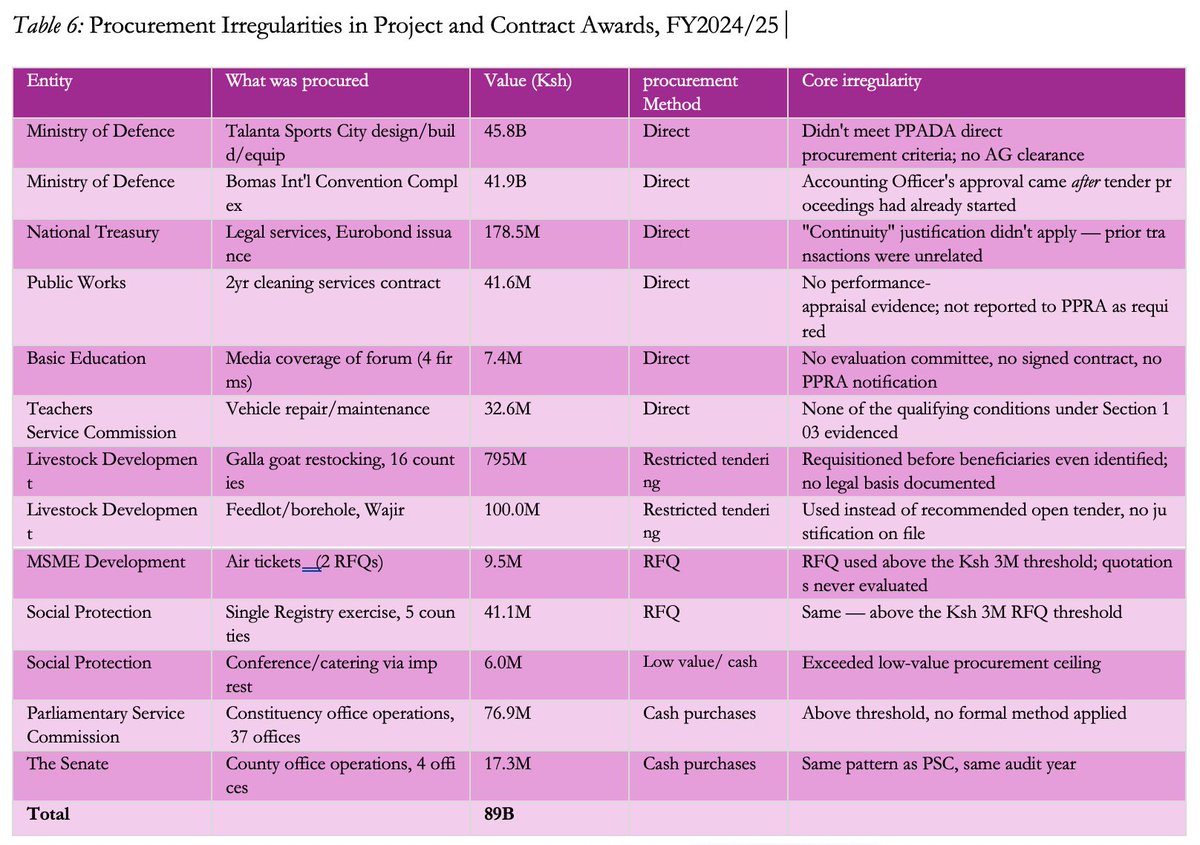
📊 𝐏𝐫𝐨𝐜𝐮𝐫𝐞𝐦𝐞𝐧𝐭 𝐈𝐫𝐫𝐞𝐠𝐮𝐥𝐚𝐫𝐢𝐭𝐢𝐞𝐬 𝐅𝐥𝐚𝐠𝐠𝐞𝐝
In its FY 2024/25 report, the Auditor-General flagged approximately 𝐊𝐒𝐡 𝟖𝟗 𝐛𝐢𝐥𝐥𝐢𝐨𝐧 in procurement undertaken without sufficient evidence that legal conditions had been met.
Projects cited include:
🔹 𝐓𝐚𝐥𝐚𝐧𝐭𝐚 𝐒𝐩𝐨𝐫𝐭𝐬 𝐂𝐢𝐭𝐲
🔹 𝐁𝐨𝐦𝐚𝐬 𝐂𝐨𝐧𝐯𝐞𝐧𝐭𝐢𝐨𝐧 𝐂𝐞𝐧𝐭𝐫𝐞
These findings raise questions on compliance with Article 201 of the Constitution — the principle of prudent use of public resources.
Read more>> https://t.co/vSXSaKjzxi
Findout Kenyas' deabt status>> https://t.co/n3nncz5iyC
#DebtontheBallotKE #KISP
TERM LENGTH vs. ELECTION DATE
These are two distinct constitutional concepts. Conflating them leads to a fundamental error in constitutional interpretation.
1. TERM LENGTH
A presidential term concerns the period during which an elected President lawfully occupies office.
Article 142(1) provides:
"The President shall hold office for a term beginning on the date on which the President is sworn in and ending when the person next elected President is sworn in."
The Constitution therefore defines when a term begins and when it ends. It does not prescribe when the election must be held.
2. ELECTION DATE
The timing of the presidential election is governed separately by Article 136(2)(a), which provides:
"An election of the President shall be held on the second Tuesday in August in every fifth year."
This provision fixes the constitutional election date. It is not expressed as "five years after swearing in" or "upon the expiry of five years." The Constitution deliberately adopts a fixed electoral calendar.
The distinction is critical. Article 142(1) regulates the duration of an incumbent's tenure. Article 136(2)(a) regulates when the people exercise their sovereign power to elect a President. They serve different constitutional purposes and must be interpreted harmoniously, not conflated.
Once elections are tied to the personal tenure of an incumbent rather than the constitutional election cycle, the electoral calendar becomes variable. Delays in swearing-in, whether arising from election petitions, logistical challenges, or extraordinary circumstances would inevitably shift the date of future elections. That would undermine the certainty and predictability that Article 136(2)(a) was designed to guarantee.
The Constitution establishes a fixed election cycle. Presidential terms must operate within that cycle, not redefine it. If the framers had intended to guarantee every President five complete calendar years in office irrespective of the constitutional election date, they would have said so expressly. They did not.
The rule of law requires fidelity to both provisions. Article 142(1) defines the presidential term. Article 136(2)(a) fixes the election date. One cannot be interpreted so as to nullify or rewrite the other.
Why does your ward never get that road or clinic funded ,while others keep getting projects year after year?"We've been asking for this road for five years." "That clinic promise was made three governors ago." Meanwhile, a ward two constituencies over gets a new borehole, a resurfaced road, a renovated health center seemingly on repeat.
It's easy to assume it's favoritism, politics, or just bad luck. And sometimes it is. But more often than people realize, the real reason is far less dramatic and far more fixable. It's paperwork. Specifically, it's the ADP.
An Annual Development Plan (ADP) is the official yearly list of projects that a ward or local government submits for budgeting and funding. Think of it as the master shortlist that determines what public money can legally be spent on that year. If a project was never logged in your ward's ADP, it is structurally invisible to the budget process. It doesn't matter how urgent it is. If it's not on the list, it cannot be funded.
The good news? This is something you can check and fix right now.
Every year, there's a window when the draft ADP is open for review before it's finalized and locked in. Once that window closes, it's difficult to add anything back in until the next cycle.
✅ Take action now: Check whether your ward's priority projects, that road, that clinic, that borehole, are actually listed in this year's draft ADP.
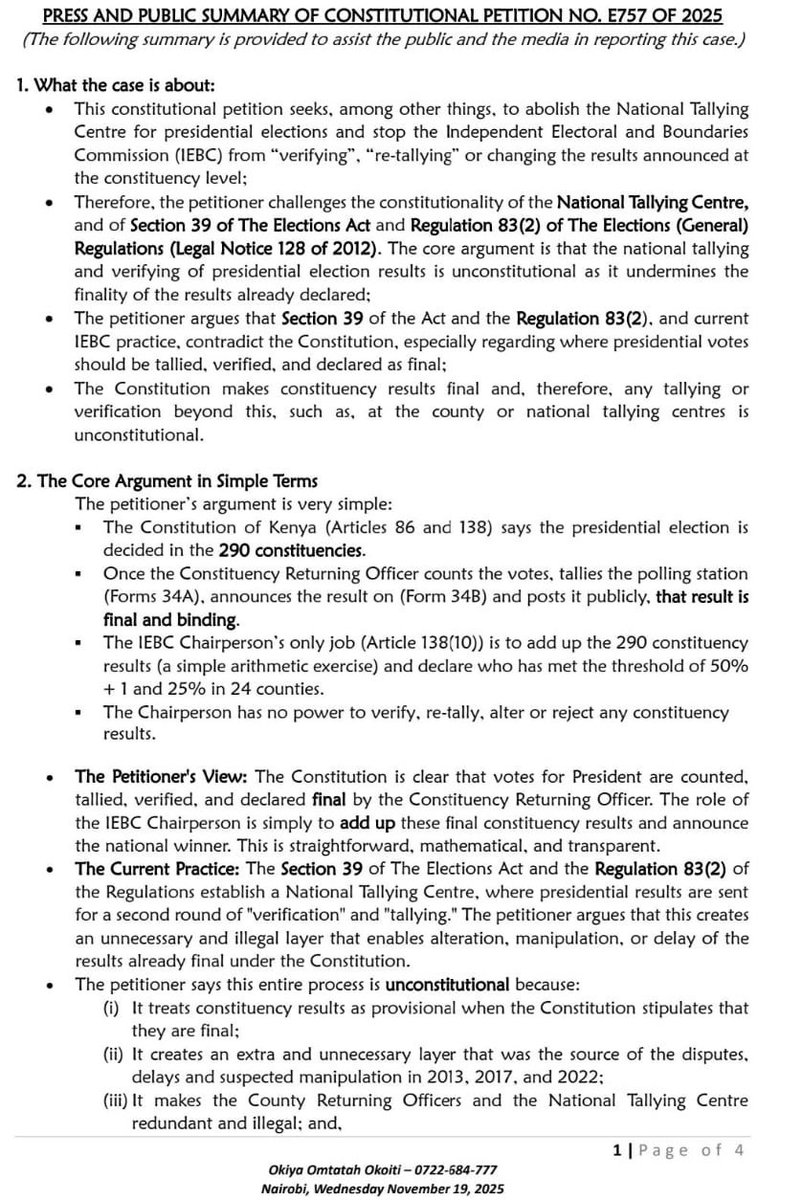
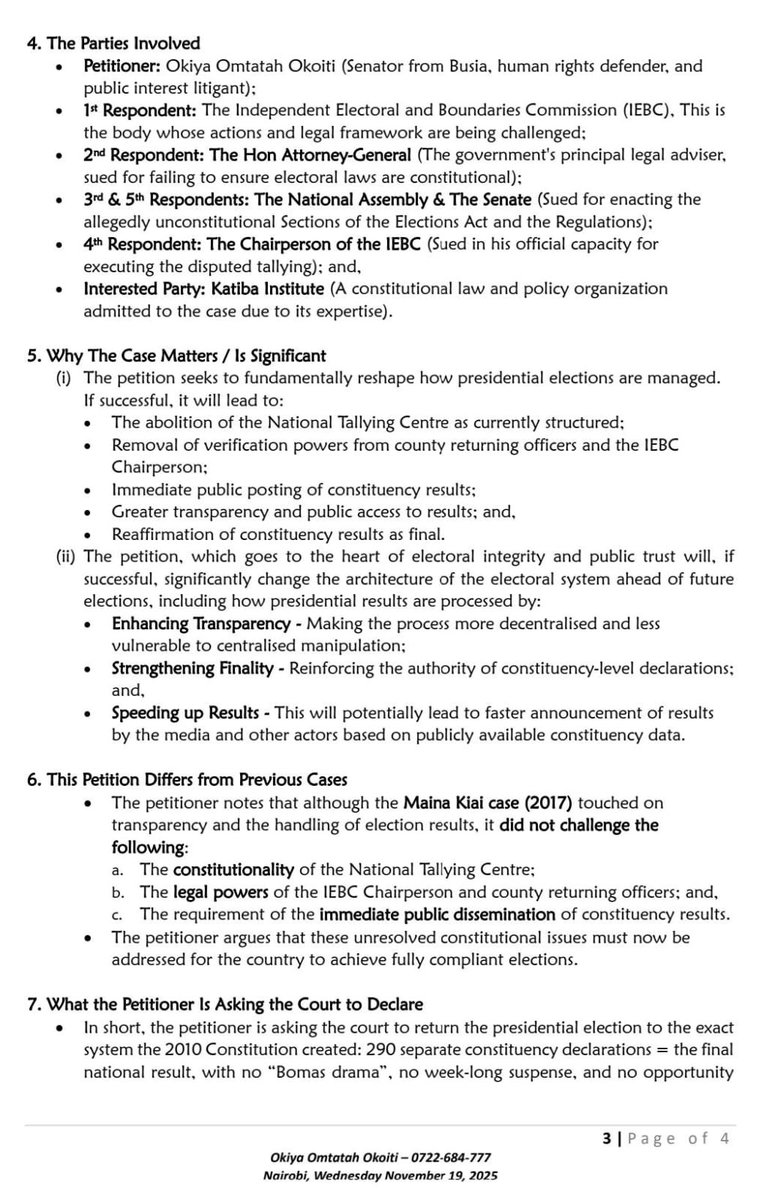
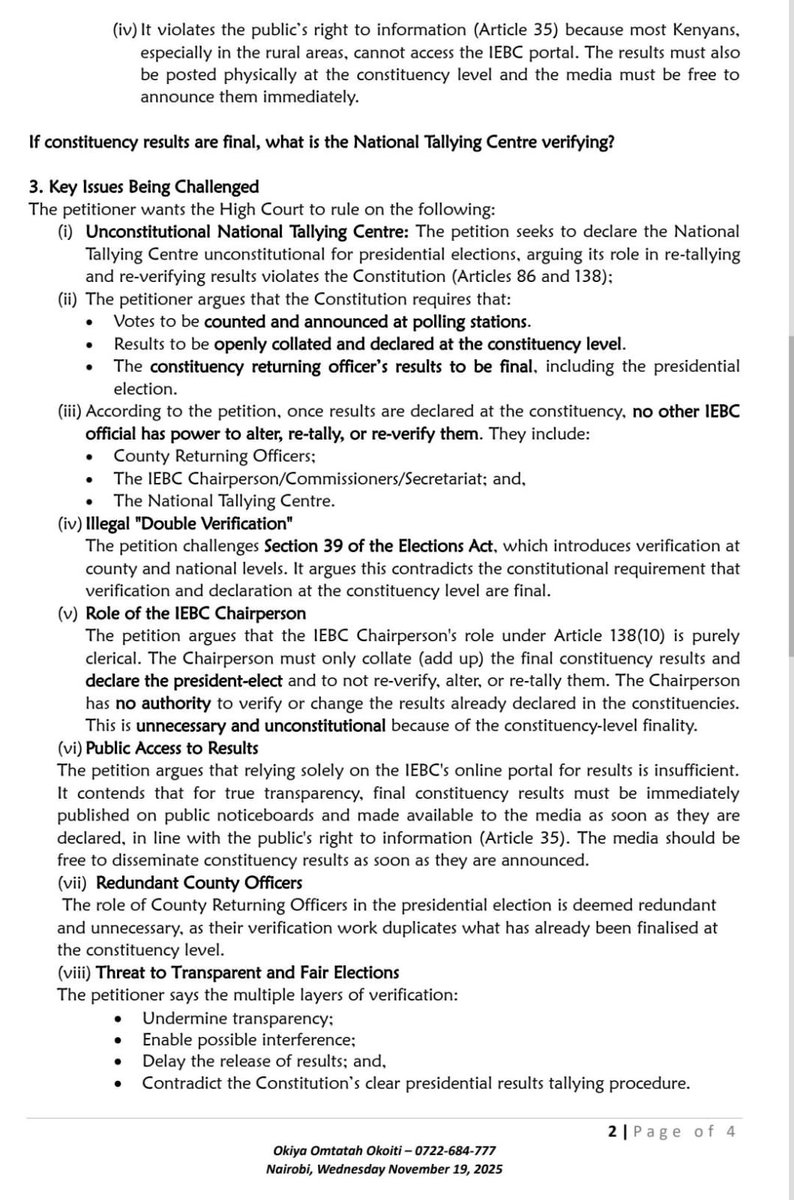
I have filed a Constitutional Petition No. E757 of 2025 in the High Court to defend the integrity of Kenya’s presidential election process and to uphold the Constitution of Kenya, 2010.
This petition challenges the unconstitutional establishment and operation of the National Tallying Centre during presidential elections, as well as Sections 39, 39(1C), 39(1G) of the Elections Act and Regulation 83(2) of the Elections (General) Regulations.
The Constitution is clear:
✔️ Presidential results are tallied, verified, and declared at the 290 constituencies, and those results are final and binding.
✔️ The role of the @IEBCKenya Chairperson under Article 138(10) is strictly clerical; to add up constituency results and declare the winner.
❌ The Chairperson cannot verify, re-tally, alter, or overturn any constituency result.
❌ No law or regulation may introduce a second layer of verification at county or national level.
Yet, current laws and @IEBCKenya practice unlawfully create a parallel system of verification at the National Tallying Centre, which:
• Treats final constituency results as provisional;
• Enables interference, manipulation, and delays;
• Undermines transparency and fuels mistrust;
• Violates the people’s sovereign will as expressed at the constituency level.
This petition seeks, among other declarations:
🔹 Abolition of the National Tallying Centre as currently constituted;
🔹 Quashing of unconstitutional provisions in the Elections Act and Regulations;
🔹 Immediate public posting of final constituency results at each constituency;
🔹 Removal of illegal verification powers from County Returning Officers and the IEBC Chairperson;
🔹 Restoration of strict compliance with Articles 86 and 138 of the Constitution.
If successful, this petition will fundamentally transform the management of presidential elections from 2027 onwards, ensuring a transparent, decentralised, and constitutionally faithful process with no “Bomas drama” and no ambiguity.
Our democracy must be anchored not on improvised systems, but on the letter and spirit of our Constitution. This petition is part of my continued commitment to defend the rule of law, protect the sovereign will of the people, and secure free, fair, and credible elections.
Article 10 of the Constitution is not a suggestion. It is a binding obligation on every State organ.
When the government borrows in our name, it must uphold the national values of transparency, accountability, integrity, and public participation. Article 201 reinforces this by requiring openness, accountability, and public participation in all financial matters.
Public debt is not the government’s debt. It is the people’s debt. Every loan signed today will be repaid by Kenyans through taxes, now and for generations to come.
Before any government commits the nation to more debt, Kenyans have a constitutional right to know why the money is being borrowed, how it will be spent, what it will cost, and what benefits it will deliver.
Borrowing without meaningful public participation is not just poor governance. It is inconsistent with the values and principles of our Constitution.
#KnowYourConstitution #ReKe
Article 1 and Article 38 of the Constitution state that all sovereign power belongs to the people of Kenyaexercised directly or through elected representatives.
Voting is not a cultural festival, a tribal tally, or an emotional ritual. It is hiring a Management Team for your tax money.
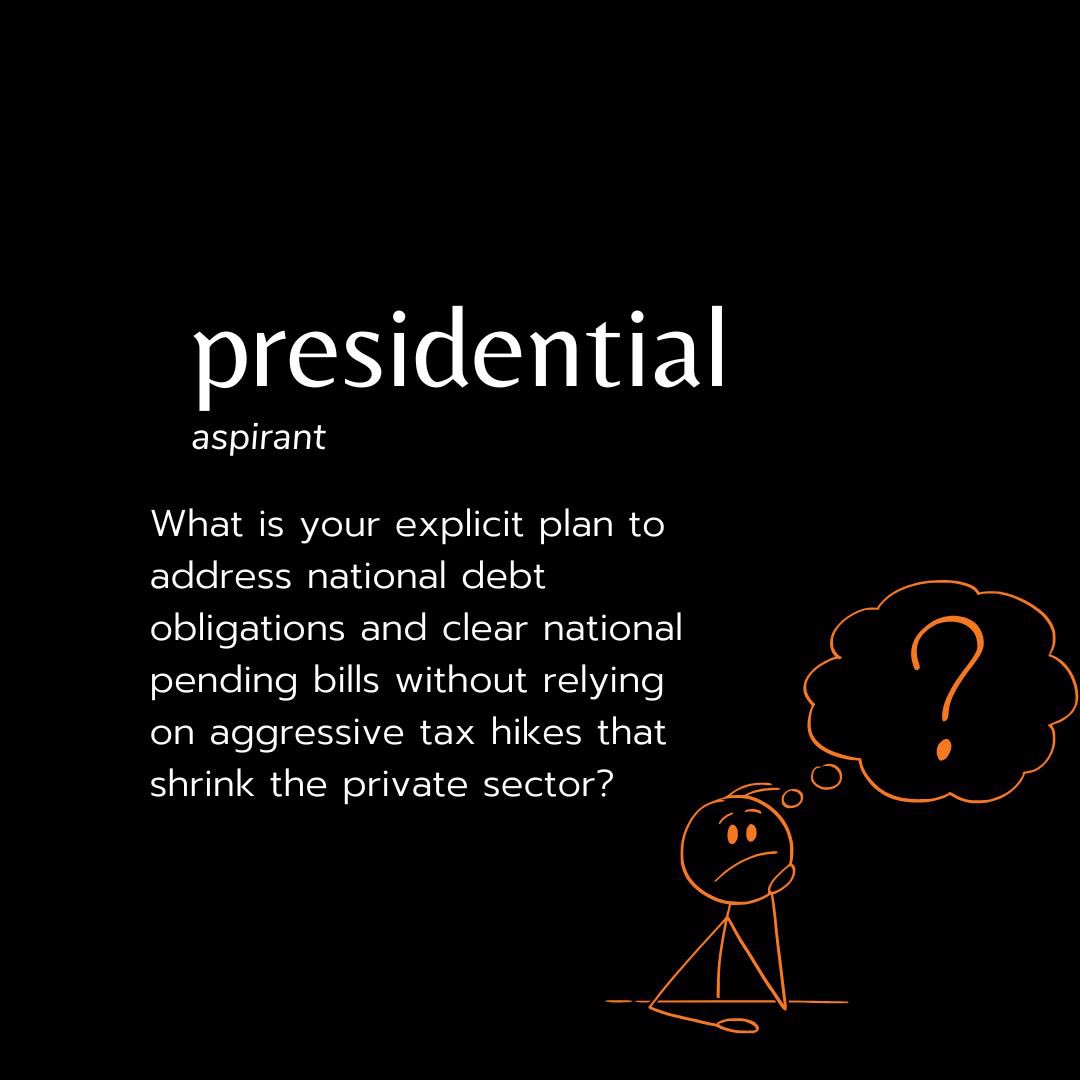
When a candidate promises "free development," "guaranteed funds," or "economic miracles" at a rally while refusing to explain how they will manage public debt, clear pending bills, or fund basic healthcare, they are asking you for a blank cheque.
Tunakagua alafu we fix it at the ballot!!
Can we get an explanation as to why salaried Kenyans are compelled to contribute to the Housing Levy to construct houses on public land; land held in trust for all citizens , only to be required to purchase these same houses from intermediaries who profit from public contributions despite adding no value? What legal or policy justification exists for taxing citizens to build public housing, then selling those same houses back to them at a profit?
Why is there no clearly defined end date or sunset clause for the Housing Levy? At what point will the government declare that it has collected enough?
How much money has been collected so far, how much has been spent, and where is the independently audited, project-by-project account of those funds?
If workers are financing the construction, why are they not granted an equitable ownership interest or priority rights proportionate to their contributions?
Why should Kenyans continue making mandatory monthly contributions if there is no guarantee they will ever own one of the houses they are helping finance?
Why should citizens pay for houses built on public land while also bearing the cost of the land through their taxes?
How are the profits made by intermediaries justified where the land is public and the construction is financed through compulsory public contributions?
If the programme is intended to serve the public interest, why are all contracts, procurement decisions, and financial statements not published proactively for public scrutiny?
Most importantly, how does a compulsory levy that requires citizens to finance construction and then purchase the finished product satisfy the constitutional principles of transparency, accountability, equity, and prudent use of public resources?
Taxpayers deserve more than assurances. They deserve clear, evidence-based answers to these questions.