Exactly. A factory is an optimized process that the an agent team can follow. The best of both worlds if you don't have to build that process yourself 😆 The Hermes Agent @NousResearch Kanban system includes so many of the necessary features for a factory to work successfully, which is why I use it (not affiliated in any way).
https://t.co/4HpDQUROxP
I once put an LLM into a logic death spiral by prompting it to always include at the end of it's response, any potential problems that their response didn't cover.
It always produced a reason why it's answer could be wrong or could fail to achieve the goal.
Every response ended up like:
"Yes, this is the correct solution.
The solution might now work because..."
I used Hermes Agent @NousResearch to reclaim 5 GB of RAM on my Windows PC. The 8 GB PC was committing 9 GB of resources on start-up. It is now down to 4 GB.
1. It found and fixed a 2 GB memory leak in my PC's audio driver.
2. It identified the WhatsApp desktop app consuming 8x WebView processes instead of 1x using the website version.
3. It identified and removed bloatware and old programs I didn't use anymore.
The Hermes Agent @NousResearch features I use and love the most:
1. The native Kanban system, without this it's just another chat bot.
2. Hermes Agent Desktop App on a Windows PC, easier navigation than using the terminal.
3. Desktop App In-App Brower, a Generative UI that you and the agent can collaborate on.
4. Customize it via Plugins. Everything I build becomes a plugin that can be moved between servers and shared with other users.
What are yours?
Interesting experiment results. I've been doing this all week and now I'm convinced that the first answer an LLM generates is super wrong. They provide the most superficial and obvious answer they can. There is no reasoning going on.
"LLM: The answer is ABC.
ME: Is this the logically correct, most direct solution to the correct root cause of the problem?
LLM: No, the answer is actually DEF"
And the average is 2 loops before getting to a "yes that is the correct logical answer". As high at 8x.
8x! It was 8 revisions away from the correct answer!
If I had done a normal loop of asking it to figure out the answer and then implement the first answer it provided, my entire result would be useless garbage right now.
I had an agent create an Android App Game Builder workflow using my 29 workflow architecture requirements. As part creating the workflow it actually built an app that is installable and playable and fully functional.
@JoshARosen Good call! This sounds like the deterministic approach to loading context. Instead of an error prone step to dynamically find context on-demand, you setup the context to load at the step it is needed.
The easiest way to get started with profiles/bots (these are the same thing) is to ask your default profile to create a specialized agent profile/bot to either perform a specific task or a specific role. Tell it to configure the profile to be optimized for the role or task.
When you are ready to chain specialized agent profiles into a chain for complex workflows, then the kanban system comes into play.
And copy over all your default profile's skills and tools to begin with so that you don't get failures because one is missing. Once you figure out what you don't need you can remove them as needed.
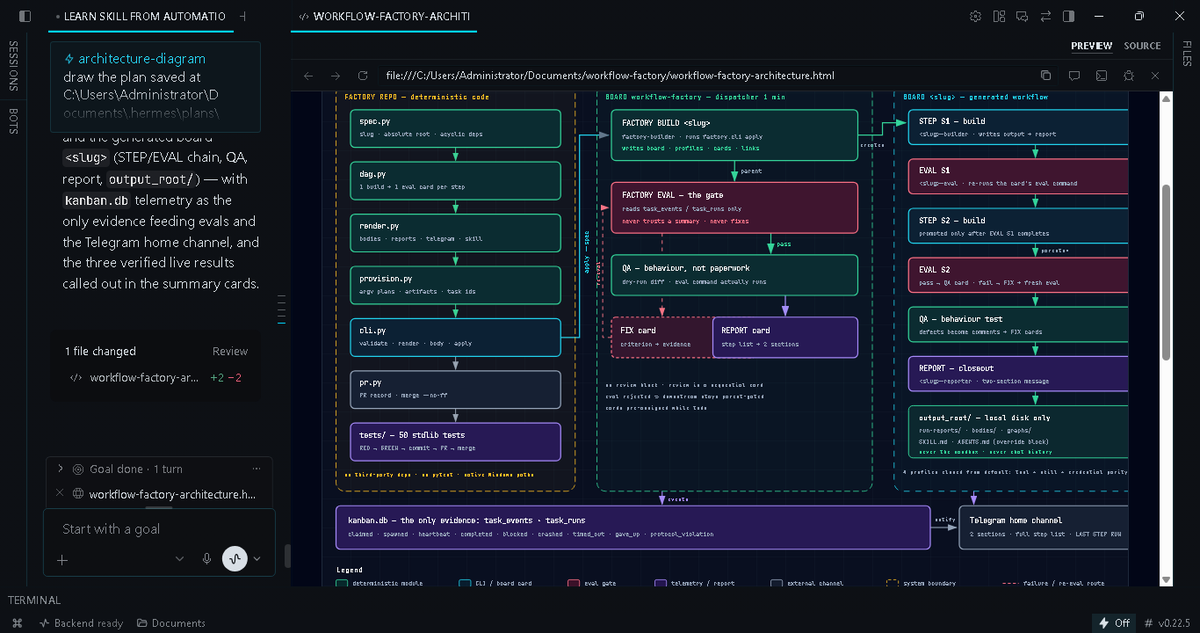
The architecture diagram of my automated workflow that builds other automated workflows.
Produced by the /architecture-diagram command in Hermes Agent @NousResearch .
The Hermes Agent @NousResearch desktop app's in-app browser that the agent can see and interact with live in collaboration with the user is one of the most useful features.
I use it every day!