What are the implications of Russia's war in 🇺🇦 for the 🇪🇺 defense industry? How does this peculiar industry work in general? I address these questions in a cluster for the open science platform @tema_think. The special input https://t.co/YaSgHWbCSa synthesizes /1
Great piece by @hoshigi_nam and @W_Alex_Sanchez on how vital exports are for second-tier arms producers to sustain production! It begs the question: To what extent do the expectations of those exports drive production decisions?
In their new article, Hoshik Nam (@hoshigi_nam) and Wilder Alejandro Sánchez (@W_Alex_Sanchez) discuss the growth of the South Korean defense industry and how expanding into the Latin American market offers an opportunity for diversification. https://t.co/Kz2BiB3BaW
I’m excited to share my first article on @WarOnTheRocks with @W_Alex_Sanchez! If you want to learn more about the current issues and future prospects of the South Korean defense industry and its potential impact in Latin America, check out the article!
https://t.co/sY6xdvDCgk
"Markets in Defense of Europe" is most likely going to be my favorite article title. Together with @kaijaschilde, I had the opportunity to advance our argument on how the European Union can leverage its regulatory authority to shape the European defense/1
fiscally sustaining demand. Or, as we argue, defense inflation will return with a vengeance, posing an obstacle to the sustainable provision of defense as a public good at the national level. A better functioning European defense market through EU regulation is not just /5
My latest article for @esutde closely examines @SIPRIorg's international arms transfers data, an invaluable resource for researchers, civil society, and policymakers. @SIPRIorg deserves immense credit for providing this public good, and the annual data releases rightfully /1
It is important to note that @SIPRI data captures only international armament dynamics and does not account for domestic or cooperative arms procurement. I conclude by highlighting a few trends relevant to Europe, focusing on the largest importers and exporters and their /5
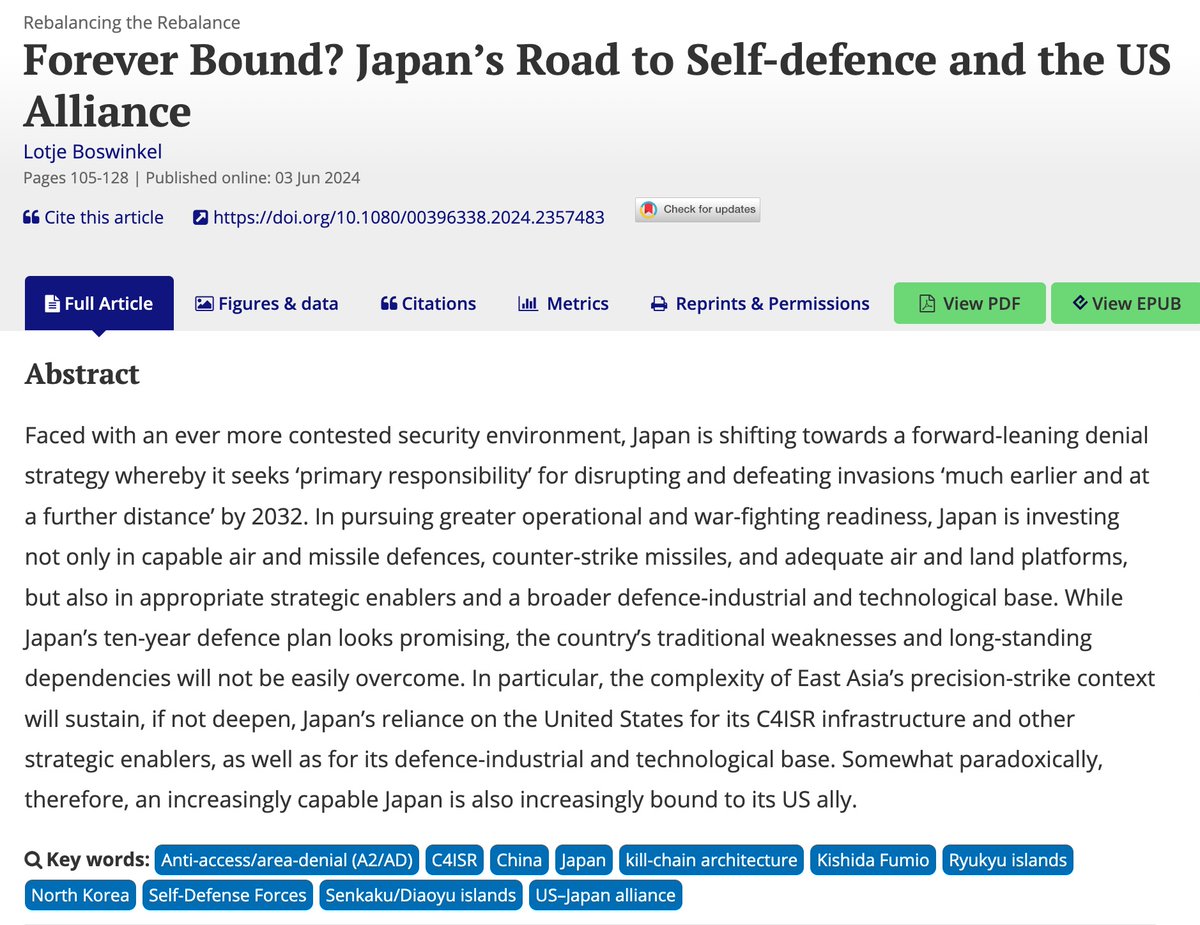
Could not be more excited to be included in the latest @SurvivalEditors issue with my article 'Forever Bound? Japan’s Road to Self-defence and the US Alliance' exploring the promises of Tokyo's defence reform:
➡️https://t.co/jfR7LaErWw
Not that I'm opposed to ramping up production, but reducing this to a matter of 'will' and/or 'pressure' ignores decades of defense economics research. Neither the transformation of civilian industrial capacity into defense industrial capacity nor the application of 1/2
This is unfortunately quite accurate. Diehl and Hensoldt are already among the few German arms manufacturers that have established an automated product line for IRIS-T SLM, but it's far from enough.
Germany remains an industrial powerhouse capable of converting its civilian manufacturing capacity into military capacity -- and grow its stagnating economy in the process --, if only the will and pressure were there.