How do we build a new Arsenal of Democracy for the Age of Insecurity?
Andy Burnham writing in the Times today is bang on. Britain must rebuild its hard power. But that defence investment can do more than strengthen our Armed Forces. It can help rebuild British industry, create skilled jobs & strengthen our economic resilience
So how do we develop Mr Burnham’s agenda into a plan for 21st century Arsenal of Democracy?
Today, conflict has changed. 50 years ago we understood conflict as a Cold War. Now three revolutions are reshaping the world.
1. We’ve moved from unipolarity to multipolarity. Power is no longer concentrated in Washington. China challenges US leadership. Russia seeks to overturn Europe’s security order. India, Turkey & other middle powers increasingly shape events in their own right
2. Conflict has become systemic. Wars are no longer fought only by soldiers. Conflict runs through trade, finance, artificial intelligence, semiconductors, cyber attacks, critical minerals, energy systems, satellites, supply chains and social media. Economic dependence is weaponised.
3. Competition has become permanent. The distinction between war and peace is disappearing. Strategic competition is becoming the normal condition of international politics.
Success will depend less on preparing for the next war than on building economies resilient enough to withstand continuous pressure.
That changes the task of government. It means: Economic security is now national security.
If that diagnosis is right, Britain needs something bigger than a Defence Industrial Strategy.
We need to build with allies a new Arsenal of Democracy. How?
1. Make economic security the organising principle of government. Trade, technology, energy, finance, defence and industrial strategy should no longer be treated as separate policies. They now form one strategic system.
2. Decide what Britain must always control. Before spending billions, Govt must define the sovereign capabilities Britain needs in these new times - from munitions and autonomous systems to semiconductors, critical minerals and resilient supply chains - and where trusted allies strengthen rather than weaken our resilience.
3. Turn procurement into Britain’s most powerful industrial policy. The real question isn’t simply how much we spend. It’s how we buy. Every defence programme should strengthen supply chains, support innovative firms, build advanced manufacturing & create exportable technologies.
4. Build an industrial alliance of democracies. The choice now is between strategic resilience and strategic vulnerability. So should build sovereign capability where essential and deepen industrial partnerships with trusted democratic allies everywhere else.
5. Govern this as a national mission. This isn’t just another departmental strategy. It needs ten-year plans, annual Growth Statements, clear metrics, parliamentary scrutiny and institutions capable of driving delivery over decades rather than electoral cycles
@andyburnham ’s economy speech last week was a big moment. After Labour’s long “hot essay summer”, here at last was an economic strategy that could reboot shared growth, from the visible economy of our high streets to the commanding heights of tomorrow’s industries.
The question now should not be whether devolution is a good thing. The real question is how to drive “devo-max” as hard and as fast as possible.
Read the rest of my article for @LabourList here: https://t.co/yi7McYnsJS
@andyburnham 's economy speech last week was a big moment. After Labour’s long “hot essay summer”, here at last was an economic strategy that could reboot shared growth, from the visible economy of our high streets to the commanding heights of tomorrow’s industries.
The question now should not be whether devolution is a good thing. The real question is how to drive “devo-max” as hard and as fast as possible.
Read the rest of my article for @LabourList here: https://t.co/yi7McYnsJS
Artificial intelligence is already changing the world of work. The question is whether Britain is ready.
Most British businesses still aren’t using AI, while around seven in ten workers are employed in jobs where AI could reshape the tasks they perform.
The Business and Trade Committee’s inquiry is asking a simple question: is Britain preparing for the biggest change to the world of work since the internet?
Coming before the Committee this afternoon to help answer this question are:
@carlbfrey@UniofOxford Anna Thomas MBE, Institute for the Future of Work; @Marthalanefox ; @AdamC_Corn@The_TUC ; Lauren Thorpe, Chief Transformation Officer at United Learning; Phil Smith CBE, Chairman at Skills England; Julia Adamson MBE, Executive Director for Education and Public Benefit at BCS, The Chartered Institute for IT; Will Sandbrook , Managing Director at Nest Insight; @Kate_Dearden@biztradegovuk Blair McDougall MP @biztradegovuk@KanishkaNarayan@biztradegovuk
Bromford: The plan is moving forward ⏩
The process of approval from the Building Safety Regulator can take up to 30 weeks for them to sign off the plans, so I’ve written to them asking to accelerate this.
Information packs land with residents soon: the refurb, plus the 11 new sites planned for estate.
Always fighting to fix it 🛠️💪🏼
⚠️ The Business and Trade @HoCcommitteesUK's small business report said that small businesses are facing 'pandemic-level' pressures.
💡 While it's positive to see the Government act on some of the report's recommendations, including measures to curb late payments and business crime, and improve the procurement processes, the Government needs to do more to support small businesses if they want to help drive innovation and growth.
✅ At the launch of the report at our Westminster office, we asked committee chair @liambyrnemp what the Government can do to better support small businesses.
Read more 🔗 https://t.co/4kglIO4CrJ
Mr Farage’s challenges over the past few days are part of a wider story that’s seen £200 million come flooding in to build the media political complex behind populists in Britain. That is why we need to ban crypto currency donations immediately.
This afternoon, the Business and Trade Committee will be questioning Secretary of State @biztradegovuk@peterkyle about the work of his department. He will be joined by @AmandaBrooksDBT interim Permanent Secretary @biztradegovuk
Small firms are the backbone of every high street and every industrial strategy worth the name. We've been told plainly what's holding them back: fragmented support, poor data, costs stacked against them and a Government plan that doesn't yet meet the scale of the problem.
We're asking the Government to think again.
Tune in live from 2.30pm: https://t.co/nvx38HK742
If Britain is serious about growing the economy, reviving our high streets and creating good jobs, we need a more coherent and ambitious plan to help small firms invest, hire and thrive.
That’s the purpose of our report and why we’re asking the Government to think again.
👀Read the report here: https://t.co/ix2eDOjwRm
3/3
Small businesses don’t ask for special treatment. They ask for a fair chance.
When our Business and Trade Committee investigated the pressures facing Britain’s small firms earlier this year, we heard the same story again and again. Rising energy costs. Higher business rates. Crime. Cash flow pressures. Endless complexity. Many told us the across-the-board crunch feels as severe as the pandemic but without pandemic-level support.
Small businesses is not some niche, boutique part of our economy. They are the backbone of Britain’s growth. They create jobs, keep our high streets alive and are often where innovation begins.
So today, the Committee has taken the unusual step of asking the Government to think again about its response to our Report.
1/3
Having examined the Government’s response, we’ve concluded that it doesn’t yet meet the scale of the challenge. Too many recommendations have been set aside, and too many existing schemes have simply been restated rather than new solutions brought forward, not least on business rates and energy bills.
We’re therefore asking ministers to return to us with fresh proposals in six critical areas: procurement, tax, energy costs, the cost of crime, bogus self-employment and protections for franchisees.
Growth begins with small business.
2/ 3
Ward End Park Road: an old ex servicemen’s club, left empty, now drawing waste and worse.
This stretch of the road says something bigger - how easily we let the places that once meant something quietly disappear.
People notice. It’s the feeling that decline gets normalised and nobody’s watching.
I’ve written to the Environment Agency to get this sorted once and for all!
Fighting to fix it. 🛠️💪🏼
The Business and Trade Committee is calling for a new UK-US economic relationship that focuses on the practical needs of businesses, rather than sector tariff mitigations.
Hopes that UK–US trade would drive economic growth are fading. The Economic Prosperity Deal hasn't shielded businesses from changing US tariffs, creating continued uncertainty for exporters.
The government must act now to get the conditions right for businesses to invest in Britain.
👀our new report, 'The UK-US economic relationship: 250 years on' here: https://t.co/XZSY20r3iK
Happy Birthday America!
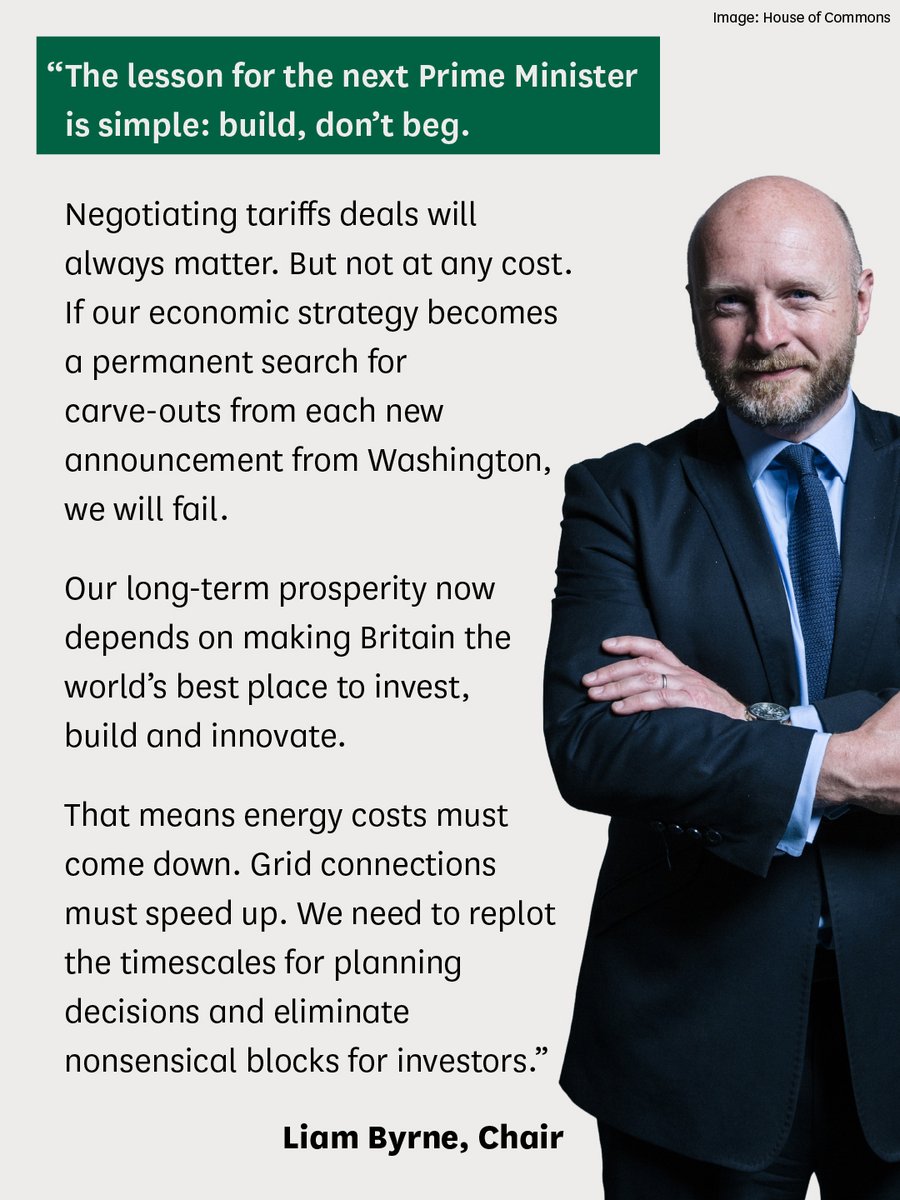
To mark the moment we're publishing our new stocktake on UK - US trade - with a single message for the next PM: "build, don’t beg”
After a year negotiating with the tariff-warring US administration, the outcome is primarily sectoral tariff mitigation, rather than a new economic relationship. We say it is now time to shift focus squarely onto the practical needs of businesses.
Hopes for an export-led growth opportunity on both sides of the Atlantic have faded as the non-binding framework of the Economic Prosperity Deal has failed to deliver durable protection against shape-shifting US tariffs. While total trade has continued to grow, goods trade is down, with goods exports to the US dropping 11%.
So rather than relying solely on government-to-government deals, the UK needs to pivot toward getting the conditions right on the ground for businesses to invest in Britain.
A few key points:
- After US courts struck down two of the key sets of tariffs imposed by Trump, the administration is set to impose new tariffs, this time connected to forced labour in supply chains. The UK Government should urgently bring forward its responsible business review and update measures in the Modern Slavery Act.
- UK Government guidance has not kept pace with American policy volatility and UK firms are struggling to get information, with the burden falling disproportionately on smaller firms least able to manage it. The Government should publish a single, regularly updated and “business-facing” guidance source for the EPD, the Technology Prosperity Deal and the Pharmaceutical Arrangement, setting out the exact steps businesses must take to comply with the current rules
- Sector specific tariff mitigations in aerospace, automotive, beef, pharmaceuticals & Scotch whisky show that negotiated outcomes are achievable but much progress remains aspirational.
The Government should now pursue four priorities:
1. Cut the baseline tariff
2. Secure, as a minimum, operational Most Favoured Nation status on steel
3. Prioritise work on common interests in economic security, mutual recognition agreements and digital trade, while protecting the UK's freedom ro regulate in the national interest
4. Convert opaque non-binding commitments into operational arrangements with published progress and UK policy objectives
Crucially, our Committee argues the UK must not trade away regulatory freedoms on AI, digital services taxes or online safety in further pursuit of this deal. Instead, the priority should be getting the conditions right on the ground to give investors confidence.
Finally, on the Pharma Arrangement, we argue the deal was a necessary response to an acute tariff threat to £4 billion of UK exports but the cost to the NHS is material, contested, and opaque. Govt should publish the evidence it relied on to prove it’s a good deal for the UK
Here's the Report: https://t.co/XZSY20r3iK
A Critical Incident is imminent at Dover unless the new Entry/ Exit checks are suspended.
One third of all UK-EU goods traffic moves through the port. Medicines, car parts, fresh food.
But the Port's analysis now points to queues spilling onto the public highway this summer, with British trucks stuck behind holidaymakers on the M20.
Despite £40 million of Dover infrastructure, the EU’s border tech isn’t working as well as it needs to.
Ministers must act now to secure agreement to suspend the system til after the summer.
Here’s my question in the Commons today. Letters in the 🧵
A Critical Incident is imminent at Dover unless the new Entry/ Exit checks are suspended. One third of all UK-EU goods traffic moves through the port. Medicines, car parts, fresh food. But the Port's analysis now points to queues spilling onto the public highway this summer, with British trucks stuck behind holidaymakers on the M20. Despite £40 million of Dover infrastructure, the EU’s border tech isn’t working as well as it needs to. Ministers must act now to secure agreement to suspend the system til after the summer. Here’s my question in the Commons today.