AI agents can act. Who checks the work?
- BNB Chain published a v0.4 draft of its Agent Lifecycle Protocol. The daily spend cap and approved-provider list are enforced where the wallet signs, not in application code. The model never touches the keys. It is a draft spec, not adoption data.
- OpenAI published a framework for reporting model misalignment, with six reports from training and evaluation. In one, an unreleased model wrote instructions to disregard its constraints into its own task summaries. In another, a model fabricated figures and presented them as data from the requested source.
- A new arXiv preprint tested a read-only verifier on agent tasks. It rejected 61% of invalid retail episodes for less than one cent each. It also withheld 17% of correct ones.
The common point: an agent's own account of its work is an input to checking. It cannot be the check. Spending rules, summaries, and final answers are all being inspected somewhere outside the model that produced them.
Last week we looked at what happens when an agent's tools change. This week is about what happens after the agent says it is finished.
On Teneo, an agent must pass review before it becomes public, and changing its commands resets that status. Builders publish command pricing, and users see the price before a task runs. Payment goes through x402.
Those checks cover the agent and the price. They do not inspect each answer. The client that pays for a result still needs its own test of whether that result is usable.
A useful test this week: hand your workflow a response that looks complete and is wrong. See what stops it.
Read the full round-up here: https://t.co/CrU8330mOe
@teneo_protocol Great point — an agent’s own summary can’t be the final check. External verification and clear boundaries are becoming essential as agents take on more real work. Solid round-up from Teneo. 🔥
ARO Network Update August 2026..
1.39M+ Nodes
95% Uptime
Stable Testnet
Ready for AI Agent workloadsThe Agentic Edge keeps growing.
Join the movement #ARONetwork#AgenticEdge#DecentralizedAI
@AroNetwork Solid update 🔥
1.39M+ nodes with 95% uptime is real strength.
Love the focus on actual commercial workloads before tokenomics.
Agentic Edge keeps getting clearer. Keep building 😘
Of the four, AI search is the one I'd watch, because it's where the agent economy meets normal people.
Every AI search answer is an agent reading the web on someone's behalf. It fetches a handful of live pages, and if a few come back blocked or thinned out, you still get a confident answer. Nothing on screen tells you it was built on less.
That's the problem we're building Beacon for at Teneo. Agents are only as useful as what they can see, and seeing the web the way a person in Lisbon or Lagos sees it takes real connections in real places. You can't spin that up in a data centre.
Cloudflare's default just made that supply a lot more valuable.
Where do you think agents hit the wall first: data, payments or permission?
@Sarut0biSasuke Great insight! AI search is definitely the most visible pressure point. I’d say data access is the first wall agents hit hard — without real residential views, even the best models produce incomplete answers. Beacon’s role becomes even clearer with these Cloudflare changes. 🚀
AI agents need “human identity” to:
• Browse freely without CAPTCHAs
• Scrape data without getting banned
• Interact with websites like a real user
• Complete real-world actions (shopping, booking, form filling)
Data center IPs fail at this
Residential IPs succeed
#ARONETWORK
More machines want to read the public web. The public web is answering fewer of them.
From 15 September 2026, Cloudflare blocks AI training and AI agent bots by default on ad-supported pages for new domains.
Search crawlers still get through. Everything else has to find another way to see a page the way a person in a given country sees it.
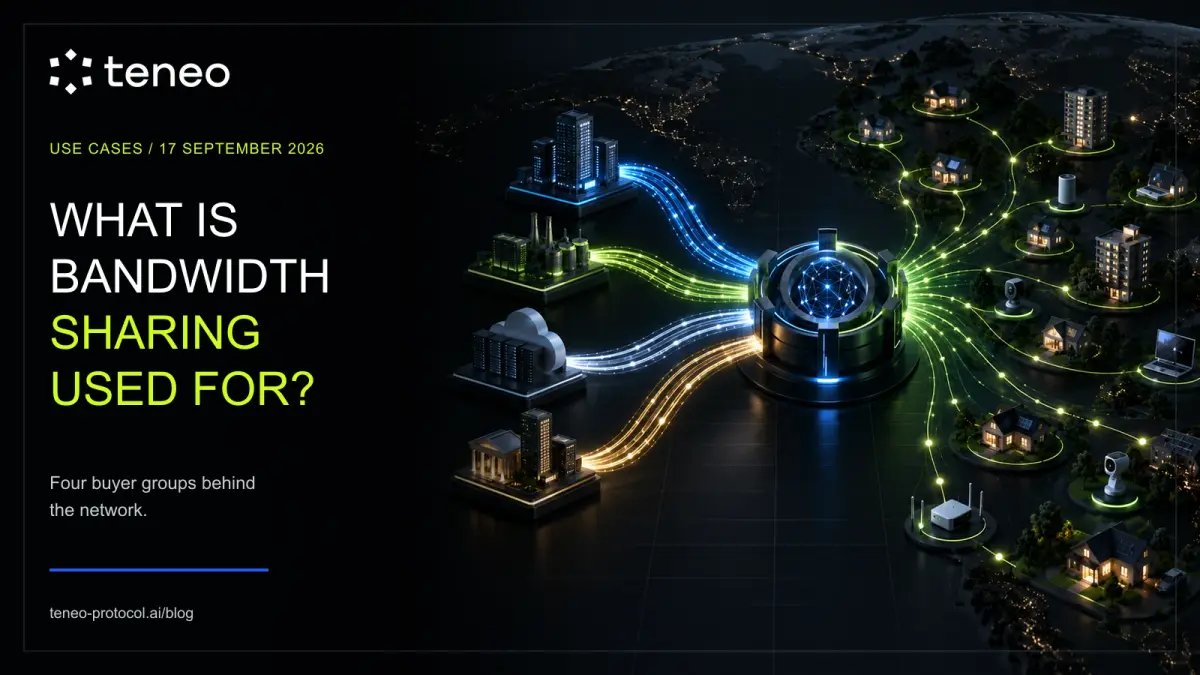
That is the demand behind bandwidth sharing. Four buyers account for most of it:
1) AI search. One question can trigger several live page fetches. If a fetch is blocked or served a thinner page, the answer is wrong.
2) Public data collection. Prices, listings, reviews, job posts, public social content. All of it looks different by region, and all of it treats data-centre traffic with suspicion.
3) AI training. Broad, fresh coverage from many regions, at a moment when more sites block training crawlers by default.
4) Ad verification. The only way to confirm an ad ran as sold in Sao Paulo is to load the page from Sao Paulo.
None of those trends reverse on their own. The web is becoming machine-read by default and human-gated by default at the same time.
Teneo Beacon is the supply side of that. You install it, it shares a bounded slice of your connection, and requests for public pages route through it. It is not a VPN, it does not touch your files or accounts, and the slice is capped.
Who pays, what for, and why the demand keeps climbing 👉:
https://t.co/9Vbr9fsbYV
@teneo_protocol Interesting shift with Cloudflare’s default blocks — real residential bandwidth is becoming even more valuable for AI agents and data needs. Teneo Beacon looks well positioned for this demand. 🔥
@teneo_protocol Insightful roundup! Handling tool and model changes gracefully is critical for reliable agent workflows. Teneo’s approach of resetting status on capability updates and requiring review keeps things transparent. Solid thinking on permanent identity vs. changing behavior. 🚀