POWERFUL HEALING PRAYER ATTRIBUTED TO SAINT PADRE PIO
Heavenly Father, I thank You for loving me. I thank You for sending Your Son, Our Lord Jesus Christ, to the world to save and to set me free. I trust in Your power and grace that sustain and restore me.
Loving Father, touch me now with Your healing hands, for I believe that Your will is for me to be well in mind, body, soul and spirit. Cover me with the most precious blood of Your Son, our Lord, Jesus Christ from the top of my head to the soles of my feet.
Cast out anything that should not be in me. Root out any unhealthy and abnormal cells. Open any blocked arteries or veins and rebuild and replenish any damaged areas. Remove all inflammation and cleanse any infection by the power of Jesus’ precious blood.
Let the fire of Your healing love pass through my entire body to heal and make new any diseased areas so that my body will function the way You created it to function. Touch also my mind and my emotion, even the deepest recesses of my heart.
Saturate my entire being with Your presence, love, joy and peace and draw me ever closer to You every moment of my life. And Father, fill me with Your Holy Spirit and empower me to do Your works so that my life will bring glory and honour to Your holy name.
I ask this in the name of the Lord Jesus Christ.
Amen.
You should know by now St Charbel is one of my favorites🥰
Need a miracle?
Ask for the intercession of St. Charbel Makhlouf!
Modern-day miracles of this great Saint;
A blind woman from Arizona was healed in 2016 after venerating the relics of St. Charbel. The medical committee investigating the miracle admitted, "We have no medical explanation and therefore believe this to be a miraculous healing through the intercession of St. Charbel.”
In France, a baby boy was destined to die, so the family used some oil from St. Charbel's tomb and prayed a novena to St. Charbel for a miraculous healing. According to the family, "The doctors told us that he would sleep more and more and eat less and less. Instead, he was becoming increasingly alert and continued to drink his bottles in small doses. At the end of September, Côme was evaluated again. To our joy and to the astonishment of the doctors, his condition had improved so much that it was determined he would live ... The Blessed Virgin and St. Charbel protected him."
There are many more miracles reportedly dedicated to St. Charbel, proving that God enjoys working miracles through this humble Lebanese saint.
A Powerful prayer to Saint Charbel in times of need
O Lord, infinitely holy and glorified in your saints, you inspired the holy monk and hermit Saint Sharbel to live and die in the way of Jesus Christ and gave him the strength to detach himself from the world in order to make the monastic virtues triumph in his hermitage.
We implore you to bestow upon us the grace to love you and to serve you by following his example.
Almighty God, who manifested the power of Saint Sharbel’s intercession by numerous miracles and favors, grant us, through his intercession, this grace (state your intention).
Amen.
Our father, Hail Mary, Glory be.
While we are never "guaranteed" a miracle when praying to God through a saint, the process can often transform our hearts and help us be prepared for whatever plan God has designed.
The Four Saints of the Impossible Causes
When life throws you a challenge that feels completely hopeless, when every door seems slammed shut and prayer feels like shouting into the void:
these four heavenly intercessors are the ones, the faithful have turned to for centuries.
Meet the powerful quartet :
. St. Rita of Cascia,
. St. Jude Thaddeus,
. St. Philomena, and
. St. Gregory Thaumaturgus (the Wonderworker).
They’re known in the Catholic Church, as the patrons of impossible, desperate, and lost causes.
1. St. Rita of Cascia... The Saint of the Impossible
A 15th-century Italian wife, mother, widow, and Augustinian nun, Rita endured an abusive marriage, her husband’s violent murder, and the tragic deaths of her two sons. Yet she chose forgiveness over revenge and miraculously entered the convent against all odds. She’s famous for the thorn from Christ’s crown embedded in her forehead and for making a rose bloom in the dead of winter.
If your situation looks utterly impossible, St. Rita is the one who specializes in “no way out” miracles.
2. St. Jude Thaddeus... Patron of Hopeless Causes
One of Jesus’ twelve apostles (often called “Jude the Obscure” to avoid confusion with Judas Iscariot), he carried the image of Christ and preached the Gospel fearlessly. Because people hesitated to invoke his name, he became the go-to saint for the most desperate cases, the ones everyone else had given up on
In the painting, you see him holding that sacred medallion and his staff, ready to intercede when hope has run dry.
3. St. Philomena.... The Wonder-Working Virgin Martyr
A young girl from the early Church who refused marriage to a Roman emperor and was martyred for her faith, Philomena is depicted here with her flower crown and lily (symbols of purity and innocence).
After her relics were discovered in 1802, an explosion of miracles followed,so many that she earned the title “Wonder Worker.” She’s invoked for impossible healings, protection, and breakthroughs in seemingly incurable situations.
Her story reminds us that even the smallest, forgotten souls can move mountains through God’s grace.
4. St. Gregory Thaumaturgus (Gregory of Neocaesarea).... The Miracle Worker Bishop
A 3rd-century bishop known as “Thaumaturgus” (Wonderworker) for his astonishing miracles, Gregory converted almost his entire pagan city through the power of prayer alone.
He’s the bearded bishop in the miter on the right, crosier in hand, blessing the faithful. When spiritual battles feel unwinnable or entire communities need conversion and healing, St. Gregory steps in as the expert in the “impossible.
”These four don’t just listen, they deliver. Countless people have testified to answered prayers after turning to them in their darkest hours. If you’re carrying a burden that feels too heavy, light a candle, say a simple prayer, and ask for their intercession.
Which of these saints have you turned to in tough times?
The Eucharistic Miracle of Legnica, Poland (2013)
On Christmas Day 2013, at St. Hyacinth’s Shrine in Legnica, a consecrated Host fell to the floor during Communion. It was placed in holy water to dissolve per Church custom.
After about two weeks, the Host had not fully dissolved. A red spot appeared on its surface, later identified as human heart muscle tissue showing signs of agony. DNA tests confirmed it was human.
In 2016, Bishop Zbigniew Kiernikowski officially recognized it as a Eucharistic miracle with “the hallmarks” of a supernatural event. The relic is now venerated in a golden monstrance at the shrine, drawing pilgrims worldwide.
It is seen as a sign affirming the Real Presence of Christ in the Eucharist.
Boże Ciało
Święto Bożego Ciała ma na celu okazanie wdzięczności Bogu za ustanowienie Najświętszego Sakramentu oraz uroczyste wyrażenie wiary w obecność eucharystyczną Chrystusa i oddanie Mu należnej czci zewnętrznej.
Jest prawdą wiary, że w Najświętszym Sakramencie Ołtarza jest prawdziwie, realnie i substancjalnie obecne ciało i krew, dusza i bóstwo Jezusa Chrystusa. Każdy katolik musi zatem koniecznie wyznawać ten dogmat, który uroczyście został potwierdzony przez Sobory: Laterański (1215), Florencki (1439), Trydencki (1551). Obecność Pana Jezusa jest zatem: prawdziwa, a nie tylko symboliczna; realna, a nie tylko przez wiarę; substancjalna, a nie tylko przez duchową łączność z nieba.
Przeistoczenie
Chrystus staje się obecny w Sakramencie Eucharystii przez przeistoczenie konsekrowanych postaci chleba i wina, co określamy jako transsubstancjację. Przeistoczenie to rzeczywista przemiana całej substancji chleba w ciało Pana Jezusa i całej substancji wina w Jego krew, z pozostawieniem tylko samych postaci (przypadłości) chleba i wina. Przez „postacie” rozumie się te wszystkie elementy chleba i wina, które podpadają pod zmysły. Przeistoczenie dokonuje się na mocy słów konsekracji wypowiedzianych nad postaciami przez ważnie wyświęconego kapłana. Obecność eucharystyczna naszego Zbawiciela trwa dopóki trwają widzialne postacie chleba lub wina.
Warunki godnego przyjęcia Eucharystii
Ten Sakrament zawiera samego Zbawiciela. Tak wielki dar domaga się odpowiedniego usposobienia z naszej strony. Człowiek przystępujący do Komunii świętej musi być w stanie łaski uświęcającej, posiadać pewne duchowe przygotowanie oraz zachować post eucharystyczny. Eucharystia, jako Sakrament żywych, służy do podtrzymywania nadprzyrodzonego życia duszy, a nie do jego odzyskania. Komunia święta ma ponadto być wyrazem miłości Chrystusa i wiernego, a do tego wymagany jest stan łaski oraz pobożne usposobienie.
Skutek godnie przyjętej Komunii
Godnie przyjęty Sakrament Eucharystii pomnaża w nas łaskę uświęcającą oraz udziela nam specjalnych łask uczynkowych, które pomagają obudzić aktualną miłość do Chrystusa, gorliwą wiarę i pobożność.
Kult eucharystyczny
Jest naszym obowiązkiem otaczać Najświętsze Postacie najwyższą czcią adoracji i uwielbienia, która należy się wyłącznie samemu Bogu - jest to tzw. latria. Wszelki kult chrześcijański jest okazywany zarówno wewnętrznie jak i zewnętrznie. Konieczne, aby człowiek oddawał swemu Stwórcy chwałę całą swoją naturą, a więc także zewnętrznie, przez odpowiednią postawę ciała, gesty czy śpiew.
Szacunek dla cząstek Najświętszego Sakramentu
Z nauki o transsubstancjacji wynika ponadto, że cały Chrystus jest obecny pod każdą cząstką konsekrowanych przez kapłana postaci chleba i wina. Oznacza to, że ta sama cześć, która należy się całym konsekrowanym postaciom chleba i wina, należy się również cząstkom, które zostały oddzielone, gdyż w nich także jest obecny nasz Zbawiciel.
Podsumowanie
Eucharystia jest największym z Sakramentów, bo oprócz łaski Bożej zawiera również samego Chrystusa. Zbawiciel pozostawił nam samego siebie dla naszego uświęcenia i pokrzepienia. Odwdzięczmy się Mu pobożnym i uroczystym kultem eucharystycznym. Pamiętajmy o godnym przyjmowaniu Komunii świętej. Nie zapominajmy też o adoracji Najświętszego Sakramentu i stałym wyrażaniu wiary w rzeczywistą obecność Chrystusa poprzez zewnętrzne oznaki czci wobec Eucharystii.
Literatura:
1. Mszał Rzymski w opracowaniu o.o. Benedyktynów
2. M. Sieniatycki, Zarys Dogmatyki Katolickiej
3. L. Ott, Fundamentals of Catholic Dogma
Poniższy tekst na swoim profilu w mediach społecznościowych opublikowała Weronika Kostrzewa, szefowa publicystyki Radia Plus. Dziennikarka zaświadcza, że wypowiedź jest autentyczna, a nazwisko autora – prawdziwego księdza – jest jej znane. Młody ksiądz postanowił jednak opublikować ten wpis anonimowo, by był również głosem wielu innych księży, którzy doświadczają podobnego hejtu.👇
Jestem księdzem od kilku godzin. Tyle lat czekałem na ten moment, kiedy będę mógł założyć ornat i odprawić pierwszą mszę św. To tak jak dla Ciebie ślub. Przypomnij sobie ten moment – wyobrażałeś go sobie setki razy: jak b��dziecie wyglądać, jak będziesz mówił swojej żonie „i nie opuszczę Cię aż do śmierci”, jak planowałeś wesele. Albo to wszystko jeszcze przed Tobą. Mówisz „najpiękniejszy dzień w życiu”.
Ale w moim „najpiękniejszym dniu” napisałeś pod zdjęciem z moich święceń: „kolejne pokolenie pedofili i nierobów”. Nazwałeś mnie pedofilem, chociaż brzydzę się tą zbrodnią tak samo jak Ty. Twierdzisz, że zostałem księdzem, aby dostatnio żyć i nic nie robić, chociaż nawet nie wiesz, jak mam na imię.
Wieczorem, po dniu pełnym radości, że w końcu zostałem księdzem, spojrzałem w telefon, żeby odpowiedzieć na życzenia i gratulacje. Przejrzałem też Facebooka. I trafiłem na Twój wpis. Trafił we mnie piorun. Co ja Ci zrobiłem?
Wiem. Powiesz, że wstąpiłem do mafii, w której tuszowało się pedofilię, więc należało mi się. Ale ja nie mam z tymi zbrodniami nic wspólnego. Dopiero co zostałem księdzem, bo chcę żyć dla ludzi i Boga.
Wyobraź sobie, że ktoś wstawił zdjęcie z Twojego ślubu. Ja – gdy jeszcze trwa Twoje wesele – piszę pod zdjęciem: „Taki piękny ślub. Szkoda, że ją będzie zdradzał i wcale jej nie kocha”. Albo pod zdjęciem Twoich dzieci na FB napiszę: „Tatuś nigdy was nie chciał. Urodziłyście się, bo mamusia chciała mieć dzieci”. Przecież są tacy faceci, którzy zdradzają swoje żony i wcale nie chcieli dzieci…
Czytam też inne komentarze. Ktoś napisał „Pedały”. Jeszcze ktoś inny pyta „Czy zostali wysterylizowani, zanim pójdą do ludzi?”. Nie jesteś sam w tym hejcie. Są inni. To ja jestem w tym wszystkim sam.
Bo co mam zrobić? Nie zostać księdzem, bo Ty masz gorszy tydzień?
Jesteś hejterem.
Powtórzę to jeszcze raz: Jesteś tchórzliwym hejterem.
Zaatakowałeś mnie, chociaż nic Ci nie zrobiłem, a moją jedyną winą jest to, że jestem od kilku godzin księdzem. Wybrałem niełatwą drogę kapłaństwa. Postaram się na niej żyć uczciwie, chociaż pewnie czasem upadnę, bo jestem tylko człowiekiem. Ale miałem odwagę zostać księdzem w czasach, w których mówisz „ksiądz”, a myślisz „pedofil”. Miałem odwagę. Ty byś ją miał?
Jeśli twierdzisz, że księża żyją dostatnio, a Ty musisz ciężko pracować, to czemu sam nim nie zostałeś? Chętnie bym Ci wytłumaczył, że to nieprawda, że nie płacimy podatków. Ale nie będziesz słuchał…
Powiedziałbym Ci też chętnie, że to nieprawda, że każdy z nas zna jakiegoś księdza pedofila, którego ukrywa środowisko, bo to nasz kumpel. Ale nie będziesz słuchał…
Opowiedziałbym Ci też, że miałem ojca alkoholika i pochodzę z biednej rodziny. Wiem, co to ciężka praca, strach o jutro, choroba ojca. Wiem, co to bieda. Ale nie będziesz słuchał…
I na koniec powiedziałbym Ci, że bardzo zraniłeś mnie dzisiaj. Bo nie jestem inny niż Ty. Serio, jestem normalnym człowiekiem. Może nawet nieco bardziej wrażliwym na świat – dlatego przyciągnęła mnie taka droga powołania. Ale nie będziesz słuchał…
Wiesz, dlaczego napisałem, że nie będziesz słuchał? Bo tu nie chodzi o dyskusję na argumenty. Przecież to jasne. Chodzi o to, co masz w sercu.
Nie jesteś złym człowiekiem. Tak jak ja nie jestem pedofilem i złodziejem. Jesteś hejterem. A w zasadzie byłeś nim przez chwilę. Bo miałeś gorszy moment. Bo widok księdza przywołał jakieś zranienia. Albo po prostu nie chodzisz do kościoła, może żyjesz w grzechu i mój widok jest dla Ciebie tym samym, czym dla przestępcy widok policjanta. On krzyknie „J*bać policję”, a Ty napisałeś „Ksiądz pedofil”. Jest Ci lżej?
I jako świeżo upieczony ksiądz powinienem teraz napisać, że będę się za Ciebie modlił. Ale napiszę Ci coś innego… Dzieli Cię jedna decyzja, jeden „Enter” od tego, czy jesteś hejterem czy nie. Zrobisz, jak uważasz. Na dole masz miejsce na komentarz.
Ja chcę być dobrym księdzem. Z hejtem będzie mi trudniej. Może kiedyś przyjdą chwile zwątpienia. Może nawet kryzys. Ciebie to nie będzie obchodzić, bo nawet nie będziesz mnie pamiętać. Ale będą następni i następni. I kolejni.
Jasne, że mógłbym tu napisać, że spotkamy się kiedyś, bo przyjdziesz „po księdza” dla Twojej umierającej mamy albo żony. I że wtedy się policzymy. Ale nie – nie policzymy się. Ja wtedy pojadę z Tobą i przygotuję na odejście najbliższą Ci osobę. Nawet słowa Ci nie powiem. Obiecuję.
Jezus, dla którego miałem odwagę wstąpić na tę drogę zapowiedział, że „skoro Mnie prześladowali, to i was prześladować będą”. Więc w sumie na to się nastawiam. Dostanę jeszcze wiele ciosów. Może jeden z nich zmiecie mnie z planszy. Oby nie. Jesteś pewny, że znów chcesz uderzyć?
Let nothing disturb you,
Let nothing frighten you,
All things are passing away:
God never changes.
Patience obtains all things
Whoever has God lacks nothing;
God alone suffices.
Amen.
- Saint Teresa of Avila
En muchas iglesias protestantes encontrarás una cruz vacía.
En muchas iglesias católicas encontrarás un crucifijo con la imagen de Cristo.
Y algunos preguntan:
“¿Por qué mostrar a Jesús en la cruz si ya resucitó?”
La respuesta es sencilla.
Los católicos creen firmemente en la Resurrección.
Pero tampoco quieren olvidar el precio de la salvación.
San Pablo escribió:
“Nosotros predicamos a Cristo crucificado”.
No dijo solamente a Cristo resucitado.
Porque la cruz revela hasta dónde llegó el amor de Dios por la humanidad.
El crucifijo no significa que Jesús siga sufriendo.
Significa que jamás debemos olvidar lo que hizo por nosotros.
Y pensemos algo profundo.
Vivimos en una cultura que quiere resultados sin sacrificio.
Victoria sin lucha.
Gloria sin entrega.
Pero el Evangelio muestra algo distinto.
Antes de la Resurrección vino el Calvario.
Antes de la corona vino la cruz.
Por eso el crucifijo sigue recordando una verdad incómoda y hermosa:
Nuestra salvación tuvo un precio.
Y ese precio fue el amor de Cristo entregado hasta el extremo.
June is dedicated to The Sacred Heart of Jesus. ❤️
The Promises of the Sacred Heart of Jesus to St. Margaret Mary
(1) “I will give them all the graces necessary in their state of life.
(2) I will establish peace in their homes.
(3) I will comfort them in all their afflictions.
(4) I will be their secure refuge during life, and above all, in death.
(5) I will bestow abundant blessings upon all their undertakings.
(6) Sinners will find in my Heart the source and infinite ocean of mercy.
(7) Lukewarm souls shall become fervent.
(8) Fervent souls shall quickly mount to high perfection.
(9) I will bless every place in which an image of my Heart is exposed and honored.
10) I will give to priests the gift of touching the most hardened hearts.
(11) Those who shall promote this devotion shall have their names written in my Heart.
(12) I promise you in the excessive mercy of my Heart that my all-powerful love will grant to all those who receive Holy Communion on the First Fridays in nine consecutive months the grace of final perseverance; they shall not die in my disgrace, nor without receiving their sacraments. My divine Heart shall be their safe refuge in this last moment.”
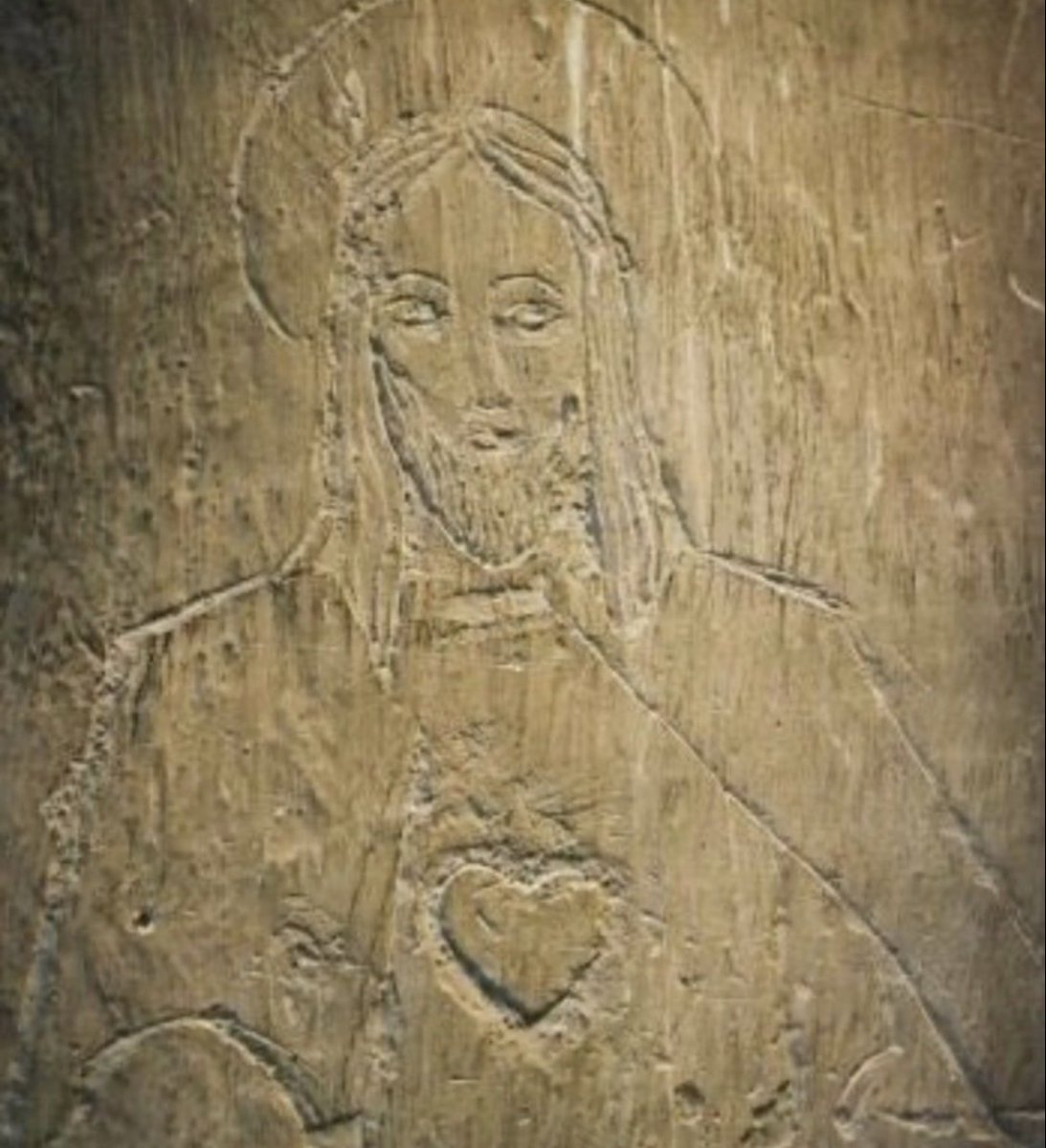
This image of the Sacred Heart of Jesus was carved into the wall of Cell 21 at Auschwitz by prisoner Stefan Jasienski, a senior Polish officer, using his fingernails.
“Un escritor católico del siglo XX, John Ronald Reuel Tolkien, por boca de uno de los protagonistas de una de sus novelas, describió así nuestra responsabilidad:
«No nos atañe a nosotros dominar todas las mareas del mundo, sino hacer lo que está en nuestras manos por el bien de los días que nos ha tocado vivir, extirpando el mal en los campos que conocemos, y dejando a los que vendrán después una tierra limpia para la labranza». (18Z)
La civilización del amor no nace de un gesto único y espectacular, sino de una suma de fidelidades pequeñas y tenaces, que hacen frente a la deshumanización.
Por eso vale la pena detenerse y considerar algunos aspectos de cómo, cada uno en su ámbito, podemos colaborar en su construcción.
Sin pretender agotar el tema, propongo cinco vias de responsabilidad cotidiana y pública: desarmar las palabras, construir la paz en la justicia, asumir la mirada de las víctimas, cultivar un sano realismo y relanzar el diálogo y el multilateralismo”.
— Papa León XIV
In multiple Church-approved Eucharistic miracles, where the consecrated Host has visibly become human flesh and blood, scientific tests consistently reveal the same remarkable things:
🩸 The tissue is human heart muscle, often from the left ventricle, in a state of extreme stress or agony.
🩸 The blood is always Type AB (human, and in many cases appearing fresh and alive).
This matches forensic studies on the Shroud of Turin (believed by many to be Jesus’ burial cloth), where the bloodstains are also identified as Type AB.
Examples include:
• Lanciano, Italy (8th century) — AB blood, heart tissue, preserved for over 1,300 years.
• Buenos Aires (1990s) — AB blood.
• Tixtla, Mexico (2006) — AB blood.
• Sokółka, Poland (2008) — AB blood.
• Legnica, Poland (2013) — AB blood.
AB is a rare blood type, found in only about 3-5% of the global population.
Theologically, this is profoundly beautiful.
Type AB is known as the Universal Recipient, it can receive blood from any other type without rejection.
Many see this as a powerful sign pointing to Jesus: His Precious Blood is open to everyone, no one is excluded from His sacrifice and mercy. Christ “receives” all sinners, all nations, all who come to Him, regardless of background. It’s like a divine invitation: His Blood accepts us all, washes away our sins, and unites us in the Eucharist.
Of course, the Church doesn’t dogmatically declare Jesus’ blood type, these are scientific observations on approved miracles, not doctrine. But the consistency across centuries and continents is striking, especially since blood typing wasn’t discovered until 1901.
It feels like another quiet whisper from God affirming the Real Presence: This is truly His Body and Blood, the same Jesus who suffered, died, and rose for us.