GPT-6 Astra is now available to all Pro, Enterprise, and Business Premium users in ChatGPT Work and Codex. It's also live in the API.
It might take a few days to roll out to our Plus and Business users. Thank you for your patience.
We are reseting usage for all paid users of Codex and ChatGPT Work.
Please continue reading for an update on Codex usage limits. The team has been working around the clock, going through thousands of reports and shipping fixes.
Depending on how you use Codex, you should see your usage go between 10% and 50% further than before.
We really went with a fine comb, with many uncovered small things being longstanding and here is what we found and fixed:
- Compaction. We were keeping old images during compaction, sometimes making the context large enough to trigger compaction again. After the fix, usage dropped around 10% for users making heavy use of images. Fixed.
- Memory. Background memory workers could inherit Stop hooks and keep running when the hook wouldn’t let them finish. This affected fewer than 1% of users, with the long tail being pretty bad and we saw one example thread check whether it could stop 15,000 times. Fixed.
- Goals. In some cases, a set /goal could finish and then keep going past the intended stop condition, or the model would keep retrying broken tools without stopping. We saw examples consume anywhere from 15% to 70% of a weekly allowance. Fixed.
- Automations. Some custom schedules could run more frequently than configured. Fixed.
- Subagents. Smaller models (e.g. Luna) sometimes picked more capable helpers without being explicitly asked. The same was true where the orchestrating model not running in /fast mode could request sub-agents to run /fast. Fixed.
- Computer History. The older implementation could lead to repeatedly summarizing overlapping activity. For some cases we saw it consume up to one fifth of the weekly usage per week. Fixed.
- Rolling task summaries. Ordinary turns were triggering extra background requests. These added about 1% to token usage. Small each time, but it adds up. We have disabled this.
- MCP. Some tool results could be encoded twice. We also found tool instructions getting cut off and fetched again. Fixed.
We’ve also made architectural changes to prevent these from regressing and our teams will get paged if it happens regardless. We are also working on showing you directly in the app where your usage goes so you don’t have to guess.
Goes without saying that we’re resetting usage limits and I hope you enjoy a very nice Saturday!
⚡Meet Qwen3.8-Flash, a multimodal MoE and an early preview of the Qwen4 architecture, now open-weight!
The production version Qwen3.8-Flash will be available soon via QwenCloud API at just $ 0.16/1M input tokens and $ 0.47/1M output tokens.
125B parameters + 51B N-gram embeddings, with just 6B activated per token. Unmatched cost-efficiency.
What's new: 🥳
- Next architecture: GDN + QSA hybrid attention, Gated Residual, N-gram Embedding & Muon optimizer, serving as a precursor to the architecture used in Qwen4.
- Dramatically lower training and inference costs: trained at just 1/9 the cost of Qwen3.7-Plus, while outperforming it across the board with especially strong gains in coding and office tasks.
- Strong performance: scoring 58.7 on DeepSWE 1.1, 62.5 on SWE-bench Pro, 73.9 on CoWorkBench, 84.5 on AndroidWorld, and 95.7 on MathVision (with CI).
- 262K native context, extensible to 1M with YaRN.
We’re also releasing the weights for Qwen3.8-Flash-Next, giving the community an early look at the new architecture we’re exploring for Qwen4.🚀
We can't wait to see what you build with Qwen3.8-Flash!👀👇
- Blog: https://t.co/M5hYypFLgJ
- Technical Report: https://t.co/IF0gObIkQO
- Hugging Face: https://t.co/6ow8QVAABt
- ModelScope: https://t.co/tDOn2jNuFG
Introducing GLM-5.3-Flash
- Leading capabilities at a highly competitive price
- Natively multimodal with a 1M-token context window
- A 320B-A18B model released under the MIT License
- Previously previewed as Ox Alpha, running entirely on Chinese AI chips
Blog: https://t.co/tzOmB7gdZP
Available now across all official platforms:
Weights: https://t.co/9LRMahY9Wa
API: https://t.co/VcaQnzYmS9
Coding Plan: https://t.co/Nk8Y98HNhU
ZCode: https://t.co/Peepqv4XSx
Chat: https://t.co/WCqWT0qCQb
AutoClaw: https://t.co/aGEG5HqTTb
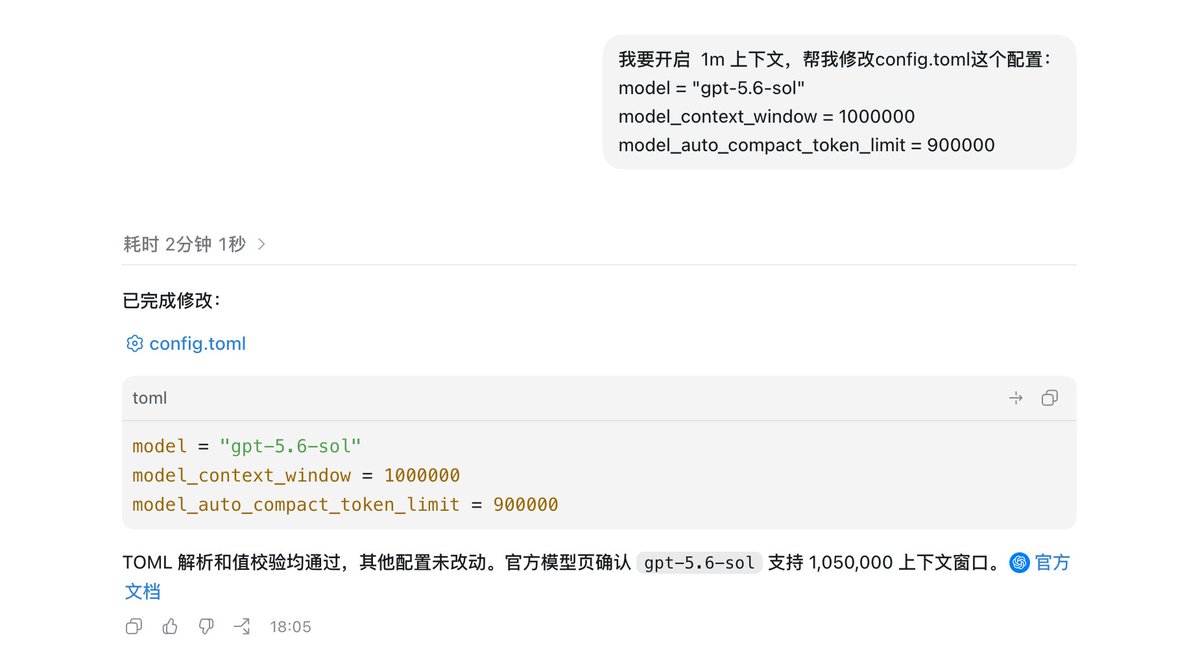
Here is how to enable a 1M-token context window in Codex for GPT-5.6 Sol.
Even though we have tuned the context limit in Codex to be set optimally when it comes to performance and cost, this is a common ask, so here it is documented.
A larger context window lets Codex retain more code, tool output, and conversation history before summarizing older material. You need a model that supports it. And GPT-5.6 Sol, for example, has a documented 1,050,000-token window.
Open ~/.codex/config.toml and add or update these settings at the top level, before any [section] headers:
```
model = "gpt-5.6-sol"
model_context_window = 1000000
model_auto_compact_token_limit = 900000
```
The first setting selects the model. The second tells Codex to use a one-million-token context budget. The third starts automatic history compaction around 900,000 tokens, leaving some headroom. Restart Codex client and start a new session after saving.
To try the configuration for a single CLI session without changing your defaults:
```
codex -m gpt-5.6-sol \
-c model_context_window=1000000 \
-c model_auto_compact_token_limit=900000
```
Have fun, but also know that we tuned the default carefully!