A retired NASA engineer who had worked on the Space Shuttle program for 25 years was hired by SpaceX at age 62. He described the first week as the most disorienting experience of his professional life.
At NASA, a design change required 3 meetings, 2 committees, a review board, and 6 to 18 months of documentation. At SpaceX, his new supervisor said "if it works, build it. If it doesn't, change it by Friday."
He sat at his desk after the first day and called his wife. He told her he felt like a man who had been swimming with ankle weights for 25 years and someone just cut them off. He could move. He could decide. He could build something in the morning and test it in the afternoon. The constraint that he had accepted as the nature of aerospace engineering turned out to be the nature of bureaucracy.
Within 6 months he had contributed to more design iterations than he had completed in his last 5 years at NASA. Not because he was working harder. Because the time between having an idea and testing the idea collapsed from months to hours. The same brain. The same knowledge. A different operating system.
He described a specific moment where he proposed a modification to a Raptor engine component. At NASA, the proposal would have entered a queue. At SpaceX, the modification was machined by the end of the day and tested by the following morning. He watched his idea become a physical object in 18 hours. At NASA, 18 hours would not have been enough to schedule the first meeting to discuss whether to schedule a meeting.
He told an interviewer: "I didn't get smarter when I went to SpaceX. I got faster. The intelligence was always there. The system was in the way."
The difference between SpaceX and NASA is not talent. NASA has extraordinary talent. The difference is the time between a thought and a test. SpaceX compresses it. NASA elongates it. The same engineer produces 10x more at SpaceX than at NASA because the bottleneck was never the engineer. It was the meetings about the meetings about the work.
In 1991, despite his failing health, Freddie Mercury recorded his final masterpiece. Before the last verse, he whispered: I need a little rest. He walked out of the studio and never returned to finish it. Brian May sang the end.
Rock history lost its voice in absolute silence.
I like to try and make a post like this every time it moves me. Follow me along on this short story..
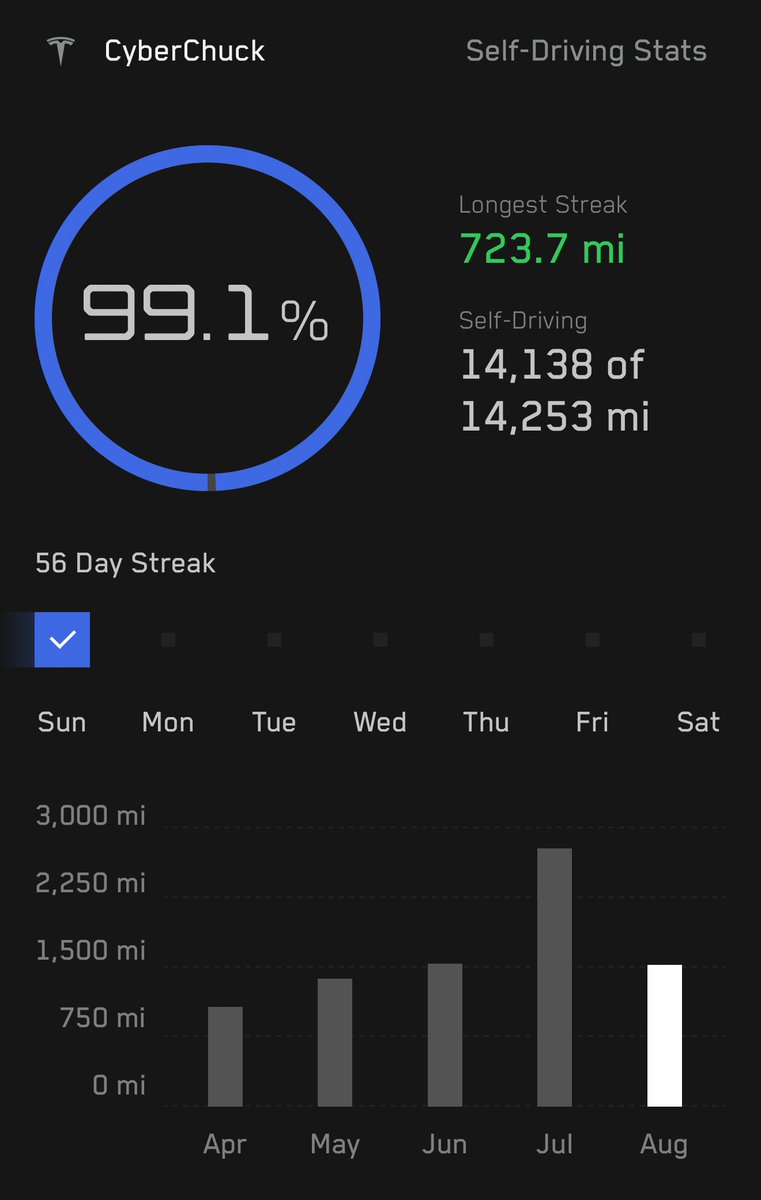
I just got off a three day trip with my airline. For those of you that don't know me I am an Airbus Captain for a US east coast airline. I experienced many long delays getting home due to many constraints that really don't matter to this story, but what does matter is I landed in Orlando at 145am, almost 5 hours late. My drive home to Jacksonville is another 2.5 hours.
This late arrival creates a decision point. Both for driving safety, life management for appointments the next day, and general work life balance.
Having FSD on your vehicle changes the math on this decision. Before FSD it would have been an automatic choice to either sleep in the parking lot, or try and find a hotel room to rest until I was ready for the drive home. With FSD the decision matrix changes. Get a cup of coffee, enable FSD, and do the drive.
This is what I did last night, not arriving home until close to 445am. It wasn't scary, it wasn't dangerous, but I would never have done it if FSD didn't have my back.
There were several scenarios on my drive home last night where Semi Trucks were swerving into my lane, and FSD safely avoided any close calls.
I hope people that don't understand this technology can see through the popular rhetoric. This is not only life changing for safety, its also life changing for giving you options. It really feels like I am supervising a train. I just sit there watching it drive. My reaction time in the WOCL (Window of Circadian Low) is definitely lower, but with FSD its not unsafe.
If you don't own a Tesla and your life has a similar use case, you need to think about looking into this technology further, or talking to someone that uses it every day.
If you own a Tesla and don't own or subscribe to FSD for your commutes or longer drives .. you are wasting your investment in the platform that is capable of this level of automation.
It is a game changer.
@Tesla@teslasi
Terafab approximate size comparison between Giga Texas, the Pentagon, Apple Park, and the Mall of America.
There has never been a building this large. Elon Musk says it will be the most valuable building by far.
Hi @Delta, I am currently on one of your planes. Can you please adopt @Starlink, because your current Wi-fi sucks.
Your competitors that have Starlink can achieve speeds 100x faster than this.
Starship soared on the second flight of the next generation, deploying advanced Starlink satellites for the first time and providing priceless data as it travelled through air, space, and sea → https://t.co/Rp7VwBzpWx
For my first post, I’m sharing a letter @NVIDIA signed on why open models matter.
AI will transform every industry, power every company, and be built by every country.
Open models strengthen safety and cybersecurity, accelerate innovation and diffusion, and enable sovereignty.
The world needs both frontier closed models and frontier open models.
https://t.co/AUKzoQ5Ikb
666,000 of them are monthly paying subscribers. The 1.48 million number excludes FSD trials, but includes previous one-time FSD purchases. Vaibhav said 45% of that 1.48M are monthly subs, and 55% is people who purchases it outright .
Monthly FSD subscription revenue as of end of Q2 is $66M ($~791M/year).
Elon Musk was asked by a room full of Stanford students what single trait separates people who change the world from people who don't. Everyone expected him to say intelligence. Or work ethic. Or vision.
He said pain tolerance.
The room wasn't sure if he was joking. He wasn't. He explained that intelligence is common. Ambition is common. Even good ideas are relatively common. What is genuinely rare is the ability to absorb punishment day after day, year after year, and keep building anyway.
He said most people he's met who are smarter than him quit after the first real failure. Not because they weren't talented. Because the pain of failure exceeded their tolerance for it. They found something easier and redirected their intelligence there.
He said the entire history of SpaceX is just a story about absorbing explosions, literally and financially, and refusing to interpret them as signals to stop.
Nobody writes that on a motivational poster. Nobody puts "pain tolerance" on their LinkedIn profile. But it's the actual filter. Not who can dream the biggest. Who can bleed the longest.
Elon Musk just said the one thing about America they made sure you’d never learn.
The one thing that should’ve made you proud, not ashamed.
Musk: “After World War 2, the US could have basically taken over the world and any country. Like we got nukes, nobody else got nukes. We don’t even have to lose soldiers. Which country do you want?”
One nation held a weapon no civilization had ever possessed.
Total monopoly on destruction. No rival. No consequence. No limit.
Every empire in history that held that kind of power did the only thing empires know how to do.
They took until there was nothing left to take.
America had a greater advantage than all of them combined.
And rebuilt the nations it just defeated.
Musk: “The United States actually helped rebuild countries. So it helped rebuild Europe, it helped rebuild Japan. This is very unusual behavior, almost unprecedented.”
Not almost unprecedented.
It had never happened. Not once in 5,000 years of recorded civilization.
The nation with the power to take everything chose to rebuild instead.
Enemies became allies. Rubble became economies. Surrender became partnership.
Germany went from ashes to the economic engine of Europe in a single generation.
Japan went from unconditional surrender to the third largest economy on earth.
Three years after the war, America was flying food into Berlin.
Into the capital of the country that just tried to end the free world.
That decision reshaped every economy, every alliance, and every trade route on the planet.
Billions of people lifted out of poverty over the next half century trace back to one moment. One nation choosing restraint over domination.
No other country in history can make that claim. Not one.
Musk: “There’s always like, well America’s done bad things. Well of course America’s done bad things, but one needs to look at the whole track record.”
Every nation on earth has blood in its history.
But the measure of a nation was never its worst chapter.
It’s what it does when nobody can stop it.
When nobody could stop America, it fed its enemies and rebuilt their cities.
You’re being told every day that this country is something to be ashamed of.
By people who have no idea what the world looks like without it.
Every free market. Every open border for trade. Every democracy that took root outside Europe stands in the shadow of that single decision.
The values that built this country didn’t just shape America.
They shaped the modern world.
AI is about to hand a small number of people a power advantage that makes nuclear monopoly look primitive.
1945 was the first test.
AI is the last.
That power is going to exist. The only question left is who holds it.
The most powerful thing America ever did wasn’t building the bomb.
It was having the power to take everything and choosing not to.
The people trying hardest to tear that story down have never built a single thing worth defending.
In honour of the Brazil v Norway game tonight, here's my favourite Norway geography fact.
The small village of Skjolden looks unremarkable on a map. Little more than a small settlement in inland Norway. However, and remarkably, Skjolden is actually a "seaside" village.
1/n
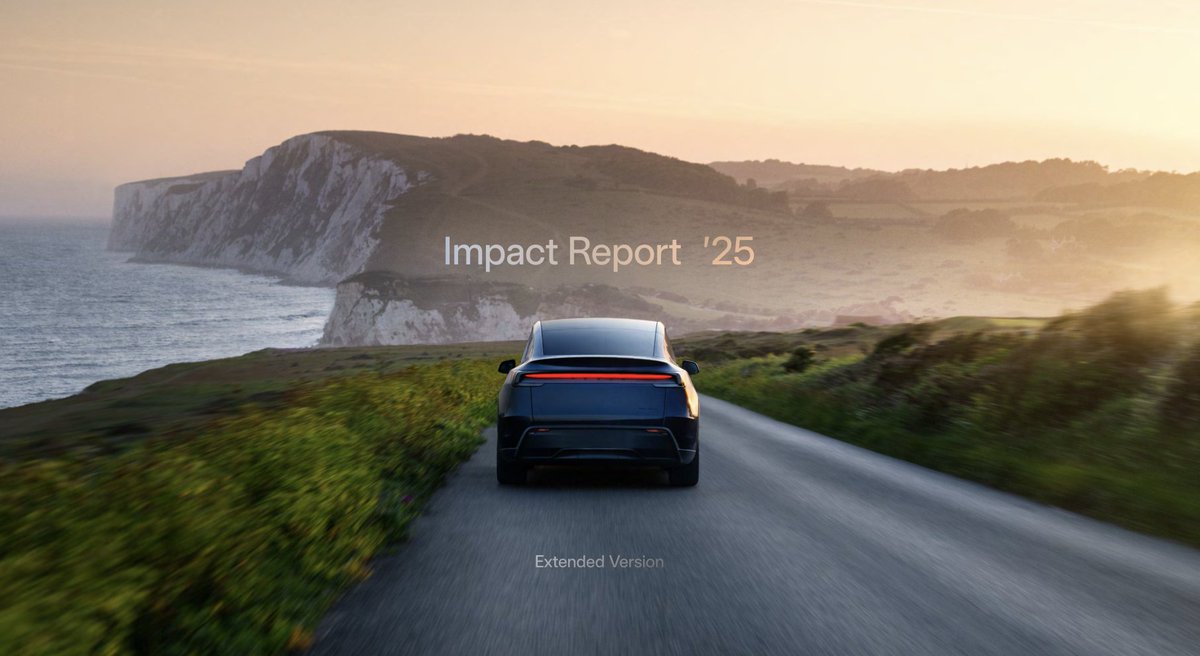
23 years ago, we set out to prove that electric cars could be great – not just great electric cars, but the best cars overall.
We’ve gone from one electric sports car to
– Over 9 million vehicles on the road
– Model Y becoming the world’s best-selling car of any kind only 3 years after first deliveries
– 5 Gigafactories & other manufacturing sites across 3 continents
– The largest & most reliable fast charging network w/ over 80,000 Superchargers globally
– Energy generation & storage systems helping power homes & grids (over 1 million Powerwalls installed, 70+ GWh of industrial energy storage operating globally across 2,200+ projects)
Today, we’re bringing AI into the real world with autonomy @teslasi and robotics @Tesla_Optimus.
Tesla is only getting started – a world of amazing abundance awaits