The small Left in #Spain is bleeding votes to the centrist #PSOE. While small indy parties grow, the dotted lines show #PP (blue) & Far-Right VOX (green) are set to win #29N elections.
#Podemos & perhaps some FA (Left) may not translate votes into seats. Tactical voting, now?
#Polymarket odds for #Sanchez winning is 17% and #Melenchon at 11%. They look way too low. If Melenchon gets to the 2nd (runoff) round, he will only receive 35% of the vote? I am not so sure.
What are the odds in reverse I wonder?
Now, ego & petty personality conflicts prevent small Left parties sharing election seats in a Broad Front entente. This will split the progressive vote, raising the chances of a Hard-Right or Far-Right government in #Spain in its General Election.
The long decline of the Left (Sumar, Podemos), partly subsumed by the Centrist #PSOE opens the door to the Far & Hard Right (53%). Regional esp. #Basque & #Catalan parties will hope to close the gap.
So far, it is #Ceuta vs #Housing.
https://t.co/tGpDtcKa5s
Progressives think a "green transition" & growth via tourism etc a roaring success. Good.
But they leave the main economic structure in place.
Inequality cemented in.
Local #PSOE promote property developers.
Gen Z see little future.
#27N#Spain
https://t.co/aJIZJMxRIg
@SouthernM46171 BD learned about garments manufacturing from #Korea 1978 onwards. A big success. But the elite chose not to learn how Seoul later diversified into other industries.
You are right re the politics as a stumbling block. "History" is seen as 1971 onwards. But potential remains.
#Spain is receiving heavy Chinese investment in EVs & batteries. Fast becoming an advanced auto platform in the #EU. I wonder if the Right & Far-Right win elections on #27N, they will push back on #China to align with the US? https://t.co/uPSmXAgvPt
@chatt16887 Yes you are right. But it's the wrong economic policy. Hence, lagging badly c.f China and ASEAN. Re vulnerabilities on export dependency - true up to a point, but that is rather short term. RCEP & global South are huge growing markets.
You cannot say "Mind the Gap" when the distance between the two is like the Grand Canyon.
#India is so behind #China in using (not using) its vast labour force. #Vietnam exports more than India with 1/14th the population
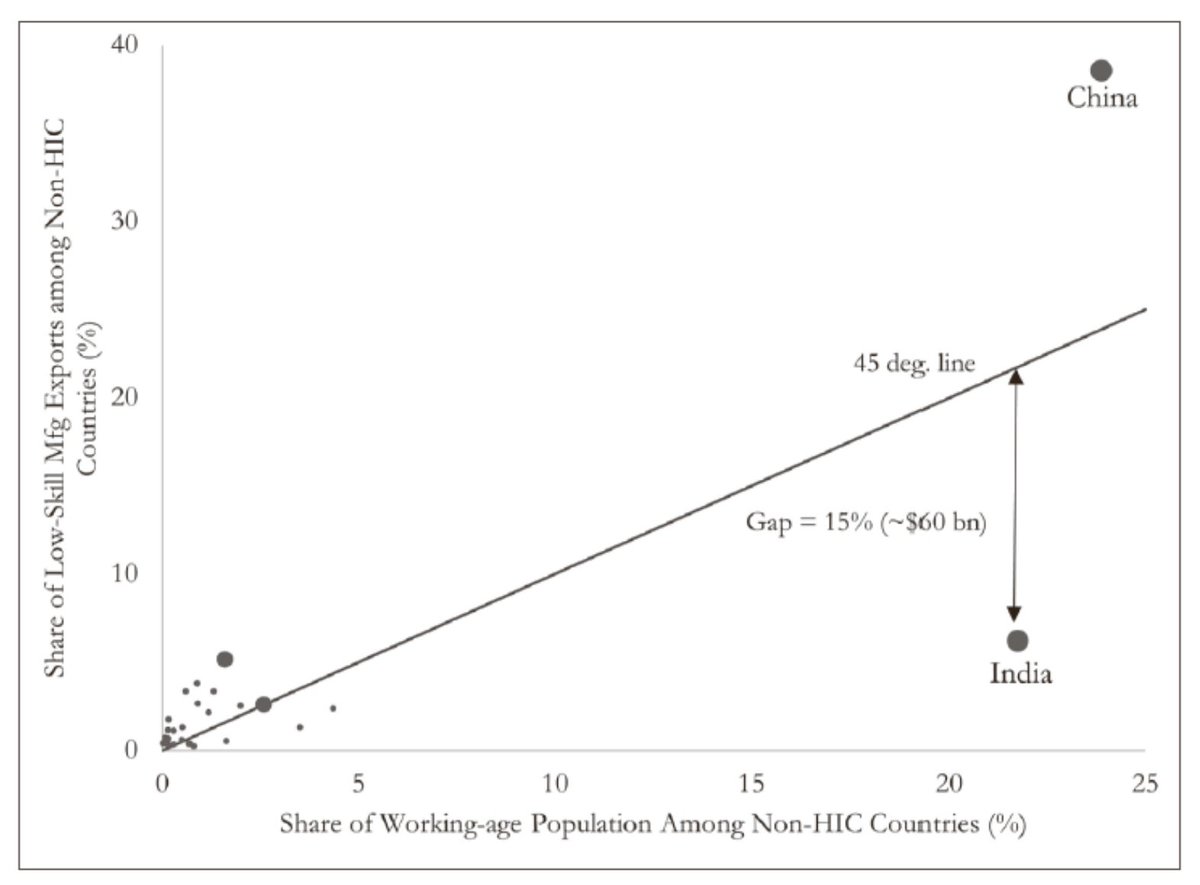
This chart from Devesh Kapur & Arvind Subramanian's latest book, A Sixth of Humanity, is shockingly revealing.
It shows India’s share in global exports of low skill-intensive products (on the y-axis) and its share in the global working-age population (x-axis).
The rough intuition is that the larger a country's low-skilled labour force, the cheaper its wages and the more competitive its products ought to be in global markets.
Instead, India’s share of global exports is about 4.5 per cent, when its endowment of people ought to have taken that share to about 22.5 per cent, i.e., barely one-fifth of what it ought to have been.
It is as if the potential of that 18 per cent of India’s workforce (about 100 million people) has been left unfulfilled, even wasted. The vast majority of India’s labour force still inhabits and works in a grey zone of low-paid informality.
In contrast, China’s global export share is close to 40 per cent, despite having about as many people as India. India’s failure (relative to potential) and disappointment (relative to China) are evident and large.
Worse still, in 2022, India’s share of global clothing exports was 3.1 percent, compared to 32 percent for China.
Even if China started vacating export space in this sector after its wages started rising, India’s export share remained stagnant at 3 per cent, while that of Vietnam and Bangladesh rose by 3.5 to 4 percentage points!
China’s loss did not translate into any gain for India in terms, thanks to the Modi government's excellent policies.
"...a way of inhabiting the land that is no longer possible." A vitally important acknowledgment that one of the reasons why Europe is being hit so hard by climate change, is a centuries-old pattern of terraforming. Sadly, it comes at a time when those very patterns are being recklessly embraced in the Global South.
https://t.co/t6FJdWRp0N
This is another episode of “the strong do what they can, and the weak suffer what they must.”
It seems that the US nowadays pays little attention to what India is thinking, because Washington is so sure that the foreign policymakers in India are so addicted to psychological inertia and geopolitical path-dependency that they are not even trying to dodge or resist, let alone find an alternative.
Note the rest of Asia much more than #India and #China fearing a long block of the Strait of #Hormuz.
American allies in the firing line. Add #remittances on top for #SouthAsia and ....
This is an interesting chart: compared with other Asian countries, particularly U.S. allies Japan and the Philippines, China is actually not very reliant on oil travelling through the Strait of Hormuz (https://t.co/W4vEkQSxVt)
Japan for instance depends on it for an incredible 91% of its oil imports and the Philippines 94%!
And all in all the narrative on the supposed reliance of China on Iranian oil is vastly overblown:
- First of all people don't realize China is very self-reliant when it comes to energy, especially with their massive green energy buildup: its energy self-sufficiency rate hit 84.6% last year (https://t.co/n9onGBVqGX)
- Secondly, Iran constitutes 17% of China's oil imports (https://t.co/W4vEkQSxVt) - less than Saudi Arabia - and oil represents roughly 59% of China's energy imports by energy content (when one converts import volumes to standard coal equivalent: https://t.co/1ZHnboX3Th)
When you do the math, given that Iran is 17% of China's oil imports → oil is 59% of China's energy imports → energy imports are 15.4% of China's total energy consumption, this means that China depends on Iran for roughly 1.5% of its energy.
In other words, almost a rounding error for a country that's increasing its own primary energy production by 4.6% a year (https://t.co/hkBhfbMizy). They could replace Iran entirely in 4 months by simply doing more of the same.
Plus this all assumes that there is some sort of strategy by the U.S. to cut off China's energy supplies, when little suggests this. After taking over control of Venezuela's oil, US Energy Secretary Chris Wright recently admitted that they're principally selling it to... China (https://t.co/f919TP62fi).
The new #BNP administration will find it an uphill struggle to revive the economy. Might be best to focus on just a few sectors this year #Bangladesh#Geopolitics
In #Bangladesh, the Black Hole of fictional/superficial political "reform" is sucking out the light from debate on jobs, new industries, revamping education etc... leaving the #IMF as the back seat driver of the economy.
“New Bangladesh is only focusing on securing negative rights. It has no strategies to deliver positive rights for the majority of people. It needs modernisation and industrialisation. Who is going to make it happen?”
Opinion by Farid Erkizia Bakht
https://t.co/76RhD9bCmR
@haque_shahidul@ThePrintIndia I read it earlier. The Print editor is eloquent but I don't have faith in his conclusions esp re China, and in this case. India is fragile.