In the spring of 2026, fighting between Israel and Hezbollah in southern Lebanon had been raging for months. Israeli strikes had killed thousands, and the northern front risked spinning into something much larger. Iran’s most powerful proxy, Hezbollah, sat at the center of it.
On June 26, 2026, after several rounds of talks in Washington, the United States under President Trump brought Israel and Lebanon together and signed a trilateral framework agreement. It was not a full peace treaty. It was the first formal step toward one.
Lebanon agreed that its own army would take full control of the country’s weapons and territory. That meant the verified disarmament of Hezbollah and every other non-state armed group. Israel, in return, agreed to begin pulling its forces out of southern Lebanon in stages, starting with two pilot zones, but only after real progress on that disarmament was verified. The United States would oversee the process through a new military coordination group and put up money — $100 million in humanitarian aid and more than $30 million to strengthen the Lebanese army.
Both countries stated they wanted to end the formal state of war that had lasted for decades and live as peaceful neighbors. The deal was deliberately built as “trust but verify.” Hezbollah immediately rejected it as null and void.
By mid-July the first pilot zone handover had already begun, and Lebanon’s president met Trump in the White House, saying the country intended to end hostilities with Israel forever.
The strategic point was simple: Hezbollah was Iran’s strongest external force. By forcing its disarmament and restoring Lebanese state control, the framework aimed to cut one of Tehran’s best tools for threatening Israel and projecting power. It was not a direct attack on Iran itself. It was the removal of one of Iran’s most important weapons.
Most people still don’t realize how complex Operation Midnight Hammer actually was.
On June 21-22, 2025, the U.S. struck three Iranian nuclear sites (Fordow, Natanz, and Isfahan) in a tightly coordinated air and submarine operation.
Seven B-2s from Whiteman Air Force Base dropped 14 of the 30,000-pound GBU-57 Massive Ordnance Penetrators, the first time the weapon was ever used in combat.
A submarine launched more than two dozen Tomahawks at the same time.
Over 125 aircraft supported the mission and roughly 4,000 personnel at Whiteman Air Force Base worked under tight secrecy.
To preserve the surprise, a decoy group of B-2s flew west toward Guam while the actual strike package crossed the Atlantic with almost no radio traffic.
The bombers flew roughly 18 hours one way with multiple aerial refuelings.
Iranian defenses never effectively engaged them. No U.S. aircraft
Operation Midnight hammer is the most sophisticated long range stealth strike ever conducted.
Mustafa Kemal was born around 1881 in Salonica, then part of the Ottoman Empire. He entered military school as a teenager, earned the name Kemal (Perfect) for his excellence in a variety of subjects and rose through the ranks as an officer.
During the First World War he gained national fame at Gallipoli in 1915, where his forces helped turn back the Allied invasion. After the Ottoman defeat and the harsh Treaty of Sèvres that sought to partition Anatolia, he landed at Samsun in May 1919 and began organizing the Turkish national resistance.
He led the War of Independence against Greek forces and the remaining Allied presence.
By 1922 the sultanate was abolished and in July 1923, the Treaty of Lausanne recognized a sovereign Turkish state.
On 29 October 1923 the Republic of Turkey was proclaimed, and Mustafa Kemal became its first president.
He then launched a sweeping program of reforms. The caliphate was abolished in 1924. Religious courts and schools were closed. The Arabic script was replaced by a Latin alphabet. A new civil code based on European models was adopted. Women received equal civil rights and, later, the right to vote. Traditional clothes such as the fez was banned under his famous "hat law."
The goal was clear: to break from the old imperial and religious order and build a modern, secular nation-state.
In 1934 the Turkish parliament gave him the surname Atatürk, meaning “Father of the Turks.” He remained president until his death on 10 November 1938.
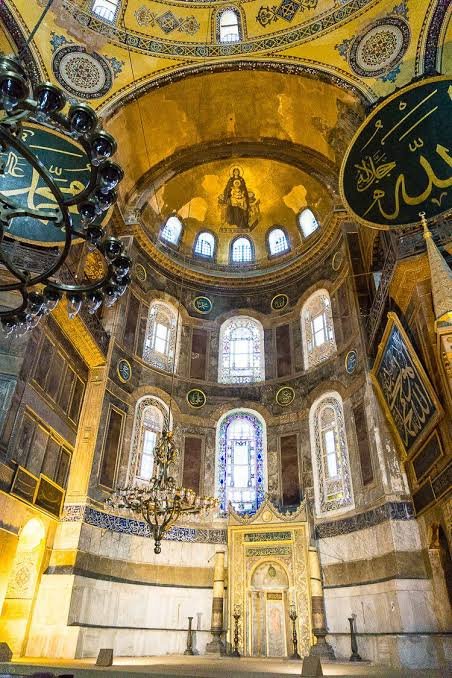
The Hagia Sophia was completed as a Byzantine Christian cathedral in 537 AD and transformed from the Great Church to the Great Mosque.
Its site had earlier churches with the first, called Megale Ekklesia (“Great Church”). The Great Church was built in 360 AD under Constantius II and burned down during riots that broke out after the exile of the popular bishop John Chrysostom In 404 AD
After it burned, the name Hagia Sophia (“Holy Wisdom”) was adopted around 415–430 AD for the rebuilt church. Though later in in 532 AD the Hagia Sophia was completely destroyed by fire during the Nika Riots, a massive uprising against Emperor Justinian I
After the second fire, Justinian I ordered the much larger and more ambitious building that still stands today, completed in 537 AD.
Following the Ottoman conquest of Constantinople in 1453, Sultan Mehmed II then converted it into an imperial mosque, known as Ayasofya.
After the fall of the Ottoman Empire, Sophia Hagia served as a secular museum (Ayasofya Müzesi) from 1935 under Mustafa Kemal Atatürk. Atatürk was the first President of the Republic of Turkey Atatürk and he wanted to break away from the Islamic imperial identity of the Ottomans.
This lasted until 2020, when it was redesignated a mosque again under President Erdoğan. Now officially the Hagia Sophia Grand Mosque (Ayasofya-i Kebir Cami-i Şerifi).
Thats the Story of how the Sophia Hagia went from Great Church to Great Mosque
Maybe we should stop calling John Thune and start calling some Democrats.
Surely at least 10 of them don’t want their party taken over by DSA lunatics… right?
The DSA will be the first ones exploiting no photo ID to get their people into government.
The Hagia Sophia was completed as a Byzantine Christian cathedral in 537 AD and transformed from the Great Church to the Great Mosque.
Its site had earlier churches with the first, called Megale Ekklesia (“Great Church”). The Great Church was built in 360 AD under Constantius II and burned down during riots that broke out after the exile of the popular bishop John Chrysostom In 404 AD
After it burned, the name Hagia Sophia (“Holy Wisdom”) was adopted around 415–430 AD for the rebuilt church. Though later in in 532 AD the Hagia Sophia was completely destroyed by fire during the Nika Riots, a massive uprising against Emperor Justinian I
After the second fire, Justinian I ordered the much larger and more ambitious building that still stands today, completed in 537 AD.
Following the Ottoman conquest of Constantinople in 1453, Sultan Mehmed II then converted it into an imperial mosque, known as Ayasofya.
After the fall of the Ottoman Empire, Sophia Hagia served as a secular museum (Ayasofya Müzesi) from 1935 under Mustafa Kemal Atatürk. Atatürk was the first President of the Republic of Turkey Atatürk and he wanted to break away from the Islamic imperial identity of the Ottomans.
This lasted until 2020, when it was redesignated a mosque again under President Erdoğan. Now officially the Hagia Sophia Grand Mosque (Ayasofya-i Kebir Cami-i Şerifi).
Thats the Story of how the Sophia Hagia went from Great Church to Great Mosque
@catturd2 Democrats still blame the tool instead of the user. The gun doesnt shoot itself, the ai doesn't just generate this content.
The freaks will just find another tool to pursue their will. Thats why you go after the freaks themselves
By 1453, Constantinople (modern-day Istanbul) was the last major remnant of the old Roman Empire. The Ottomans under 21-year-old Sultan Mehmed II wanted it badly as it controlled the vital straits between Europe and Asia, and taking it would make their empire the dominant power in the region.
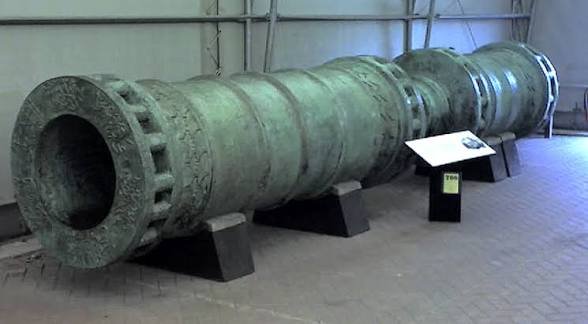
The city’s land walls (the Theodosian Walls) were some of the strongest ever built. Triple-layered defenses with a moat, outer wall, and massive inner wall. They had held off attackers for over 1,000 years. What finally broke them were the Ottomans’ giant cannons, which pounded the same sections of wall for weeks until they cracked.
Emperor Constantine XI refused to run. When the walls finally fell on May 29, he threw off his imperial insignia and died fighting in the streets with his men.
This was the end of the Byzantine Empire (Christian, Greek-speaking Romans) for good.
A Christian capital that had stood for over a millennium became the new Muslim capital (Kostantiniyye).
This left Greek scholars fleeing west with ancient texts, helping to spark the Renaissance.
This marked the moment the Ottomans became a true European superpower.