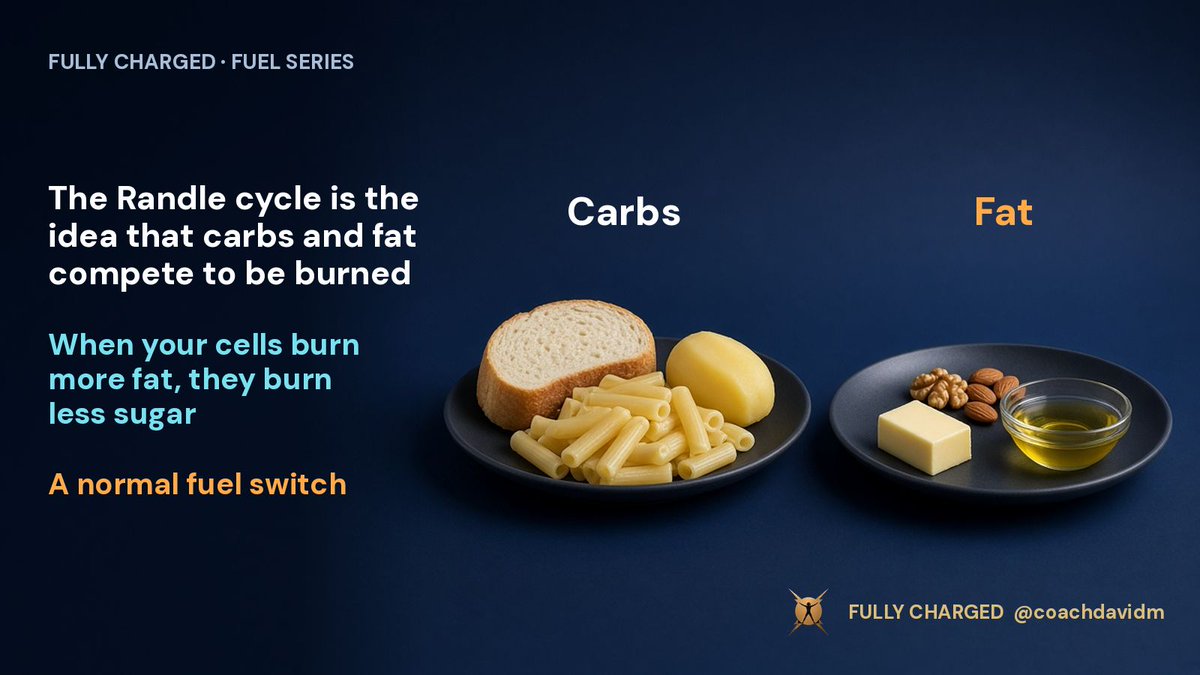
The Randle cycle is the idea that carbs and fat compete to be burned in your cells. It's a normal fuel switch.
The studies don't show that eating them together makes you store fat. Chips and cookies are just easy to overeat.
https://t.co/L8FrLL3Ewc
It’s sick care not health care.
You are a source of revenue.
There is no money in healing people because then they don’t need the Dr and revenue stops.
There is no profit in trying to cure you. Goldman Sachs said the quiet part out loud.
“While this proposition carries tremendous value for patients and society, it could represent a challenge for genome medicine developers looking for sustained cash flow.” (2018 article)
Fat is slow, steady fuel. It's the largest energy store in the body.
Lower intensity and rest use more fat.
Next: what happens when food packs carbs and fat together.
https://t.co/L8FrLL3Ewc
Carbohydrates are fast fuel. Your body stores carbs as glycogen in muscle and liver.
The harder you work, the bigger the share of carbohydrate you burn. Sprints and hard intervals sit at the hard end.
Next: fat, the slow, steady fuel.
https://t.co/L8FrLL3Ewc
When you exercise, your muscles run mainly on two fuels: carbohydrate and fat.
The harder you work, the bigger the share of carbohydrate you burn. At easy efforts, fat covers a bigger share.
This week: how food fuels your training.
https://t.co/L8FrLL3Ewc
Maybe?
The value of a single pearl can range from $5 to over $10,000, depending on its type, size, and quality. Cultured pearls, which make up the vast majority of the modern market, typically sell for $20 to $500 each, while exceptionally rare natural pearls can command millions of dollars at auction.
The Gemological Institute of America (GIA) evaluates a pearl's worth based on seven primary factors: size, shape, color, luster, surface quality, nacre thickness, and matching. The type of pearl is the single biggest price driver, as saltwater oysters grow only one or two pearls at a time, whereas freshwater mussels can produce dozens.
Here are the typical price ranges for individual cultured pearls by type:
PEARL TYPE
PRICE RANGE
Freshwater
$5 to $500
Akoya
$50 to $1,500
Tahitian
$100 to $3,000
South Sea
$200 to $10,000+
Within these categories, size is the steepest lever on price, as worth rises exponentially with diameter. Luster, which is the sharpness of the pearl's surface glow, is the second most important factor and can double the price of a pearl with otherwise identical characteristics.
If you get a say in where your desk goes, use it. The 2022 light-experts paper cites one office study where more access to natural daylight at work went with better measured thinking performance. One study, but a decent argument for the brighter seat.
A 2025 study tracked cortisol every few minutes at home in 201 healthy adults. The rise didn't speed up after waking. The famous wake-up spike may be the daily clock already running. Still debated.
Cortisol has a reputation as the stress hormone. It also follows a daily clock: it rises around waking, peaks in the morning and falls through the day. A big share of the day's cortisol comes out in the hours around waking.
Same room, same light, very different body-clock response. In a 2019 lab study of 55 young adults, sensitivity to evening light, measured by its effect on melatonin, varied more than 50-fold from one person to the next.
A dim week can change how tonight's lamp lands. In a small lab study of 17 young adults, days in very dim light went with a 60 to 70% bigger body-clock shift from the same later light, compared with typical room light. Small study, early days.