My take: auto-migration is a safety net, not a plan. The two or three Gems you actually rely on deserve a manual rebuild and a real test before Monday — a draft skill you never switch on helps nobody.
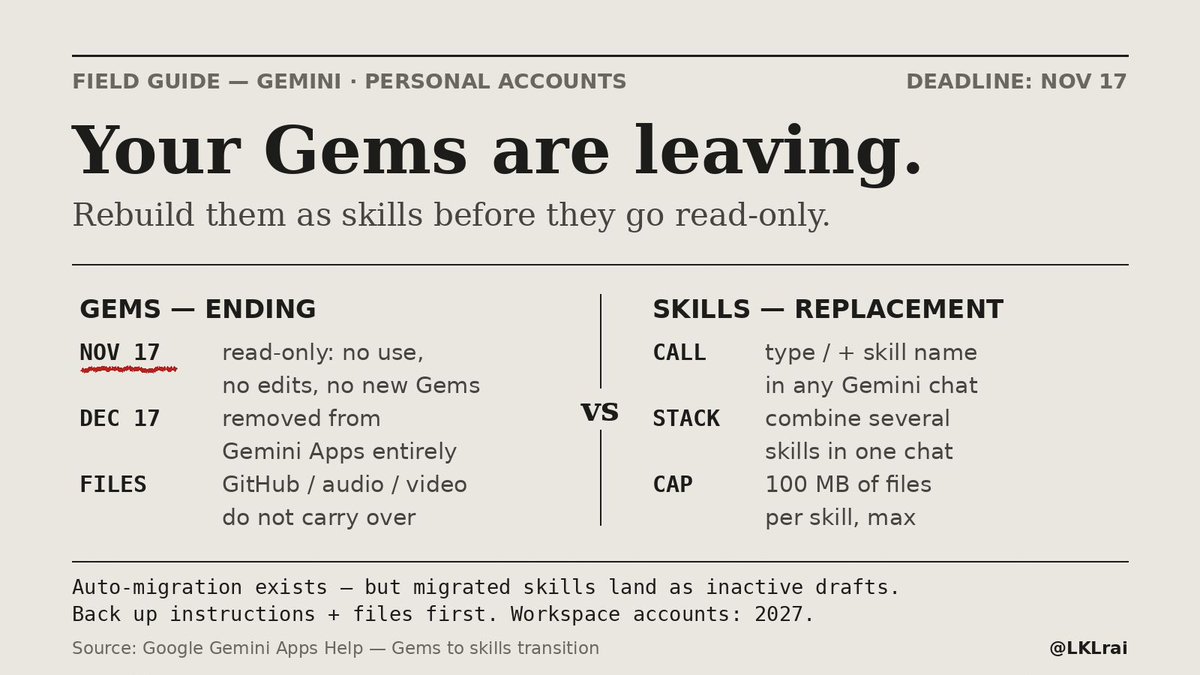
3 days left: personal Gemini Gems turn read-only on Nov 17 and are removed Dec 17. Don't wait for the auto-move — rebuild them as skills now. Source: Google — https://t.co/oXu4l5gW5X
4/ What won't survive the move: GitHub files aren't supported in skills, audio/video and archive files are dropped, and each skill caps at 100 MB — over that, the largest files go first. Gems made in Google Labs (and Opal) don't convert at all.
NEW: GlobalFoundries just broke ground in New York on the first fab of a $21B US-Japan chip deal — Japanese money, American manufacturing. Source: GlobalFoundries — https://t.co/oL1vJ48Cm6
4/ Why it matters: this is the trusted-capacity play — foundational chips the AI buildout still runs on, made under a two-government umbrella. The constraint is time: shovels now, wafers in 2029.
My read: today's pattern is spillover — power orders, shopping links and a supplier breach all landed somewhere else. The model is rarely the whole risk anymore.
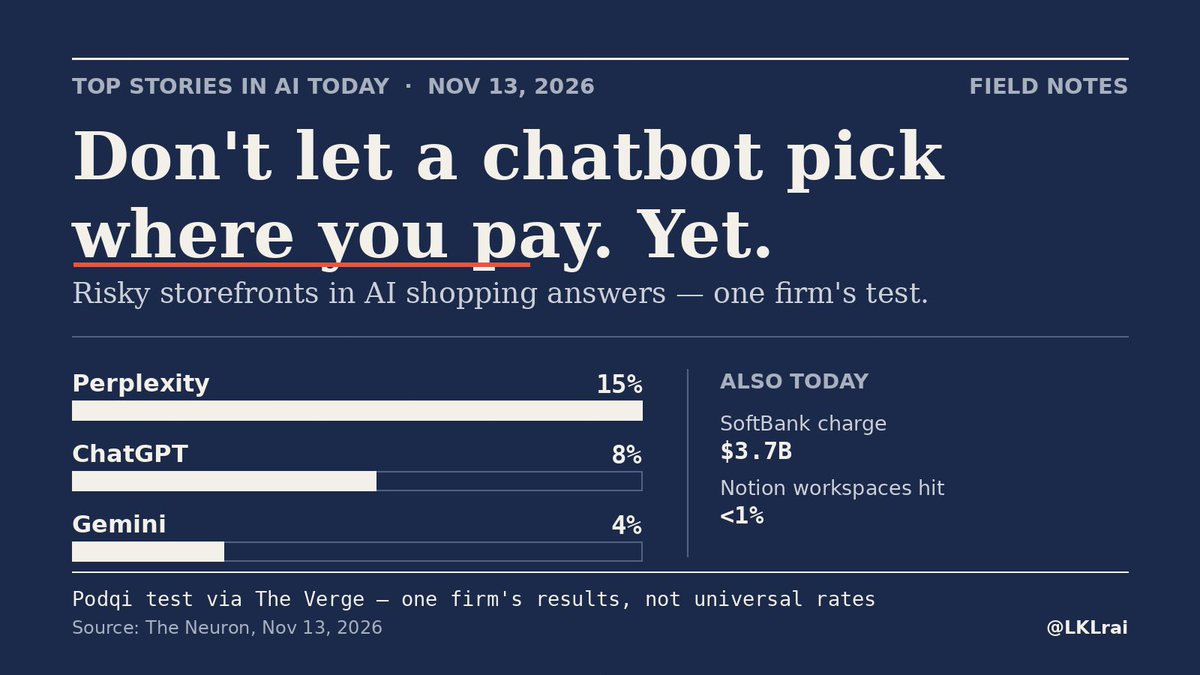
Top stories in AI today: SoftBank takes a $3.7B hit on AI power gear, AI shopping assistants point to risky stores, and Notion confirms a breach spillover. Source: The Neuron — https://t.co/kD14sEXtnd
5/ World Labs opened Atlas to everyone, with apps and developer tools for reconstructing 3D scenes from images and producing videos or 3D assets. Another step from flat images toward worlds you can actually build in.
RESULTS: 25.5 million cells in the basal ganglia — the brain region that turns thoughts into action — have just been mapped, cell by cell. Source: NIH — https://t.co/PLXYf7c5NZ
4/ In mouse models of Parkinson's, a genetic switch boosted a dopamine precursor in striatum cells — symptoms eased, side effects less severe. And all of it is public: data, tools, even a browser explorer. First major output of BICAN, NIH's whole-brain parts-list project.