“Life” -
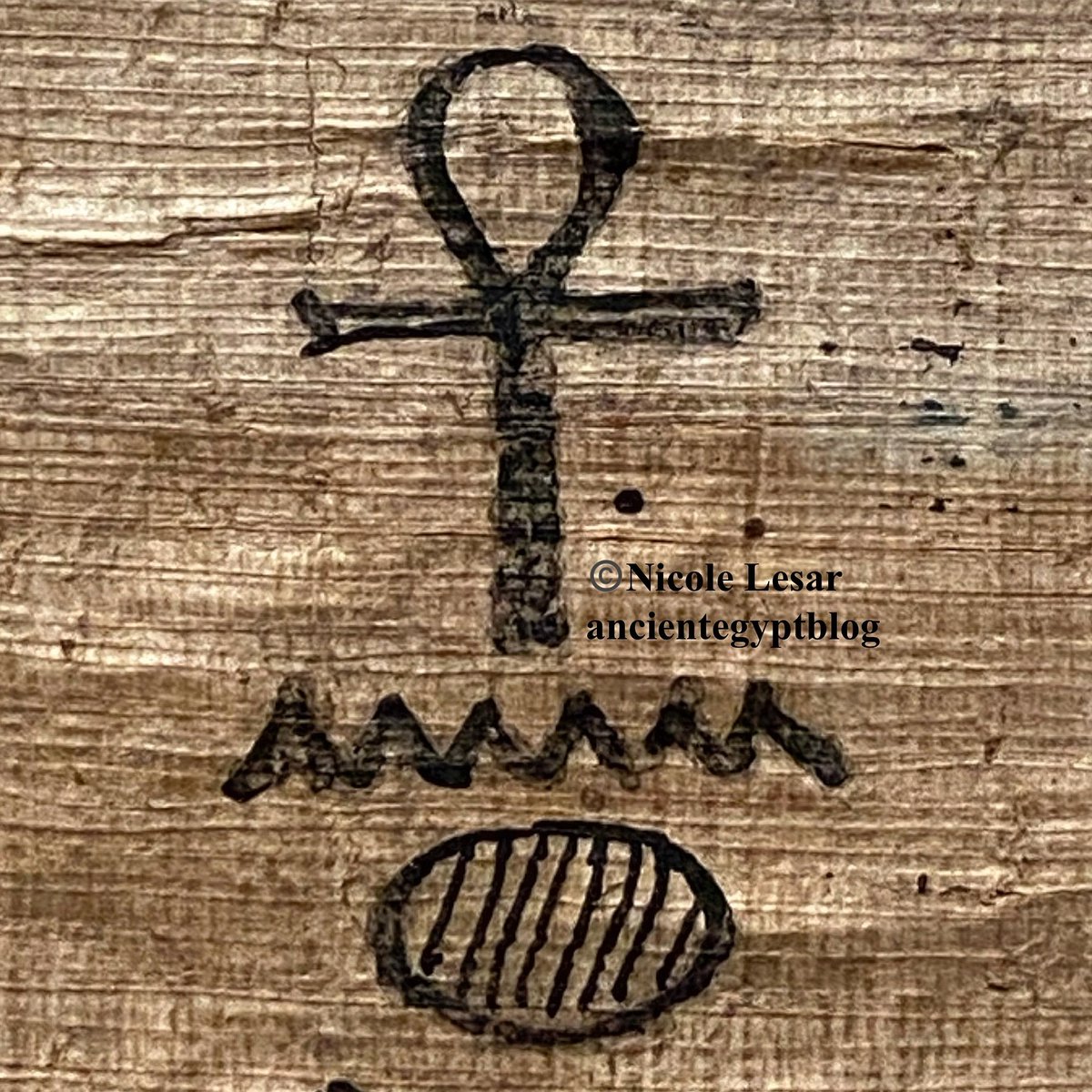
This is a piece of papyrus with the word “Life ” written on it. To the ancient Egyptians 𓆎𓏏𓀀𓁐𓏪, words were powerful because if something was written down, it was put into existence for all eternity 𓆖. This is why they put such importance on preserving the image
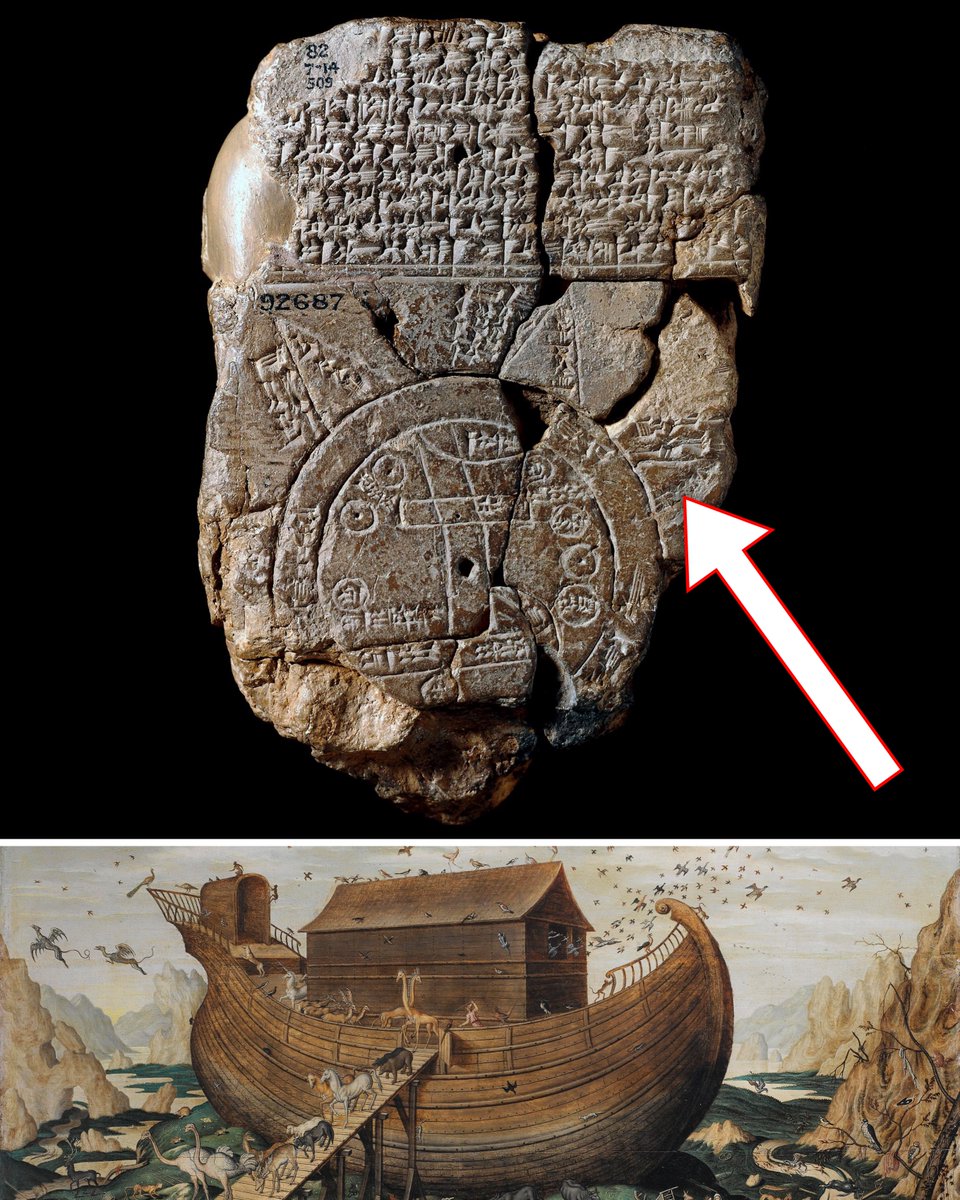
This 2,700-year-old tablet is the oldest map of the world.
It reveals just how differently the ancients understood the world — but one detail is particularly strange.
It sheds light on a VERY ancient story… (thread) 🧵
Los descubrimientos arqueológicos más surrealistas que has visto nunca.
Prepárate para alucinar 😵
1. En 2008, los arqueólogos descubrieron el pie colosal de mármol de una estatua del emperador romano Marco Aurelio (que reinó entre 161 y 180 d. C.) en Sagalassos, Turquía.
The country's unity reached its fullest during this era, and the rapid development of the arts of architecture, construction, sculpture, and engraving characterizes this
Sun cross, also called solar cross, sun wheel, is one of oldest symbols, dating back to prehistoric cultures. It has been found around the world and holds different interpretations to various cultures. It is believed to be one of oldest religious symbol in world, with links to Indian, Asian, American and European religious art from prehistoric ages.
The symbol, and its many variations, have been found around the world. Carvings from the Bronze Age show the solar cross depicted on burial urns, dating back to 1440 BC. It makes appearances on ancient cave walls, in places of worship, on coins, artwork, sculptures and in architecture.
Most basic form of sun cross features an equilateral cross set within a circle. This variation is known as Odin’s cross in Norse culture. It represented Odin, the most powerful of Nordic gods. Interestingly, English word cross is derived from Norse word for this symbol – kros.
Celtic pagan god of thunder, Taranis, was often depicted with a spoked wheel in his hand, often associated with the solar cross. This wheel has been found on Celtic coins and jewelry. The Celtic cross is believed to be a variation of the wheel of Taranis, with the circle in its center believed to represent the sun.
Swastika is a variation of the solar cross, featuring bent arms in a turning motion. This symbol was considered a good luck charm and used around the globe by many cultures, including the Native Americans, until Hitler appropriated it and altered its positive symbolism forever.
It’s a symbol of sun, an object that has been worshipped since ancient times. Belief was that symbol represented chariot wheel of Sun god. Ancient kings in Egypt and elsewhere used this symbol as they saw it as representing highest power – sun. It represents wheel, which gave power, strength and mobility to people and society. In modern astronomy, the solar cross is used as the symbol for the Earth, rather than the sun.
In Christianity, sun cross represents a halo, which is associated with angels and saints. Christians also consider it a symbol of the power of God.
#archaeohistories
The Kōshin Stone Tablet in Kamakura, Japan is a significant artifact dating back to 1677 AD. It depicts the origins of the three monkey motif, famous for its symbolic meaning. The intricately carved stone tablet showcases monkeys in poses avoiding harm and negativity.
2/9
Discover the power of "See no evil, Hear no evil, Speak no evil" - a timeless message by Shri Mahatma Gandhi.
Did you know this iconic symbol of peace and tolerance actually originated in 17th century Japan? It's a powerful global symbol that still resonates today.
1/9
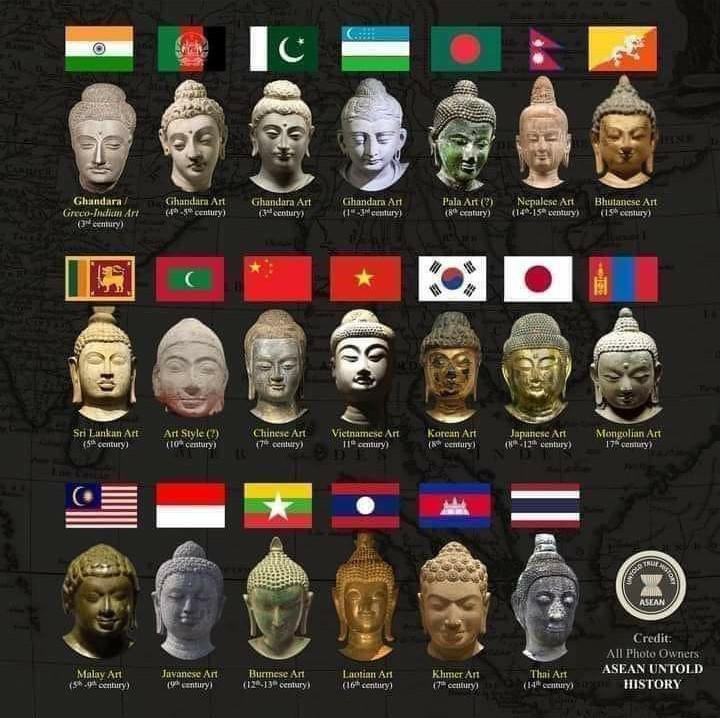
Face of ancient Buddha images, in different arts across Asia :
In Buddhist art, image of historical Buddha is often labeled Shakyamuni (sage of Shakya clan). This distinguishes image of historical Buddha, Buddha who lived on earth during this present period, from past, future, or cosmic buddhas, bodhisattvas, or other divine beings. There is a significant debate concerning the development of the Buddha image, where it first occurred, why, and when. Broadly speaking, image of Buddha emerged during first few Centuries CE, in two major centers of Indian art during Kushana period. One center of artistic production was ancient region of Gandhara, an area that includes northwestern India as well as parts of present-day Pakistan and Afghanistan. Gandharan images have a style that is reminiscent of Hellenistic sculpture and artists in region were certainly influenced by presence of Hellenistic colonies, and large-scale trade and exchange that occurred in this cultural crossroads.
A second area of artistic production is associated with Mathura, India. Here, artists developed a style that can be characterized as more indigenous, less concerned with naturalistic realism in human form and more with symbolic qualities of spiritual figure. Mathura artists created other kinds of religious imagery as well. It is probable that Buddhist imagery was influenced by the development of Hindu and Jain figures and that various communities were developing images of devotional figures simultaneously.
A very significant gap of several centuries exists between lifetime of historical Buddha and creation of first surviving images of Buddha in stone or any other medium. First surviving Buddhist art in stone was actually created prior to images of Buddha himself. During Maurya period, in reign of Emperor Ashoka (272–231 BC), significant monuments and other artworks in stone were commissioned, apparently for first time. Although stone sculpture, such as large columns surmounted by images of lions and wheels, expressed Buddhist symbolism and motifs, there are no Buddha images from this period. Many scholars have speculated that an aniconic (without idols) period existed in Buddhist art, where there was a prohibition against depicting actual Buddha and various symbols substituted for an explicit anthropomorphic representation. Some scholars have interpreted narrative reliefs at early Buddhist monuments to illustrate early Buddhist processions or festivals, where aniconic symbols, rather than anthropomorphic symbols, represented Buddha.
More than 300 years later, in Kushana era, a strong imperial ruler bringing various outside artistic and stylistic influences to realm, seems to have contributed to further artistic developments and a hitherto unseen profusion of sculpture created in stone. Scholars still not entirely sure how all Buddhist figures were used in ritual and worship. Buddhist images and sculptures originally adorned complexes of stupas as well as monastic structures. Early Buddhist sites also incorporated indigenous imagery such as loving couples and fertility figures. Caves were hewn from rock in parts of India, creating spaces for worship rituals and community meetings, as well as monastic dwelling quarters. These rock-cut cave complexes became increasingly elaborate in terms of imagery and iconography, which was created in painting as well as carved from stone in situ. Votive images also developed for private use, and as souvenirs for pilgrims to sacred sites. Figure of Buddha and attendant bodhisattvas and other divine and semi-divine beings, became objects of devotion themselves. As these divine personages expanded in number and complexity, they required larger stupa and temple structures to house them. Over time, proliferation of great numbers of Buddhist images, in some cases explicitly created through mass production techniques, reflected beliefs in meritorious repetition of various names and phrases.
#archaeohistories
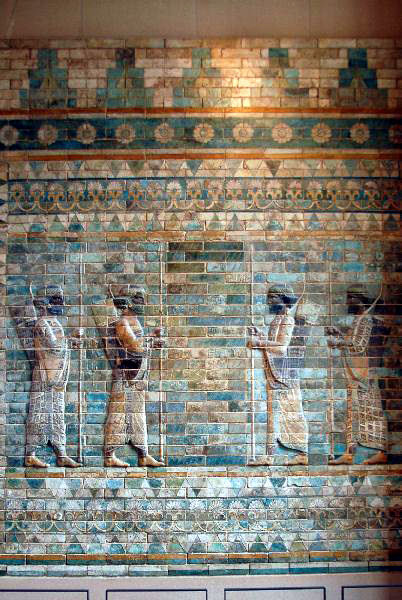
A friezed made of 'Glazed Brick Tiles', depicting "Persian Warriors", from the Palace Of Darius (6th Century BC), Susa, Iran (Persia).
The palaces of the Achaemenid kings were often decorated with representations of long lines of courtiers and soldiers, dressed for a festive occasion: although they carry arms, they have no shields or helmets. The soldiers/warriors are often called "Immortals" or "Apple Bearers", although "Companions" appears to have been their real name (more...). In Persepolis, they are carefully sculpted out of stone. In Susa, the soldiers were made from glazed brick, which gives us an idea of the colors.
The other reliefs show lions (comparable to those from Babylon) and mythological creatures like sphinxes and winged lions. They are also very common and can be found in the form of both sculpture and glazed brocks
When Susa was excavated at the end of the nineteenth century, the French archaeologists had a deal with the government that every object made of gold and silver was to remain in Iran (or Persia, as it was called in those days). As a consequence, the colorful reliefs are now in the Louvre in Paris, where they are illuminated by yellowish light, making it difficult to make good photos.
There are incomplete inscription in old Persian, Elamite and Babylonian, written on glazed bricks that belonged to a relief.
Translation :
I am Darius, the great king, king of kings, king of all nations, the son of Hystaspes, the Achaemenid.
King Darius says: Ahuramazda gave me this great kingdom, so full of men; he made me king in this earth.
By grace of Ahuramazda these are the countries of which I became king: Persia, Elam, Babylonia, Syria, Arabia, Egypt, Lydia, Greece, Media, Armenia, Cappadocia,
Parthia, Drangiana, Aria, Bactria
Chorasmia, Sogdia, Gandara, Sattagydia, Arachosia, Sindh, Thrace, Macedonia (remainder lost) ....
Pergamon Museum, Berlin
- Subscribe for Weekly Newsletter -
https://t.co/QSjn4yGpeh
#archaeohistories