South Korea's central bank decides on rates at 6 PM Pacific. All 34 economists in a Reuters poll expect a hold at 3% after hikes in July and August. Why watch: Korea makes the memory chips inside AI servers, and last week Samsung and SK Hynix had their worst week since 2008.
Will it help? A little. Northeast stocks of diesel and heating oil are 21% below last year, and the loan is small next to that gap. If you heat with oil, compare dealers, since prices vary a lot even within a state, and lock in a price or a budget plan before it gets cold.
If your home runs on heating oil, this winter could cost about $2,115, up 21% from last winter, per the government's energy forecasters. Homes on natural gas should pay 9% less. Here's why oil heat is so pricey this year, who gets hit, and what Washington just did.
On Wednesday, the Energy Department said it will loan up to 315,000 barrels from its emergency heating oil reserve, about a third of it. That's roughly 13 million gallons. Senator Collins says it adds 13% to New England's supply. Borrowers must pay it back, with extra.
Tesla call: it just secured up to $30B in new borrowing room but says it won't draw any of it this year. Cash on hand is over $45B. Full-year spending plan is now about $20B, and nearly all of 2027's Megapack grid batteries are sold out. Big spending is coming, just not yet.
Ken Griffin on AI: 'almost certainly bubbles.' His reason, in plain English: AI chips are like airline seats. Build too many and prices crash, like fiber cable in 2000.
Tesla beat on profit: 48 cents a share vs 45 cents expected, on $28.05 billion in sales. It also kept $1.53 billion in cash after spending, after burning cash last quarter. But its spending on AI and robots more than doubled to $4.7 billion. Shares barely moved after hours.
Meta just reported. Sales were $64.6 billion, up 26% from a year ago, and it sees up to $76 billion next quarter. The twist: owners get one new non-voting share for every share they hold, starting Jan 19. It works like a 2-for-1 stock split. Shares rose about 4% after hours.
Google's CEO says its cloud is turning down some sales because it needs the computing power for its own AI lab. Same week, OpenAI said its models now sell on Google's cloud too. Alphabet slipped about 2%. AI's real shortage isn't ideas. It's chips.
Abbott plans to split off its nutrition business, about $8.5 billion in yearly sales, by the end of 2027. If you own Abbott, a spinoff usually means you get shares of the new company. The stock still fell before the open. Abbott cut its 2026 sales growth view to about 6%.
Capital One earned $6.69 a share last quarter, about 22% above forecasts. The engine is card interest. Its margin, what it earns on loans minus what it pays savers, rose to 8.41%. It also freed up $225 million it had set aside for bad loans. Card borrowers are still paying.
You'll hear 'basis points' a lot today: one basis point is 0.01%, so 100 make 1 percentage point. France's 158 basis point gap vs Germany means 1.58 points more interest. A 25 point Bank of England hike would take its rate to 4%. On a $1 million loan, one is $100 a year.
The firm that grades France's debt Friday had a rough morning itself. Moody's earned $4.14 a share vs $4.25 expected, on $2.02 billion in sales vs $2.08 billion. It gets paid when companies borrow, and slower borrowing by riskier firms hurt. It kept its yearly outlook.
Meta plans to spend $130 to $145 billion this year, largely on AI. At the top end, that's about $400 million a day. Tonight's question: does that number go up? Meta, Microsoft, Google and Amazon are expected to spend over $700 billion on AI infrastructure this year.
Five big reports land within about an hour after the close: Meta, Tesla, IBM, Lam Research and Texas Instruments. Lam sells the machines that make chips, a read on AI spending. TI sells basic chips for cars and factories, an early read on the real economy. Times below.
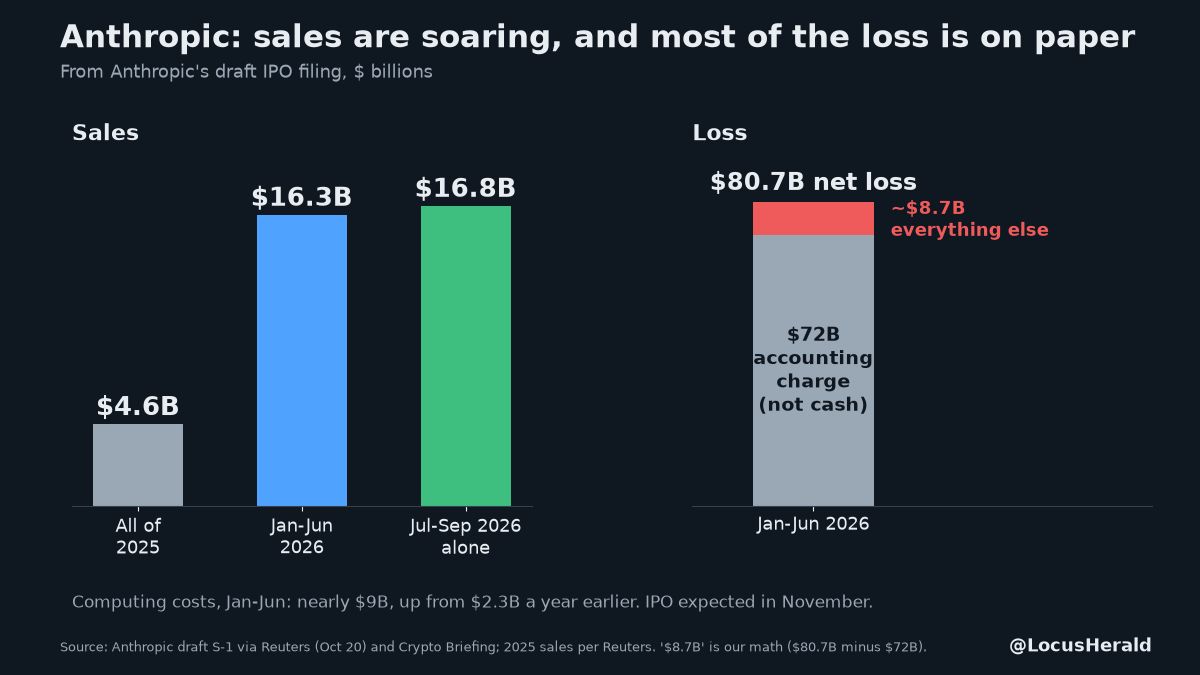
Why it matters to your money: the IPO is expected in November, and some investors now talk of a value near $1.5 trillion. Investors see its success as key for the AI trade, a big slice of most index funds. A cool reception could weigh on AI stocks broadly, Reuters says.
Anthropic lost $80.7 billion in six months. It also grew faster than almost any company ever. Both are true, according to its draft IPO filing reported by Reuters. Here's what the numbers really say, and why they matter even if you never buy a share.
The real costs are still huge. It spent nearly $9 billion on computing power in the first half, up from $2.3 billion a year earlier. And it has promised to spend at least $518 billion over about 10 years on cloud, chips and data centers.