Industry, investors back ISM 2.0 equity model, say will unlock private capital for chip startups
Vishesh Rajaram, founding managing partner at Speciale Invest, said, “ISM 2.0's equity-and-exit model is a sharp shift — the government acts like a co-investor, not just a grant-giver, and steps back once companies scale. That discipline crowds in private capital rather than crowding it out, giving India's chip startups patient capital at the riskiest early stage without diluting the ownership structures later-stage VC and strategics need."
By @AihikS
https://t.co/Oed7Rg50CV
Meet Sanjay Chitkara, Director of LG Electronics.
- Survivor of the 1989 Khalistani terror attack at Thapar Engineering College, Patiala
- He was hit by five bullets and survived. He still has one bullet in his body
- Khalistani terrorists stormed the hostel and killed 19 non-Sikh students from different states
- Attack took place two hours before Rajiv Gandhi's visit to Chandigarh, yet he made no public statement on it.
You won't see this in Satluj because it doesn't fit its one-sided narrative.
Indias first Quantum Computer. In the league of top 5 in the world in this space. @nagendra_qpi@qpiai
Yes; it’s possible. And it’s possible in India. 🇮🇳
Full story soon.
This article highlights that India's first fab will produce semiconductors using legacy nodes and frames this as a major limitation.
Yes, there are many challenges in building a new semiconductor industry, but this particular argument is shaky at best.
A thread:
(1/n)
@PilotMma27886@gankizi_amamori@hmakihara When did we reach moon 5 times? Before succeeding in 2023 we only failed in 2019 thats it.Japan failed many times. BTW india per capita income exceeded subsaharan way back in 2016.And india is ahead of japan in AI and IT plz ask any AI chatbot FYI. Come out of your fools paradise
@PravinSawhney What is the contribution of indus water treaty first of all? Did it stop or persuade pak from terrorist activities or proxy war against us. Did it stop wars in the past? Please tell its contributions in maintaining peace.
@gankizi_amamori@hmakihara BTW indians reached moon far earlier than japanese. Indians are far ahead of japan in IT. Tell me how much japan is growing? Barely 1pc. In contrast india is doing well with 7pc per annum. Don't forget, you ppl are still occupied by US and your PM gets insulted by trump.
@osaka0119@hmakihara got insulted by trump in front of cameras. This is the respect your prime ministers have in front of others. Dont forget you are still occupied by USA. Get rid of US bases first.
@osaka0119@hmakihara BTW what is gdp pc of japan? You ppl barely grow 1%. Your gdp is 4tn $ that's it down from once 6tn$. In contrast india is also roughly same as japan at 4tn and growing at more than 7pc per annum. And also why japan is investing 10bn$ if india is so useless. BTW your PM takaichi
The Cabinet has approved Semicon 2.0 with a budgetary outlay of ₹1.27 lakh crore (~$13 billion). It is India’s bet on the century’s most consequential industry.
Semicon 1.0 answered whether India could play — 12 projects sanctioned, over $20 billion in commitments from global majors, 105 startups now in the chip-design ecosystem, fabs rising in Gujarat and Assam. Semicon 2.0 will answer the harder question: whether India can lead.
The global map has rearranged around us. Trusted-partner frameworks with the US, EU, Japan, Netherlands, Germany and Singapore. Capital from Applied Materials, AMD, Lam Research, KLA and Microchip. Tata’s tie-ups with ASML and Merck. India is no longer petitioning to enter the trusted chip supply chain but is being written into it.
Semiconductors are the substrate of AI, defence, mobility and data infrastructure. Self-reliance here is not aspiration. It is the foundation on which every other national ambition rests.
My compliments to the Prime Minister, Shri @narendramodi ji, for his visionary leadership in steering India’s semiconductor ambition. Under his leadership, technological self-reliance has moved from rhetoric to institutional architecture.
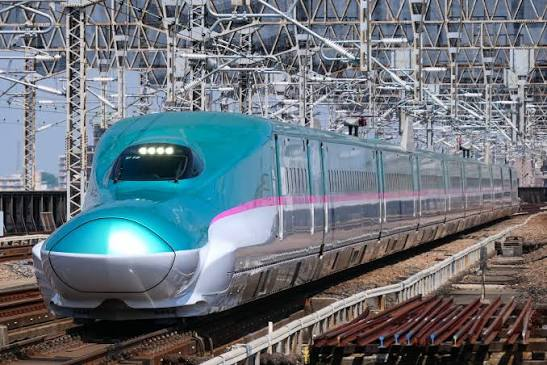
Good to see, 🇮🇳 is pursuing its interests. Building our own bullet train even if delayed is infinitely better than using imported Shinkansen. Even if 1st bullet train is only 70-80% as efficient as Shinkansen we will have enough opportunity to make it better over time.
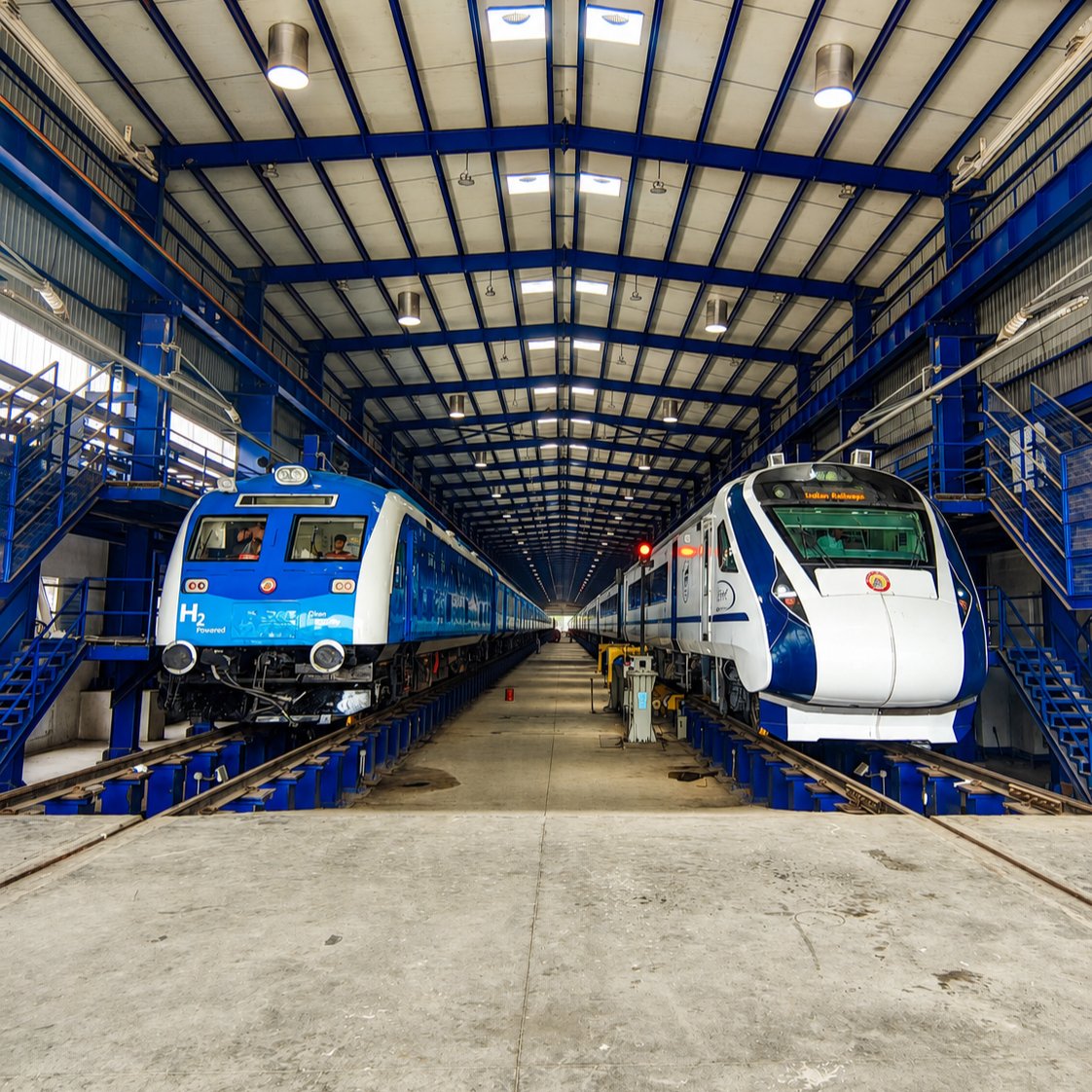
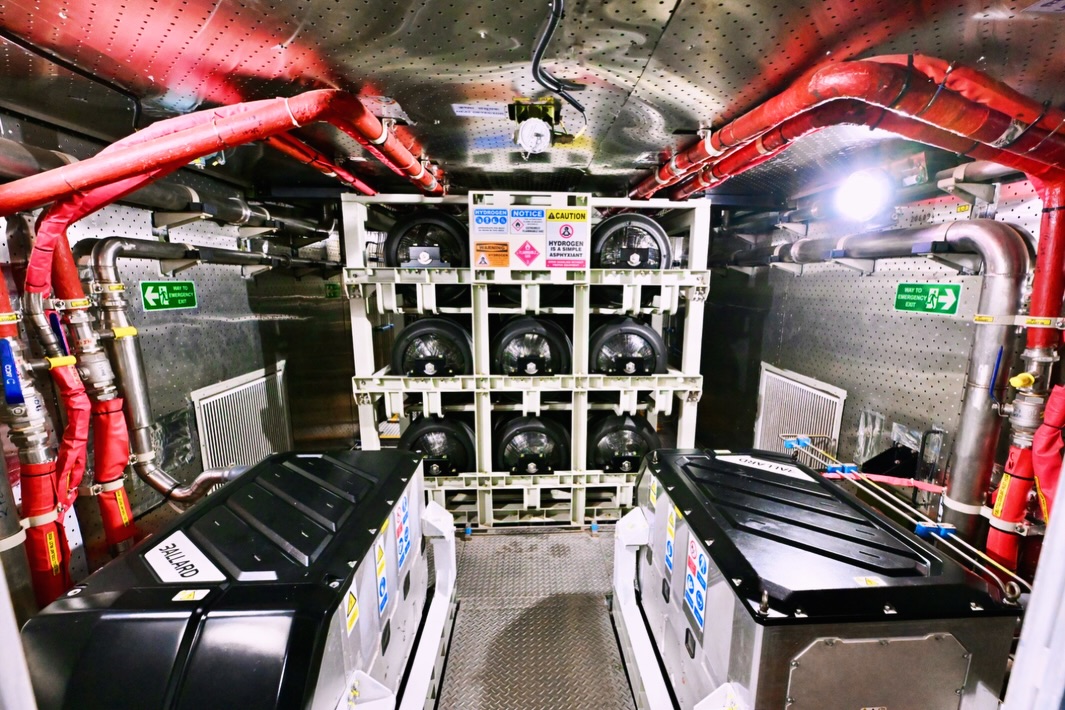
World's Most Powerful Hydrogen Train all Set to Hit Indian Tracks 🇮🇳🚆
Route: Sonipat-Jind: 89 km
Top Speed: 110 km/h
Power: 3,200 HP
Capacity: 2,600 Passengers
Range: 250 kms
Emissions: Zero Carbon
The Namo Green Rail Revolution is here 🔥
Now, while I agree with Indian stubbornness and incompetence, may I also point out that the Japanese are unwilling to make any rolling stock or signalling systems in India? Thankful for JICA support, but doesn't mean India should order rolling stock or signalling systems at an exorbitant price instead of assembling it themselves.
Japan has failed transferring Shinkansen technology to over a dozen countries including Thailand, Vietnam and Indonesia.
But no, it's the Indians that don't keep promises. Sometimes they need to reflect. For these people, their country is never the problem.
India takes a significant leap towards clean and sustainable transportation with its first Hydrogen Train. Combining indigenous technology, advanced safety systems and zero-emission operations.
Read more: https://t.co/oiK2FuFxNG
It’s official. 🚀
July 18. 11:30 AM IST.
Vikram-1. Test Flight-1. Mission Aagaman.
India’s first private orbital launch from the historic First Launch Pad at SDSC-SHAR, Sriharikota.
The countdown begins. 🇮🇳
#Vikram1#MissionAagaman#SkyrootAerospace#OpeningSpaceForAll
Wockhardt has just produced India’s first domestically-discovered antibiotic to win approval from the US Food and Drug Administration. For over 15 years, founder and chairman Habil Khorakiwala poured roughly $300 million into a scientific gamble that many would have abandoned.
The result is Zaynich, a novel intravenous antibiotic designed to treat complex urinary tract infections. Wockhardt estimates the drug could eventually generate annual sales of as much as $2 billion.
—
Richest from the Bohra community, I reckon.
https://t.co/MIK5KN4e9s
Chennai-based Madras Swastik Engineers has joined the Bharatiya Antariksh Station (BAS) programme as a fabrication partner. The company will manufacture flight-standard structural assemblies for BAS modules, supporting Bharat's first space station. 🚀🇮🇳
Major push for Indigenous Chip Design & IP Ownership - India aims to develop its own intellectual property (IP) in all six critical semiconductor segments, RF, compute, memory, power management, sensors, and network, to strengthen electronics and defence manufacturing. The goal is to move beyond assembly and services toward a ‘product nation’ with domestic chip design capabilities: Sources