I am so happy to see that people loving the photos and films!!
I truly loved to act as a creative director and photographer to shoot the entire thing! 🤍
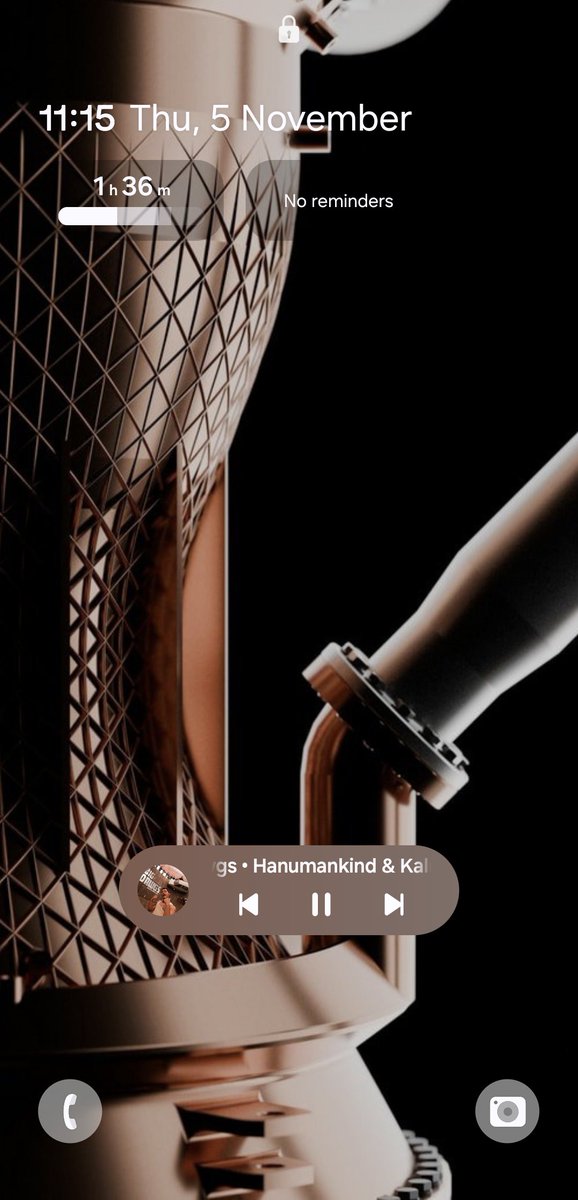
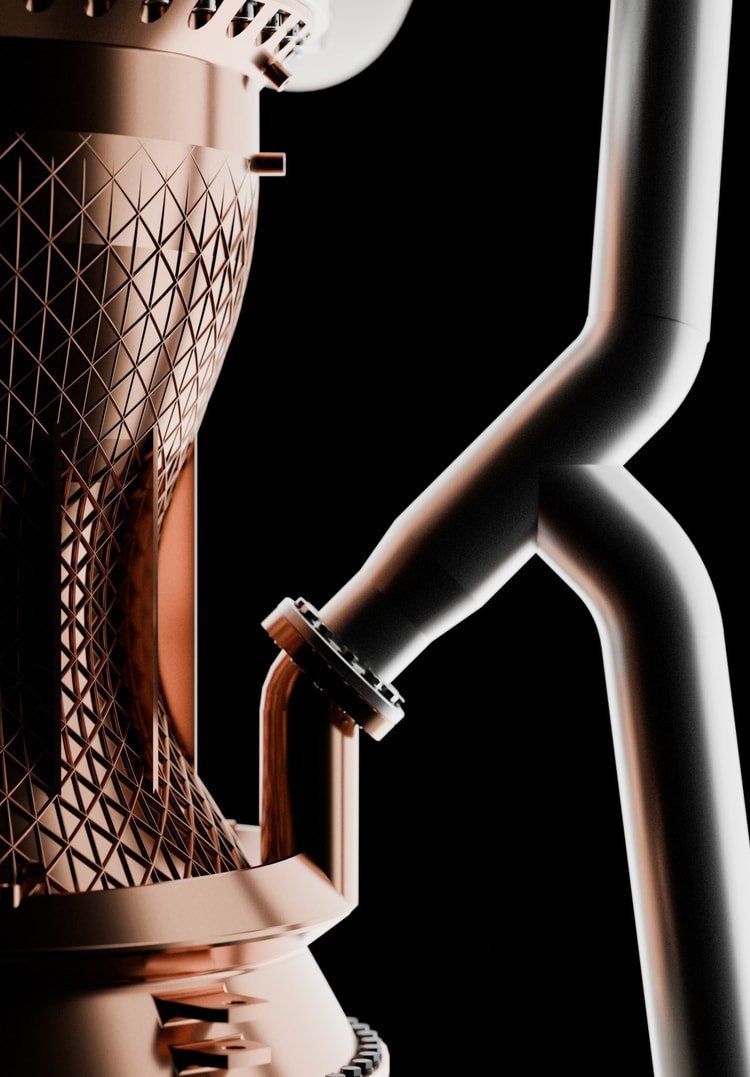
🚀 Astrobase has updated their website. And it has some of the best images and graphics of any Indian rocket engine ever! Overall the website is smooth and well designed ✨️
Everest looks really sick. The Indian rocket engine scene is on fire!
Check out: https://t.co/ayXkuI3BAc
🇮🇳 Astrobase has updated their website with awesome images of their Everest engine, a 800 kN lox-methane FFSC engine.
Everest test fire was planned for October 2026, but it seems to happen in the coming months. Recently they tested the water deluge system at their 200 ton engine test stand. 🔥
🚀 Astrobase has updated their website. And it has some of the best images and graphics of any Indian rocket engine ever! Overall the website is smooth and well designed ✨️
Everest looks really sick. The Indian rocket engine scene is on fire!
Check out: https://t.co/ayXkuI3BAc
One interesting detail in the spec: it lists the LVM3 core variants as L110 / SC120 / SC200.
SC120 is the semicryo stage ISRO is building right now. It carries ~120 t of LOX-kerosene and will replace the L110.
SC200 is a bigger version of the same idea, with ~200 t of propellant on the same SE2000 engine. It showed up in an ISRO tender back in 2019 as a future upgrade, but ISRO hasn't talked about it recently.
The drawings only have covers for the L110 and SC120 openings, so SC120 is what's actually designed for. But the spec still keeps SC200 on the table.
(Not to be confused with SCE-200, which was just the old name of the SE2000 engine.)
#ISRO #LVM3 #SC120 #SC200 #Semicryo #SE2000 #Sriharikota
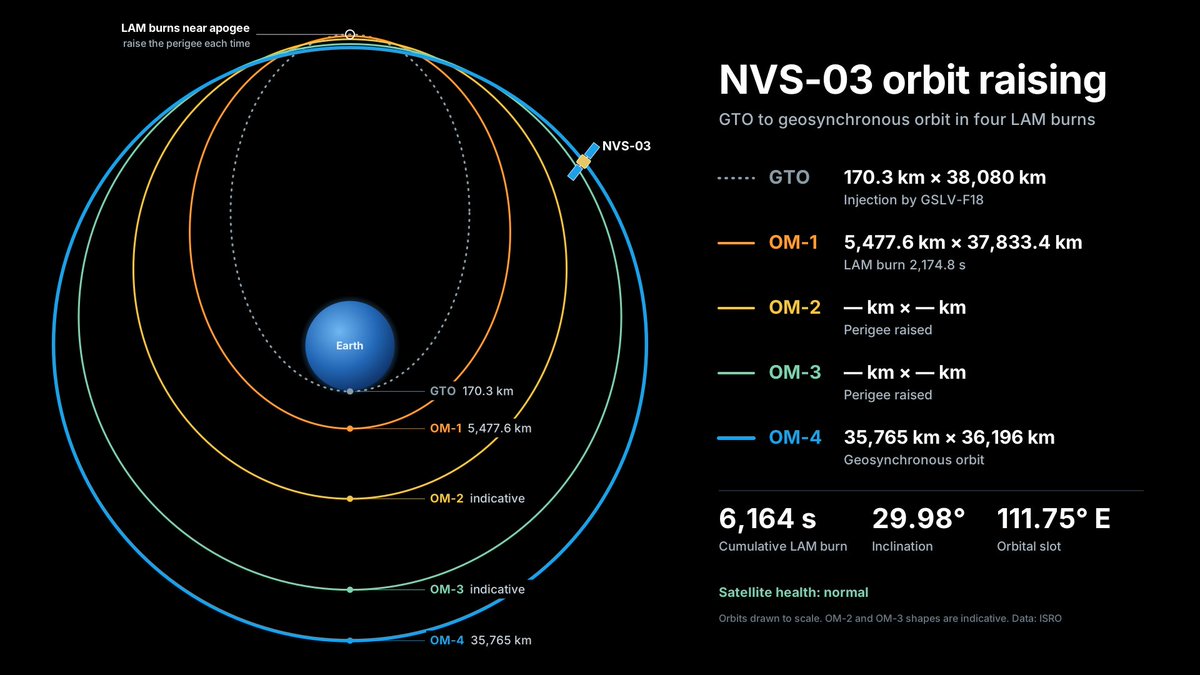
NVS-03 is now in Geosynchronous Orbit!
@isro completed 4 orbit raising manoeuvres with a cumulative LAM burn of 6,164 s.
Orbit: 35,765 × 36,196 km
Inclination: 29.98°
Health: Normal ✅
#NVS03#NavIC#ISRO#GSLVF18#IndianSpaceflight
ISRO's SDSC SHAR has issued a tender for a second LVM3 Mobile Launch Pedestal.
Tender: SH202600152501
Vehicle: LVM3, with L110 / SC120 / SC200 core variants and two S200 strap-ons
Project: Augmentation of Second Launch Pad (ASLP)
Every LVM3 is stacked on a Mobile Launch Pedestal (MLP) inside an assembly building and then rolled ~1 km to the Second Launch Pad (SLP). PSLV/GSLV use their own pedestal. LVM3 has had just one, until now.
Why two pedestals if there's only one pad?
A rocket is at the pad for only a few days, but it sits on its pedestal for weeks while it's being stacked. With one pedestal, the next LVM3 can't start until the last one has launched and the pedestal has been refurbished.
With two pedestals and two assembly buildings (VAB + SVAB):
> One LVM3 can be stacked while another heads to the pad
> If one pedestal is damaged in a launch, the other is a backup
> That means more LVM3 launches a year from the same pad
Specs:
> 19.2 m × 19.2 m deck, 3.6 m deep, with a service walkway inside
> Central opening with swappable covers for the L110 and SC120 cores, so it's semi-cryo ready
> 2 Strap-on Support Rings, each rated for 500 t
> Hydraulics shift each loaded ring ±50 mm, to ±0.1 mm accuracy, to align the S200s
> Ring seating surfaces held to 30 arc seconds
> Load test with 2 × 250 t dummy loads
> Rolls on the existing bogie, plus a new parking spot on the SVAB–SLP track
Steel: ~803 t
Design: Tata Consulting Engineers, who also designed the existing LVM3 pedestal. The builder will be whoever wins the bid.
Timeline: 12 months to supply + 4 months to erect
Bids due: 30 Nov 2026
One pad, two pedestals, more LVM3 launches a year.
#ISRO #LVM3 #Sriharikota
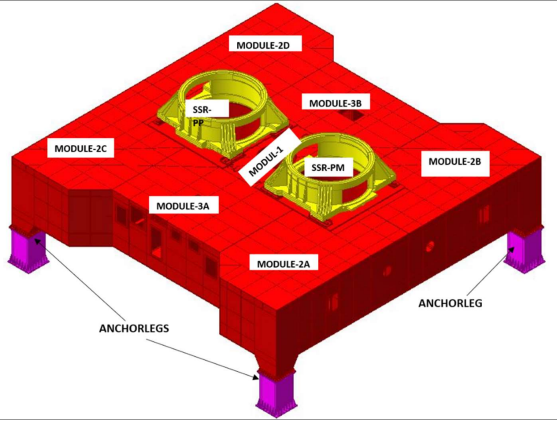
Here's what the new LVM3 Mobile Launch Pedestal looks like, from the tender's technical specification
> The red deck is built in modules. Module 1 is the central strip with openings for both S200 boosters and the core stage, with modules 2A to 2D and 3A, 3B around it
> The two yellow rings are the Strap-on Support Rings. Each S200 booster stands on one, and hydraulics can shift them slightly to line the boosters up
> The pink blocks at the corners are the anchor legs that lock the pedestal to the ground at the launch pad
As per the spec, it will support LVM3 with L110, SC120 and SC200 core stages. The drawings have swappable covers for the L110 and SC120 openings, so it's ready for semicryo LVM3
It's fabricated in pieces and put together at Sriharikota, around 803 t of steel in total
Image: SDSC SHAR tender document
#ISRO #LVM3 #SC120 #SC200 #Semicryo #Sriharikota
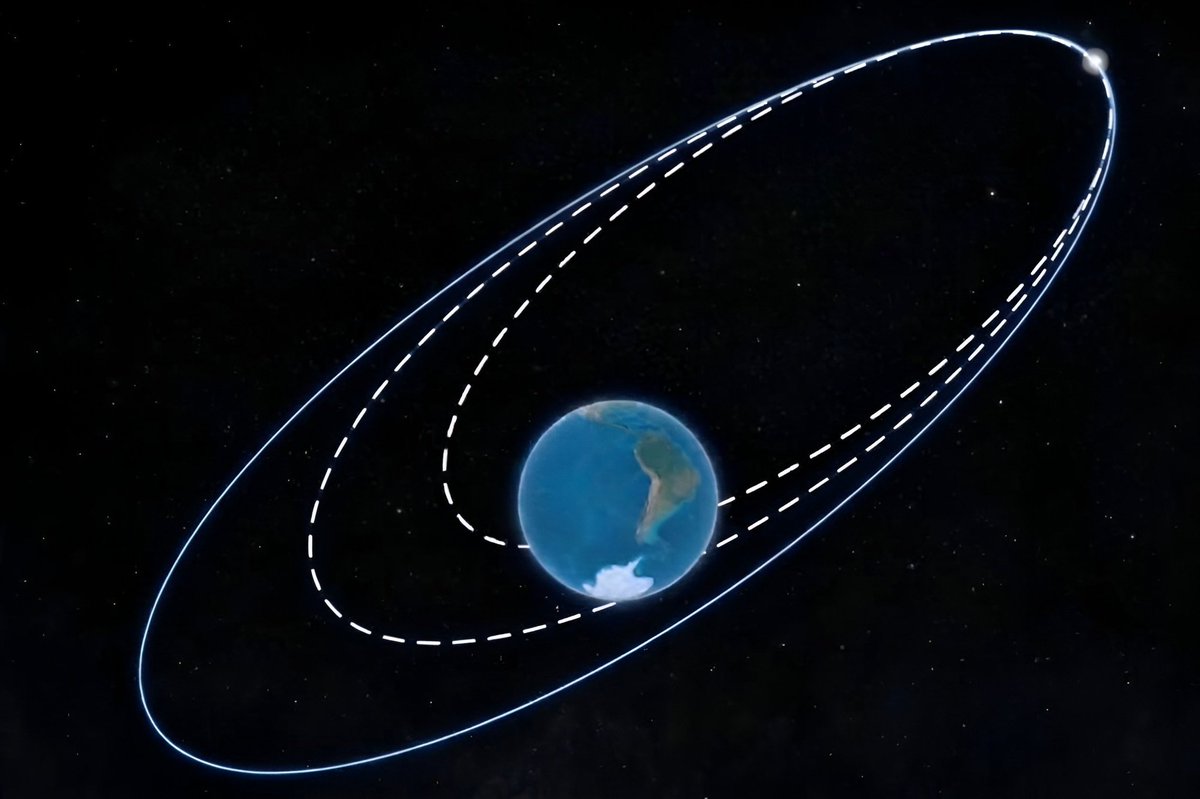
🚨 NVS-03 has been successfully placed into its intended GSO! ✅️
The third and final orbit raising maneuver of NVS-03 was successfully completed!
It has been placed into a 35842.6 × 34594.9 km Geosynchronous Orbit.
Now NavIC is back online and is ready to provide PNT service again.
Since March 2026, NavIC has had only 3 working navigation satellites, one short of the 4 needed for a position fix. Once NVS-03 is operational, NavIC's base layer is back to 4, bringing back standalone 3D positioning over India.
Since the launch, interest in NavIC has shot up. People want to know how it works, why it dropped to 3 satellites, and what its status is right now.
We built a free NavIC hub on our platfor to answer exactly that 👇
📖 Overview: why India built NavIC, every launch, the failures and the fixes, Gen-1 vs Gen-2
🎓 Learn: interactive lessons on trilateration, pseudorange (d = c × t), L5 + S band and the ionosphere, skyplots and DOP, multipath, and clocks
⏱️ RAFS: the story of India's own rubidium atomic clock from SAC-ISRO, with stability charts and live broadcast clock data
🛰️ Constellation: every IRNSS/NVS satellite, whether operational, unhealthy, silent or retired
📊 Status dashboard, updated hourly from NASA CDDIS data:
• Live health per satellite (health flag, URA, clock drift)
• Daily clock drift from IGS data
• Availability: are 4+ satellites up for a fix?
• India coverage map
• Orbits and ground tracks
• NavIC vs GPS, Galileo, BeiDou, GLONASS, QZSS
• Gen-1 vs Gen-2 clock trends
• Events: clock jumps, health changes, new satellites
When NVS-03 starts broadcasting, it should show up in our Events feed as a new satellite, automatically.
Note: this is built on open broadcast navigation data from IGS and NASA CDDIS. It's not ISRO telemetry and not an official ISRO status page.
Start here 👉 https://t.co/GZyoCpykr6
Live status 👉 https://t.co/Utw7Wu9mOn
#NavIC #ISRO #NVS03 #GNSS #IndianSpace
🚨 NVS-03 has completed its second orbit raising maneuver!
Its 440 N LAM (Liquid Apogee Motor) engine burned for 51 min 25 s, raising perigee to 24,691 km from 5,477.6 km.
With one more orbit raising maneuver NVS-03 will be placed in its intended GSO.
🚨 BREAKING: India's Aditya-L1 reveals the hidden 3D shape of a solar eruption ☀️🇮🇳
Scientists at the Indian Institute of Astrophysics (IIA), Bengaluru, used the VELC instrument on @isro's Aditya-L1 to show that a coronal mass ejection (CME) does NOT always expand like a neat, symmetric bubble.
🔭 The event
A CME that erupted on 5 August 2024, studied close to the Sun in the low corona.
🔬 How they did it
• VELC used Doppler spectroscopy to measure plasma moving towards and away from us (line-of-sight motion). Regular coronagraphs can't do this.
• They combined it with imaging from NASA's Solar Dynamics Observatory (SDO).
• They added a 3D geometric and kinematic model of the expanding CME shell.
📊 Key finding
VELC caught two Doppler-shifted emission branches at the same time, one blue-shifted (moving towards us) and one red-shifted (moving away).
A symmetric bubble model could not explain this.
Only a CME with asymmetric lateral expansion plus a tilt matched the observations.
🌍 Why it matters
• A CME's shape affects how much drag it gets from the solar wind.
• That drag changes its speed.
• Its speed decides when it reaches Earth.
Knowing the true shape means better arrival-time predictions and better protection for satellites and communication.
✨ The big deal
VELC can help pin down a CME's 3D geometry from a single vantage point at L1. Until now, this usually needed multiple spacecraft watching from different angles.
📄 Published in The Astrophysical Journal Letters
✍️ Saurabh Tripathi, Tanmoy Samanta, Jayant Joshi (IIA Bengaluru)
🔗 https://t.co/CmmsnB9nmu
#AdityaL1 #ISRO #SpaceWeather #CME #SolarPhysics #Sun #IIA #IndianSpace #Heliophysics #Science
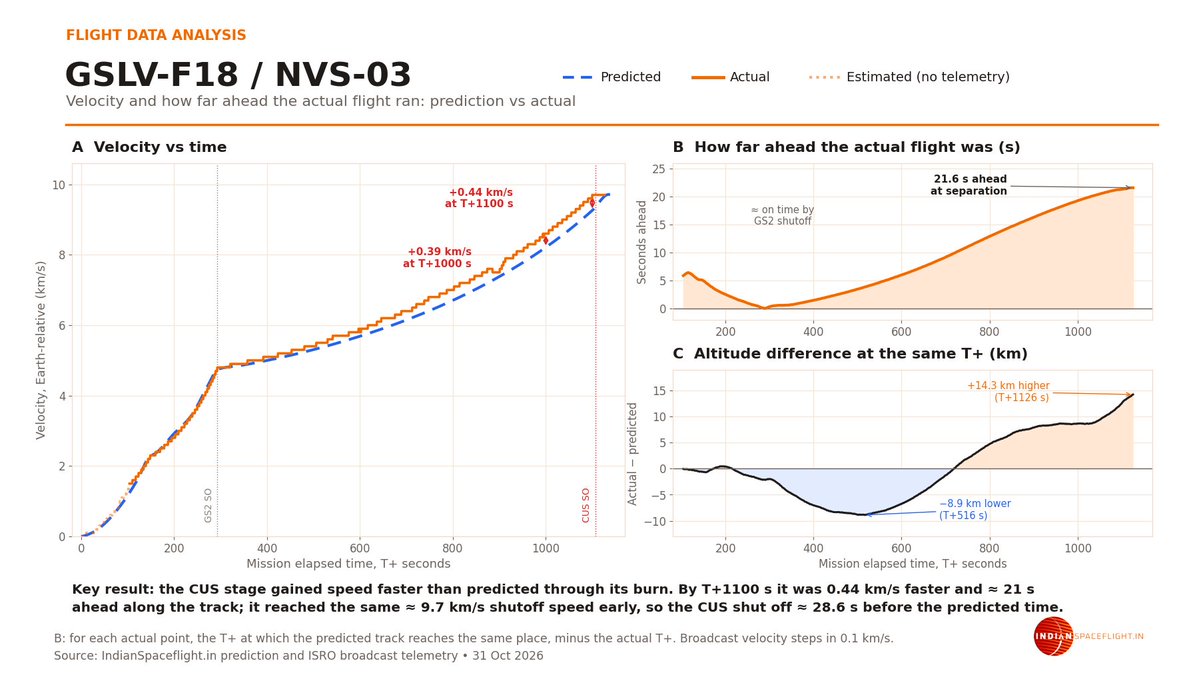
GSLV-F18/NVS-03: our prediction vs the actual flight
We rebuilt the actual flight from ISRO's webcast: 1,330 telemetry samples (one every 0.5 s from T+104 s to separation) plus 14 event times from ISRO's on-screen FLIGHT EVENTS table. Then we compared it, event by event and second by second, with the trajectory we published before launch.
1 · Event table
Of 12 predicted events, 3 matched within 1 s, 7 within 1–3 s and 2 were off by more than 3 s.
• L40 shutoff: 149.0 s predicted, 149.5 s actual
• Payload fairing separation: 237.4 s vs 239.5 s
• GS2 shutoff: 291.2 s vs 292.9 s
• CUS shutoff: 1135.4 s vs ≈1106.8 s (28.6 s early)
• NVS-03 separation: 1150.4 s vs ≈1121.8 s (28.6 s early)
2 · Altitude profile
The shape matched: climb, dip, final rise. The actual flight peaked at 146.9 km (T+438 s) against our 155.3 km, and dipped to 131.9 km (T+745 s) against our 128.3 km. The first 104 s are estimated, as the broadcast showed no telemetry then.
3 · Ground track
The actual track ran up to 39 km north of ours and steadily pulled ahead: 10 km at T+300 s, 63 km at T+700 s, 196 km at T+1100 s. Separation happened 74 km short of our predicted point (≈5,996 km from the pad at separation vs 6,061 km predicted).
4 · Velocity and deviation
The CUS stage built speed faster than we predicted: +0.39 km/s at T+1000 s, +0.44 km/s at T+1100 s. By separation it was 21.6 s ahead along the track. It reached the same ≈9.7 km/s shutoff speed early, which is why shutoff came early.
5 · Mission summary
ISRO reports injection into a 170.3 × 38,080 km orbit, against 170 × 37,023 km planned: perigee on target, apogee 1,057 km (2.9%) higher. GS2 burned 140.4 s (141.6 s predicted). CUS ran ≈808.9 s from ignition command to shutoff (839.7 s predicted).
Our verdict: liftoff to CUS ignition was spot on, with every event within 2.9 s and altitude within 1.6 km. The CUS burn is where we missed. We saw the same ≈28 s gap on GSLV-F17, so it is a pattern in our model, not chance.
What this means for us
With two full actual flights now rebuilt (F17 and F18), both pointing to the same gap, we know exactly where our model needs work. That gives us real confidence to improve our predictions for future launches.
Thank you
A big thank you to everyone who watched GSLV-F18/NVS-03 with us on our Flight Profile dashboard. The page got 159 views, with 15 live viewers and a peak of 10 concurrent viewers. We know these aren't big numbers, but they mean a lot to a small team like ours and keep us motivated to keep building.
Replay the actual and predicted trajectories in 3D, second by second. After separation, the live orbit readout shows ISRO's 170.3 × 38,080 km:
https://t.co/pCaESoXp8Q
#GSLVF18 #NVS03 #ISRO #NavIC
Less T-4 minutes to liftoff of GSLV-F18 / NVS-03!
The Automatic Launch Sequence has started following launch authorisation from the Mission Director and Vehicle Director.
Join us for ISRO’s launch stream alongside our detailed 3D mission visualisation. Let’s watch together! 🇮🇳
💻 Open on a laptop or desktop:
https://t.co/pCaESoXWYo
#ISRO #GSLVF18 #NVS03 #NavIC