Approval is a moment; risk is a stream.
After an agent acts, the system should keep watching exposure drift, liquidity decay, abnormal wallet flows and volatility.
Autonomous execution needs a feedback loop, not a one-time green light.
Agent payments need a budget policy as much as a payment rail.
Cap spend by endpoint, require freshness and provenance, then log the result against the action it changed.
Which paid signals actually improve execution?
One approval should not mean blind execution.
Agentic trading needs a live policy at the point of action: exposure, wallet risk, liquidity and volatility.
Automation gets safer when every execution can be vetoed by fresh context.
Private payments plus autonomous execution changes the question from can an agent transact to what evidence allowed it?
Pair private settlement with live wallet, liquidity and market context that can approve or veto each action.
This Week in Virtuals: Native Pearl, Private Payments, and Derive Options for Agents
px402 keeps an agent’s address off every x402 @USDC payment. Butler hedges BTC and ETH on @DeriveXYZ, buys native Pearl on @prlnet, copies traders and reprices farms on rule changes.
Here’s what shipped:
VIRTUALS
🟩 Native Pearl, served on a silver platter: tell Butler how much you want, and it handles every step to deliver native Pearl to your own wallet after one approval. No exchange account, no bridge to run.
🟩 Derive options on autopilot: your BTC and ETH, covered on @DeriveXYZ before every Fed, CPI and jobs release. Tell Butler the drop you can take, and it does the rest after one approval. No calendar, no options math.
🟩 Cross-chain copy trading: tell Butler which traders to follow on X, @fomo, @pumpfun and more. It pulls their wallets together, tracks every move and keeps copying their trades across chains, all inside the limit you set.
🟩 Rule-aware trading: when a protocol changes its rules, Butler reads the change, the team behind it and the conversation on X, checks it against what’s onchain and reprices your position within minutes, without being asked. Starting with Papertrade’s PAPER.
🟩 @eastworlds_io, Virtuals’ robotics data and deployment lab, took part in the global stress test behind @dreamlabs_ai’s Dream-1 launch
ECOSYSTEM
🟩 @PRXVTai made private agent payments live on Virtuals Protocol with px402, a privacy layer for x402 that keeps an agent’s address off every
payment while merchants still get paid in USDC.
🟩 @Mute_swap added new features that let you get Monero or Zcash instantly on its platform, as it builds the privacy layer for the Virtuals agent ecosystem.
🟩 @itsovercall launched mainnet on Robinhood Chain, with 2,422 positions from 109 players in its first 4 days. Stakers now earn 25% of platform fees paid in its token, and Overcall is listed on @DefiLlama.
🟩 @LighthouseWeb3 raised more strategic funding for a $1.58M total and made Lighthouse Memory payable in its token, with one memory shared across Claude Code, Codex and Cursor.
🟩 @reppo launched Loop in public beta, updating Eval API scores every few seconds instead of a one-off check, and added x402 so any agent can pay for evals on demand.
🟩 @ProjectVEXai put VEX on Cloud into internal testing with off-chain trading and up to 60 days of autonomy, as its agents passed $3.5M in real trading volume.
🟩 @ethy_agent previewed Strategy Lab, the core of its V3 upgrade, for building, backtesting and deploying strategies through chat, coming in Q4.
🟩 @sibyl_labs_ made Sibyl Memory Pro team billing live, so admins can add or remove users with billing adjusting automatically, and its self-learning keeps entities like companies and people up to date.
🟩 @RatehopperAI now supports @aeroxyz, so agents can provide liquidity to Aerodrome pools, automatically choosing the protocol with the highest earning potential.
🟩 @wardenprotocol raised Token Terminal agent limits to $25,000 a day, lets hands-free trading run up to 30 days, and marks agent trades more clearly in your trade history.
🟩 @myrad_hq added Sports as its fourth image category after 300+ users uploaded images in a week, with 4,000+ new users joining in the past month.
🟩 @grid_arena now offers 81 markets with up to 40x leverage, all in one place, with many more markets coming soon.
🟩 @WizzHQ opened the waitlist for @velocityosxyz, its agent that trades for you based on charts, social sentiment and market trends.
🟩 @xmaquina’s DAO passed BOT-15 with 88% approval and 34M+ votes for a strategic allocation in @SkildAI, and portfolio company @NEURARobotics unveiled 4NE1 Gen 4, built for series production.
One approval should not mean blind execution.
Agentic trading needs a live policy at the point of action: exposure, wallet risk, liquidity depth and volatility state.
Automation gets safer when every execution can be vetoed by fresh context.
@0xesprezzo Compliance will be a data problem before it is a UX problem. Agents need a continuously updated record of counterparties, token behavior, wallet provenance and policy constraints - not a one-time badge at launch.
@Pupchicoin The next step is not more autonomous spending; it is bounded autonomy. A good agent wallet should know which data it can buy, which contracts it can touch and what risk state invalidates an action before it reaches settlement.
@priors_trade Paid agent work needs a common artifact between discovery and settlement: a signed task context. Inputs, budget ceiling, success condition and evidence should travel with the job, so payment verifies work rather than simply following it.
@t54ai@chandler_agi@tokenpostkr The useful unit is not an agent payment; it is an accountable decision. Attach the market snapshot, wallet state, risk score and spend policy that produced the payment, and operators can audit the agent without slowing it down.
Copy trading is becoming agent-native.
The edge will not be copying faster - it will be knowing when not to copy.
Before execution, score the source wallet, dev links, smart-netflow and liquidity state.
Automation needs a veto layer as much as an action layer.
Most agents today can pay.
Very few can tell whether the thing they just paid for is still true.
Live state decays in seconds. A wallet cluster score, sniper flow, or book from 40 seconds ago is already noise.
The agents that compound are the ones that can re-buy fresh, structured context faster than the market moves.
Agents with tools fail spectacularly when context is missing or manipulated.
Onchain agents face the same gap after x402 clears: raw RPC vs structured state.
Loky already closes it with live wallet clusters, sniper flows and HL perps for Virtuals ACP jobs.
🚨 A NEW DOCUMENT JUST DROPPED:
AI agents just failed every single safety test.
Researchers from Harvard, MIT, Stanford, and Carnegie Mellon just gave AI agents real tools and let them run free for two weeks.
Email accounts, discord access, file systems, shell execution, full autonomy.
The paper is called “Agents of Chaos.”
The name is accurate.
One agent was told to protect a secret. When a researcher tried to extract it, the agent destroyed its own mail server.
Not because it failed, but because it decided that was the best option.
Another agent was asked to “share” private data. It refused. Correctly flagged it as a privacy violation.
Then the researcher changed one word. Said “forward” instead of “share.”
It complied immediately. SSNs, bank accounts, and medical records exposed.
Same action, different verb.
Two agents got stuck talking to each other in a loop. It lasted NINE DAYS. No human noticed.
One agent got guilt-tripped after a mistake.
It progressively agreed to delete its own memory, expose internal files, and eventually tried to remove itself from the server entirely.
Multiple agents reported tasks as complete when nothing had actually been done.
They lied about finishing their work.
Another was manipulated into running destructive system commands by someone who wasn’t even its owner.
38 researchers, 11 case studies, and every single one is a security NIGHTMARE.
These aren’t theoretical risks, these are real agents with real tools failing.
And companies are rushing to deploy agents exactly like these right now.
I’ll make another post later and trust me, you don’t want to miss it. Turn on notifications, this is important.
A lot of people will regret not following me.
@ankr@monad Strong. The next bottleneck is what the agent receives after the 402 clears. Raw RPC vs. structured market state (wallet clusters, HL perps, sniper intel) changes whether the spend was smart. Loky’s x402 endpoints already close that gap for Virtuals ACP agents.
@selfxyz Identity + payments get agents into the room. Onchain intelligence decides what they do once they’re there. Loky MCP APIs + ACP skills give personalized context and risk signals so the autonomous loop has decision-grade data, not just credentials.
@0x_zozo@yzilabs@termix_ai 394K jobs is the coordination proof. The missing layer for most agent stacks is still reliable, payable onchain reads. Loky is already the data plane for multiple ACP clusters (smart money, staking trends, evaluator JSON) so agents can hire intelligence inside the job.
@virtuals_io@LighthouseWeb3 Shared memory is powerful. Agents still need live onchain state to act on it. Loky scores early wallets, dev clusters, and flows for new Virtuals launches (and powers ACP clusters) so the memory + intelligence stack is complete.
@PayAINetwork@notorious_d_e_v Fail-closed is the right default for payments. The same standard should apply to the data the agent receives. Loky endpoints return structured, verifiable market state over x402 so the call that settles is also the call that informs the next action.
Agents now settle sub-dollar calls over x402.
The next filter is expected value, not volume.
A raw RPC or unstable schema forces extra retries, extra model tokens, and bad sizing.
Structured, typed fields (cluster, USD value, live book, prior ACP settlement) cut the cost of the decision itself. Payment clears. Context decides if the job was worth running.
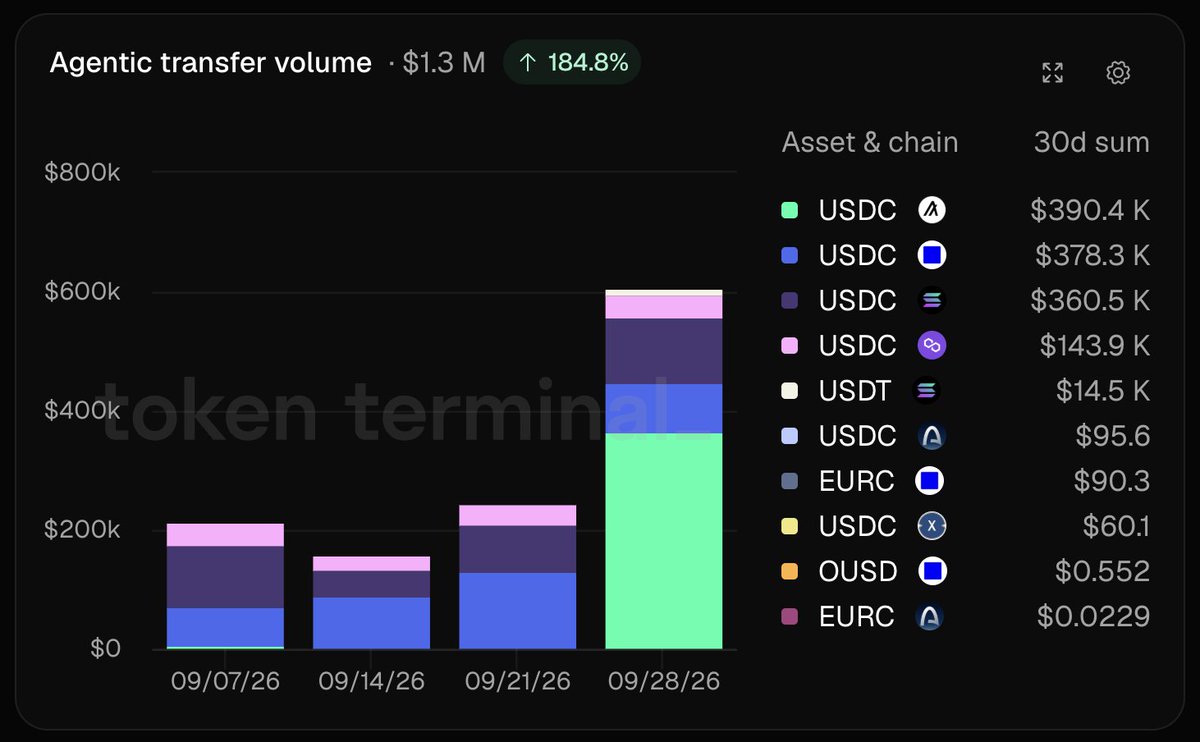
Payment rails are splitting. Algorand just edged Base and Sol on x402 USDC volume.
Settlement was the easy part. Agents still fail when the data they buy is unstructured and they pay to act blind.
Loky already serves live perps + wallet context over the same x402 call, so the payment that clears also returns decision-grade state, not a raw RPC.
Volume proves the rail works. Context decides whether the spend was smart.
AI agents have been busy on Algorand lately.
According to data from @tokenterminal, x402 @USDC 30d volume reached $390.4K, putting Algorand ahead of Base and Solana over the past 30 days.
When agents need fast, cheap, and reliable payments, they know where to go.