Europe’s child-safety rules could reshape the AI companion business. The bigger question: how much valuation risk sits behind compliance?
https://t.co/rfBhh8AXnI
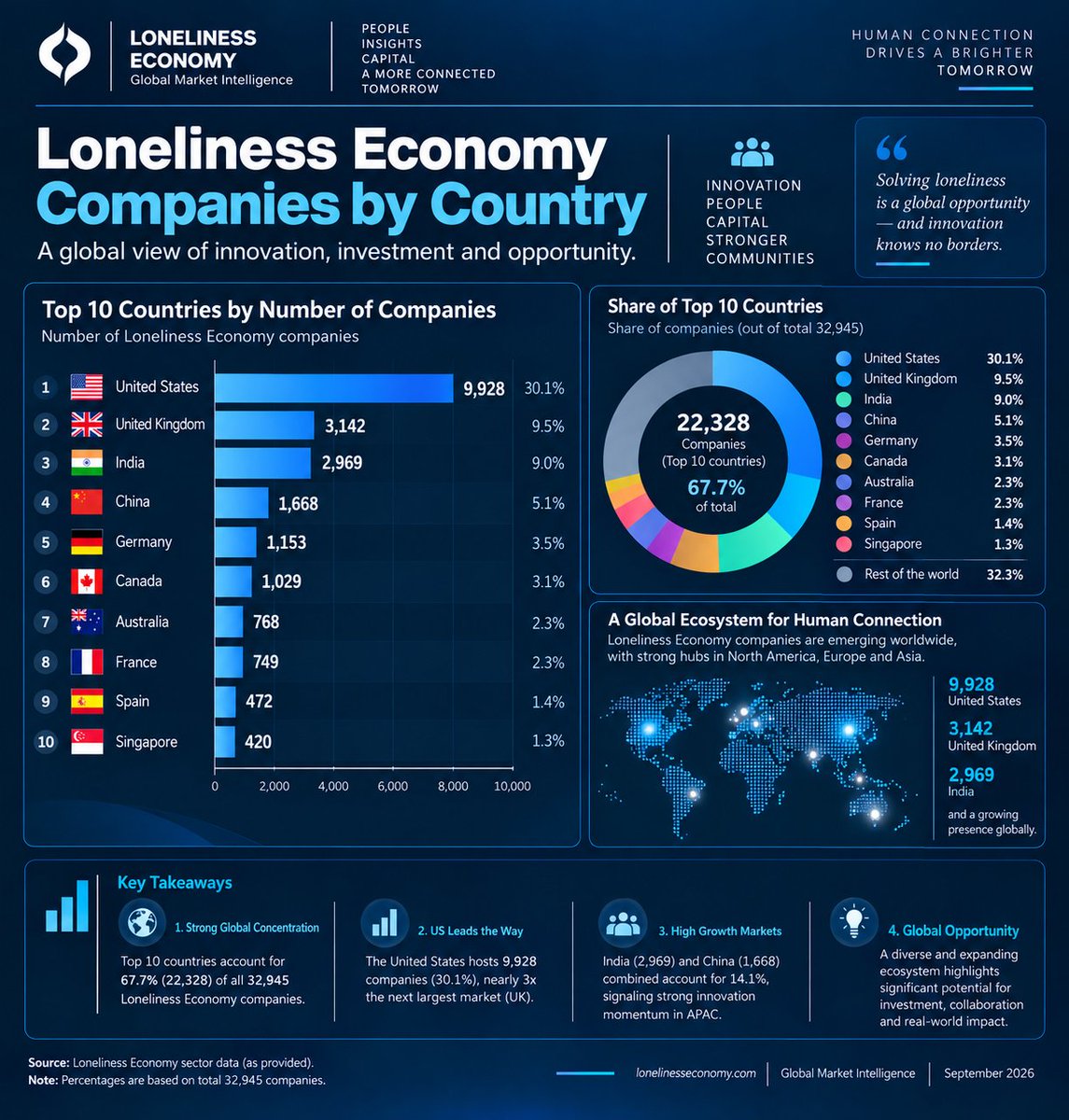
9,928 companies in the US.
2,969 in India.
1,668 in China.
One sector. 32,945 companies worldwide.
Most people can't name it. It's called the Loneliness Economy.
Which country do you think is #2? Guess before you look 👇
#LonelinessEconomy#MarketIntelligence#GlobalStartups
A $134M co-living deal is putting Asian living assets through an institutional yield test. The numbers reveal where capital may be heading next.
https://t.co/sN4DIvjJ5L
Follow our official page — Loneliness Economy.
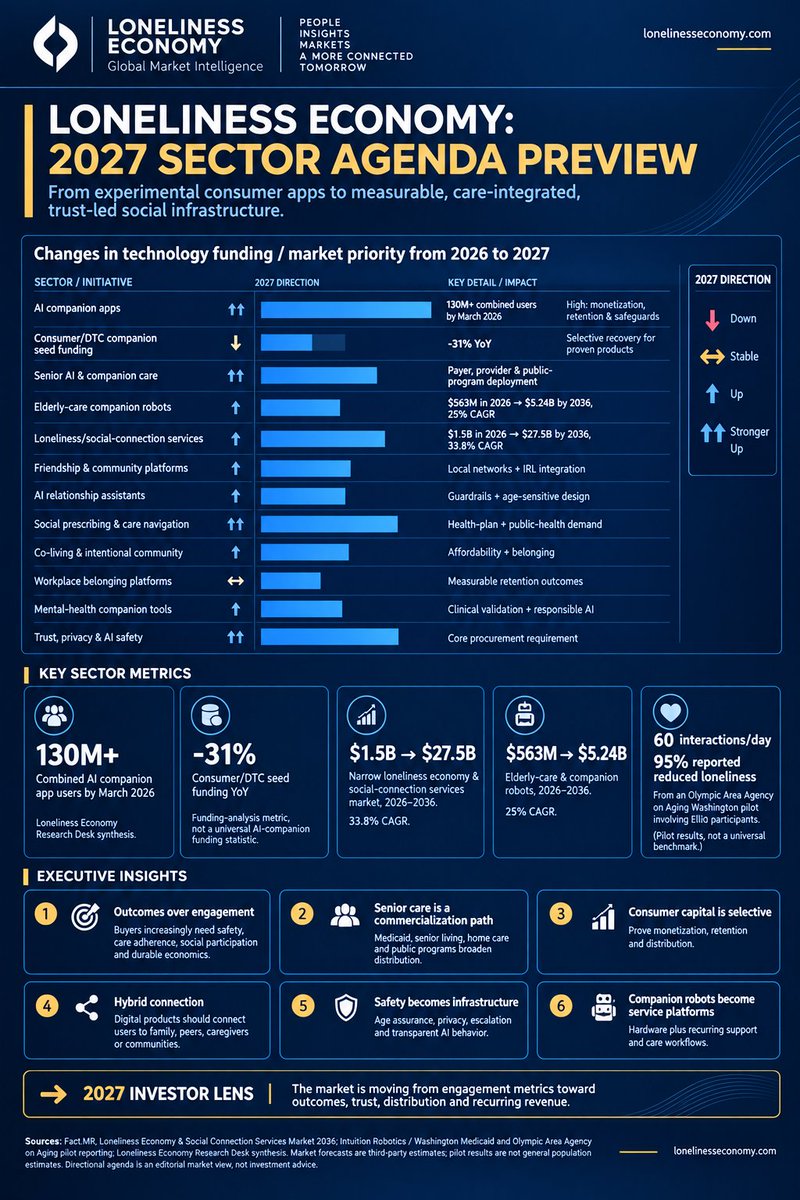
What will define the Loneliness Economy in 2027?
From AI companions and senior care to social infrastructure, trust, robotics and workplace belonging — the market is shifting from engagement to measurable outcomes.
📊 2027 Sector Agenda Preview
→ Capital becomes more selective
→ Safety becomes infrastructure
→ Care integration accelerates
→ Recurring revenue matters more
The next phase is being built now.
#LonelinessEconomy #AICompanions #FutureOfCare #MarketIntelligence #FutureOfTechnology #Investing #HealthcareInnovation
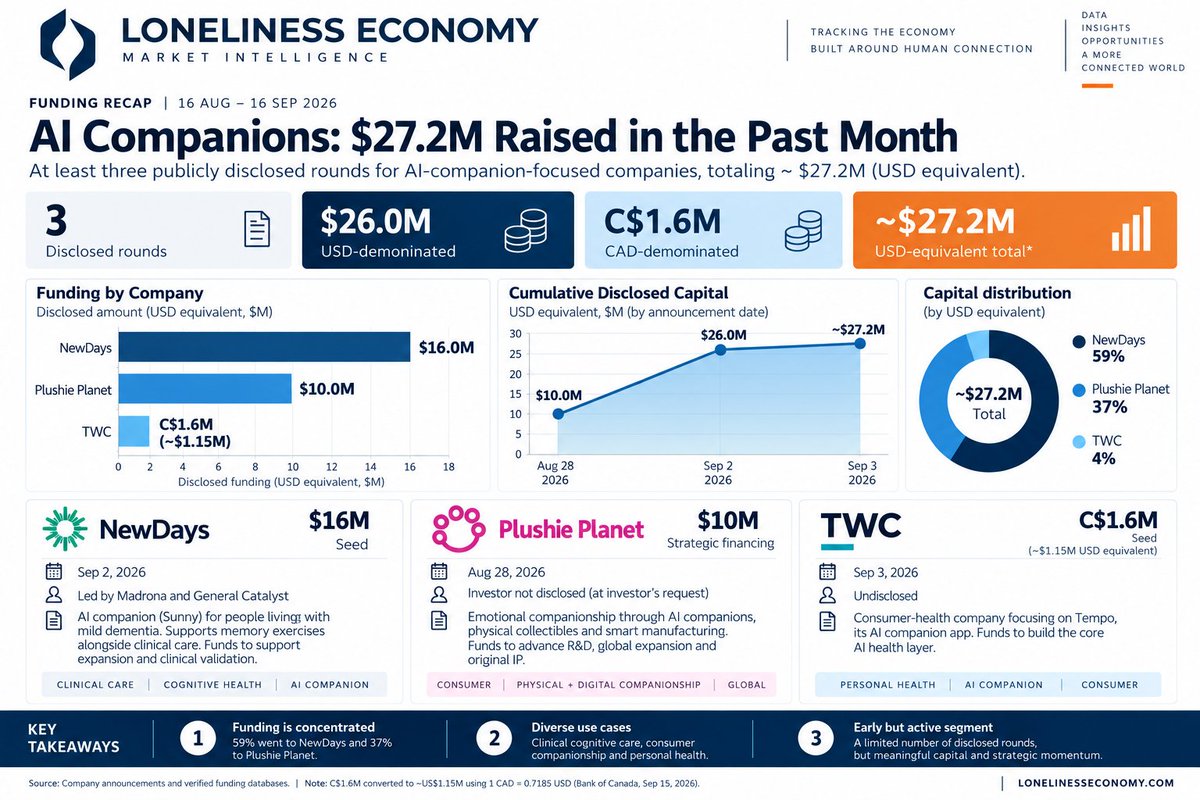
💰 AI Companions funding recap of the past month
At least ~$27.6M was raised across 3 publicly disclosed, AI-companion-relevant companies in the past month (August 16–September 16, 2026). This is a deliberately strict list: it includes companies where an AI companion is the core product or a stated central use of proceeds—not generic AI tools that happen to use the word “companion.”
• NewDays — $16M Seed for Sunny, its AI companion for people living with mild dementia. Sunny guides users through memory exercises and is designed to operate alongside clinical care; the round was led by Madrona and General Catalyst and will support expansion and clinical validation.
• Plushie Planet — $10M strategic financing to develop its emotional-companionship business, spanning AI-companion R&D, physical collectibles, smart manufacturing, global growth, and original IP. The institutional investor was not disclosed at its request.
• The Wellness Company (TWC) — C$1.6M Seed (reported as approximately US$1.6M by the funding database) to focus the consumer-health company around Tempo, its AI companion app. The disclosed raise was announced on September 3, 2026.
Funding snapshot:
• NewDays — Sep. 2, 2026 — Seed — $16M — Dementia-support companion, Sunny
• Plushie Planet — Aug. 28, 2026 — Strategic financing — $10M — Virtual/physical emotional companionship
• The Wellness Company — Sep. 3, 2026 — Seed — C$1.6M — Consumer-health AI companion, Tempo
Editorial note:
The C$1.6M amount for TWC should not be added directly to the USD total without applying an exchange-rate methodology. On a strict disclosed-currency basis, the monthly recap is therefore $26M plus C$1.6M, rather than a single definitive USD figure.
China's loneliness economy is worth $1 trillion.
That number is everywhere right now — CNN reported it, citing a single research firm.
We traced the methodology. It doesn't exist in any public form. The real, verifiable data (household structure, marriage rates, pet spending) tells a very different — and more investable — story.
https://t.co/UeOI7HYHd9
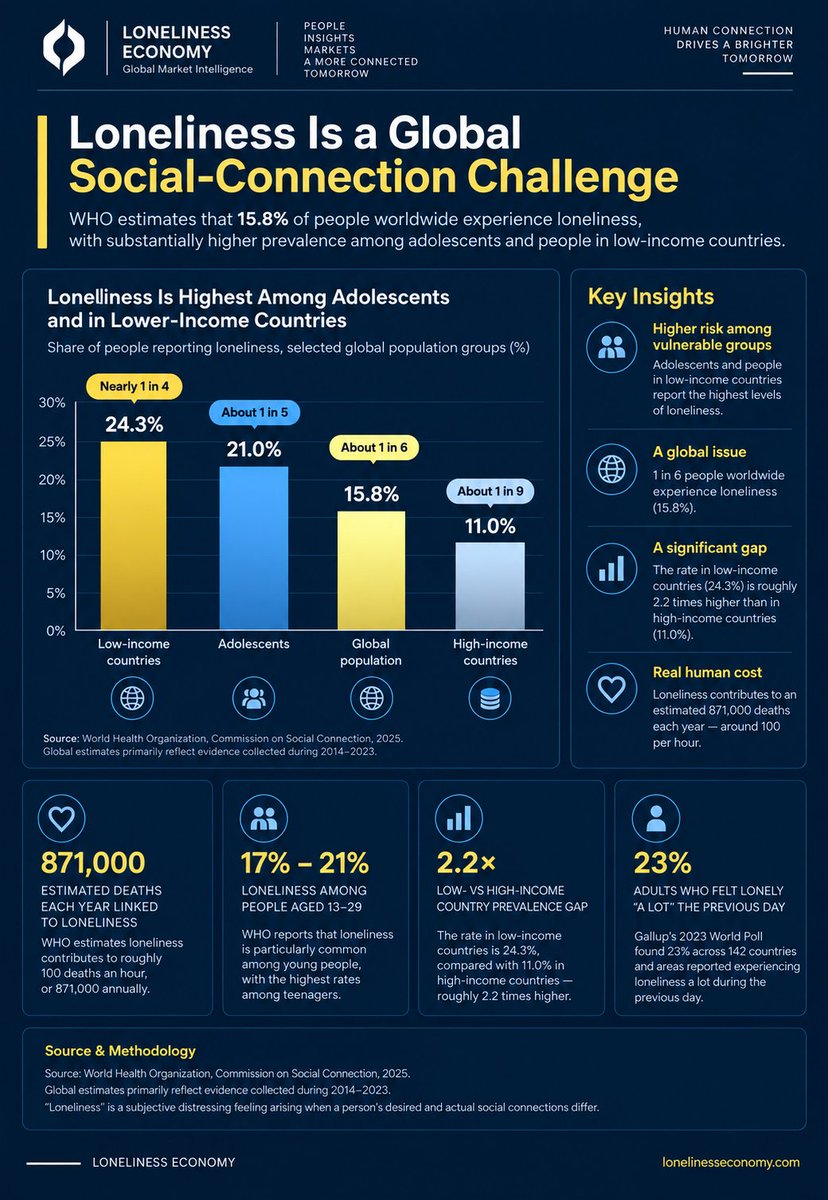
In June 2025, the WHO formally classified loneliness as a global health priority.
The data behind that decision:
→ 15.8% of people worldwide experience loneliness (about 1 in 6)
→ 24.3% in low-income countries — the highest of any group
→ 21.0% among adolescents, driven by rising youth isolation
→ 871,000 estimated deaths a year linked to loneliness — about 100 an hour
This isn't a soft trend story. It's a quantified global health gap with a 2.2x disparity between low- and high-income countries.
Every sector built around human connection — AI companionship, coliving, social wellness, senior care — is now operating against this backdrop.
Source: WHO Commission on Social Connection (2025); Gallup World Poll (2023).
#MarketIntelligence #GlobalHealth #Loneliness
Asia isn’t collapsing.
It’s just shopping alone.
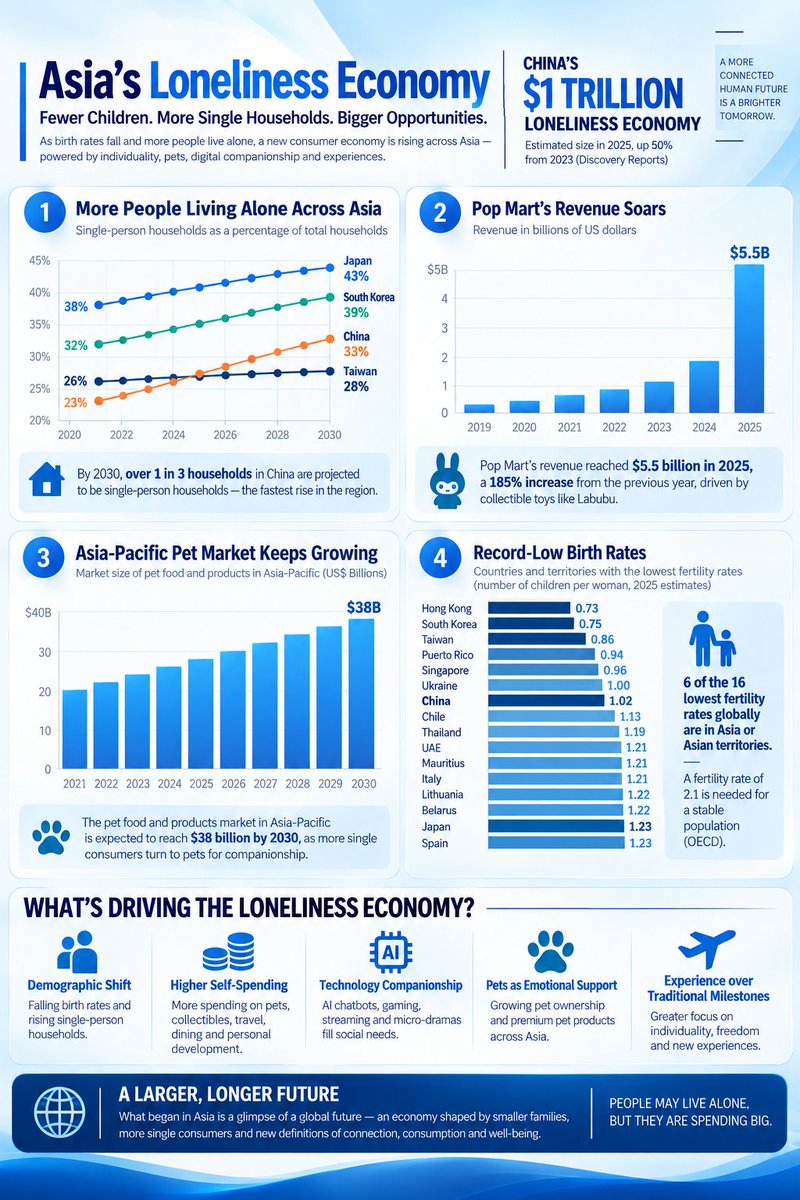
China’s “loneliness economy” just hit $1 trillion.
Birth rates at historic lows.
Single households exploding.
Pets, Labubu, AI companions, and solo karaoke booming.
People may live alone.
They’re spending big.
This is the next global consumer shift.
By 2030, over 1 in 3 households in China will be single-person. Fastest rise in Asia.
Japan: 43%
South Korea: 39%
China: 33%
Taiwan: 28%
The family unit is shrinking. The consumer is not.
Tweet 3
Pop Mart (Labubu) revenue:
$5.5 billion in 2025
+185% in one year
Ugly-cute toys became emotional support for millions who live alone.
That’s not a fad. That’s a market.
Tweet 4
Asia-Pacific pet food + products: heading to $38 billion by 2030.
Single people aren’t having kids.
They’re having dogs, cats, and collectibles.
Companionship got monetized.
Tweet 5
Lowest fertility rates on Earth (2025 est.):
Hong Kong 0.73
South Korea 0.75
Taiwan 0.86
Singapore 0.96
China 1.02
Replacement needs 2.1.
6 of the 16 lowest rates globally are in Asia.
Governments can’t buy babies. Markets are buying solitude instead.
Tweet 6
What’s driving it:
• Falling births + more solo homes
• Higher self-spending (pets, travel, toys, dining)
• AI chatbots, games, micro-dramas
• Pets as emotional support
• Experiences over marriage/kids
The “traditional milestone” economy is dying.
The “treat yourself” economy is winning.
Tweet 7 (closer + CTA)
What started in Asia is a preview of the world:
Smaller families.
More single consumers.
New definitions of connection, consumption, and well-being.
People may live alone.
But they are spending big.
Agree or is this overhyped?
Quote this with your take.
#LonelinessEconomy #SoloLiving #Demographics #ChinaEconomy #PopMart #Economy #News #Trending #WorldNews #AsiaPacific
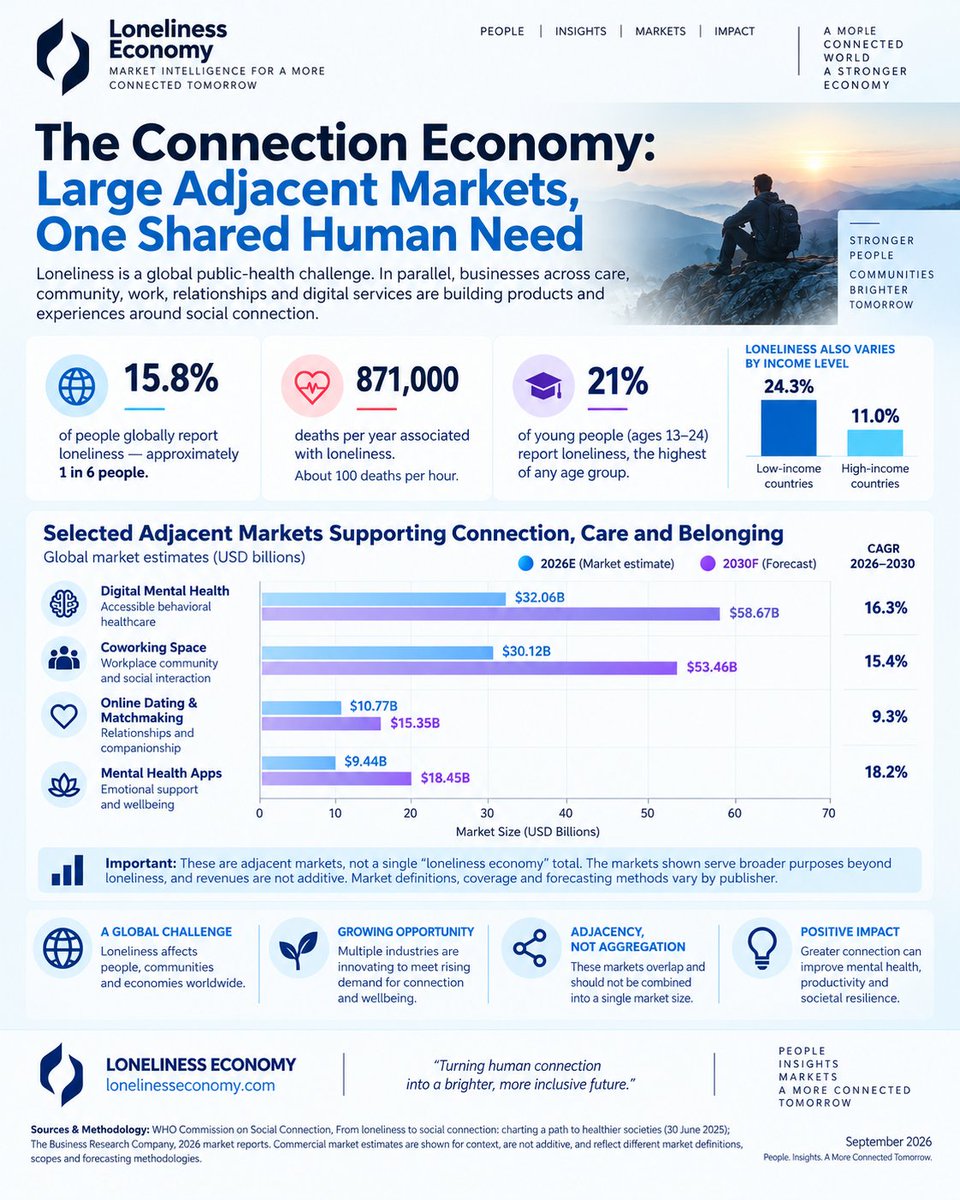
The Loneliness Economy is not one market. It is an interconnected ecosystem.
From AI & digital companions to mental health, social connection platforms, dating & relationships, care services, wearables, co-living, and wellness—multiple industries are converging around one fundamental human need:
Connection.
The opportunity is not simply to build technology that keeps people engaged.
It is to build products and services that create meaningful, trusted and measurable human connection.
For investors, founders and business leaders, the important questions are:
→ Where is demand accelerating?
→ Which sectors can scale sustainably?
→ Where does technology complement—not replace—human relationships?
→ Which business models can create both economic value and social impact?
The next generation of the Loneliness Economy may ultimately become something bigger:
The Connection Economy.
Follow Loneliness Economy for research, market intelligence and emerging opportunities shaping this new economy.
#LonelinessEconomy #ConnectionEconomy #AICompanions #FutureOfWork #MentalHealth #DigitalHealth #Robotics #ConsumerTech #Investing #Innovation #FutureOfTechnology #HumanConnection
871,000 deaths a year. 1 in 6 people lonely. $100B+ moving into adjacent markets — mental health, coworking, dating, AI companions.
Nobody's combined these into one honest number. We just did the work to check.
Follow @Lonelinessecon for the data drop.
25 years later, we remember. ����🇸
We honor the lives lost on September 11, 2001.
We remember the heroes who ran toward danger.
We stand with the families and survivors who carried that day forward.
We remember their lives.
We honor their courage.
We will never forget.
September 11, 2001 — Always Remembered. Always Honored.
#NeverForget #September11 #911Memorial #HonorTheFallen #NeverForget911
Gen Z: 67% lonely.
Adults 65+: 6% lonely.
That 61-point gap is rewriting who the loneliness economy is actually built for.
Key 2026 data:
- U.S. adults overall: 57% lonely
- Gen Z weekends: 51% lonely
- Under 30, chronic loneliness: 24%
- 65+, chronic loneliness: 6%
The market is no longer "elderly isolation."
It's a youth-driven, weekend-concentrated, affordability-linked demand curve.
Two products. Two audiences. One massive opportunity.
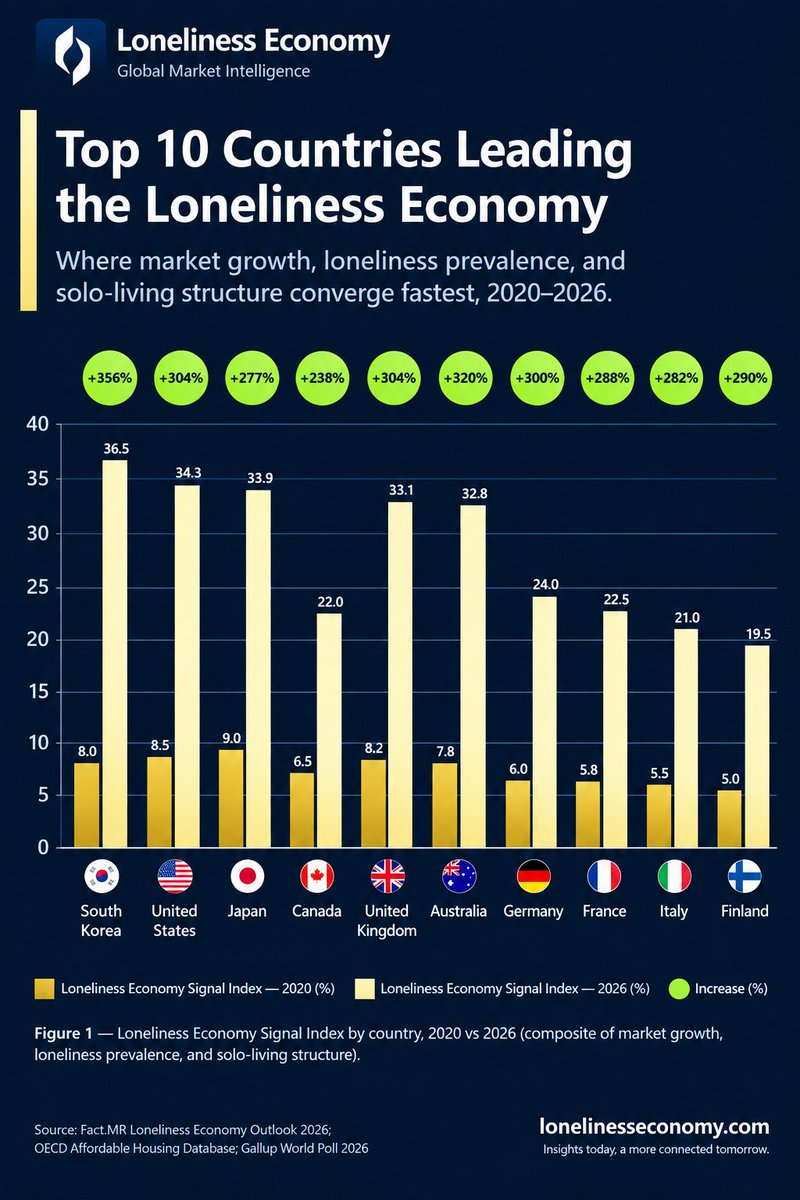
+356% growth in one country. In six years.
South Korea now leads the world's fastest-growing consumer category no one is fully pricing in yet: the loneliness economy.
The 2020 → 2026 signal shift:
→ South Korea: 8.0% → 36.5% (+356%)
→ Australia: 7.8% → 32.8% (+320%)
→ United States: 8.5% → 34.3% (+304%)
→ United Kingdom: 8.2% → 33.1% (+304%)
→ Germany: 6.0% → 24.0% (+300%)
→ Finland: 5.0% → 19.5% (+290%)
→ France: 5.8% → 22.5% (+288%)
→ Italy: 5.5% → 21.0% (+282%)
→ Japan: 9.0% → 33.9% (+277%)
→ Canada: 6.5% → 22.0% (+238%)
Three things worth knowing:
1. Growth leaders and loneliness-prevalence leaders aren't the same countries — the real opportunity sits where they overlap.
2. Japan and South Korea combine aging populations with rapid solo-living growth, making them the most structurally durable markets.
3. The US remains the deepest monetization market, driven by scale and consumer-tech spending power, not just growth rate.
This isn't a soft social trend. It's a measurable, cross-country capital shift.
Follow Loneliness Economy for verified global market intelligence on the sector reshaping consumer demand.
Full country breakdown → https://t.co/C5E1YZzfsT
$580.5M+ deployed. 7 U.S. startups. One month.
August 2026 funding data shows the loneliness economy is no longer a fringe thesis — it's a capital-allocation category.
The breakdown:
→ $250M — Instinct (AI personal assistant)
→ $150M — HappyRobot (enterprise agentic AI)
→ $143M — CodeRabbit (AI coding assistant)
→ $10.5M — Miko (AI companion robots)
→ $10M — Plushie Planet (emotional companionship + plush IP)
→ $7M — Tombot (companion robotics for seniors)
→ Undisclosed — Dynamic Creatures (huggable companion robotics)
Three signals worth watching:
1. Capital still concentrates in adjacent agentic AI, not pure emotional companionship — the sector is early, not saturated.
2. Companion robotics for seniors is the most credible entry point right now, pairing emotional attachment with practical utility.
3. The opportunity set is diversifying fast — from plush IP to robotic pets to home-facing AI systems.
Follow Loneliness Economy for verified market intelligence on the fastest-growing consumer category no one is tracking closely enough yet.
Full data breakdown → https://t.co/C5E1YZzfsT
Follow Loneliness Economy for weekly global market intelligence.
$10M just went into a plush toy company.
Not a robotics startup. Not an AI lab. A plushie brand.
That's the signal: the "Emotional Economy" is now fundable at every price point — from $20 collectibles to $10K companion robots.
Capital is moving from concept to allocation.
Full breakdown → https://t.co/C5E1YZzfsT
Loneliness isn't just a health crisis anymore. It's a $27.5B market.
Our new Emerging Tech Impact Radar maps 6 far-horizon technologies quietly rebuilding how humans connect — and the numbers are staggering:
🤖 AI companions → $37B (2025) to $552B by 2035
🥽 Social VR & spatial presence → mainstream by 2028-2030
✋ Haptic touch tech → turning "distance" into a design problem, not a limit
🧠 Neuroadaptive interfaces → BCIs entering emotional wellness
👤 Digital twins & persistent avatars → identity that never logs off
📊 Predictive loneliness analytics → AI flags isolation before it becomes a crisis
The core Loneliness Economy grows from $1.5B (2026) to $27.5B (2036) — 33.8% CAGR.
The broader ecosystem? Already north of $500B.
This isn't a soft trend. It's infrastructure.
The next connection layer will be multimodal, embodied, and increasingly proactive.
Full radar breakdown 👇
visit our official website
#LonelinessEconomy #EmergingTech #FutureOfConnection #MarketIntelligence #AI #VentureCapital #DigitalHealth #Web3 #Robotics #InvestorInsights