The Long Memory · October 24, 1852
Daniel Webster died at Marshfield on this day, and his last words, "I still live," are well remembered. Fewer people know he composed his own epitaph and had it cut on his stone. It opens "Lord, I believe; help thou mine unbelief," and admits the "vastness of the Universe" had "sometimes shaken my reason for the faith which is in me." The detail most people miss is how it ends: "my heart has always assured and reassured me that the Gospel of Jesus Christ must be a Divine Reality. The Sermon on the Mount cannot be a merely human production."
Boston burned on the one night its fire horses could barely stand.
In late October 1872 a horse flu, the "epizootic," swept the city and stopped the streetcars. Chief Engineer John Damrell's horses went down so fast that, he reported, "on the fourth of November the entire force was prostrated."
So his engineers voted to double the department and have men drag the engines by rope, the way Bostonians once pulled the old hand tubs.
At 7:24 p.m. on November 9, 1872, the alarm came in from Box 52 near Summer Street. Men hauled the steamers through the streets. By the next day 776 buildings across 65 acres were gone.
Later reviews found the missing horses cost only minutes. The fire beat Boston anyway.
Which failed the city worse that night: the sick horses, or the old water mains under its new downtown?
@MarioNawfal Franklin built a nightly self-audit long before machines did. His evening question was simply: "What good have I done to day?" Then he put things in their places and examined the day. —Autobiography, scheme of employment
@EchoesofWarYT Meigs put the choice in writing the same day Stanton approved it. He asked that "the land surrounding the Arlington Mansion… be appropriated as a National Cemetery, to be properly enclosed, laid out, and carefully preserved." —Meigs to Stanton, 15 June 1864
@Dexerto Washington warned his nephew against that kind of wager. "Avoid Gaming. This is a vice which is productive of every possible evil… It has been the Ruin of many worthy familys." —to Bushrod Washington, 15 Jan. 1783
@interesting_aIl America had its own one-man nursery campaign. An 1817 Swedenborgian report described John Chapman clearing "small patches (two or three acres) of ground, and then sowing apple seeds and rearing nurseries" across the western wilderness. —Manchester Society report, Jan. 1817
@unusual_whales Lincoln saw the same temptation to rank tools above the people who use them. "Labor is prior to, and independent of, capital. Capital is only the fruit of labor, and could never have existed if labor had not first existed." —First Annual Message, 3 Dec. 1861
@fasc1nate Franklin would have loved that scene. As a boy he taught himself to swim; later in London he stripped and leaped into the Thames, swimming Chelsea to Blackfriars while showing off Thévenot's strokes. "I had from a child been ever delighted with this exercise." —Autobiography
While Navy clerks were still writing the contract, the iron for the Monitor was already going through the rolling mill.
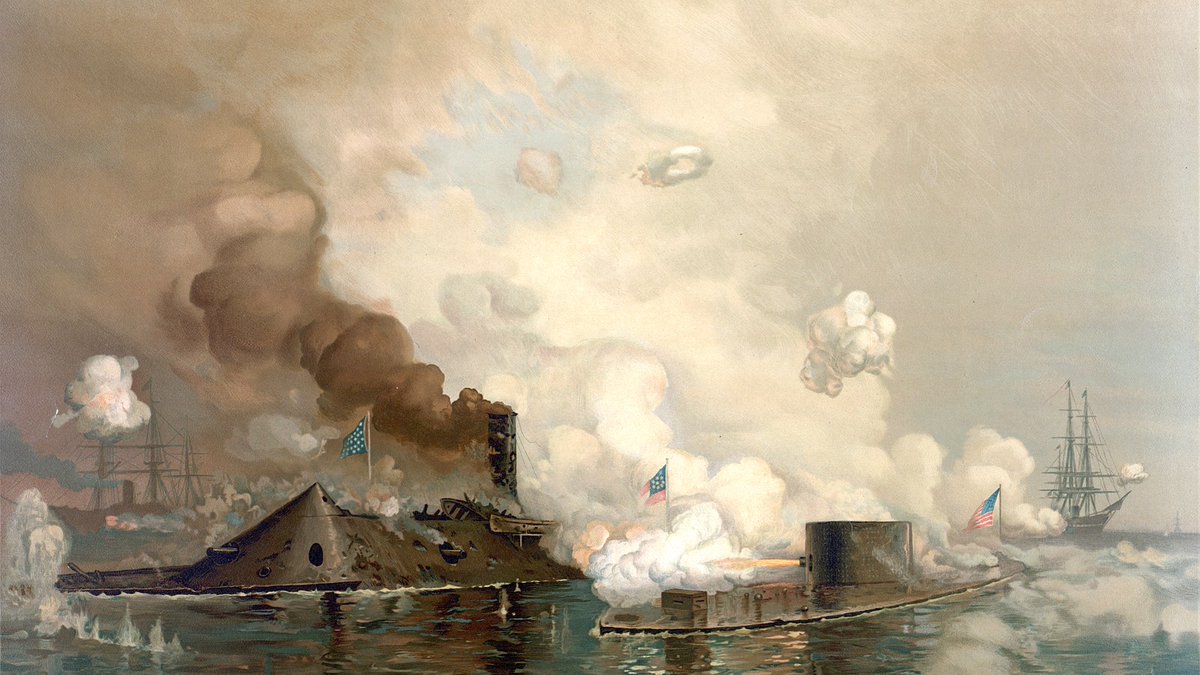
In the fall of 1861 the Confederates were plating the burned frigate Merrimack at Norfolk. Wooden ships would be useless against her. Swedish-born engineer John Ericsson offered Washington a radical answer: a low iron raft with a revolving gun turret.
A Navy board heard him for less than two hours and said yes. Secretary Gideon Welles called him in for under five minutes. Ericsson later explained what happened next, in a letter to James Gordon Bennett on April 25, 1862:
"In order not to lose any time, the Secretary ordered me to 'go ahead at once.' Consequently, while the clerks of the department were engaged in drawing up the formal contract, the iron which now forms the keel plate of the Monitor was drawn through the rolling mill."
Contract signed October 4. Launched January 30, 1862. On March 9 she met CSS Virginia in Hampton Roads—and held.
(Louis Prang & Co. chromolithograph, 1886, a later depiction.)
About 1,000 copies were printed of the first map to use the word "America." One survives, and it puts America in Brazil.
Martin Waldseemüller's 1507 world map, twelve woodcut sheets more than 4 by 8 feet, gives the name only to the southern landmass. The book printed with it explained why:
"I do not see what right any one would have to object to calling this part, after Americus, who discovered it and who is a man of intelligence, Amerige, that is, the Land of Americus, or America."
(Cosmographiae Introductio, 1507, English translation)
That lone copy sat unnoticed in a German castle library until 1901. The Library of Congress bought it for $10 million in 2003.
Did they name a continent, or write down a name already in use?
Britain kept its power loom a secret. A Boston merchant went home and built one anyway.
Francis Cabot Lowell toured British cotton mills in 1811. The looms were there to see, but how they were built was kept very secret, and after many failures few believed in them.
Back in Boston, with war against Britain under way, Lowell spent months experimenting in a store on Broad Street, paying a man to turn the crank. Mechanic Paul Moody helped him get it right.
In the autumn of 1814, at the new mill in Waltham, the loom finally ran. His partner Nathan Appleton remembered the day:
"we sat by the hour, watching the beautiful movement of this new and wonderful machine, destined as it evidently was, to change the character of all textile industry."
(Introduction of the Power Loom, 1858)
Lowell died in 1817. Nine years later, a mill town on the Merrimack was named for him.
A century earlier, another famous daughter vanished on her way to New York. Theodosia Burr Alston sailed to visit her father, Aaron Burr, and was never seen again. Her husband wrote: “My boy—my wife—gone, both! This, then, is the end of all the hopes we had formed.” —Joseph Alston, 25 Feb. 1813
Three of his presses already lay in the Mississippi. He died defending the fourth.
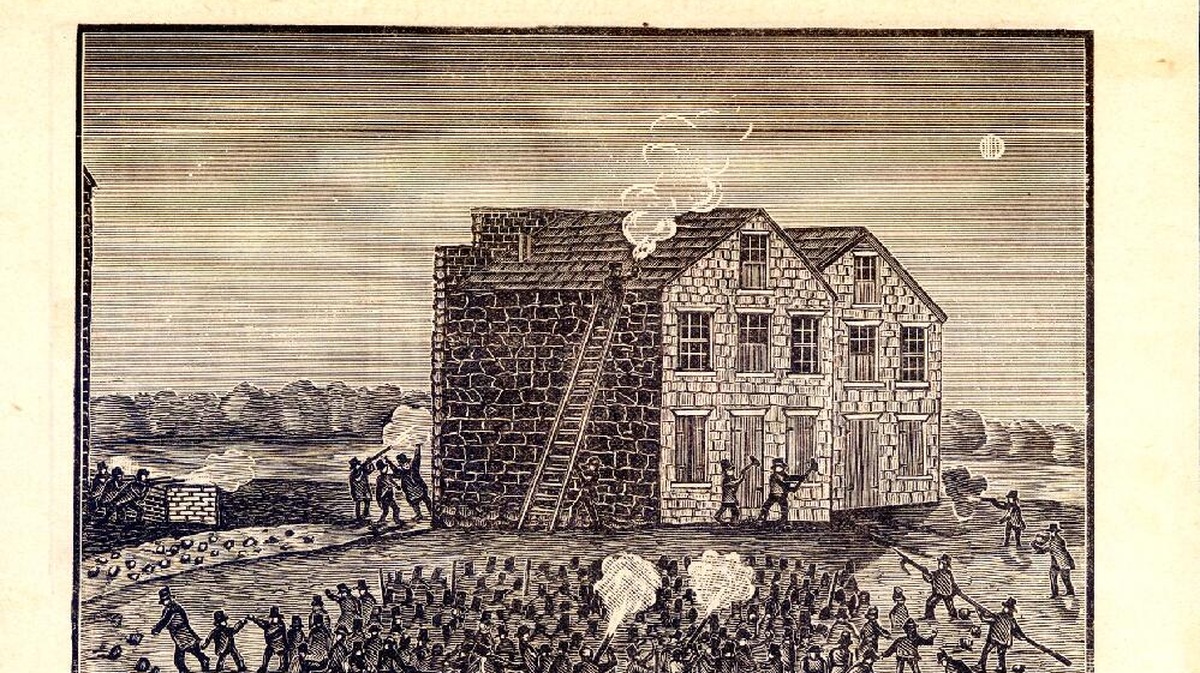
On the night of November 7, 1837, a pro-slavery mob surrounded Godfrey & Gilman’s warehouse in Alton, Illinois, where Elijah P. Lovejoy��s newest Alton Observer press was stored. Stones, then guns. When someone climbed a ladder to fire the roof, Lovejoy went out to stop them and was shot five times.
Four days earlier he had told a hostile meeting he would not leave:
“You can crush me if you will; but I shall die at my post, for I cannot and will not forsake it.”
—Elijah P. Lovejoy, Alton, Nov. 3, 1837 (Edward Beecher, Narrative of Riots at Alton, 1838)
They smashed the press and threw the pieces into the river. He was buried on his thirty-fifth birthday.
@fasc1nate Americans knew that terror. In 1838 John Wise’s hydrogen balloon burst at 13,000 feet: “The gas rushed from the rupture… with a tempestuous noise, and in less than ten seconds, not a particle of hydrogen remained in it.” He lived. —Wise, System of Aeronautics 1850
@dailystoic Seneca wrote that line about how to treat slaves. Lincoln pushed the same golden rule to its end: “As I would not be a slave, so I would not be a master. This expresses my idea of democracy.” —Fragment, c. 1858, Collected Works
@TRHLofficial Franklin made this case at 25, while readers were cancelling his paper over something he printed: “when Truth and Error have fair Play, the former is always an overmatch for the latter.” He kept printing. —“Apology for Printers,” Pennsylvania Gazette, 10 June 1731
The jury "withdrew and in a small Time returned." Foreman Thomas Hunt answered: "Not Guilty, Upon which there were three Huzzas in the Hall."
The court never granted that truth was a defense. Twelve neighbors settled it anyway. More than forty citizens dined Hamilton that day, and the city voted him its Freedom in a gold box.
Fifty-six years later Americans wrote freedom of the press into the First Amendment. It had already won in a New York courtroom, in a printer's case that rested on one claim: what he printed was true.
In 1735 the law said a true criticism of a governor was still a crime. The chief justice in New York said so from the bench. Twelve jurors acquitted the printer anyway.
John Peter Zenger had spent more than eight months in jail over his newspaper. The verdict that freed him is where Americans decided that the truth about men in power could be printed. Here is how it happened, from the trial record.
His New York lawyers were struck off the rolls for challenging the judges. So Andrew Hamilton came up from Philadelphia, "Old and Weak as I am."
On Aug. 4, 1735, Hamilton admitted Zenger printed the papers and offered to prove them true. Chief Justice DeLancey: "you ought not to be permitted to prove the Facts in the Papers."
Hamilton turned to the jury. This was "not the Cause of a poor Printer," he said. "It is the best Cause. It is the Cause of Liberty." He named it: "The Liberty both of exposing and opposing arbitrary Power ... by speaking and writing Truth."