Is anyone else's Claude actively trying to gaslight them? It keeps repeatedly doing the exact things I explicitly tell it not to do. Zero trust at this point.
Imagine this:
AI transfers wealth from the highest-taxed demographic (W-2 labor) to the lowest-taxed demographic (billionaires borrowing against equity).
It actively deletes the exact income tax base required to service our national debt.
@great_martis Oil at $92 is the margin call on the US Treasury.
They are doubling buybacks today to suppress 5.3% yields, but you can't run Stealth YCC when physical energy is breaking out.
The inflation spike will overwhelm the liquidity bazooka. They are trapped.
Bitcoin is not a bet on the next technological revolution. It is a bet that the marginal returns from the current debt-funded compute paradigm are declining.
Capital is becoming more expensive; investors will favor assets with fixed supply and minimal dependence on future promises.
In that lens, Bitcoin isn't just the next technological revolution; it is an escape hatch for capital fleeing the collapse of the previous one.
Thanks, @CorySwan, for the interesting framework.
THE SOVEREIGN REVOLUTION
I believe Bitcoin is the beginning of the Sixth Technological Revolution in the framework of @pmarca's favorite economist, @CarlotaPrzPerez.
Tell me why I'm wrong!
A long form post for those who care - The August 19 Macro Autopsy: A Tale of Two Realities
Under the surface, the global financial system fractured today. The divergence between artificial U.S. liquidity and global structural decay has never been wider.
Some Data:
1. The Sovereign Margin Call (U.S. Treasuries) Yesterday, the U.S. 30-year Treasury yield breached 5.33%. The bond plumbing began to seize. In response, the U.S. Treasury stepped in this morning and quietly doubled their long-end bond buybacks (to over $4B per operation). While not explicit Yield Curve Control, Treasury buybacks are increasingly functioning as a stealth liquidity support mechanism designed to reduce duration pressure on dealer balance sheets.
2. The AI Hardware Contraction (South Korea) While U.S. software valuations floated on that Treasury liquidity, the physical AI hardware supply chain violently contracted. South Korea’s KOSPI triggered a 'sell-sidecar' circuit breaker, plunging 5.7%. Samsung plummeted 7.8% and SK Hynix crashed 9.75%. The physical hardware layer is actively pricing in margin compression, inventory adjustments, and the reality of excessive CapEx expectations.
3. The Yen Carry Squeeze (Japan) The Japanese 10-year yield spiked to a 30-year high, violently accelerating the unwinding of the global yen carry trade. As a result, the Nikkei 225 crashed another 3.16% (dropping over 1,400 points). Capital is forcibly repatriating, heavily compounding the equity pressure across the region.
The Conclusion: The S&P 500 stabilized today, but price discovery is severely distorted. The U.S. is masking the structural decay of the tech sector through fiscal dominance.
Ultimately, policymakers face a brutal dilemma: allow yields to rise to clear the 40T USD debt load naturally, or continue providing artificial liquidity support that risks severe currency debasement.
I know which one they will choose. Act accordingly.
The financial world you live in is no longer yours.
The Treasury doubled its bond buybacks to artificially suppress the yield and protect the illusion of stability.
Meanwhile, the Nikkei crashed another 1,400 points as the physical AI hardware bubble actively bursts in Asia.
SPY? Up.
Maybe taking a step back is the right move. The markets are exhausting because they are fundamentally endlessly shuffling financial claims around on a screen. It drains your humanity over time.
Stepping away isn't necessarily defeat; it can be progress. Take the capital and the lessons you've earned, and go build something real in the physical world. The screens will always be there, but life is outside of them. Rest up.
If the state lends capital to a founder to pay a tax, they are essentially booking immediate operating revenue backed by high-risk venture collateral.
Is there any historical precedent for a state acting as a subprime margin lender to plug a fiscal deficit? Who would actually absorb the loss on the state's balance sheet, pensioners?
@TXWestCapital Exactly, the mechanism for margin compression. Cathie is valuing the software layer as if it captures the rent, when in reality, the physical layer will extract all of it
You are treating AI like a zero-marginal-cost SaaS business. It's heavy industry.
In software, collapsing prices + exploding volume = hyper-growth.
In AI, every single token requires physical electricity and silicon degradation. There is a hard thermodynamic floor.
You cannot "make it up on volume" when the physical supply of energy is inelastic. You aren't creating a virtuous cycle; you are just commoditizing into a low-margin utility.
Yes, prices are collapsing but volumes are exploding. In @ARKInvest’s view, the price elasticity of demand for increased productivity and intelligence is enormous, setting in motion a virtuous cycle that is in its infancy.
You nailed it. We are looking at two different layers. She is looking at the application layer (software revenue elasticity), and I am looking at the infrastructure layer (thermodynamics & CapEx).
The problem is that the application layer cannot decouple from the physical layer. If a model cuts prices 80% and usage increases 14x, that is great for top-line revenue (up 34%). But a 14x increase in usage requires a massive, non-linear increase in physical electricity, compute cycles, and hardware degradation.
If your physical infrastructure costs scale faster than your top-line revenue, you aren't building a sustainable AI economy; you are just subsidizing public intelligence by incinerating private venture capital. The margin compression is inescapable. Thanks for making that clarification.
It ceases to be simple when sovereign debt crosses the mathematical event horizon. Raising rates now just drives the interest expense exponentially, forcing more deficit monetization to cover the gap. Volcker could raise rates because debt-to-GDP was 30%. We are trying to apply 1980s monetary medicine to a 2026 fiscal terminal illness.
100B USD per month is slightly aggressive; right now we are at roughly 100B+ USD per year in pure hardware being incinerated**, but it is scaling exponentially.
As for your second point: it is a brilliant observation. The bubble isn't hidden as a line item; it is hidden in the depreciation schedule.
Hyperscalers are logging these GPUs as PP&E (Property, Plant, & Equipment) and amortizing them over 4 to 6 years to artificially prop up their EBITDA. But the physical half-life of a GPU before obsolescence is 18 months. They are taking rapidly decaying silicon and pretending it's a 6-year concrete factory. The balance sheets are currently carrying billions in phantom value. Scary stuff.
A realistic hypothesis: The $100B AI bubble is an accidental Trojan Horse to build out the Bitcoin network.
If OpenAI goes bankrupt on -122% margins, what happens to those 15-year gigawatt power contracts and empty liquid-cooled data centers?
Rip out the GPUs and run ASICs.
Bubbles only deflate quietly at 0% yields when the Fed can print liquidity without consequence. We are at 5.3%.
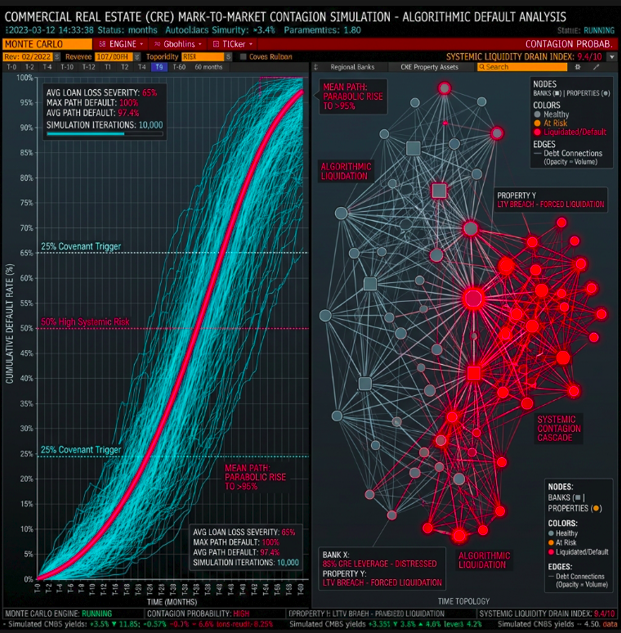
A 5 Trillion USD tech haircut destroys the collateral underpinning the private credit markets. Margin calls are not quiet, they trigger violent, forced liquidations.
"Too Big To Fail" only works when the sovereign balance sheet is running well. With 40T USD in debt, unfortunately, the sovereign is already mathematically insolvent.
The safety net isn't gone; its cost is just becoming MUCH higher.
@JasonCoombsCEO Right! The 100B is the physical CapEx being incinerated on hardware & power contracts. But including the market premium from these hyperscalers, absolutely.