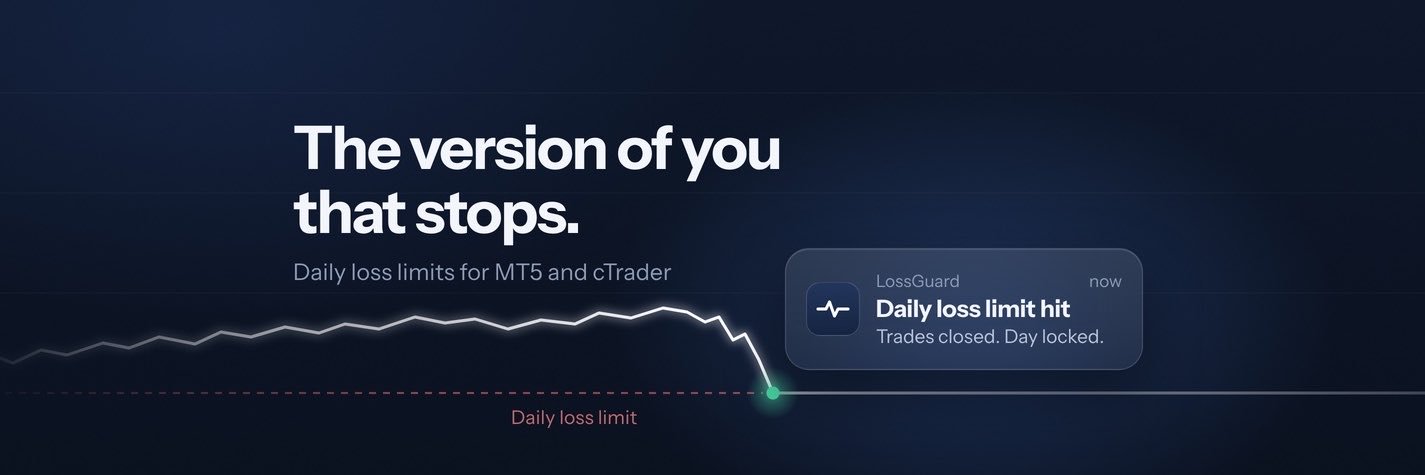
Most traders don’t blow accounts from bad strategy.
They blow them on one bad day.
Here I post daily: risk rules, trading psychology, market news explained, prop-firm realities.
And I’m building LossGuard: it enforces your daily loss limit on MT5 & cTrader.
Free 7 days, link in bio.
sitting out is a position too.
most bad trades don't come from a setup. they come from boredom at 3pm with nothing on the chart.
before you click, ask: did the setup show up, or did i just want to be in?
your stop on a short trade can get hit while the chart never touched it.
charts show the bid. a short closes at the ask. when spreads widen around news, the ask jumps and your stop triggers on a candle that looks clean.
check the spread before placing tight stops near news.
gold is not forex with a different name.
1 lot of gold = 100 oz, so every $1 move is $100. one $15 candle on 1 lot = $1,500.
check the lot before you click, not after the candle. what lot size do you use on gold?
a 10% loss needs an 11% gain just to get back to even.
a 50% loss needs a 100% gain.
small losses are cheap to recover from. the big ones are the ones that end accounts.
same lot size on demo feels like nothing. on a funded account your hand shakes.
the fix isn't being braver. cut the size until a full stop loss feels boring.
which are you?
1 demo hero
2 funded freezer
3 neither, you overtrade
revenge trading never feels like revenge while you're doing it. it feels like "one more clean setup to get it back".
LossGuard (works with MT5 and cTrader) enforces the daily loss limit you set: closes everything and locks trading till the next reset.
link in bio
@DRAWUPxyz agreed, plain numbers first.
once the daily loss and drawdown are clear numbers, you can set the same limits on your own account, a bit tighter, so you stop before the firm stops you.
stop-out rate would be a solid 4th.
before paying for a prop challenge, check 3 things:
1. payout proof from real traders, not paid promoters
2. rules in plain numbers (daily loss, drawdown), not "at our discretion"
3. how long they have been paying out
vague rules page = vague payout. which do you check first?
london and new york overlap for about 4 hours a day.
that's usually when liquidity is highest. you don't need the whole 24 hours. one clean window beats eight hours of staring at a chart.
a strategy that wins 50% of trades will most likely hit 5 losses in a row somewhere in 100 trades.
that's not the system breaking. that's just maths.
size your risk so loss #5 doesn't hurt.
year 1 of trading: you hunt for the perfect strategy
year 2: the perfect indicator
year 3: you realise the strategy was fine all along. the losses came from the trades you took after the 2nd red one
which year are you in?
Most traders don’t blow accounts from bad strategy.
They blow them on one bad day.
Here I post daily: risk rules, trading psychology, market news explained, prop-firm realities.
And I’m building LossGuard: it enforces your daily loss limit on MT5 & cTrader.
Free 7 days, link in bio.
the most expensive trade on a data night is the one you take 10 minutes after the big candle, just because you felt left out.
missing a move costs you nothing. chasing it costs you a stop.
after a big release you:
1 sit out
2 wait for a retest
3 chase
4 close the charts
forex is open 24 hours, but only 5 days a week.
that means you get a built-in reset every weekend. if the week went badly, use the break to close the charts. monday's price doesn't know your last trade.
lose 10% and you need 11% to get back.
lose 50% and you need 100%.
the math gets cruel fast. that's why a small loss taken early is the cheapest thing you will ever buy.
1 lot of gold = 100 oz, so every $1 move is $100.
a $20 candle on a data day (CPI is 7 PM IST tonight) means $2,000 swing on a single lot.
work out your loss in dollars if price moves $20 against you. if that number scares you, the lot is too big.
@tradercams At starting of the career the reason may be inability to understand and get in sync with the markets, but after several years of that if you’re still unprofitable its definitely not sticking rules and risk management.