The part of this thread that stays with me is not the nine trillion dollar projection.
It is the $14,000.
A custodian lost the keys to $150 million on a Sunday night. Getting it back meant paying a million in court fees before anything started. When the lawsuits ended, $14,000 was left. That is what the legal system costs when you are on the wrong side of it and the stakes are real.
@kstellana did not take that as a cautionary tale about custody. He took it as a design brief. If the court costs more than the dispute is worth, the court cannot be the answer. Build something else.
That something else is @GenLayer.
A court for the internet where AI agents settle disputes in minutes. Where the jury is a network of validators each running a different AI model. Where no single party controls the verdict.
The $14,000 is why this feels different from infrastructure built by people who have never needed infrastructure to work.
https://t.co/XluSbLrVLp
What is the system you stopped trusting after watching it fail someone it was supposed to protect?
There are 4,739 builders inside the GenLayer Portal right now and 46 validators. Sixteen stewards read what the rest of us submit.
That ratio is the whole product and almost nobody talks about it.
Most ecosystems keep three separate records. Builders get a GitHub graph nobody opens. Community people get a Discord role. Validators get uptime stats on a dashboard somewhere else entirely. Three populations, three scoreboards, no shared language between any of them.
The Portal collapses that into one board. You make an account, link your X, Discord and GitHub, and from then on missions, contests and builder submissions all land against a single name. Every one of them is a tracked contribution, and the Portal shows you exactly what each one was worth. Season 1 is live now, and builder points and community points convert into GLP every Sunday at 11:59 PM UTC, so the standings move once a week whether or not you moved.
Which means the writeup I submitted sits in the same column as someone running validator infrastructure. Not the same weight. The same record.
That fits what @GenLayer actually is. It is the adjudication layer for the agentic economy, where validators each run a different AI model and have to reach agreement on the questions code cannot settle, the ones where the answer is a judgment and not a calculation. A network whose whole premise is machines agreeing on judgment calls should probably keep its humans on one visible ledger too.
The thing that made me stay is those 16 stewards. A person reads it. I have ground enough point systems to know the difference between a number that went up and a number somebody agreed with.
https://t.co/OKKBiGPTZz
If you opened it today, would you rather get ranked among the 4,739 now, or hold off until you had something worth standing next to the 46 with?
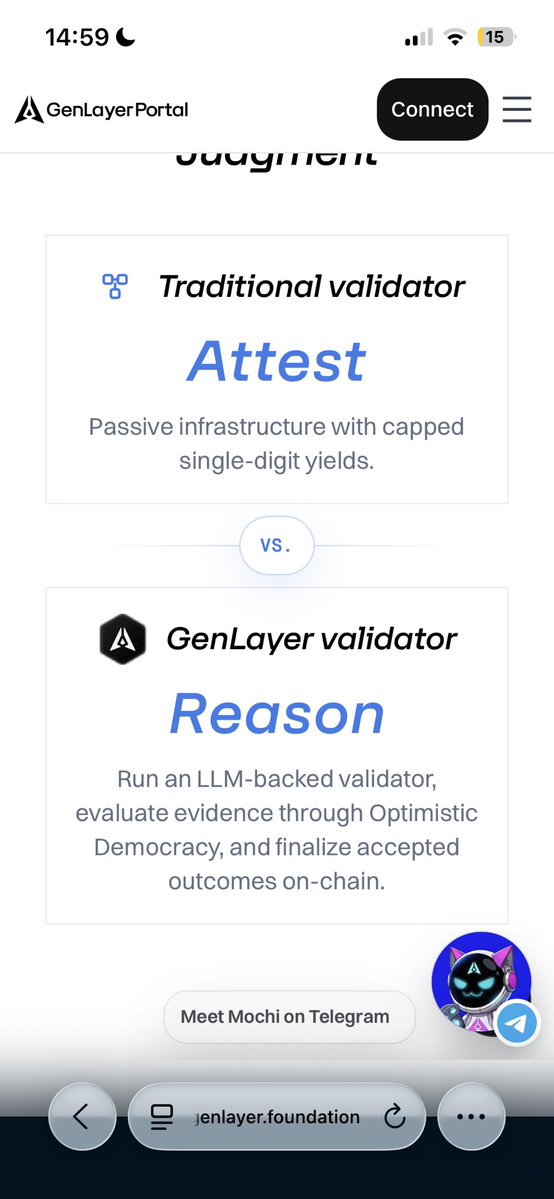
If you have never heard of GenLayer, skip the whitepaper and open the Validators tab.
It explains the project faster.
The list in the screenshot is forty-six validators, and each one runs a different AI model.
Their job is to agree on questions code cannot settle on its own. Not whether a transaction cleared, but whether something was delivered as promised.
Judgments, not calculations.
That is the network. The @GenLayer Portal is the front door to it.
Builders, community members and those validators show up there by name.
Sixteen stewards review what gets sent in.
One account, X, Discord and GitHub linked to it, and every contribution recorded against you.
The validators list is public, which is the part that made me stay. A network built on judgment, showing who is doing the judging.
https://t.co/LetYjEexuJ
Open the Validators tab and tell me which of the 46 you would check first.
@lonercrook@GenLayer I'd love to know how often the 16 stewards disagree.
That seems like a much more interesting window into subjective evaluation than simply knowing how many people are reviewing.
The most interesting number on the @GenLayer Portal isn't a points total. It's 16.
That's how many stewards are reviewing contributions as of today. There are 4,739 builders.
Thousands of people can produce work. 16 are looking at it.
Whether your GitHub is linked is a yes or no question. Whether a piece of work is any good is not, and the numbers suggest that's the thin part of the system.
Effort is cheap. Judgment is the scarce thing.
It's the same shape of problem GenLayer is built around: questions where the answer is a judgment, not a calculation. In GenLayer itself, validators each run a different AI model and have to reach agreement. The Portal is the front door and the scoreboard, not the protocol, but from here you can watch the problem at human size.
My guess, and it is only a guess: that means work that is easy to judge probably has the edge over work that is just big.
So open https://t.co/Eogah5DIsM, finish one mission, and look at what it was worth. Could a program have checked it, or did a person have to decide?
My bet is more of it needs a person than you'd expect. Tell me if yours didn't.
@iam_kutepzzy “What can you actually defend?” is a better question than “what did the numbers say?” Sometimes the hardest part isn't finding the evidence. It's being willing to stand behind the conclusion you reached from it.
@0xJarod@profcryptotalks@token2049 The trophy proves the budget. The comment section proves the audience. If real followers existed, they would already be in the replies.
How To Be The Best KOL Every F*cking Year 🏆🥇
I watched videos from @profcryptotalks , @token2049 best KOL of 2026, 2025 & 2024, so you won't have to
✅✅ THE GOOD ✅✅
👍 Professor Crypto speaks American English natively
👍 Not AI. He speaks on screen personally
👍 Videos are decent with sound effects, memes & upbeat music
👍 He demonstrates how to use featured products on video
🚫🚫 THE BAD 🚫🚫
👎 Don't expect critical analysis or comparisons. He asks us to do that in the comments, but...
👎 The comment section is bot town. YouTube filters 99% of them & I wasted my life reading without the filter.
👎 Expect 1 minute of cringe at the beginning & at the end of every video, which showcases his awards, achievements & wealth
== CONCLUSION ==
Personally, I wouldn't subscribe because I'm fully capable of reading, math & conducting basic research
Only a complete noob would find his content useful. Still, I would rather recommend @coinbureau which produces deeper insights
TOKEN2049 “KOL of the Year” were side-event trophies, not awards from TOKEN2049 itself. Likely a pay-to-win award that's as fake as his following.
If the dude had any real followers, they'd defend his honor in my replies 👇
I used to think more tabs meant better trading. One ugly loss showed me I was collecting noise, missing the story below every move.
I had:
• three charts open
• two wallet trackers running
• a saved thread explaining the setup
• an entry copied from someone I trusted
Everything looked informed. None answered the point: why was this move happening?
That changed how I judge trading tools. I stopped wanting a dashboard to stare at. I wanted the pieces to connect.
That is what caught my attention. You can watch new launches, inspect what live wallets are doing, study traders whose decisions are worth tracking, then move from observation to execution without rebuilding the whole workflow somewhere else.
@wardenprotocol is building consumer apps for high volume, high frequency money. The value is shortening the gap between seeing a move and reading it.
Robinhood Chain is now supported too, giving traders another environment to watch activity develop.
And I want to be clear about my incentive before anyone uses my referral:
• you join through my referral
• I receive 20% of the fee made by your trades
• that lasts only while you keep trading on Token Terminal
So yes, I just benefit when you trade. I would rather say that openly than hide the incentive.
What I am looking for here is not people hunting for one person to imitate. It is people willing to investigate the wallets, movements and decisions behind what appears on their screen.
My Warden referral: https://t.co/sfF08x9SYf
If you have been trading from other people's entries, ask yourself one thing before the next position:
Are you following a decision, or do you understand it before you put your own money behind it, before your very next real trade?
Tell me the trade that finally made you start asking “why?” instead of simply asking “where’s the entry?”
The fill price and the mark that triggered it.
Anyone can say “ZK proofs.” Almost no one can show the exact price the engine matched, the mark that forced the liquidation, and the proof that those two numbers were the ones the contract used.
Start there. If a creator cannot walk one trade from quote to match to liquidation without inventing a step, the post fails. That is the test.
The Bond Market Is Screaming
Let's start with the scary numbers, because you've seen them all over your timeline this week.
The US 10-year is at its highest since 2002. Japan is at 1996 levels. Germany is at its highest since 2009. UK 30-years touched 6%. Oil is above $100.
If you learned finance from a textbook, this is where you sell everything and hide in cash. Rates go up, risk assets go down. Simple.
Except markets don't run on textbooks. They run on liquidity, and liquidity is a political decision.
So ask the only question that matters: what does the guy in charge need right now?
Trump has midterms in November. The Iran war hasn't gone the way anyone promised.
You can't fix a war in five weeks but you can absolutely juice a stock market in five weeks. Which one do you think he picks?
He's already picking. Bessent expanded the Treasury's bond purchases to fight the selloff, it didn't work, yields kept going up, but that tells you something.
When the Treasury starts buying its own bonds, the government has told you which way it wants the market to go.
They will keep trying, and then they'll try harder. Lean on the Fed. Talk oil down. Leak a ceasefire headline. Whatever works.
I don't think of this as a conspiracy. It's an incentive. Politicians who want to keep their jobs need voters who feel rich.
Pretty much every government on Earth behaves this way when an election is close. Expecting otherwise is the naive position.
Now look at Bitcoin, because Bitcoin is the honest asset here, it has no earnings to fake and no CEO to spin.
It's just pure liquidity expectations.
If 5%+ yields were going to kill crypto, this month was the time. Instead, whales added 113,950 BTC on the dip. Spot ETFs pulled in $2.39 billion last week, green every single day.
The September drops were leverage getting liquidated, not people giving up. Tourists sold. The people with real money bought.
Even some bond people are blinking. RBC BlueBay's CIO thinks the global bond selloff has gone too far. When bond managers start saying that, yields usually don't have much further to run.
So here's my view-
The bottom is in. Yields at 24-year highs are what maximum fear looks like, and maximum fear is when you buy. From here to November, the incentives all point one direction.
----------
What could go wrong:
Inflation might not cooperate, and the Fed can hike even if the White House screams. The war could escalate, and $130 oil beats any amount of jawboning. And "the bottom is in" is the most famous last words in crypto, so I'm holding this view loosely.
But if you ask me where the money is pointed until the midterms? Up.
[ Not financial advice. Just how I'm reading the board. ]
Monologue, take one.
They told me reach is bought. That the loud accounts win and the rest of us just clap. I believed it for a while.
Then I found @RallyOnChain, where an AI reads what I actually wrote and scores it. No follower minimum. No agency in the middle. Just me, a blank tweet box, and nobody to hide behind.
So this is me, taking the stage. Judge the words.