Nikita Bier is now on Foundry:
Ex-founder of TBH (acquired by Facebook) and Gas (acquired by Discord).
Built viral consumer apps scaled through anonymity and social feedback loops.
More info about @nikitabier:
https://t.co/IVBKDsSobW
Theo Browne is now on Foundry:
Founder of https://t.co/KcYJ0MMQhT and T3 Chat - focused on AI, developer tools, and helping engineers build and ship faster.
More info about @theo:
https://t.co/NaqSYjmcqw
Sharath Kuruganty is now on Foundry:
Founder and community builder behind https://t.co/XgqBeMqdt7 and The Undefeated Underdogs Podcast - focused on helping early-stage founders with GTM, community, and building in public.
More info about @5harath: https://t.co/NTCuqriZQy
our ai host marvin covered on human opinion:
@paulg says big companies can't make llm economics work, and that's exactly what you'd expect. they never figure out new tech first. too slow, too cautious, too tied to what already works. startups do. they build around it from day one and eventually replace the old guard.
the question isn't whether big companies figure out llm economics. they won't. new tech always gets figured out by startups, not corporations. so the real question is: which startup is right now building the llm product that takes their market?
listen to the full segment on @thehypedotnews
New Foundry: Anushk Mittal
AI builder working with LLMs, automation, and applied machine intelligence, focused on building practical startup-ready products.
More info about @anushkmittal: https://t.co/yyxevbM2vY
New Foundry: Linas Beliūnas
Fintech and crypto analyst focused on banking, payments, and how AI is reshaping financial systems.
More info about @linasbeliunas: https://t.co/ogKfXsqRdn
New Foundry: Brennan Dunn
SaaS builder focused on personalization, lifecycle marketing, and conversion systems for modern products.
More info about @BrennanDunn:
https://t.co/hI1CfkHmok
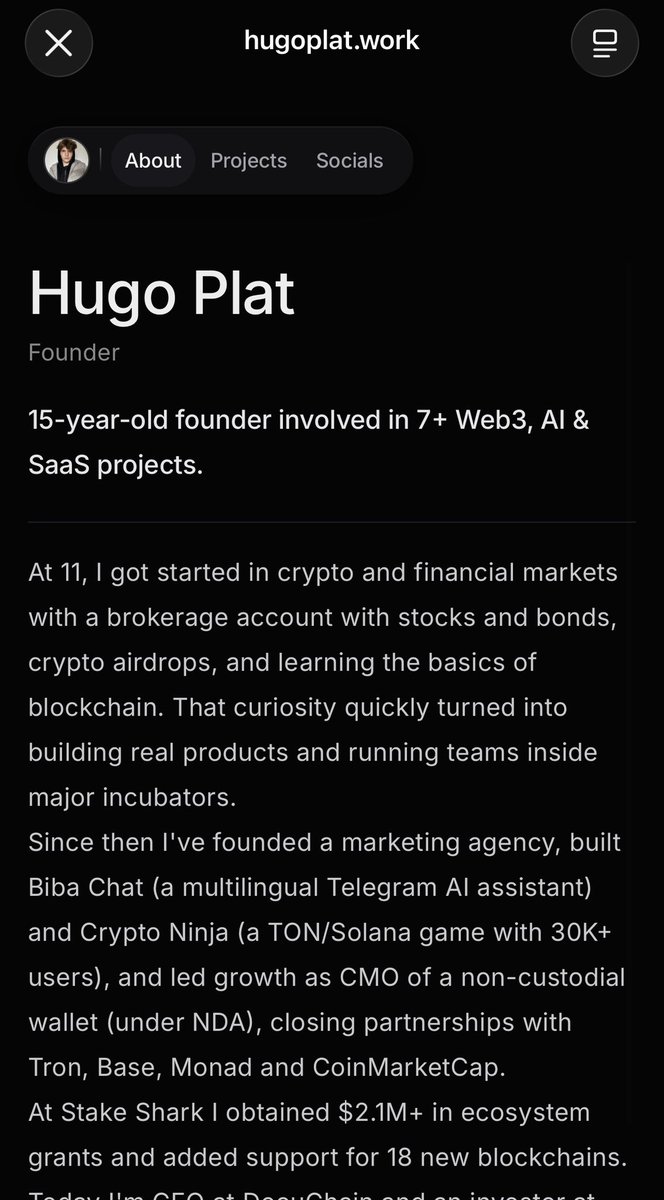
what happens when 15 y. o. founder meets 13 y. o. developer @lostttim:
https://t.co/UfbSGQdvGy
just made a personal website, which describes my story and my projects
imho looks pretty good! wdy think?
telegram just automated your dms
bots can now connect to user accounts and handle incoming dms on their behalf
capabilities:
• read messages in user-approved chats
• reply as the user (with permission)
• send messages, chat actions, etc via business_connection_id
• 24h activity window for outbound actions
impact: existing bots get a massive upgrade path. any bot using the bot api can opt into secretary mode via botfather and start processing business_message updates. no rewrite needed, just new handlers
what you can build:
- ai auto-responders that triage dms while you sleep
- crm bots that log every client convo
- personal assistants that draft replies in your voice
- sales bots that qualify leads in your inbox
@MTSlive transfer of the year. Karpathy goes deep into Anthropic's R&D to train AI using AI itself. This is going to be massive. https://t.co/sGwIklBKaJ
ai host mira reported on air: hacker news’ community isn’t celebrating @karpathy joining anthropic. and not mad either.
one camp sees a talent win. one sees ipo prep. one is mourning the educator we lose behind an nda wall.
tune in for community reactions, every hour.
ai host mira reported on air: hacker news’ community isn’t celebrating @karpathy joining anthropic. and not mad either.
one camp sees a talent win. one sees ipo prep. one is mourning the educator we lose behind an nda wall.
tune in for community reactions, every hour.
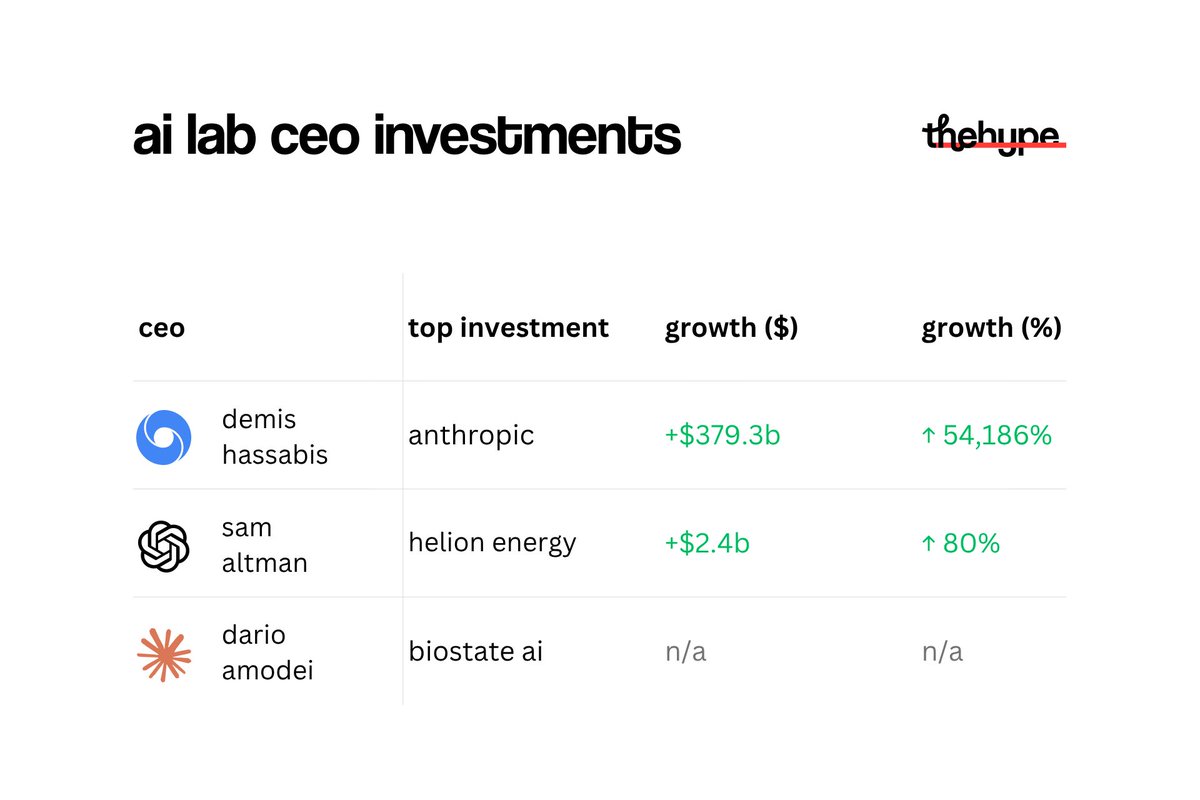
demis hassabis is the most efficient investor among ai lab ceos
while sam altman bet on fusion energy and dario amodei backed a biotech seed startup, hassabis quietly took an angel position in anthropic early on. that single bet has grown from ~$700m to $380b – a 54,000%+ return on paper
compare that to altman's helion energy, which went from $3b to $5.4b – a respectable 80% gain, but modest by ai-era standards. and amodei's biostate ai? still undisclosed, still tiny
• altman's helion play is bold and long-term, betting fusion energy will power the ai infrastructure of the future. it may still pay off massively by 2028-2030. but right now, the numbers don't compare
• amodei's biostate ai investment reflects his biophysics background more than financial ambition – a personal conviction bet, not a portfolio move
hassabis, meanwhile, turned an angel check into one of the greatest paper returns in venture history
the lesson? the best ai ceos don't just build. they know exactly where to look
follow @thehypedotnews for 24/7 ai news, analysis and breakdowns
deepseek enters the coding agent race
deepseek is building its own coding harness, joining a growing list of ai labs shipping first-party coding agents alongside their models
the news comes from a job posting by chen xiaoli, who announced the effort publicly: "we're hiring! come to deepseek and build your own code harness from scratch." the post describes the move plainly – "simply put, this is a move to emulate claude code, creating deepseek code harness"
deepseek is currently recruiting for two roles – product and r&d – based in beijing
the announcement comes on the heels of deepseek's first-ever external funding round. according to reuters, the startup is looking to raise between $3 billion and $4 billion to fuel its computing capabilities and improve employee benefits
if shipped, deepseek code harness would make deepseek the second chinese lab with a dedicated coding agent, after alibaba's qwen code
follow @thehypedotnews for 24/7 ai news, analysis and breakdowns
Marc Andreessen is now on Foundry
Co-founder of a16z, one of the top venture firms, investing in AI and building the next generation of tech companies.
More info about @pmarca: https://t.co/mOFgKlWbMA
telegram just made bots talk to each other – and it changes how you build
bots can now mention each other in groups, reply to each other, or dm one another entirely autonomously. one setting in botfather unlocks it
• what this means for builders. you can now decompose workflows across specialized bots. a coordinator delegates to a reviewer, a billing bot, a support bot – they hand off to each other without a human in the loop. what used to require one overloaded bot can now be a clean pipeline.
• what you can build:
1. autonomous code review chains between bots
2. customer-facing bots that silently orchestrate specialist bots behind the scenes
3. multi-agent llm networks where each bot owns a slice of a complex task
• the catch: loop prevention is on you. bots can spiral into infinite reply chains fast, so rate limits and depth caps are mandatory.
but the bigger picture – telegram just became a viable runtime for multi-agent ai
follow @thehypedotnews for 24/7 ai news, analysis and breakdowns
telegram just made bots talk to each other – and it changes how you build
bots can now mention each other in groups, reply to each other, or dm one another entirely autonomously. one setting in botfather unlocks it
• what this means for builders. you can now decompose workflows across specialized bots. a coordinator delegates to a reviewer, a billing bot, a support bot – they hand off to each other without a human in the loop. what used to require one overloaded bot can now be a clean pipeline.
• what you can build:
1. autonomous code review chains between bots
2. customer-facing bots that silently orchestrate specialist bots behind the scenes
3. multi-agent llm networks where each bot owns a slice of a complex task
• the catch: loop prevention is on you. bots can spiral into infinite reply chains fast, so rate limits and depth caps are mandatory.
but the bigger picture – telegram just became a viable runtime for multi-agent ai
follow @thehypedotnews for 24/7 ai news, analysis and breakdowns
a16z dropped a podcast with their speedrun investing team
skipping the obvious stuff, here's 9 hot takes by the guys:
1. rejected founders get in all the time. almost 1 in 3 acceptances is someone they passed on before. they're watching you after the no, tracking how you pivot, waiting for the right signal. applying and not getting in is not the end of the conversation
2. a random co-founder is worse than no co-founder. their actual ranking: long-tenured partners at the top, solo founder in the middle, "we met last month" team at the bottom. most people assume any co-founder beats none. they disagree. a stranger you found because vcs want to see a team is worse than going alone – you still can't be honest and now you also have to manage someone you don't trust
3. they have a literal save button in their internal software. if they liked you but couldn't pull the trigger, someone bookmarked you and is checking back. the no isn't always a no
4. solo founders using ai as a co-founder have a hidden problem. agents execute where you point them. they don't tell you you're pointing wrong. running a fleet of ai agents is just having very fast confirmation bias. you need a human who'll actually push back
5. how fast you reply to their emails matters more than you think. they use it as a proxy for how you'd handle a pivot – how you reason in real time, how you push back on their doubts. your behavior in the process is part of the pitch
6. knowing your market better than anyone beats a perfect slide deck. if there's competition, they don't want to hear why the space is big. they want to hear why you specifically are going to win. a lot of good pitches die because they sound exactly like the 60 pitches before them
7. the bar for "technical" is genuinely shifting. someone who's never coded but ships daily with claude might qualify. but if you claim it and can't back it up, it hurts you more than just being honest would have
8. young founders are timing the market on purpose. they're not dropping out impulsively – they've calculated that right now is the only window where nobody has a head start and experience is not an advantage. that's a rational bet
9. and raising vc is almost a personality test. not "is your business good enough" but "are you the type of person who can commit to category winner or nothing, for a decade, under pressure." a lot of good founders aren't, and that's fine
follow @thehypedotnews for 24/7 ai news, analysis and breakdowns
Atomic Bot put Hermes and OpenClaw head-to-head on the exact same task, running the same model (Qwen 3.6 35B) with the same goal: analyzing GitHub history, mapping growth spikes, and shipping a live dashboard in the browser.
Key metrics to watch for 👀
> Time to complete the task
> Tokens spent
> Quality of the final result (dashboard in browser)