Today, I launch The British Cræft Prize.
A new £60,000 national award for maverick and misfit
makers, technologists, designers, and engineers.
Seeking inventions that fuse the deep wisdom of
heritage crafts of the past with cutting-edge
technologies of the future.
🧵👇
Yes seemingly easy to get but my question is whether they actually do it in house OR they use a network of trusted suppliers for joinery, leatherwork, etc.
No one in my network of artisans seems to know who’s actually making it. My suspicion is that it may be a secret due to security / sensitive info.
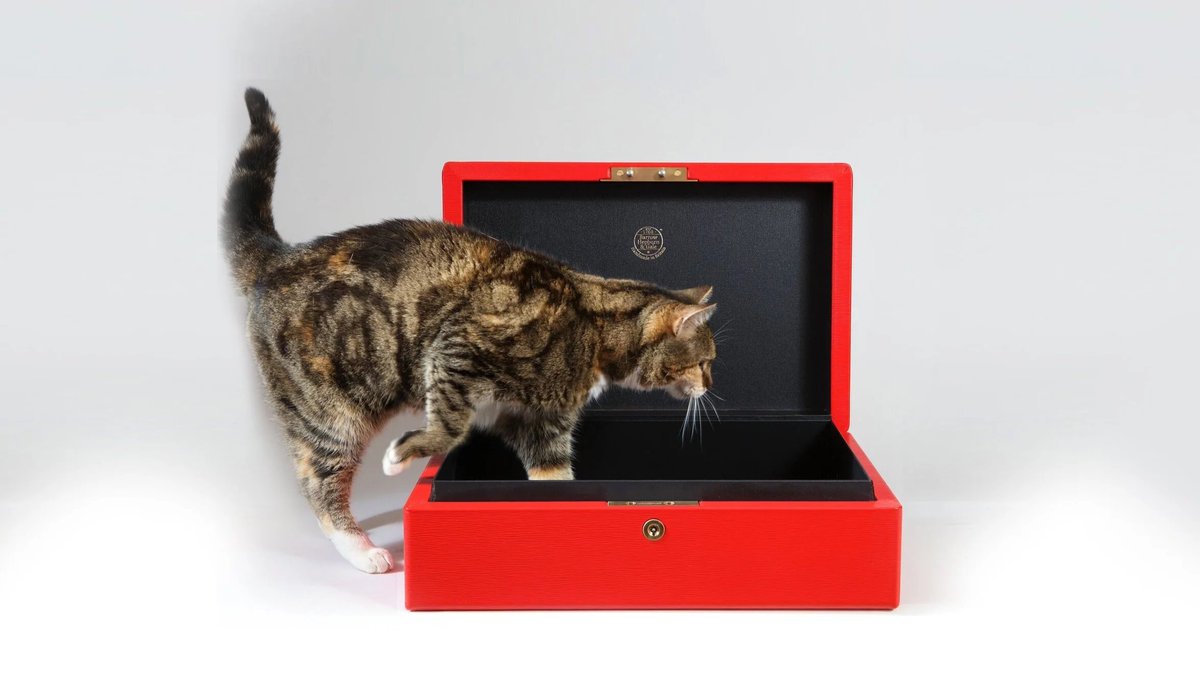
Now, the interesting question to me is: who crafts these red dispatch boxes?
I've gone down a rabbit hole, but with little success!
The red dispatch boxes have historically been sold by a small Bermondsey-based business called Barrow Hepburn & Gale, which was founded in 1760.
It is known to supply these red dispatch boxes to both the Government and the Royal Family.
Indeed, they supplied Rishi Sunak with a delightful red folder as a gift to Australian PM Albanese just a few years ago.
From their website, it's unclear whether they still manufacture in-house or if it is all outsourced to smaller makers. Indeed, the whole business is rather mysterious!
It's seemingly owned by Mohammed Suleman, who seems to be something of a leather goods multi-entrepreneur. Companies House also lists Jennifer Patrick and Angela Scragg as directors,
The procurement of gifts is a powerful, potentially very powerful tool for not only supporting local artisans and small craft-led SMEs but also as a global-reaching advert for such businesses, which employ highly skilled makers to craft beautiful things.
Mr Suleman / Ms Patrick / Ms Scragg if you are reading this: I would love to meet! I make films about artisans making culturally significant products around the U.K., and I'd love to do one about Barrow Hepburn & Gale...
BREAKING
Donald Trump wanted a personalised red dispatch box as a gift from Keir Starmer
Sir Olly Robbins, the then permanent sec at the Foreign Office, said it would 'mean the most' to Trump
The suggestion was that it should have a gold crest and lettering 'mimicking' a government ministerial box but with 'President of the United States' inscribed
Robbins had concerns
What became of the box is unclear
It was 'commercially costed, designed and the manufacturer gave a lead time of 8-10 weeks
The discussion around the box - and discussions with the manufacturer - appears to have engulfed the most senior levels of government. There are dozens of emails about it involving Robbins, McSweeney, other senior figures in No 10...
How to end the Age of Slop, by Louis Elton (@louiselton96)
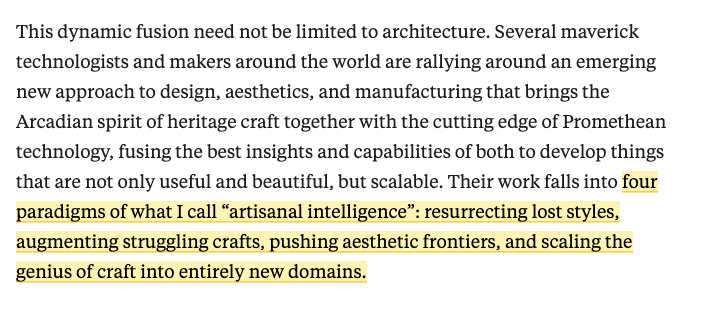
Several maverick technologists and makers around the world are rallying around an emerging new approach to design, aesthetics, and manufacturing that brings the Arcadian spirit of heritage craft together with the cutting edge of Promethean technology.
Some are reviving dormant aesthetics for a mass audience. Not Quite Past uses generative AI to design personalised delftware and chinoiserie-inspired ceramics, digitally printed in Stoke-on-Trent, Britain’s pottery heartlands, making a dying aesthetic once reserved for the wealthy accessible to all.
Others use technology to augment crafts on the brink of extinction. Monumental Labs pairs CNC-milling robots with stonemasons to produce ornate statues and facades, absorbing the apprentice toil that is no longer sustainable. Meanwhile Sony has trained AI on centuries of Japanese archives to generate new, structurally complex kimono weaves for master artisans to execute.
Read more below ⬇️
https://t.co/GDsAMPNKvM
yet more proof that @LouisElton96 is truly one-of-a-kind
an excellent essay on nostalgia vs accelerationism, the aesthetics of progress, and how to end slop by tapping into artisanal intelligence:
How to end the Age of Slop, by Louis Elton (@louiselton96)
Several maverick technologists and makers around the world are rallying around an emerging new approach to design, aesthetics, and manufacturing that brings the Arcadian spirit of heritage craft together with the cutting edge of Promethean technology.
Some are reviving dormant aesthetics for a mass audience. Not Quite Past uses generative AI to design personalised delftware and chinoiserie-inspired ceramics, digitally printed in Stoke-on-Trent, Britain’s pottery heartlands, making a dying aesthetic once reserved for the wealthy accessible to all.
Others use technology to augment crafts on the brink of extinction. Monumental Labs pairs CNC-milling robots with stonemasons to produce ornate statues and facades, absorbing the apprentice toil that is no longer sustainable. Meanwhile Sony has trained AI on centuries of Japanese archives to generate new, structurally complex kimono weaves for master artisans to execute.
Read more below ⬇️
https://t.co/GDsAMPNKvM
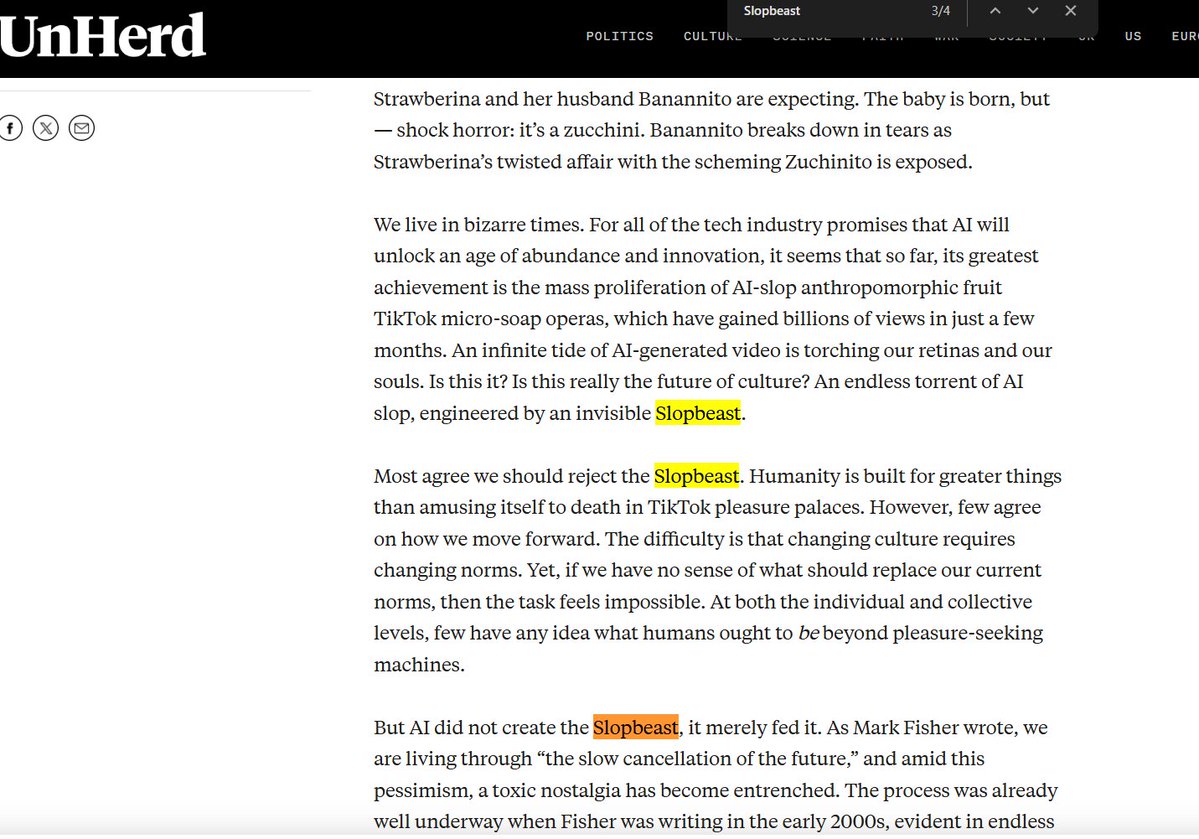
There is a newly discovered AI slop creature
called the “Slopbeast”
it’s a creature made out of algorithms, AI models and endless content loops, basically the brainrot engine behind all those random viral slop characters
https://t.co/f8PAcZLycz
An infinite tide of AI-generated video is torching our retinas and our souls. Is this it? Is this really the future of culture? NO. It must not be!
My new essay in @unherd is a grand thesis on how "artisanal intelligence" is the perfect antidote to the prevailing "autonomous hyperslop" that is torching our retinas and our souls.
The piece is a meditation that starts with a framing of slop and stagnation via Mark Fisher and @JonAskonas.
I then decode two factions warring for our post-slop future:
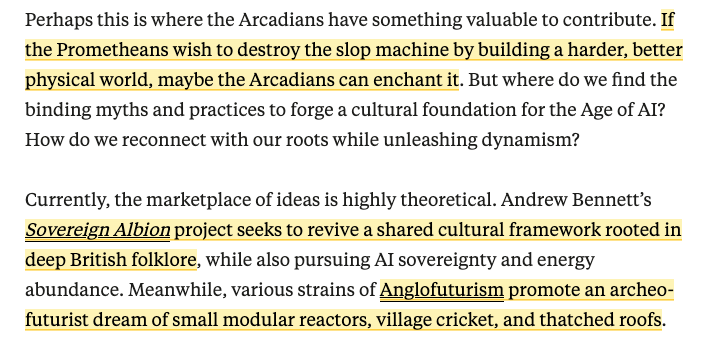
1. Arcadians. The people who want to run away from the machine, e.g. tradwives, Bopeas, soil people, offal eaters, RETVRNists — via Rousseau, Thoreau, Morris, Heidegger, Kaczynski.
2. Prometheans. The people who want to fully embrace the machine, e.g. Andreessen, Karp, Marinetti, Thiel, Musk, Klein, Bastani
Then it gets weird as I draw upon John Ruskin, Paul Ricœur, architectural theorist Kenneth Frampton, Simone Weil, and King Alfred the Great’s ninth-century translations of Boethius to argue that while we cannot stop the machine, we can at least root it with a tradition to extend the good bits of culture, rather than be flattened by it!
I argue the answer isn’t Arcadian retreat or Promethean machine worship.
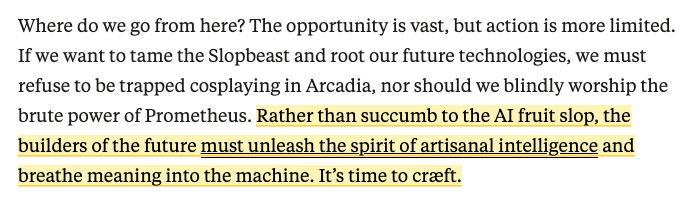
Rather, it’s artisanal intelligence: artisans and technologists fusing the deep wisdom of craft with cutting-edge technology to build things that are useful, beautiful, and scalable.
I actually wrote it in January while unpicking the philosophy behind the £60k Cræft Prize, but it took on a life of its own… crawling to self-indulgent 6000 words before the editors wisely negotiated me down from the edge of naval gazing, esoteric irrellevance.
My mother tells me it is *still* esoteric and navel-gazing. Give it a read and tell me if you agree with her!
How to end the Age of Slop, by Louis Elton (@louiselton96)
Several maverick technologists and makers around the world are rallying around an emerging new approach to design, aesthetics, and manufacturing that brings the Arcadian spirit of heritage craft together with the cutting edge of Promethean technology.
Some are reviving dormant aesthetics for a mass audience. Not Quite Past uses generative AI to design personalised delftware and chinoiserie-inspired ceramics, digitally printed in Stoke-on-Trent, Britain’s pottery heartlands, making a dying aesthetic once reserved for the wealthy accessible to all.
Others use technology to augment crafts on the brink of extinction. Monumental Labs pairs CNC-milling robots with stonemasons to produce ornate statues and facades, absorbing the apprentice toil that is no longer sustainable. Meanwhile Sony has trained AI on centuries of Japanese archives to generate new, structurally complex kimono weaves for master artisans to execute.
Read more below ⬇️
https://t.co/GDsAMPNKvM
You could enjoy the sun like a normal person.
Or you could lock into my 3000-word thesis on how the age of autonomous hyperslop must be fought with artisanal intelligence (or indeed cræft!)
How to end the Age of Slop, by Louis Elton (@louiselton96)
Several maverick technologists and makers around the world are rallying around an emerging new approach to design, aesthetics, and manufacturing that brings the Arcadian spirit of heritage craft together with the cutting edge of Promethean technology.
Some are reviving dormant aesthetics for a mass audience. Not Quite Past uses generative AI to design personalised delftware and chinoiserie-inspired ceramics, digitally printed in Stoke-on-Trent, Britain’s pottery heartlands, making a dying aesthetic once reserved for the wealthy accessible to all.
Others use technology to augment crafts on the brink of extinction. Monumental Labs pairs CNC-milling robots with stonemasons to produce ornate statues and facades, absorbing the apprentice toil that is no longer sustainable. Meanwhile Sony has trained AI on centuries of Japanese archives to generate new, structurally complex kimono weaves for master artisans to execute.
Read more below ⬇️
https://t.co/GDsAMPNKvM
New post: Artisans will rebuild the nation's spirit!
Revisiting an argument I made in 2024:
(1) Beauty and industry are not in conflict.
(2) Britain's historical snobbery towards superficial commercialisation of craft via global luxury will serve it in the long run as the global consumer evolves beyond shallow consumption of simulacra luxury. Even in the markets you would least expect!
(3) In the future, Britain can uniquely own beautiful craft and innovation that is neither slop nor purist as a sort of hub (yes, hub) for interdisciplinary craft, creativity, and commerce!
We’ve grown enormously over the past year, and now we’re looking for someone exceptional to help us take the next leap.
It’s a special role on a special team. Please share with brilliant people - and consider applying yourself!