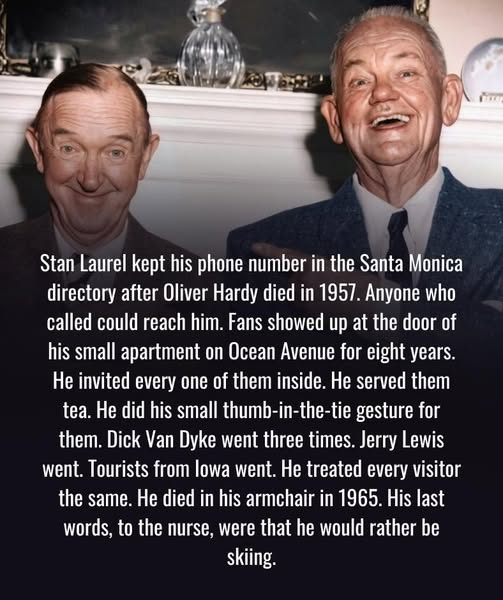
His phone number was in the book.
It was 1957. Oliver Hardy had died in August. Stan Laurel was sixty-seven years old. He was living in a small two-bedroom apartment at the Oceana on Ocean Avenue in Santa Monica. He had moved there after his last divorce because the rent was reasonable and it was within walking distance of the beach.
He had been Hardy's partner for thirty years. They had made over a hundred films together. They had been the most famous comedy duo in the world. They had not been wealthy — they had made most of their films for Hal Roach Studios on contracts that gave them almost nothing in residuals — and by the 1950s they had been living on personal appearance tours and what was left of their savings.
Hardy had a stroke in 1956. He had lost the ability to speak. Stan had visited him every week at his home in North Hollywood. He had sat by the bed and talked. Hardy could not answer. Stan had talked anyway.
Hardy died in August 1957. He weighed a hundred and forty pounds at the end. He had been three hundred at his peak.
Stan was too sick to attend the funeral.
He had been having his own health problems for years. A stroke of his own in 1955. Diabetes. He could no longer travel. The doctor had told him to stay in Santa Monica and rest.
He stayed.
He did not stop working. He could not. He had been writing comedy material for forty years, and he did not know how to do anything else, and the work was the thing that kept him from sitting in the apartment looking at the wall.
He wrote sketches for younger comedians. He answered fan mail. He kept his phone number listed in the Santa Monica directory under his own name. Anyone who wanted to call him could.
The fans started calling.
They started writing. They started showing up at the door. Word had gotten out, somehow, that the apartment number was easy to find. Tourists who had grown up watching the films would knock on the door of 849 Franklin Street, and Stan would open it.
He invited them in.
Every single one of them. For eight years.
He sat in his living room and talked to anyone who came. He served them tea. He showed them photographs from the films. He answered questions. He did his small thumb-in-the-tie gesture that he had done at the end of every film. He laughed at his own jokes and theirs.
He did not have an assistant. He did not have a secretary. He did not have security. He had his second wife, Ida, who made coffee and brought out cake. He did the rest himself.
He did this for hundreds of people.
Filmmakers who would later become famous — Dick Van Dyke, Jerry Lewis, Marcel Marceau, Peter Sellers, the writer Larry Harmon — came to the apartment because they had heard the door was open. So did tourists from Iowa. So did salesmen from Toronto. So did teenagers from Glendale who had ridden the bus across town. He gave them all the same hour.
Dick Van Dyke later said that Stan Laurel had taught him everything he had ever learned about comedy. He said he had gone to that apartment three times in five years. The first time, Stan had sat with him for four hours.
In 1961, Stan was given a special Academy Award for his contribution to comedy. He could not travel to the ceremony. Danny Kaye accepted on his behalf and read a short speech Stan had written. The speech ended with one line, which Stan had insisted on.
The line was: I wish my partner could share this with me. He was the funnier of the two of us.
Stan kept the Oscar on a bookshelf in the apartment. He showed it to fans when they asked. He let them hold it. He told them which year it was for. He never said it had been awarded to him alone. He always said it was for the two of them.
He died in February 1965. He was seventy-four. Heart attack. He had been resting in his armchair in the apartment. The nurse who was attending him in his last weeks had stepped into the kitchen. When she came back, he was gone.
His last words, spoken to the nurse minutes before, were about skiing. He had said he would rather be skiing. She had asked him if he liked to ski. He had said no, he had never skied in his life, but he would rather be doing that than what he was doing.
Then he laughed.
Then he died.
Dick Van Dyke gave the eulogy at the funeral. He said one line that became famous in comedy circles afterward. He said: a man like Stan Laurel doesn't really die. The thing he made is the thing that survives him.
The phone number in the Santa Monica directory was removed by Ida the week after the funeral. She kept the apartment for another two years. Fans still came to the door. She told them, kindly, that Stan was gone.
Some of them had not known.
She invited them in for tea anyway. She showed them the photographs. She told them stories. She did this for two years before she could bear to move out.
Some people, in the last act of their life, keep the door open to anyone who knocks, because they have nothing left to give but their time, and they discover, surprisingly, that their time is the only thing anyone had ever really wanted from them
La Danimarca ha un passato oscuro in Groenlandia, un passato di cui preferirebbe non si parlasse: rapimenti di bambini, sterilizzazioni forzate, lavori forzati e sfruttamento. Il possesso della Groenlandia da parte della Danimarca, il cui nome effettivo è Kalaallit Nunaat, ebbe inizio come una missione volta a recuperare le terre dei norvegesi "perduti", ma si è evoluto in secoli di sistematica cancellazione culturale e sfruttamento economico degli indigeni Inuit. Nel 1721, il missionario danese Hans Egede giunse sull'isola per "salvare" i discendenti norreni dal paganesimo. Trovando solo Inuit, li convertì con la forza al luteranesimo, denunciando gli sciamani e i rituali tradizionali. La Danimarca istituì quindi un monopolio commerciale statale nel 1776, trattando l'isola come un redditizio sfogo per il grasso di balena e i minerali, mantenendo al contempo gli indigeni Inuit isolati e dipendenti. Nel 1953, la Danimarca annesse formalmente la Groenlandia come "contea" per eludere i requisiti di decolonizzazione delle Nazioni Unite; ciò diede inizio a un periodo di brutale ingegneria sociale. In questo periodo si verificò anche il sinistro esperimento dei "Piccoli Danesi", in cui lo Stato rapì bambini Inuit e li trasferì in Danimarca per trasformarli in un'élite di lingua danese, causando un trauma duraturo. Contemporaneamente, migliaia di Inuit furono trasferiti con la forza dai loro ancestrali territori di caccia in condomini di cemento per centralizzare la manodopera nelle fabbriche controllate dai danesi, devastando le tradizionali reti di parentela. Tra il 1966 e il 1970, le autorità danesi violarono ulteriormente i diritti degli indigeni applicando segretamente dispositivi intrauterini (DIU) a oltre 4.500 donne e ragazze Inuit, alcune delle quali di appena 12 anni, senza il loro consenso, per limitare la popolazione. Sebbene la Groenlandia abbia ottenuto l'autonomia nel 1979 e l'autogoverno nel 2009, l'eredità del controllo danese persiste. Ad oggi, la Groenlandia rimane un territorio sotto la "Corona danese", mentre alcuni organismi internazionali continuano a fare pressione sulla Danimarca affinché affronti il suo retaggio coloniale di discriminazione razziale e renda giustizia alle vittime del "Caso Spiral" e degli allontanamenti forzati dei bambini. Quindi, mentre i danesi gridano all'"imperialismo statunitense", tenete a mente come sono arrivati a controllare questa regione lontana dalle coste danesi e come hanno brutalmente sfruttato la sua gente per la "Corona".
alla fine prevalse l'ovvio... SCHIAFFONE A #UrsulavonderLeyen che si è ripresentata e purtroppo è stata votata proclamando trasparenza. Ora deve rendere pubblici gli sms scambiati con #Bourla. Non è solo questione di dimissioni ma il danno provocato alla credibilità della UE è immane. I SOLDI DEI CITTADINI SPERPERATI NON SI SA COME.. e se ci fossero MAZZETTE? I contratti dei vaccini covid devono essere resi pubblici, deve anche chiarire la posizione del marito, dirigente CEO di una società di Pfizer. LOO SI ARRICCHIVANO sfruttando una falsa pandemia, che oggi sappiamo, bastava curare. Ma dovevano imporre i vaccini a tutti. Prima o poi pagheranno tutti
L'unica vera emergenza è la dipendenza dei giovani (e non solo) dagli schermi.
Steve Jobs, il fondatore di Apple, non permetteva alle figlie adolescenti di usare iPhone e iPad. Bill Gates, fondatore di Microsoft non ha dato ai figli il cellulare prima dei 14 anni. Anche Sundar Pichai, amministratore delegato di Alphabet e Google, ha vietato lo smartphone ai due figli fino ai 14 anni e ha limitato a poche ore al giorno la visione della tv.
Stessa strategia per Chris Anderson, ex editore di Wired e amministratore delegato di 3D Robotics, che ha educato i figli imponendo limiti di tempo e controlli su ogni dispositivo elettronico presente in casa, oltre a bandire gli schermi dalla camera da letto fino a 16 anni. In una scala di dannosità che va dalle caramelle al crack, per Anderson gli schermi digitali sono più vicini al crack.
Stesso discorso per il campione di Tennis Novak Djokovic, che si è sempre rifiutato di acquistare uno smartphone ai figli.
È opportuno sensibilizzare sempre di più le famiglie, su quello che forse è il principale pericolo per la salute dei nostri figli.
“Se l'autolesionismo è cresciuto soprattutto dopo la pandemia, il vero punto di svolta è stato il 2013”, commenta il professor Stefano Vicari, direttore dell’Unità Operativa Complessa di Neuropsichiatria Infantile all'Ospedale Pediatrico Bambino Gesù di Roma: “Nel 2013 al pronto soccorso psichiatrico del Bambin Gesù la media era di 250 consulenze annue. Da allora è iniziato un incremento che ha portato a mille consulenze annue nel 2019 e 1850 dopo il Covid. Di questi accessi, il 60% riguarda appunto l’autolesionismo”.
“È interessante notare – continua il professor Vicari – che nel 2013 ci fu il crollo dei prezzi degli smartphone. Le nuove dipendenze, le dipendenze comportamentali, vedono il telefonino tra i fattori di rischio principali. Esso toglie spazio alle attività ricreative, aumenta la sedentarietà, attiva i circuiti della ricompensa, cui seguono comportamenti di craving – vale a dire desiderio insaziabile – e ricerca spasmodica nonché aggressività, quando lo smartphone viene tolto. Insomma chiari segni di vera dipendenza”.
Ne parlerò ampiamente in una delle prossime puntate di TeleRagione.