🚨 José Mourinho: “Pep Guardiola said something to me yesterday… he won six trophies and I won three, but I won fairly and cleanly”.
“I don't want to win by dealing with 150 lawsuits”.
“If I lost, I want to congratulate my opponent”, says — via @MailSport.
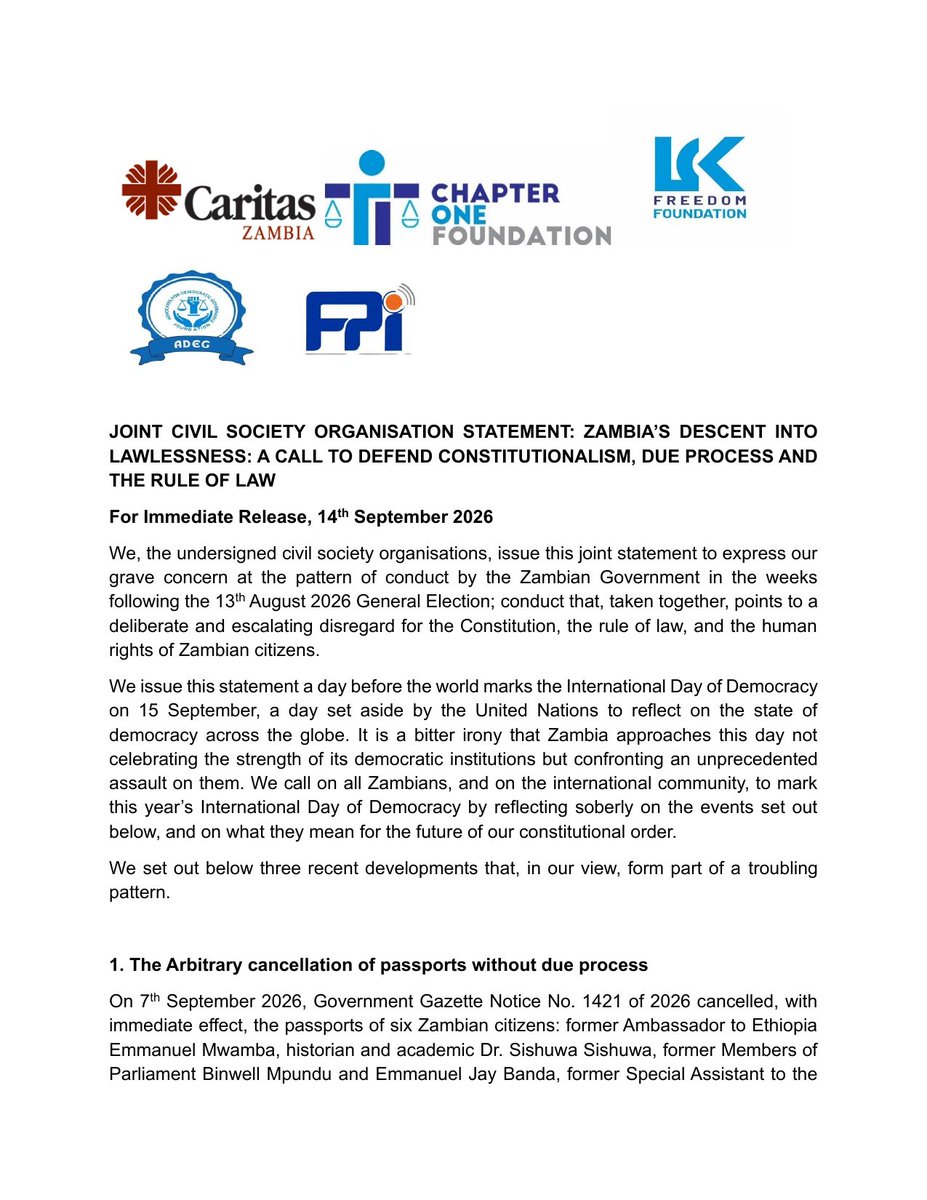
FOR IMMEDIATE RELEASE
14th September 2026
ZAMBIA'S DESCENT INTO LAWLESSNESS: A CALL TO DEFEND CONSTITUTIONALISM, DUE PROCESS AND THE RULE OF LAW
We, the undersigned Zambian civil society organisations, are issuing this statement to express our grave concern at a pattern of conduct by the Zambian Government in the weeks before, during, and after the 13th August general election; conduct that, taken together, points to a deliberate and escalating disregard for the Constitution, the rule of law, due process, constitutionalism, and the human rights of Zambian citizens.
We are issuing this statement one day before the world marks the International Day of Democracy on 15th September, a day set aside by the United Nations to reflect on the state of democracy across the globe. We call on all Zambians, and on the international community, to mark this year's Day of Democracy by reflecting soberly on what we set out below.
We highlight three developments that, in our view, form part of a troubling pattern:
First, the arbitrary cancellation of passports without due process. Six citizens' passports were cancelled by government gazette notice, with no hearing and no opportunity to challenge the decision. Those affected include former Ambassador to Ethiopia Emmanuel Mwamba, academic Dr Sishuwa Sishuwa, and two former Members of Parliament.
Second, treason and sedition charges against opposition presidential candidate Brian Mundubile and his running mate Makebi Zulu, who have been detained since late August without being brought before a court. We are further gravely concerned for 18 other detainees held in connection with these matters, over allegations made in a court petition under oath of unlawful detention, denial of access to lawyers and family, and torture, including waterboarding.
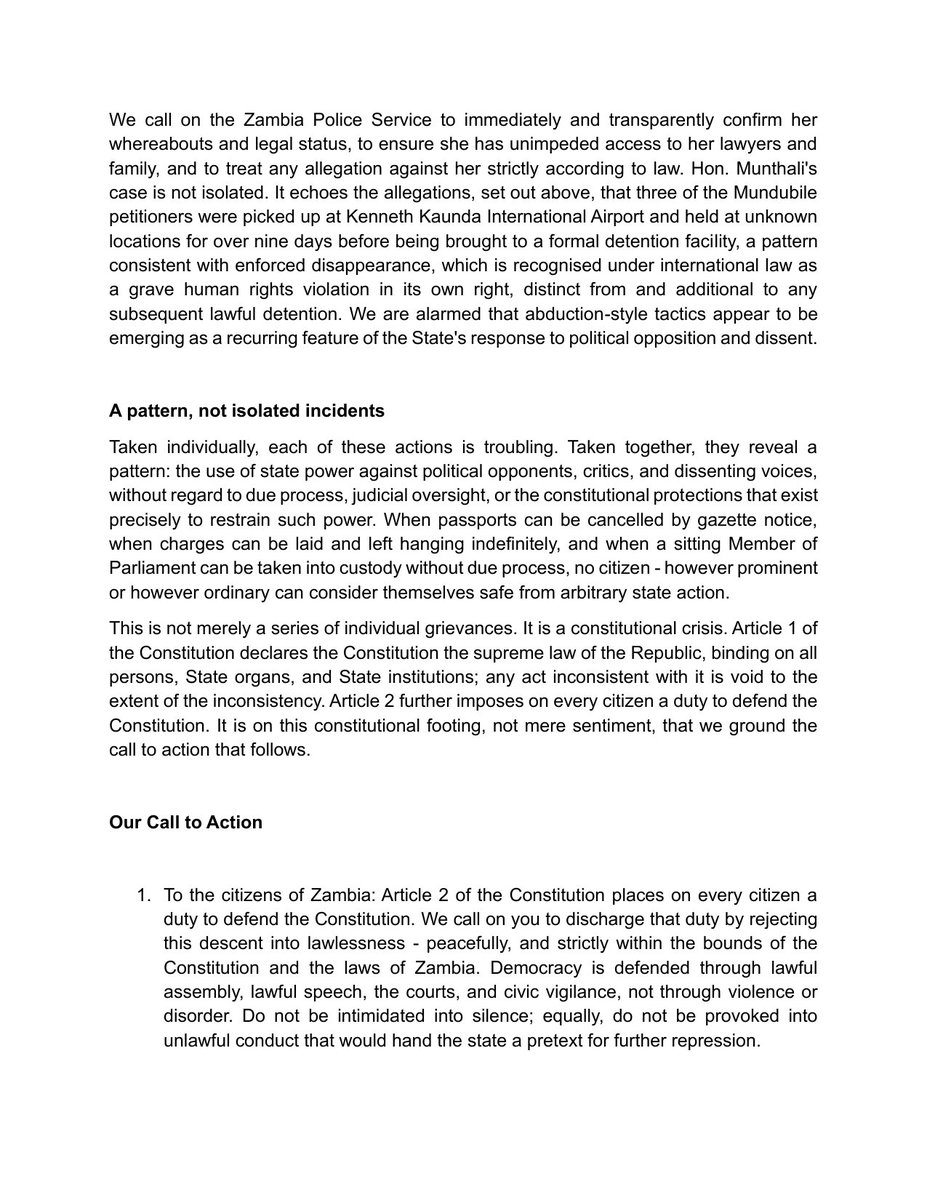
Third, a growing trend of abductions, illustrated by the arrest of sitting Member of Parliament Honourable Faith Munthali, which we believe echoes a wider pattern of abduction-style detentions of government critics and opposition figures.
We do not view these as isolated incidents. Taken together, they amount to a constitutional crisis, breaching guarantees on freedom of movement, personal liberty, and the right to a fair hearing.
We call on the Government of the Republic of Zambia to: restore the cancelled passports; bring all detainees before the courts without further delay, or withdraw the charges; independently and transparently investigate all allegations of torture; end any practice amounting to enforced disappearance; and restore and consistently observe the rule of law, due process, and the separation of powers.
We further call on government to take concrete steps to restore public confidence in the integrity and independence of our constitutional and public offices, including the Judiciary, the Defence Force, law enforcement wings, and the Electoral Commission. We further urge the Government to convene an inclusive national dialogue bringing together government, opposition, civil society and faith communities.
We also call on the African Commission on Human and Peoples' Rights, the Commonwealth, SADC, and United Nations human rights mechanisms to engage directly with the Zambian Government on these concerns, and not to look away.
Signed by:
Linda Kasonde
Executive Director, LCK Freedom Foundation
For and on behalf of:
Advocates for Democratic Governance Foundation
Caritas Zambia
Chapter One Foundation
Free Press Initiative Zambia
LCK Freedom Foundation
Full statement attached below.
@UNHumanRights@SADC_News@commonwealthsec@achpr_cadhp@IBAHRI@cla_lawyers@LawyersofAfrica@AmnestySARO@hrw@cnni@BBCAfrica@ReutersAfrica@nytimes@RFIAfrique@DeutscheWelle@SABCNews@FreedomLck@CofZambia
Two gunshots to the chest, nobody can survive. If you’re a good shot and you know your weapon. Also if they claim that the military wanted to kill Mutotwe kafwaya, why would they take him to a military hospital?? Won’t they just finish him off there? This story is a lie. There’s a level of intelligence one requires to fabricate a conspiracy. The author lacks the ability to do so.
🚨 EXCLUSIVE: Rick Ross may still be beefing with Drake, but that didn't stop him from running through all their biggest collaborations during the opening night of his new tour.
@FabrizioRomano Cap..they sold Toni Kross who went on to win a 3peat in the UCL..you mean to tell me you didn't miss him on the pitch..Olise will go for the right amount
@Space2013M@iam_kapumo The bill has passed the third reading and awaits presidential ascent.. technically it has not been enacted..but it should be soon enough
Watch out for ethnic-regional imbalances in Hichilema’s judicial appointments
By Sishuwa Sishuwa
On 8 August 2025 President Hakainde Hichilema signed into law the Superior Courts Act, which provides for the number of judges of the Supreme Court, the Constitutional Court, Court of Appeal, and the High Court. The new statute repeals and replaces the Superior Courts (Number of Judges) Act of 2016. It provides for thirteen judges of the Supreme Court, including the Chief Justice and the Deputy Chief Justice; thirteen judges of the Constitutional Court, including its President and Deputy President; not more than thirty-one judges of the Court of Appeal (this is up from 19 in 2016), including the Judge President and the Deputy; and not more than one hundred judges of the High Court (up from 60 judges in 2016).
There are three broad points I wish to make on this important development.
The first is that I commend President Hichilema for increasing the number of judges at the two busiest levels of our justice system: the High Court and Court of Appeal. A key reason why it takes a long time for cases to be disposed of is because judges are simply overwhelmed. On average, a High Court judge in Lusaka handles about 300 cases a year. This is simply unmanageable and prevents the timely delivery of justice. When one adds the low salaries that judges receive, it is hard to understand why any self-respecting individual would aspire to be a judge under the circumstances.
According to the latest Judges (Salaries and Conditions of Service) Regulations published in May 2025, the current annual basic salary of a judge on the High Court bench is K370, 473.73. Their counterpart on the Court of Appeal receives a basic salary of K388, 997.38 per annum. This means a High Court judge gets about K30, 000 monthly before tax while one on the Court of Appeal receives about K32, 000. This is far less than what politicians in the two other branches of government – parliament and the executive – get.
It is largely because of Zambia’s high rate of unemployment that many people are prepared to take up such low-paying jobs on the thinking that although ‘the salary is low, it is better than nothing’ especially when other conditions of service such as housing allowances are added. And precisely because such individuals join the judiciary for the paycheck, not any commitment to justice, many of them, eager to beef up their income, become susceptible to corruption from a highly corrupt executive that often wants to use judges for its partisan goals.
Judges of the Constitutional Court and the Supreme Court handle very few cases a year, averaging 20 at most, so I am not concerned about them. Much of the workload that is before the superior courts is handled by the low-staffed High Court and Court of Appeal benches. That is why I am praising Hichilema for increasing the numbers of judges to the two courts by 40 and 12 respectively. In fact, even these additional numbers are not enough, given the volume of work that is before the High Court and Court of Appeal, but the increase marks a good starting point. Instead of fighting to increase the number of members of parliament, Hichilema is better advised to increase the number of judges because they provide a clear and more important service to the people.
The second point is that there is an urgent need to enact a law that provides for a transparent system that would result in merit-based identification, interviews, and appointment of potential judges. The increase in the numbers alone is not enough. It needs to be supported by other measures. In addition to an unmanageable caseload and poor conditions of service, another factor that contributes to poor and late delivery of justice is the sheer incompetence of some of our judges. However, we will not solve the problem of corruption and incompetence in the judiciary if people who end up as judges are not appointed on merit. Even before Judicial Service Commission (JSC) and President Hichilema move to fill up the created vacancies in the judiciary, it is important to enact an Act of Parliament that would provide for a competitive, merit-based, and transparent system of appointing judges. This should involve advertising vacancies, publishing the names of both unsuccessful and shortlisted candidates, and conducting interviews before a properly reconstituted JSC which should include the Chief Justice.
Presently, everything is done in secrecy and in a manner that overly concentrates power in the presidency. Judges are currently appointed by the President on the recommendation of the JSC, but members of this body are themselves appointed by the President subject to ratification by a generally pliant parliament through a simple majority. No one knows the criteria that the JSC uses to identify judges. People just wake up to news that so and so has been appointed to this or that court without any knowledge of how the affected individuals were identified. Right now, the appointment of judges operates like an admission to a secret society. What is needed is to create legislation that will provide for a very clear process of appointing judges in a transparent, competitive, and open manner.
As earlier stated, let there be adverts calling for interested candidates to apply for positions in the judiciary so that anyone interested and meeting the outlined requisite qualifications is free to apply and become a judge. The JSC, whose members should not be appointed by the president, will then hold open and even televised interviews with the shortlisted candidates. Members of the public should be free to give evidence-driven testimony against any shortlisted person whom they think lacks the integrity to serve as a judge. This manner of proceeding would ensure that those who end up as judges in our superior courts do so not because they know someone in the corridors of power but are qualified, competent, and impartial individuals with demonstrable experience, intimate knowledge and understanding of the law and who possess proven levels of integrity.
The incompetence that we see in our judiciary today is not accidental; it is the result of the lack of a transparent and open mechanism of appointing judges. A key reason why I voted for Hichilema in the 2021 election was that I had hoped that he would change this undesirable status quo where judges are appointed in a secretive way that does not foster transparency. After all, he had promised to create such a mechanism when he was in opposition. But after winning power, the President has reneged on his campaign promise, as he has done on so many others, and has used the same rotten system that his predecessors relied upon to appoint judges.
The problem, in my view, is not just the lack of capacity in the individuals appointed to these roles; it is the inadequacies of a system that allows such individuals to end up as judges in the first place. Unless the current system is changed, the next crop of appointments to superior courts risks including several dishonourable magistrates, mainly those in Lusaka, who have been making a truckload of such questionable judgements in favour of the executive that one would be forgiven for thinking that they have been promised appointments to the High Court if they secure the interests of those in power.
The third and final point is the need to ensure regional, gender, youth, and equitable representation of persons with disabilities in the appointment of judges. This would promote inclusion and national unity and prevent accusations and perceptions that the President is packing the courts with individuals who predominantly come from one region. The good thing is that there already exists a law in place for this measure. All that is required is for the President to comply with it.
Article 259 of Zambia’s Constitution provides that “Where a person is empowered to make a nomination or an appointment to a public office, that person shall ensure — (a) that the person being nominated or appointed has the requisite qualification to discharge the functions of the office, as prescribed or specified in public office circulars or establishment registers; (b) that fifty percent of each gender is nominated or appointed from the total available positions, unless it is not practicable to do so; and (c) equitable representation of the youth and persons with disabilities, where these qualify for nomination or appointment.”
The same Article also states that “A person empowered to make a nomination or appointment to a public office shall, where possible, ensure that the nomination or appointment reflects the regional diversity of the people of Zambia.” This means the Constitution itself requires the President to be sensitive to regional representation when making appointments to any public office. Unfortunately, Hichilema has so far not shown much respect for the law.
For instance, in February 2023, the President appointed a total number of 20 judges to various positions in the superior courts. These included Margaret Munalula, Arnold Shilimi, Mudford Mwandenga, Maria Mapani, Kenneth Mulife, Mwiinde Siavwapa, Laston Mwanabo, Mwaka Ngoma Samundengu, Mbile Muwindwa Wina, Vincent S. Siloka, Greenwell Malumani, Mabolobolo Mwananjiti, and Situmbeko Chocho. The rest were Abha Nayah Patel, Yvonne Chembe, Enias Chulu, Obister Musukwa, Anne Malata – Ononuju, Geoffrey Chilufya Mulenga, and Malaro Nyirenda.
Of these 20 appointments, the first thirteen came from only three provinces or one region: Southern, Western, and Northwestern. Such regional imbalances are unlawful and must be avoided in the next set of appointments. If there are 50 vacancies in the judiciary, Hichilema must make sure that those appointed reflect regional, gender, youth, and equitable representation of persons with disabilities in Zambia today. If there is to be any departure from this constitutional principle, there must be compelling grounds.
As the Judicial Service Commission and Hichilema move to fill the numerous vacancies created in the superior courts, I make an earnest appeal to members of the public to remain vigilant and specifically watch out for ethnic-regional imbalances in the distribution of the soon-to-be announced appointments of judges. We owe it to ourselves to build a better, equal, united, just, and fair Zambia in which no citizen feels shut out or excluded from any public opportunities on account of their ethnic identity, region of origin, gender, disability, and where presidents respect the laws that we have set for ourselves. It is possible.