Tech, Innovation and Research in Artificial Intelligence, computer vision, deep learning and learning distance in @UTPL #AI#computervision#iHCI_UTPL#IA_UTPL
⚠️ El rendimiento académico de los estudiantes se reduce un 12% durante los Mundiales de Fútbol y las Eurocopas. Y si el estudiante es muy aficionado al fútbol, se reduce hasta un 28% las probabilidades de aprobar.
Estimaciones causales para UK:
https://t.co/zgxdLJwoxB
1 objetivo: transformar búsquedas bibliográficas en conocimiento útil
Mendeley + Overleaf + GitHub + NotebookLM + evidencia científica
Resultado: borrador de 1 capítulo d libro x pregunta y 1 proceso completamente trazable
La IA procesó información; el humano guió el proceso
OpenAI publicó una guía de buenas prácticas para Codex.
Me quedo con estas ideas:
1) Context → explicá el objetivo y cómo se ve un buen resultado. 2) Planning → usá /plan para tareas complejas. 3) AGENTS.md → guardá instrucciones repetidas. 4) Configuration → definí una vez modelos, permisos y herramientas. 5) Validation → enseñale cómo verificar resultados. 6) MCP → acceso a GitHub, docs y bases de datos. 7) Skills → convertí workflows repetidos en Skills. 8) Automations → automatizá tareas que ya hacés manualmente. 9) Subagents → delegá investigación, testing o debugging.
Cuanto mejor diseñado está el entorno, más trabajo puede hacer el agente por su cuenta.
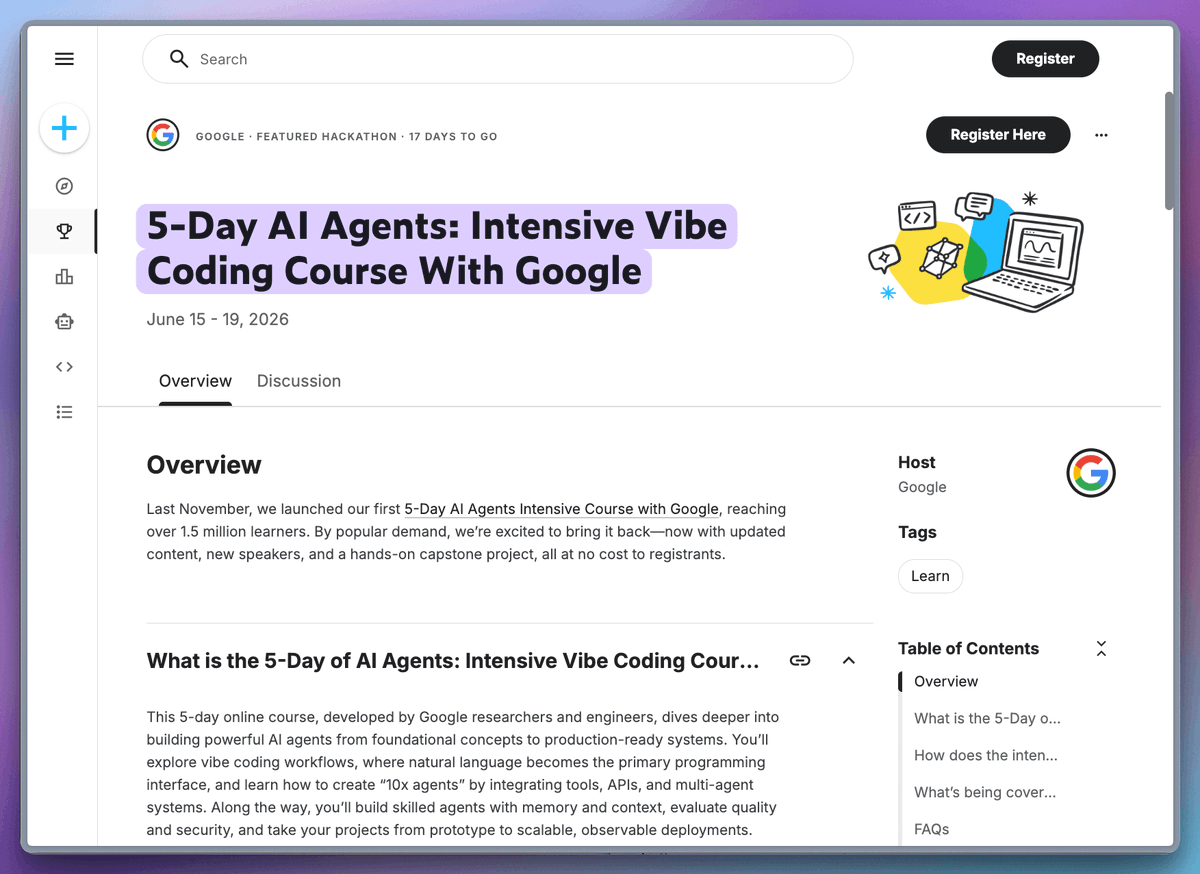
Regresa el curso intensivo y GRATUITO de Google y Kaggle para aprender a construir y desplegar Agentes de IA en solo 5 días.
Con él aprenderás:
✅ Vibe Coding: Usa lenguaje natural como tu interfaz de programación principal.
✅ Sistemas multiagente: Crea agentes avanzados con memoria, contexto y herramientas.
✅ De prototipo a producción: Cómo escalar tus desarrollos de forma segura en la nube.
🌟 Regístrate aquí: https://t.co/RswXl8HjiF
Efficient AI Lecture 18: Diffusion Models
Diffusion models can be understood from three connected layers:
🔹 Basic Diffusion Model
Add noise step by step in the forward process, then train a neural network to predict and remove that noise during generation.
🔹 Conditional Diffusion
Guide the denoising process with extra information, such as class labels, text prompts, or pixel-level conditions. Cross-attention is the bridge that injects text meaning into image generation.
🔹 Efficient Diffusion
Make diffusion practical through latent diffusion, fast sampling methods like DDIM, and acceleration techniques such as sparsity, quantization, and parallelism.
My note:
https://t.co/41HmAzYRfP
I ran 2D pose estimation on a pickleball rally, with skeletons on all four players through the entire point:
- Keypoint R-CNN (torchvision) detects the 17 body joints for each player
- PyTorch runs the model inference
- OpenCV connects the joints and draws the skeleton overlay onto the frames
Datos oficiales revelados por el doctor Luis Medina Gual, director de Innovación Educativa de la Universidad Iberoamericana, señalan que el 66% de la comunidad estudiantil universitaria utiliza herramientas de Inteligencia Artificial (IA) de manera cotidiana, a pesar de que el 73% de los alumnos desconoce si su institución cuenta con lineamientos claros de regulación.
El especialista detalló que ocho de cada 10 jóvenes emplean esta tecnología para la generación automática de textos y un 80% proyecta que los algoritmos transformarán profundamente el ejercicio de sus futuras profesiones.
Más información en: https://t.co/jBMecTzv2V
Ultralytics is heading to Edge AI London 🚀
Join Ultralytics and @Raspberry_Pi for a hands-on workshop exploring computer vision at the edge - from training to deployment on real hardware.
📍 London
📅 Workshop: June 9 | 3.40PM - 4.30PM
Learn more ➡️ https://t.co/wgEPVRIyfk
❗️ Para quienes son profes de tesis (o deseen apoyar procesos de investigación), les comparto un documento gratis en PDF que les puede servir: https://t.co/GJiidTRUQa
Introducing the research paper behind Ultralytics YOLO26.
For years, we've focused on building YOLO and getting it into the real world: into your products, your pipelines, your research. With YOLO26, we wanted to go a step further: we've published a research paper that shares the full story of how it works.
"Ultralytics YOLO26: Unified Real-Time End-to-End Vision Models" covers:
✅Native NMS-free, end-to-end inference: no post-processing
✅DFL removal for a lighter, easier-to-export head
✅MuSGD, a hybrid optimizer adapted from LLM training
✅Progressive Loss + STAL for stronger small-object detection
✅One unified pipeline — detection, segmentation, pose, classification & OBB — plus YOLOE-26 for open-vocabulary, prompt-free inference
✅40.9–57.5 mAP on COCO at just 1.7–11.8 ms (T4 TensorRT)
A big thank you note to the authors who made it happen: Glenn Jocher, Jing Qiu, Mengyu Liu, Shuai Lyu, Fatih Akyon, and Muhammet Esat.
This community has shaped every version of YOLO, and this paper is our way of sharing back. Thank you for building alongside us. 💙
📰Read the paper and explore all our research → https://t.co/A8alH9g6Rl
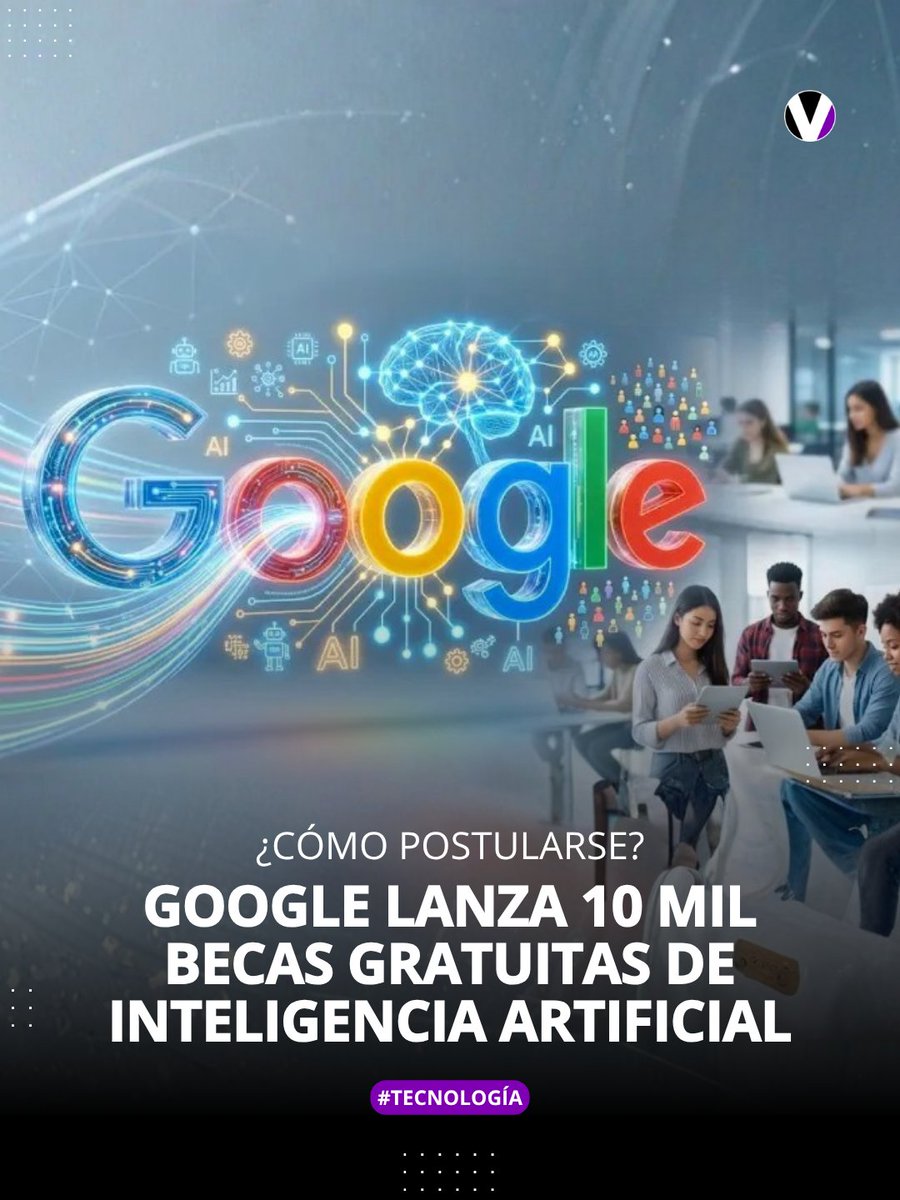
¡Oportunidad! Google abrió la convocatoria para 10.000 becas gratuitas en Inteligencia Artificial. No se requiere experiencia previa en programación para acceder a este aprendizaje. Conoce cómo aplicar 👉🏻 https://t.co/TzxmTqPiVb
Google's back with another free 5-day AI Agents course.
The last edition hit 1.5 million learners, and this time, they will dive into vibe coding with agents.
The daily progression actually mirrors how agent development works in practice:
→ Day 1: Agent fundamentals and vibe coding:
↳ You will go from basic chatbots to autonomous agents using natural language as the primary dev interface.
→ Day 2: Tool integration and multi-agent systems:
↳ You will learn how to wire agents to external APIs and get multiple agents coordinating with each other reliably.
→ Day 3: Context engineering:
↳ You will build agents that maintain reasoning across sessions using short-term recall, long-term memory, and persistent state.
→ Day 4: Evals and security:
↳ You will set up testing, guardrails, and observability to catch the failure modes that only show up when agents have real tool access.
→ Day 5: Prototype to production:
↳ You will deploy everything to production and build a capstone project where you ship your own agent end-to-end.
Everything runs on Kaggle notebooks with daily livestreams, taught by Google's ML engineers.
1-2 hours a day, and it's completely.
Register before June 2nd here: https://t.co/SOd7ZdKztp
Thanks to the Google Cloud team for their collaboration on this post.
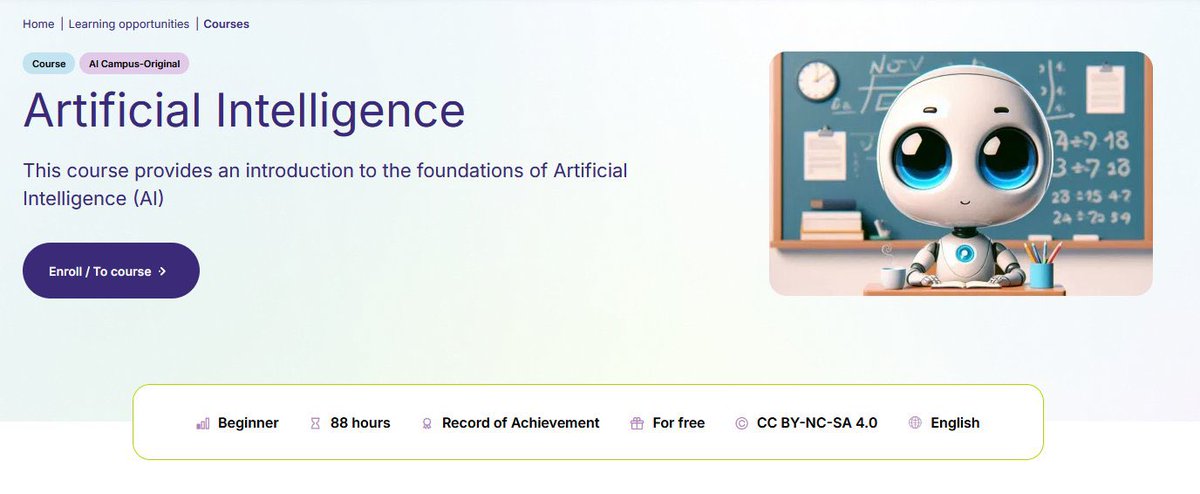
Yapay Zekanın temellerini öğrenmek için ücretsiz, 88 saatlik bir kurs.
Hannover Üniversitesi'nden Profesör Wolfgang Nejdl ile birlikte geliştirilen bu kursta arama algoritmaları, Markov karar süreçleri, pekiştirmeli öğrenme ve AI’ın temellerine ulaşabilirsiniz.
🔗 https://t.co/X0Y3ebX4ut
🤖 IA y universidad: un cambio de era para la educación superior
El artículo analiza el profundo impacto de la inteligencia artificial, especialmente la generativa, en la enseñanza universitaria.
▶️https://t.co/itKAsVic3B
Introducing the newest Coral board, for efficient, on-device AI!
Check out the demos in the video:
- On-board speech translation
- Natural language controlling hardware
- Vision & sound generating music
Hace unos días la @UNAM_MX🏫publicó tres guías para el uso de IA🤖generativa en la evaluación educativa de bachillerato, licenciatura y posgrado.
Un insumo clave para docentes👩🏽🏫, directivos y responsables académicos que buscan integrar la #IA con criterios pedagógicos📚 y éticos.
¿Ya las revisaste? Consúltalas aquí 👉https://t.co/8s0pj5pYQd.