🚨 Everyone is watching the wrong bubble.
And missing the greatest opportunity in 40 years because of it.
While the crowd argues about AI and crypto, the real story is the asset sitting in every "safe" portfolio on earth.
Bonds.
The 1981 top printed 14% yields. The 2020 bottom printed 0%. That was 39 years of falling rates, and it ended in a single Covid panic.
Covid was the turn. Rates hit zero, the system flooded itself with liquidity, and the 40-year bull in bonds quietly ended in the very moment everyone felt rescued.
That's reflexivity in the Soros sense. For four decades, falling yields lifted every asset, which convinced everyone yields would keep falling, which lifted assets again. Belief and reality reinforced each other all the way down to zero. Then the loop turned. And here's the part almost no one has grasped: a turn this big isn't the end of the game. It's the start of a far better one.
Here's why I'm genuinely excited.
For 40 years, falling rates lifted everything together. Correlations converged. The tide carried every boat, so owning the whole ocean beat knowing which boat was seaworthy. Index beat judgment. Skill was a rounding error.
That era is over, and what replaces it is the best environment for active investing in two generations.
When the secular tide reverses, dispersion comes roaring back. Winners and losers split apart violently. Suddenly the things that were invisible for 40 years, valuation, balance-sheet quality, real cash flow, pricing power, decide everything. The gap between the great business and the mediocre one stops being a footnote and becomes the whole return.
This is the world that made Buffett, Lynch, and Templeton. It's the world before 1981, where picking actually paid. It's coming back.
And it arrives at the most lopsided starting line imaginable, which is exactly what makes the opportunity so rich.
Concentration at a record. A handful of names carrying the entire index. Record IPOs listing at peak valuations and getting forced straight into peak index weights through mechanical, price-insensitive buying. The passive bid that everyone treats as ballast has become the marginal price-setter at the worst possible altitude.
JPMorgan's own Guide to the Markets makes the setup clear. Map starting valuation against subsequent ten-year returns, and today's level points to roughly zero percent per year from the S&P over the coming decade.
Sit with that. Zero from the broad index for ten years.
Now flip it over. If the average is zero, the spread around that average is enormous. Some things compound beautifully. Others go nowhere or worse. A flat index for a decade isn't a dead market. It's the richest hunting ground for active investors in living memory, because the distance between right and wrong has never paid more.
The whole architecture of modern investing was engineered for the era that just ended.
- Buy stocks and chill. Built on a discount rate going one direction. Down.
- The 60/40. Built on bonds rallying whenever equities fell.
- Just buy the ETF. Built on a 40-year tailwind no one managing money today has ever seen reverse.
That's the trap. And the mirror image of every trap is an opening for the people who see it first.
Strauss and Howe gave this moment a name. The Fourth Turning. The last of the four cycles, the Crisis, when the institutions built for the old era meet the conditions of the new one. These turns feel like danger to everyone clinging to the last playbook. They are the launchpad for everyone holding the next one.
The tide is turning. The old map is worthless.
And the greatest opportunity of our generation is hiding in plain sight, inside the thing everyone still calls safe.
Offshore Drilling Notes
(1) Noble's 7G Viking is reportedly nearing a $465k, ~300 day award from Petronas in 2028, according to SB1M and S&P Global. This is likely for the Kelidang gas project in Brunei. Strong number from recent low-$400k levels on rising regional utilization.
Eldorado's sale of drillships Dorado and Draco to Turkey last summer was a positive signal for deepwater dayrates — vessels that would otherwise have competed for SE Asian and global tenders are now absorbed into Turkey's domestic energy security program and effectively removed from marketed supply. Also, the Eni/Petronas JV (Searah) will use 2 rigs on multiyear terms in Indonesia, along with Eldorado's Platinum Explorer moving to India leads to rising utilization in the region pushing dayrates higher.
(2) Transocean Norge was awarded a $497k dayrate in Norway on a 300-day term. Given market strength, short duration contracting is the right posture for Tier 1 Semisubs here — Norway runs heavy on shorter-cycle brownfield demand, drilling intensity is rising, and exploration activity remains active (see dayrate chart). Norge at $497k is positive readthrough for Odfjell Drilling, whose semisubs are comparable.
(3) Odfjell Drilling is a pure-play NCS with a >9% div yield and visible growth potential. Alongside Transocean Norge, their 5-rig fleet is the best in Norway. Its Deepsea Atlantic dropped its BOP to the seabed in April, though it's since been secured and is trending toward a return to work.
The strength in NCS Semisubs is also applicable to the valuation of Northern Ocean's Deepsea Mira, although Mira has been mostly working Namibia's Orange Basin drilling and appraising key discoveries, waiting for Namibia to mature into a development drilling market. TotalEnergies' Venus is the nearest FID, with more likely to follow in coming years. A return to Norway is possible for Mira, though mobilization carries costs and Namibia has promising long-term return potential.
(4) SED Energy Holdings tender barges T-15, T-16 and Vencedor were once collateral on a distressed $2.7B Seadrill Partners LevLoan issued a dozen years ago (eventually bankruptcy due to other asset troubles), but have proven resilient assets with good utilization since. Tender rigs compete against jackups as lower cost options in SE Asia and are exposed to jackup dayrate and utilization trends.
Somewhat reminiscent to me of the Shelf Drilling old 1st lien HY bonds w/ mid-teen YTM before ADES bought them, but ENH is only 0.3x leveraged so free cash flow is instead paid to equity investors. Downside: these aren't expensive to build in Chinese yards, limiting asset valuation upside. ENH currently trades at a low-to-mid teens yield on 2009–2014 vintage assets.
@Energy_Fuels Receives Conditional U.S. Government Support to Accelerate Growth in Rare Earths and Critical Materials
Ross Bhappu, President and CEO of Energy Fuels, said: "This important financing support from key investors aligns with Energy Fuels' objective to be a vital player in the rare earths supply chain. The United States government has been steadfast in its support of critical materials security, and we appreciate the OSC's financial support at this important time as we develop our vertically integrated supply chain."
Read the full details in our most recent press release: https://t.co/mh4y8Yrxkh
$UUUU $EFR #EnergyFuels #uranium #rareearths
Guys, hormuz is never going back to normal. Once you realize that and accept it you will get clarity on what to do.
For me that means full portfolio plus leverage into energy and metals.
$CNQ $SU $CVE $ATH #COM heavy oil literally cant loose
$NHC.ax $WHC.ax $COAL $NRP $ARLP etc
$CCJ $URNM $COPX etc $ARG.to $IVN.to etc
The US will not do a ground war in Iran anytime soon. That means missiles and drones pecking at the straight continues. long energy and chill
The @U.S. Department of Justice highlights the national significance of the Stibnite Gold Project as the only domestic #antimony source capable of meeting the urgent US defense need.
Read the DOJ announcement on the recent Idaho District Court Decision. https://t.co/2tqrxqMT2h
This is how I'm playing the Colombian election: betting on $PXT / $PARXF — Colombia's leading oil & gas producer. 2x production growth outlook, solid cash flow, and 5.7% divvy yield.
https://t.co/l6aYNh7WHB
@robin_j_brooks your comments below reveal a profound lack of understanding of the oil market. Commodity futures price inventory, NOT expectations. That isn't ideology; it's a fact grounded in the economics of carry.
The Brent price in your graph is not a risk anyone can actually hold — it's a spot contract stitched together at each expiry. In normal times that's a fair proxy; these are not normal times. Construct a series an investor could truly hold — a rolled BCOM index, or the USO ETF — and the picture inverts: it slopes hard up and to the right, consistent with the largest supply shock in history.
USO keeps climbing because the shortage is showing up in the futures curve — not in the headline price on the screen. The carry pays an investor nearly 50% a year, even if the price of oil never moves.
The SPR was drawn down before commercial inventories — when it is normally the other way round. Strategic stocks are meant to be the last line of defence, not the first, but this time Washington spent them first, managing headlines not risk.
When you have no crude in storage, THEN and only then will the spot price move to a level to destroy demand. I have no idea if it is 150, or 200, or 250. The observed indication from Asia is ~200.
BREAKING: Perpetua Resources Lands Massive $2.9B U.S. Loan for Idaho Gold & Antimony Project $PPTA $UAMY
Mining company Perpetua Resources has secured a $2.9 billion loan from the U.S. Export-Import Bank, CNBC has learned. The deal comes as the U.S. looks to secure access to critical minerals and break China's stronghold on essential supply chains.
The financing, which is the largest loan under EXIM's "Make More in America" initiative and the agency's fourth largest loan on record, will fund Perpetua's Stibnite Gold project in Idaho. The mine will also produce antimony, which is essential for defense applications – including for munitions – as well as semiconductor manufacturing and renewable energies including solar panels and wind turbines, among other things.
https://t.co/s8wJRh4zOx
This is how I'm playing the Colombian election: betting on $PXT / $PARXF — Colombia's leading oil & gas producer. 2x production growth outlook, solid cash flow, and 5.7% divvy yield.
https://t.co/l6aYNh7WHB
🚨@ParexResourcesis about to 2X production thru accretive acquisition of @FronteraEnergy assets + farming into 2 high-potential @ECOPETROL_SA fields.
Add a 5.7% #dividend yield, serious upside with income.
Election in 10 days 🚀
$PXT $PARXF
Don’t sleep on this. Link below👇
Colombia election preview.
*I see 65% chance of a conservative victory.
*I'm most bullish on $AVAL.
*Also like $TGLS and $AUNA ahead of the election.
*Thoughts on $EC, $CIB, and other Colombia-linked equities along with the Peso and general biz climate.
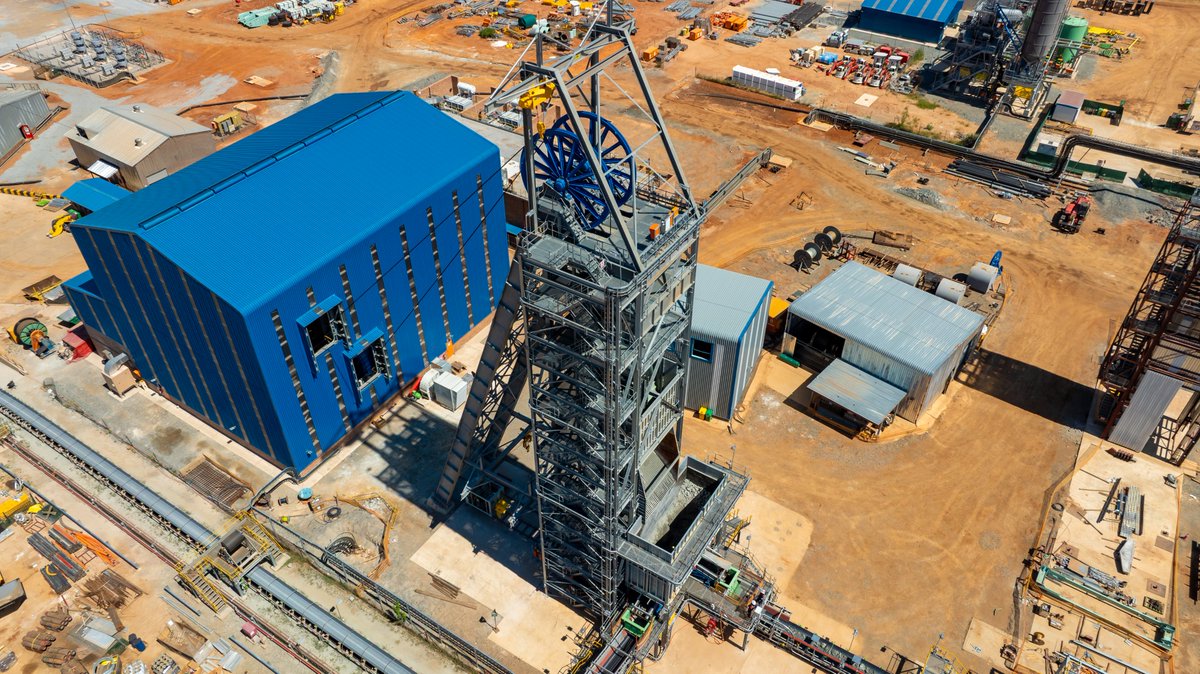
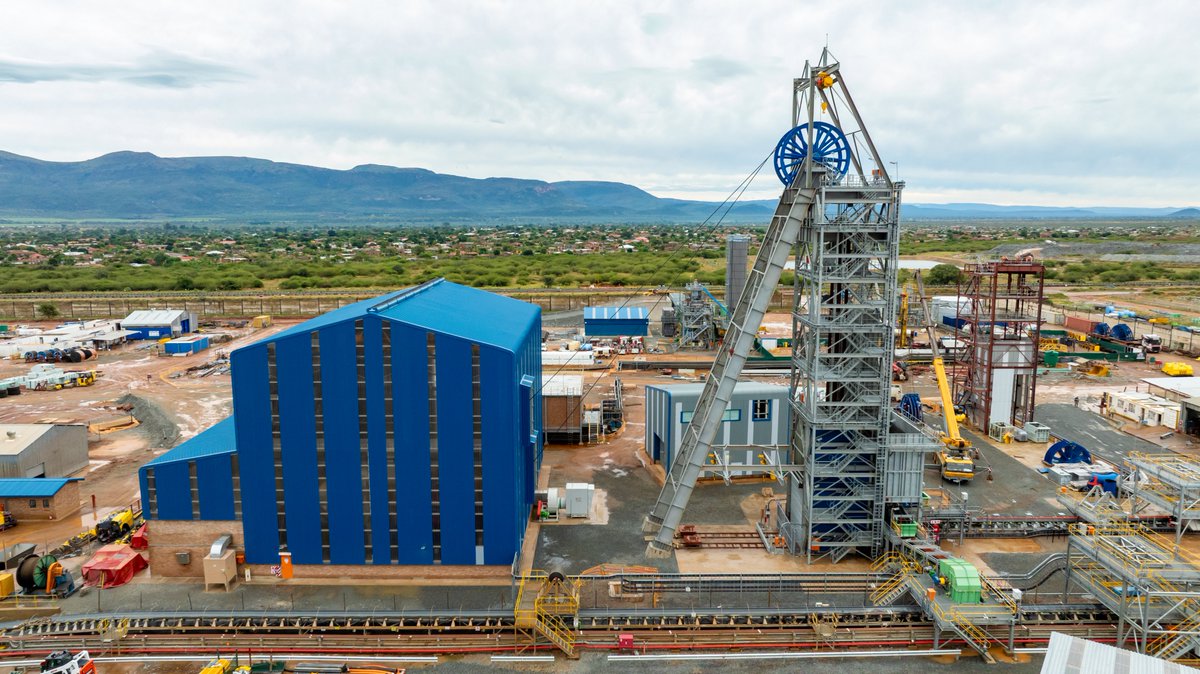
Shaft #3 at our Platreef Mine in South Africa is complete.
What that means: hoisting capacity increases five-fold to 5 Mtpa. Shaft #3 will significantly increase the rate of underground mining and underground development.
Phase 2 earthworks are underway.
Production targeting over 450,000 oz PGMs and gold is within reach by end of 2027.💥
The build continues.
What Bhappu implies is this:
Don’t put the cart before the horse.
Magnet makers redesign to avoid expensive HREEs out of necessity, not preference.
HREE magnets function at high temperatures; LREE magnets do not — that’s physics.
"So look, I think there's some wishful thinking in there. And perhaps that will happen at some point in the future but up till now, we're seeing a lot of requests from potential offtakers on the DyTb side of the equation."
"You take yttrium, for example, the demand and the request we're getting out of the aerospace industry is off the charts. So look, I think we're going to continue to see very heavy demand for the heavies."
Ross Bhappu of $UUUU say, "I think what you're hearing in the market about demand shifting has more to do with what people are producing. What we're seeing is there continues to be very heavy demand for Dy and Tb. The fact is not everybody can produce Dy and Tb..."
MP expects demand for some of the most expensive rare earth materials to drop sharply as magnet makers adopt alternative metals https://t.co/0peY5iXIbV
"So when I look at what we're doing at the mill, I think we want to be able to produce the whole suite of heavies. And that's not just Dy and Tb, it includes Sm, Gd, Ey, yttrium because there is demand out there for those minerals."
"Magnet manufacturers are trying to design magnets that reduce the reliance on Dy and Tb, but by no means have they solved that puzzle yet so there remains big demand for Dy and Tb in these magnets. And I think that's going to continue for the foreseeable future."