There is no more damning verdict on the Modi years than this: farming's share of Indian jobs bottomed at 42.5% in 2018-19 — the lowest ever recorded — and then climbed back to 46.1% by 2023-24.
Demonetisation reversed India's structural transformation.
https://t.co/G7nTGOHryg
They spent $75 billion fighting Iran, then another $300 billion rebuilding Iran, just to reopen the Strait of Hormuz that was already open before the war started.
USA the superpower 🤡🤡😂😂
>Children dying from tainted cough syrups
- block over the counter sales
>National medical and engineering entrance test exam papers leaked
- block the messaging apps
>Calling out pseudoscientific, quackery and fraud practices - block the medical science accounts
Do we really have a working Government or are we inside a Block Panchayat?
I write as a student of history.
History will be brutally cruel to Hon'ble CJI Ranjan Gogoi, D.Y. Chandrachud, and Surya Kant et al.
Like judges under Hitler who swore personal loyalty to the Führer and turned courts into regime weapons, these men presided over the slow death of judicial independence in India
Ranjan Gogoi: Fast-tracked Ayodhya to favour the regime. Sealed covers in Rafale. Ignored Kashmir habeas corpus while prioritising a "land dispute." Sexual harassment allegations handled in a kangaroo court he himself led. Reward? Rajya Sabha seat. Classic post-retirement payoff.
D.Y. Chandrachud: Master of the roster who delayed critical cases against power — electoral bonds struck down too late, bail pleas of dissenters buried. Ayodhya bench justified majoritarianism. Prayers before verdicts and public Ganesh Puja with the PM? Optics of captured judiciary.
Surya Kant: Part of benches delivering selective justice. Controversial remarks and decisions that echo executive comfort over constitutional duty. When judges start sounding like regime defenders, the institution is in ICU.
Under them, Supreme Court became an "Executive Court" — dual system where ordinary cases limp along, but politically sensitive ones deliver predictable outcomes.
History judged Nazi-era judges harshly for enabling persecution under the colour of law. Yours won't be kinder.
The records are unforgiving.
Finnish scientists trucked in real forest dirt and grass and laid it over the gravel at four daycare yards. They let the kids dig around in it for a month. The blood tests came back with changes the researchers hadn’t expected to see so fast or so clear.
The study ran at ten daycares in two Finnish cities with 75 kids aged three to five. Four of the yards got the forest treatment: about a tennis court worth of soil and grass laid over the gravel, plus planters and peat blocks the kids could dig and climb on. Three others stuck with their normal gravel yards. The last three were daycares where the kids were already visiting real forests every day.
After one month, the variety of bacteria living on the kids’ skin shot up, and the kind that helps train the skin’s immune defenses jumped the most. Their gut bacteria started to look like the gut bacteria of the forest-visiting kids. Their blood showed more of the immune cells whose job is to keep the body from freaking out at harmless stuff like pollen and peanuts, and overall inflammation dropped. The kids on the plain gravel yards showed none of this.
Childhood asthma in the US doubled between 1980 and 1995. Food allergies in kids jumped 50 percent between 1997 and 2011, then jumped another 50 percent between 2007 and 2021. And peanut allergies in one-year-olds tripled between 2001 and 2017.
The Finnish researchers think one of the reasons is simple: kids today don’t get dirty enough. 37 percent of American preschoolers now spend an hour or less outside on a normal weekday. Their immune systems are getting trained in environments stripped of the bacteria humans have always lived around.
Aki Sinkkonen, who led the study, put it in plain words: “It would be best if children could play in puddles and everyone could dig organic soil.” The Finnish government is now helping pay for daycares across the country to make the same changes.
While celebrity anchors remain busy discussing and distributing “melody,” people in Valsad, Gujarat are battling a severe water crisis. Residents are being forced to climb down wells over 45 feet deep using ropes, just to collect water for daily needs.
Robert McNamara was US Secretary of Defense in the 1960s during the Vietnam War.
In 2003, McNamara sat down for a documentary and said something about World War Two that no American official had ever said.
Primeminister of India, Narendra Modi, would not take my question, I was not expecting him to.
Norway has the number one spot on the World Press Freedom Index, India is at 157th, competing with Palestine, Emirates & Cuba.
It is our job to question the powers we cooperate with.
THIS IS BIG:
A Supreme Court bench of Justices BV Nagarathna and Ujjal Bhuyan STRONGLY CRITICISED the judgement denying bail to Umar Khalid and Sharjeel Imam. While granting bail to a Kashmiri man who was charged with UAPA, the bench made no hesitation in stating that the order denying bail to Umar Khalid and Sharjeel Imam was completely WRONG.
The bench said, "We have serious reservations about judgment in Gulfisha Fatima.... The broad reading of Najeeb suggests that the mere passage of time, if it arises from all surrounding circumstances, mechanically entitles an accused to release."
The bench said, "We have no manner of doubt in stating that even under the UAPA, bail is the rule and jail is the exception."
The bench clearly said that the KA Najeeb order was binding on the two-judge bench which denied bail to Umar Khalid and Sharjeel Imam.
In Najeeb case, a three-judge bench of the Supreme Court had ruled that bail must be given in UAPA cases if the trial is indefinitely delayed. Umar Khalid is in jail for more than 5 years without trial and Sharjeel Imam is in jail for more than 6 years without trial.
The bench which denied bail to Umar Khalid and Sharjeel Imam was a two-judge bench. The court clearly said that a two-judge bench can't go against the order of a three-judge bench.
The bench further said, "We make it clear that Najeeb is binding law and entitled to the protection of judicial discipline. It cannot be diluted, circumvented, or disregarded by trial courts, High Courts, or even by benches of lower strength of this Court."
Reports of 100 people killed in UP due to storm in Indian Media : 00
Reports of 100 people killed in UP due to storm in Foreign Media : 15
Indian TV Media is the worst organisation in the world and the worst thing to happen to India.
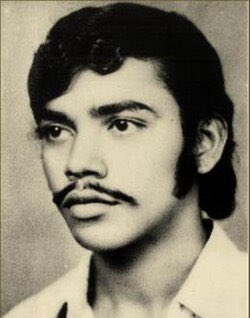
His name was Rajan.
He was a final year engineering student at the Regional Engineering College in Calicut, Kerala. His father, T V Eachara Varier, was a Hindi professor at the Government Arts and Science College in the same city.
On the morning of March 1 1976 the police came to the college campus and took Rajan away.
India was under Emergency. Civil liberties were suspended. Courts had effectively turned away.
His father found out the next day from the college principal.
He went to every police station in the district. No one admitted to having his son.
He met the Home Minister of Kerala, K Karunakaran, directly.
He sent petitions to the Home Secretary of the Government of Kerala three times. Not a single reply or acknowledgement came.
He wrote to the President of India and the Home Minister of the central government, with copies to every Member of Parliament from Kerala.
Nothing.
What Eachara Varier did not know at the time was that his son had been taken to an illegal police interrogation camp at Kakkayam.
He was tortured.
A practice called uruttal was used, where a heavy wooden log is rolled over the body of the victim.
Rajan died from his injuries. His body was disposed of by the police and was never found.
When the Emergency ended in 1977 Eachara Varier filed a habeas corpus petition in the Kerala High Court.
It was the first such petition filed in Kerala after the Emergency.
He did it without legal training, without political backing, without money.
He had spent everything searching for his son.
The court case slowly unravelled the truth.
It forced K Karunakaran to resign as Chief Minister of Kerala in 1978 when the adverse judgment came.
Rajan’s mother became mentally unstable from the grief. She died in 2000 still not knowing where her son was.
Eachara Varier wrote his memoir, Memories of a Father, which won the Kerala Sahitya Akademi Award in 2004.
In its final lines he wrote, “I don’t close the door. Let the rain lash inside and drench me. Let at least my invisible son know that his father never shut the door.”
He died on April 13 2006. He never found his son’s body.
Rajan was picked up from his college campus on a March morning in 1976. He was never seen again.
Repost this. Some stories must not be allowed to disappear.
Nation wouldn’t have been in this situation if the oil and gas discovered in 2005 by @narendramodi and Gujarat State Petroleum Corporation was actually available today.
Feku had claimed that GSPC found 20 trillion cubic feet (tcf) of gas offshore near the Krishna Godavari basin. In 2009, GSPC revised the estimate from 20 tcf to just 1 tcf.
Think about the scale of Modi's lies. Not even 5% of what he claimed was true.
CAG later found that ₹21,000 crore went into the sea, and not even a teaspoon of oil or gas was produced.
To cover up the scam and failure, Modi allegedly forced ONGC to take over the company after becoming Prime Minister. ONGC paid $1.2 billion (₹11,400 crore) to acquire 80% stake in Modi’s marketing vessel, GSPC. Again public money is poured into save Modi's failures in Gujarat as a CM.
Her name is Aradhana Prakash.
She was 14 years old in August 1990. Ruchika Girhotra’s best friend. A fellow tennis trainee at the Haryana Lawn Tennis Association.
She was in the room when S P S Rathore called them both to his office. He sent her out on a pretext. When she returned she found Ruchika distressed.
She was the sole eyewitness. The only person who could testify to what happened that day.
For 19 years Rathore tried to silence her.
He filed civil case after civil case against her family. Cases against journalists covering the story. Cases against the lawyers fighting it.
Ruchika died in December 1993. Her father and brother were harassed so badly they had to leave Panchkula entirely.
Aradhana and her parents stayed.
Her father Anand Prakash and mother Madhu Prakash attended over 400 hearings across 19 years. Every single one. They never settled. They were never intimidated.
The court found Aradhana’s testimony unimpeachable. The judgment relied on her as the sole witness to convict Rathore in December 2009.
When Rathore was attacked outside court by a member of the public she went on television and asked people not to take the law into their own hands. She said that for 19 years they had always worked within the law.
Her father Anand Prakash died of prostate cancer in January 2018 aged 74. He had attended more than 400 hearings. He lived long enough to see Rathore convicted. He did not live long enough to see justice feel complete.
Yesterday, many people here read the story of Ruchika Girhotra for the first time.
Most of them had never even heard her name before.
They should.
Follow for stories India deserves to remember.
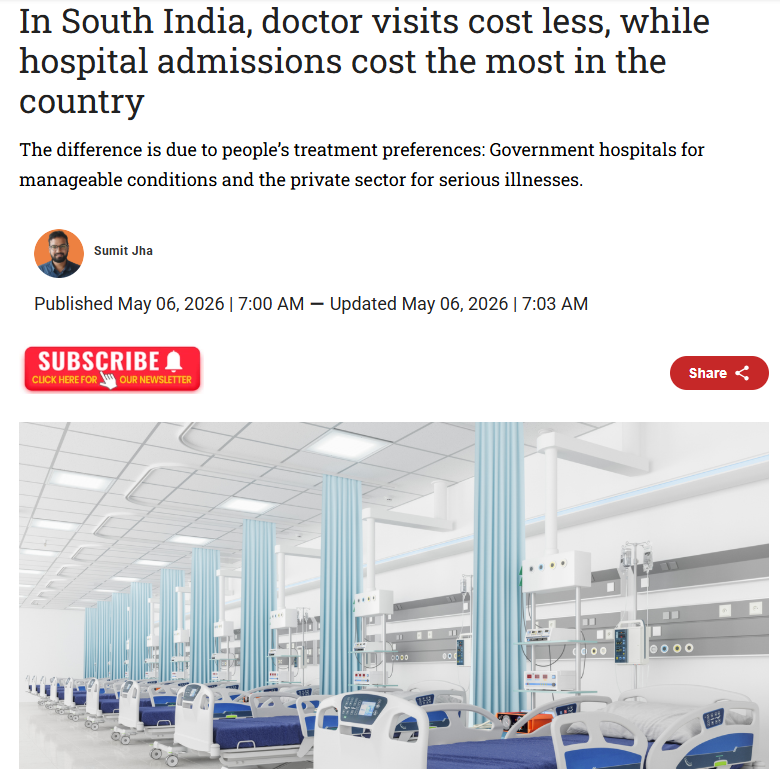
You live in the South. You believe your healthcare is better than the rest of India.
You are right. And you are wrong.
NSO survey reveals the paradox sitting at the heart of southern healthcare that nobody talks about openly.
Kerala charges ₹583 for a doctor's visit. Karnataka ₹629. Two of the cheapest states in the country for routine medical care. Tamil Nadu sends half its sick population to government hospitals for nearly nothing.
Now imagine you stop needing a doctor and start needing a hospital.
Kerala's hospitalisation bill climbs to ₹35,338. Tamil Nadu's hits ₹44,535. Telangana's reaches ₹46,316, the highest among all major states in India. Karnataka sits above the national average too.
The South has built public clinics so effective that your fever, your diabetes check, your routine prescription costs almost nothing.
Then it built private hospitals so dominant in serious care that when illness turns critical, the bill arriving in your hand is among the highest in the country.
The South socialised the cost of daily illness. It privatised the cost of serious illness at a premium.
A routine cold costs you ₹583 in Kerala. The same person's cardiovascular treatment in a private hospital costs ₹70,456.
This is not a coincidence. This is a system working exactly as it was built, and the new national survey has finally put the numbers to it.
Read the full story:
Flipkart's new ad for its SASA LELE Sale features Kodinhi, a town in Kerala's Malappuram district.
Known as India's "Twin Town", it has a high twin birth rate, about 400 pairs among 2000 families.
Very creative, with genuinely good jokes. They hit a home run with this concept.