@bookwormengr https://t.co/amVWNKNTI9
In a later phase, Moonshot used a more targeted approach, attempting to extract and reconstruct Claude’s reasoning traces.
@bookwormengr it’s an open secret that you can hack the model to print out the reasoning traces. That’s also why R1’s reasoning looks like OpenAI’s O1 model. Honestly, I think ppl should be informed better. Read Anthropics blog about how distillation attack work and how they crack it
I have been screaming my lungs out about Anthropic for more than a year, but it is too dangerous now not to amplify this beyond posts.
I would love to go on air & talk about Anthropic and how shady and malicious they are. If you have a podcast / show and want a breakdown, DM me.
The US government, citing national security authorities, has issued an export control directive to suspend all access to Fable 5 and Mythos 5 by any foreign national, whether inside or outside the United States, including foreign national Anthropic employees.
The net effect of this order is that we must abruptly disable Fable 5 and Mythos 5 for all our customers to ensure compliance.
Access to all other Claude models is not affected.
We apologize for this disruption to our customers. We believe this is a misunderstanding and are working to restore access as soon as possible.
Read our full statement: https://t.co/bwn0sximKZ
@The_AI_Investor and he worked on dojo at Tesla (which got cancelled)
Jump to rival wihh without launching a single product (just yap yap)
looks like a bad signal for oai asic
https://t.co/cGA4pkptzB
Microsoft Research announces TinyGSM: achieving >80% on GSM8k with small language models
paper page: https://t.co/NdLTAALXOf
Small-scale models offer various computational advantages, and yet to which extent size is critical for problem-solving abilities remains an open question. Specifically for solving grade school math, the smallest model size so far required to break the 80\% barrier on the GSM8K benchmark remains to be 34B. Our work studies how high-quality datasets may be the key for small language models to acquire mathematical reasoning. We introduce TinyGSM, a synthetic dataset of 12.3M grade school math problems paired with Python solutions, generated fully by GPT-3.5. After finetuning on TinyGSM, we find that a duo of a 1.3B generation model and a 1.3B verifier model can achieve 81.5\% accuracy, outperforming existing models that are orders of magnitude larger. This also rivals the performance of the GPT-3.5 ``teacher'' model (77.4\%), from which our model's training data is generated. Our approach is simple and has two key components: 1) the high-quality dataset TinyGSM, 2) the use of a verifier, which selects the final outputs from multiple candidate generations.
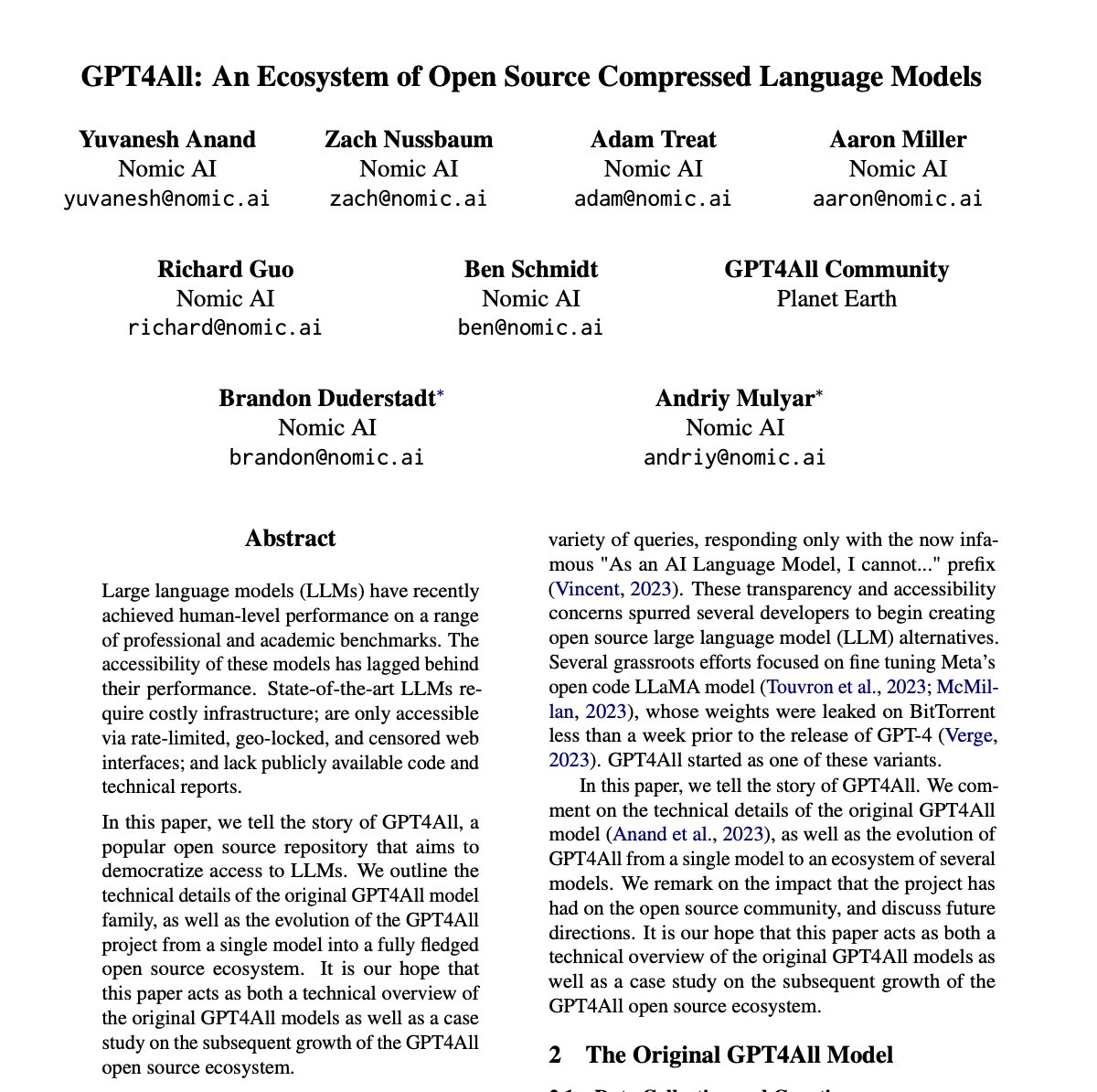
GPT4All: An Ecosystem of Open Source Compressed Language Models
paper page: https://t.co/qZWP785HdN
Large language models (LLMs) have recently achieved human-level performance on a range of professional and academic benchmarks. The accessibility of these models has lagged behind their performance. State-of-the-art LLMs require costly infrastructure; are only accessible via rate-limited, geo-locked, and censored web interfaces; and lack publicly available code and technical reports. In this paper, we tell the story of GPT4All, a popular open source repository that aims to democratize access to LLMs. We outline the technical details of the original GPT4All model family, as well as the evolution of the GPT4All project from a single model into a fully fledged open source ecosystem. It is our hope that this paper acts as both a technical overview of the original GPT4All models as well as a case study on the subsequent growth of the GPT4All open source ecosystem.
An important update on the #CVPR2024 submission deadline from the conference organizing committee:
Our Program Chairs have voted to shift the CVPR 2024 submission deadline to November 17th (A one-week extension). The website will be updated shortly to reflect this change.