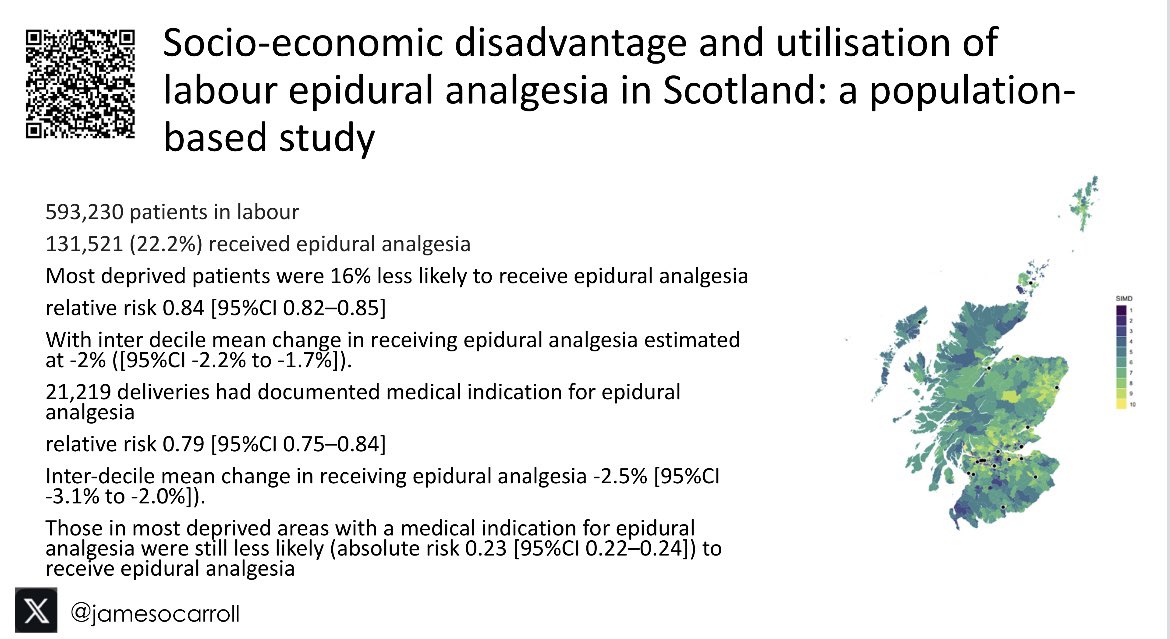
Socioeconomically disadvantaged women are 16% less likely to utilise labour epidural analgesia…
Article published in anaesthesia today!
@rjharrison79@profscottnelson
https://t.co/ar2TBNo8vw
Uptake of epidurals in deprived obstetric patients is reduced; which is concerning given that deprived obs patients tend to be more co-morbid (ex. In terms of BMI) @LucyHalliday7@Assoc_Anaes @Anaes_Trainees
Expert, unbiased, trustworthy information on pain relief choices during labour. We're passionate about supporting parents expecting a baby. If you are a healthcare professional please help us by sharing our website https://t.co/fy8pHVbUN0
It’s not often #OBAnes gets a mention in @NatGeo . @OAAinfo welcomes the widespread interest in the research by @rjharrison79@LucyHalliday7 Prof Lawlor Prof Nelson and colleagues.
https://t.co/LGlFGG3JUP
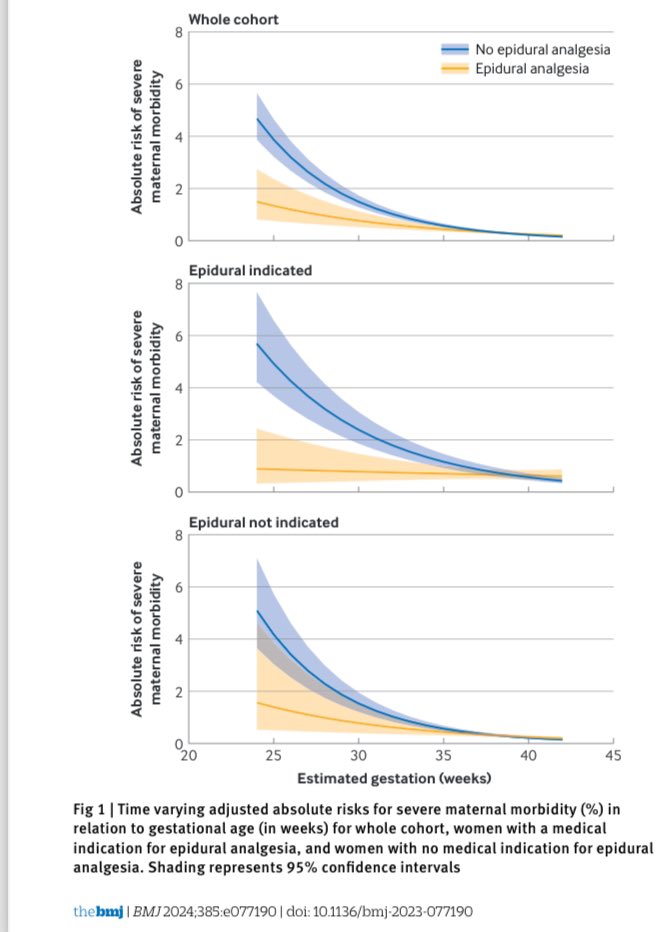
🔑 Need to ensure access to epidurals, particularly for those who are most vulnerable – women facing higher medical risks or delivering prematurely
ℹ️ accurate patient information is vital!
Some fantastic resources at @labourpainsOAA
✅Epidural during labour associated with significant reduction in severe maternal morbidity
Data from >0.5 million women
Out in BMJ NOW!!!
https://t.co/huOFstGxY0
#obanes@profscottnelson@LucyHalliday7@dr_aizhan
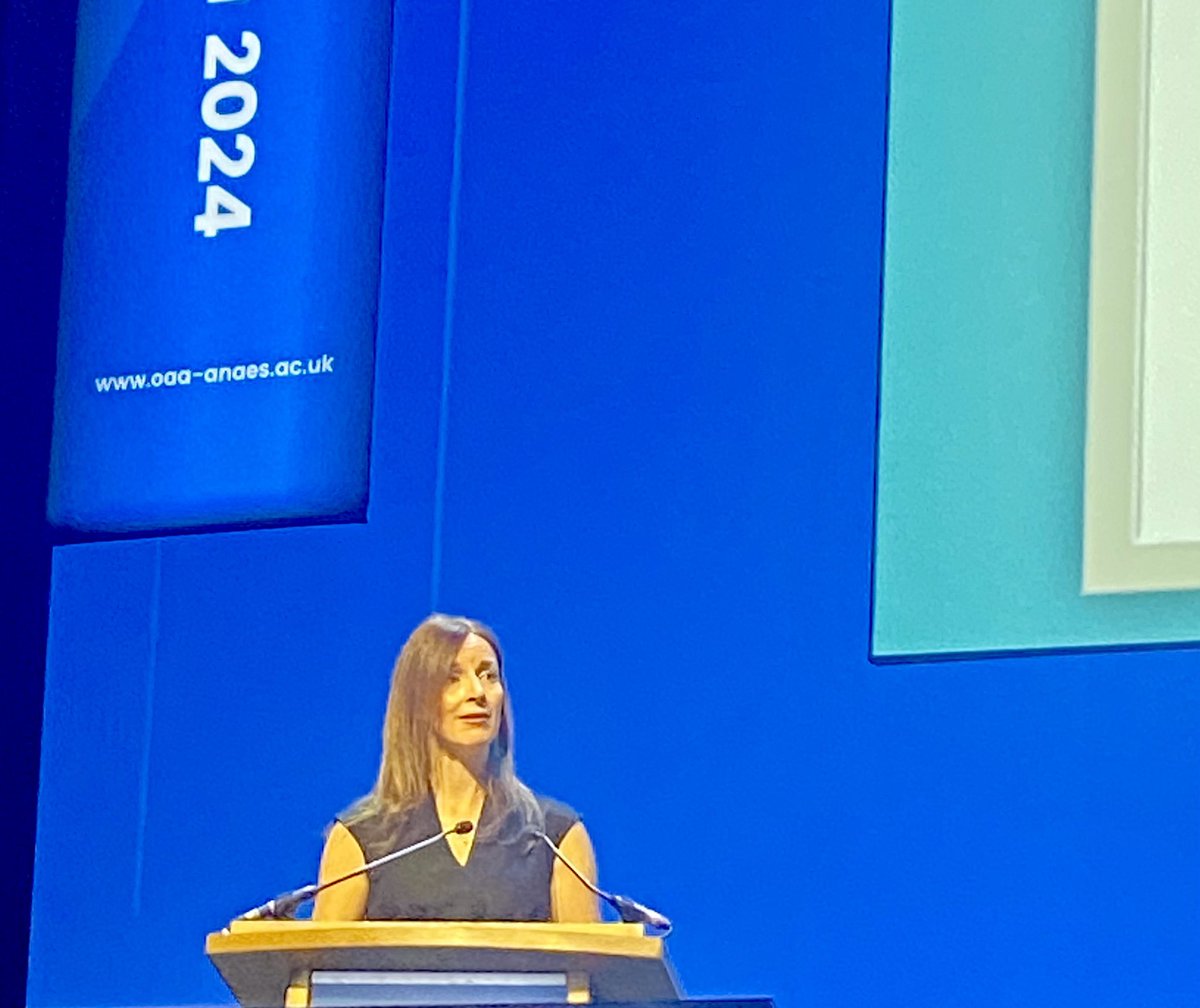
Brilliant curated selection and commentary on Pick of the Posters from new @OAAinfo Executive Committee member @rjharrison79 at #OAA24ASM highlighting thought provoking work much from @OAATrainee members. This is the bedrock of the @OAAinfo ASM. Can’t wait for #OAA25ASM!
🚨We're hiring!! 🚨
Clinical Research Fellow in Anaesthesia, Perioperative Medicine and Critical Care https://t.co/qS4c7KitdF
⚖️50/50 clinical / research
📜Work towards a higher degree (optional)
🌍Wide variety of (funded) projects
💰Salary equivalent to clinical posts
🆕Our paper is now available online 🙏 @BJAJournals
💥Moderate or severe in-hospital #pain after uncomplicated vaginal delivery is associated with significantly ⬆️ odds of postpartum #opioid use in the first year after delivery 🤰
https://t.co/2dGq7lVu9I
@bmj_latest commentary on our work led by @LucyHalliday7 on inequities in maternity care. "The scope of the problem in wider society is vast & requires strategies to tackle any systems & policies that might inadvertently perpetuate the economic divide".
https://t.co/3YtZetHllI
🔓Disparities relating to postpartum recovery outcomes in different socio-economic and racial ethnic groups are underexplored.
We conducted a planned analysis of a large prospective caesarean delivery cohort to explore the relationship between ethnicity, socio-economic status and postpartum recovery.
Eligible patients were enrolled and baseline demographic, obstetric and medical history data were collected 18 h and 30 h following delivery.
Patients completed postpartum quality of life and recovery measures in person on day 1 and by telephone between day 28 and day 32 postpartum.
Socio-economic group was determined according to the Index of Multiple Deprivation quintile of each patient's usual place of residence.
Data from 1000 patients who underwent caesarean delivery were included.
There were more patients of Asian, Black and mixed ethnicity in the more deprived quintiles.
Patients of White ethnicities had shorter postpartum duration of hospital stay compared with patients of Asian and Black ethnicities.
In adjusted models at day 30, patients of Asian ethnicity had a significantly greater risk of moderate to severe pain (numerical rating scale ≥ 4) at rest and on movement (odds ratio (95%CI) 2.42 (1.24–4.74) and 2.32 (1.40–3.87)), respectively).
There were no differences in readmission rates or incidence of complications between groups.
Patients from White ethnic backgrounds experience shorter postpartum duration of stay compared with patients from Asian and Black ethnic groups.
Ethnic background impacts pain scores and recovery at day 1 postpartum and following hospital discharge, even after adjusting for socio-economic group.
Further work is required to understand the underlying factors driving differences in pain and recovery and to develop strategies to reduce disparities in obstetric patients.
@Jamesocarroll@lianazucco@eleanor_warwick@rmoonesinghe@elboghdadly@CarvalB@PervezSultanMD@ObsQoR
🔗https://t.co/Vs7zLRN4th
@UofGlasgow PhD student @LucyHalliday7 work in the news today, and still more papers on deprivation and anaesthesia during pregnancy to come from our team @rjharrison79 https://t.co/9saRmFaLPV
Work from @LucyHalliday7 PhD finds that women from most socioeconomically disadvantaged areas are less likely to receive labour epidural analgesia. Inequities in care must be addressed if we are to improve maternal outcomes @OAAinfo@RegionalAnaesUK@UofGAnaesCrit@WoSOA#OBAnes